
Skill engineering answers "how do you encode experience?" Loop engineering answers "how do you execute experience?" In our previous teardown of ResearchStudio, we saw Microsoft encode human mentor judgment as skill files—experience frozen in files. But experience only comes alive at runtime. Who decides when experience should trigger? Who checks execution results? Who corrects errors? Who decides "enough, we can stop"? The answer is a running loop system. That is what loop engineering solves.
I. A Single Sentence That Sparked a Paradigm Discussion
In June 2026, Boris Cherny—creator and lead of Anthropic's Claude Code—said something in an interview that sent shockwaves through the developer community:
"I don't prompt Claude anymore. I have loops running that prompt Claude and figuring out what to do. My job is to write loops."
Almost simultaneously, Peter Steinberger (creator of OpenClaw) posted on X to roughly 6.5 million views:
"You shouldn't be prompting coding agents anymore. You should be designing loops that prompt your agents."
Then Google Cloud AI Director Addy Osmani published a long-form article on June 7, 2026, giving the practice a name: Loop Engineering.
Three voices from three different companies, three different products, all pointing to the same thing: the leverage point in human-AI collaboration has shifted. You used to optimize how you write prompts. Now you optimize how you design loops.
Andrew Ng, in DeepLearning.AI's The Batch column (2026-06-30), summarized the three loops he uses: an agentic coding loop, a developer feedback loop, and an external feedback loop. Business Insider reported that the term has been spreading among developers using OpenAI Codex, Anthropic Claude Code, Cursor, and OpenClaw.
But most discussions remain at the "what is loop engineering" explainer level. This article aims at deeper questions: Why has the loop become the unit of engineering? What makes it actually hard to build well? Which loops are fragile, and which can survive production?
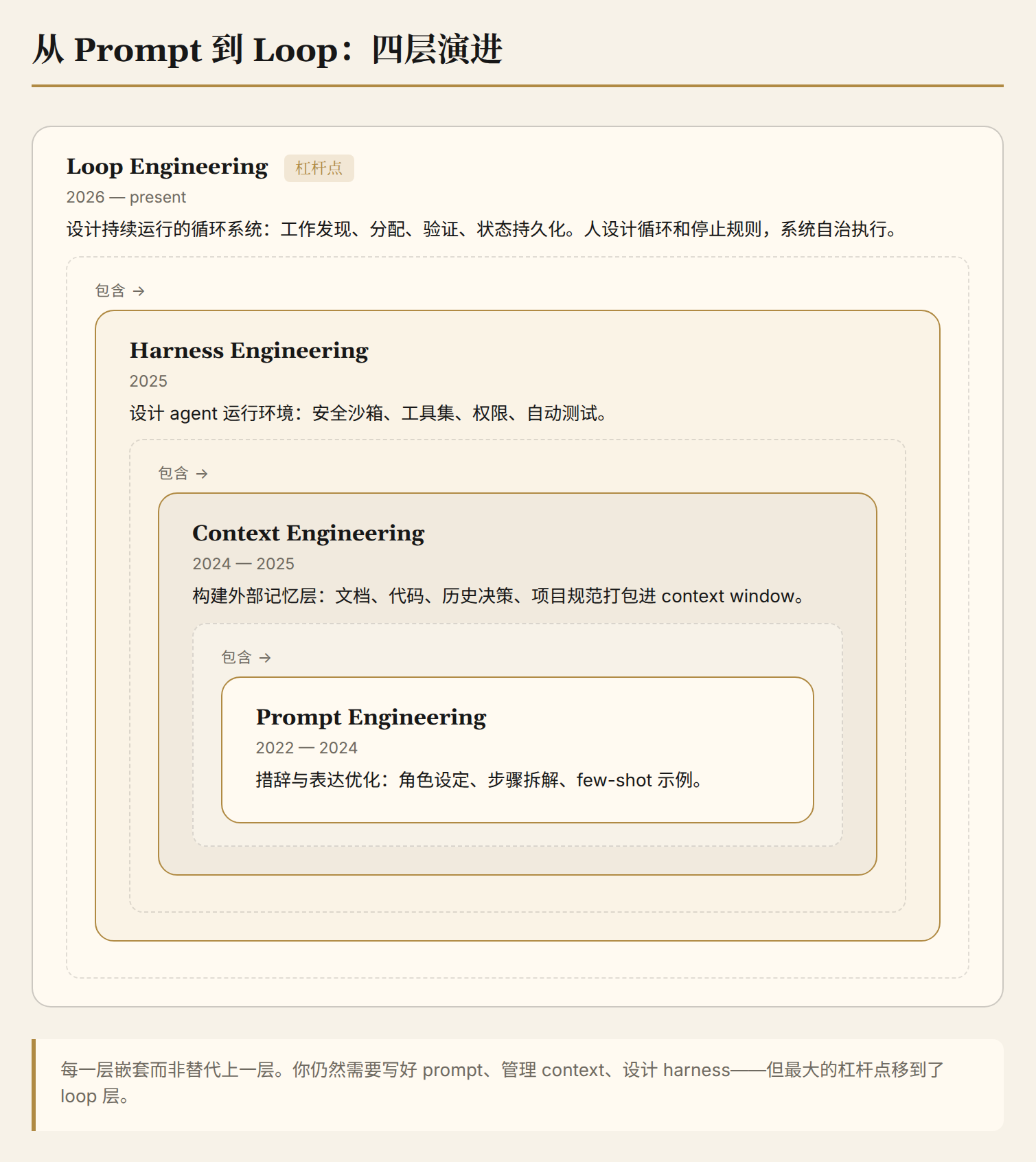
II. Four Layers of Evolution: Prompt → Context → Harness → Loop
To understand loop engineering, you first need to see where it came from. Addy Osmani and subsequent authors traced a clear evolutionary line:
Layer 1: Prompt Engineering (2022–2024)
The core skill is wording. Give the model a role, break the task into steps, add a few examples, let it think step by step. Prompt engineering optimizes expression—how to translate your intent into the format the model most easily understands.
Its ceiling is hard: no matter how well you write a prompt, the model cannot know information it has never seen. If your codebase uses an obscure framework, the model doesn't know its API, and no amount of prompt craft will conjure it.
Layer 2: Context Engineering (2024–2025)
The core skill is environment construction. Don't just write prompts—package relevant documentation, code snippets, API definitions, historical decisions, project conventions—everything the model needs—into the context window.
Anthropic's Boris Cherny himself said: "Prompt engineering is about 10% of the work, context engineering is about 90%." This means the Claude Code team puts the bulk of its engineering effort into "how to give the model enough context," not "how to phrase things."
Context engineering's breakthrough was recognizing that LLMs are stateless. Between calls, the model remembers nothing. All persistent information—project rules, historical decisions, intermediate results—must live outside the model, in disk files, git repos, or structured memory. Context engineering is building this external memory layer.
But context engineering has a hidden assumption: a human is in the loop. The human reads the model's output, judges whether it's correct, and writes the next prompt. The human is both scheduler and quality gate.
Layer 3: Harness Engineering (2025)
In September 2025, Simon Willison wrote "Designing agentic loops," clearly describing this middle layer for the first time: you're no longer just providing context to the model—you're designing the environment the agent runs in. Security sandboxes, tool sets, credential permissions, automated tests, YOLO mode (no step-by-step approval needed).
The harness is the agent's "workstation": an isolated code repository (worktree), a set of tools (shell, filesystem, browser, API), a set of permissions (read-only? can file PRs? can deploy?), and a set of feedback signals (test pass rate, lint results, type checking).
Harness engineering automates some of the human's in-loop behaviors. The human no longer manually judges "did the model do this right" every single time—the test suite and lint rules run first, and only when they pass does the human step in.
Layer 4: Loop Engineering (2026)
If you put a harness on a timer—letting it discover work on its own, assign it to agents, check results, remember state, and decide the next step—you get a loop.
Loop engineering adds a scheduling system on top of the harness. In Osmani's words: "Loop engineering sits one layer above the harness. The harness is the environment a single agent runs in; the loop is a system running on a timer that generates its own little helpers (sub-agents) and feeds itself."
The four layers are nested, not substitutive:
| Layer | Core Question | What Humans Still Do | What's Automated |
|---|---|---|---|
| Prompt | How to phrase | Write every instruction | Almost nothing |
| Context | What the model needs to know | Organize and provide background | Single-shot context assembly |
| Harness | What environment the agent runs in | Design tools and permission boundaries | Single-task execution |
| Loop | How the system runs continuously | Design loops and stopping rules | Work discovery, assignment, verification, state persistence |
None of these layers disappear. You still need to write good prompts (just not line by line), still need to manage context, still need to design harnesses. But your biggest leverage point has moved to the loop layer.
III. Why Loops Are Necessary: The Stateless Nature of LLMs
Cherny's "my job is to write loops" sounds like a manifesto, but behind it is a cold technical fact: every Transformer-based LLM is stateless.
The model doesn't remember the last conversation. Doesn't remember the project spec you gave it yesterday. Doesn't remember whether the code it wrote three minutes ago passed tests. Every inference call is a blank slate.
This means any task requiring multi-step continuation—writing code, fixing bugs, conducting research, processing tickets—must rely on a system external to the model to maintain state. That "system" is a loop.
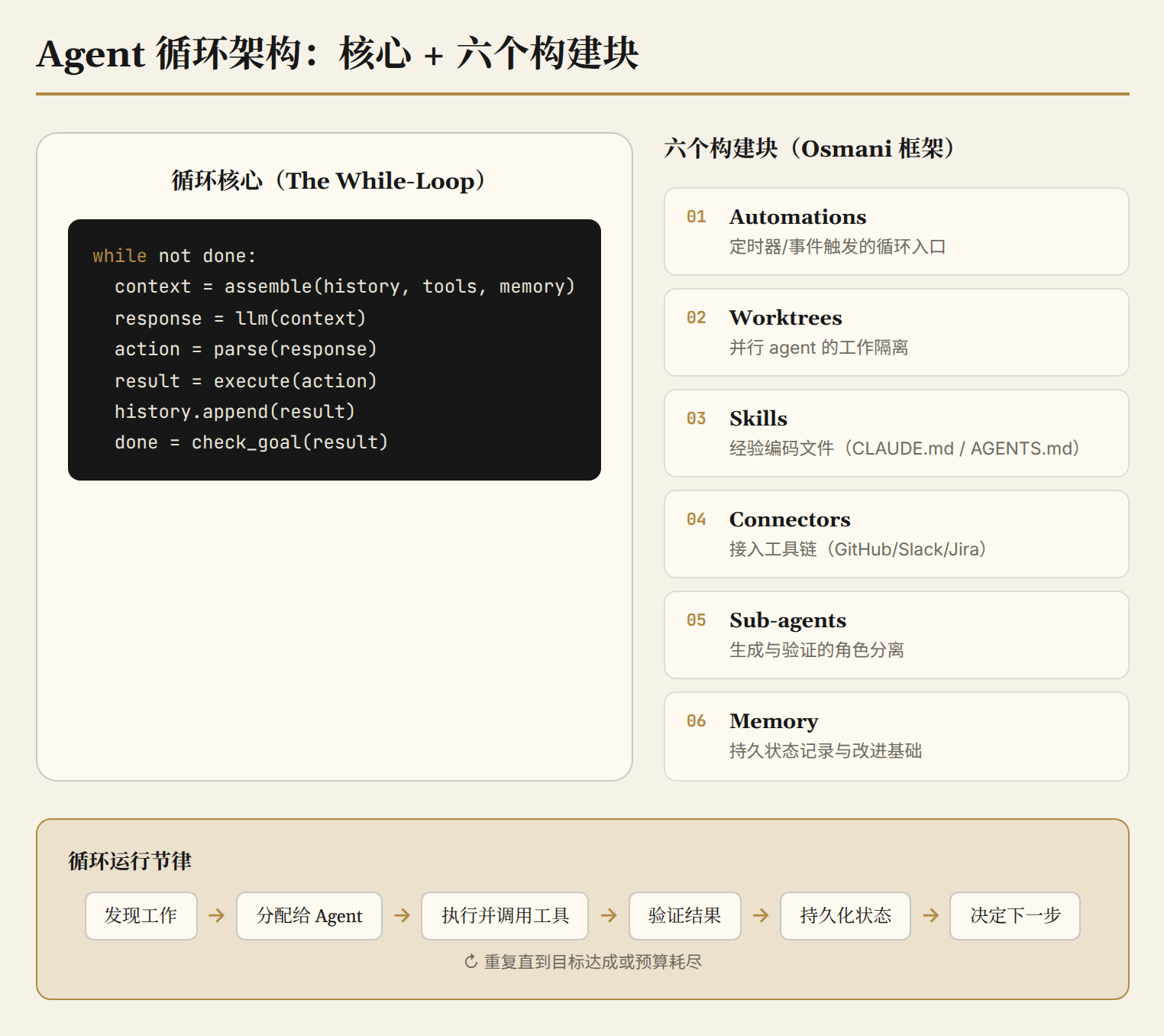
A minimal agent loop can be written as:
while not done:
    context = assemble_context(history, tools, memory)
    response = llm(context)
    action = parse_action(response)
    result = execute(action)
    history.append((action, result))
    done = check_goal(result)
This pseudocode appeared in a 2026 arXiv paper analyzing Claude Code's architecture (arXiv: 2604.14228). The paper describes Claude Code's core as "a simple while loop that calls the model, runs tools, then repeats."
But "simple" is deceptive. The real engineering happens outside the loop: permission management, context compression, extensibility, sub-agent delegation, storage. This engineering determines whether the loop runs stably or spirals out of control.
Tool Convergence Between Claude Code and Codex
A noteworthy signal: although Anthropic's Claude Code and OpenAI's Codex are competitors, in the first half of 2026 they shipped nearly identical loop primitives. Cobus Greyling noted in his loop engineering survey: "The convergence in tools is striking—Claude Code and Codex have both landed very similar primitives, so the shape of the loop is becoming tool-independent."
This means loop engineering isn't one company's product feature—it's an industry-wide engineering consensus taking shape.
Six building blocks confirmed by both ecosystems (Osmani's framework):
- Automations: Timer- or event-triggered loop entry points. Not manually started, but triggered by cron, webhooks, file changes, PR creation, and other events. Once triggered, the loop runs on its own.
- Worktrees: Letting multiple agents work in parallel on independent branches of the same repository without interfering. Without worktree isolation, two agents editing the same file simultaneously is a disaster.
- Skills: Writing project knowledge as structured files (e.g., CLAUDE.md, AGENTS.md) so agents don't have to guess. Skills are externalized experience—the ideation patterns and anti-patterns from the previous ResearchStudio article are essentially skills.
- Connectors: Connecting agents to your existing toolchain—GitHub, Slack, Jira, databases, browsers. Connectors define the operational boundary an agent can reach.
- Sub-agents: Letting one agent generate ideas and another review them. Osmani emphasized "sub-agents so one of them has the idea and a different one checks it"—encoding generate-verify separation into the system structure.
- Memory: Each loop iteration starts from zero unless you recorded what happened. Without memory, loops don't improve—they repeatedly hit the same wall. Osmani's oft-quoted line: "The agent forgets, the repo doesn't." Anthropic's official documentation also advises: "Provide a place to write notes, as simple as a markdown file."
These six building blocks answer one core question: when you're not present, what keeps the system running?
IV. The 88% Failure Rate: The Engineering Gulf Between Demo and Production
Loop engineering became a focal point in 2026 not just because of what Cherny and Steinberger said, but because a cold statistic reverberated through the industry: 88% of AI agent projects fail in production.
This number comes from Digital Applied's analysis of 2024–2025 enterprise deployments. Gartner's January 2026 analysis confirmed the same direction: at least 50% of generative AI projects are abandoned after the POC (proof of concept) stage. McKinsey's 2025 State of AI report found that fewer than 20% of AI pilots scale to production within 18 months.
Fiddler AI synthesized multiple studies for a more detailed breakdown: on the WebArena benchmark, the best GPT-4-based agent's end-to-end task success rate was only 14.41%, compared to 78.24% for humans. Carnegie Mellon researchers found that AI agents fail approximately 70% of the time on common office tasks. MIT's report found that 95% of generative AI pilots cannot produce measurable impact on the P&L.
The question: why do agents look great in demos but collapse in production?
The answer isn't that models aren't smart enough. GPT-5.2 and Claude 4.6 are already very strong on capability benchmarks. The real failures happen in the engineering layer outside the model.
Failure Mode Breakdown
Synthesizing multiple studies and industry reports, agent failures in production concentrate around seven modes:
1. Silent Tool Call Failures
An agent calls a tool. The tool returns data in an unexpected format—maybe the API schema changed, maybe a downstream service timed out and returned an empty payload, maybe the auth token expired. The agent doesn't know this is an error and continues making decisions based on bad data.
This is the most dangerous failure mode because the system appears to be working normally. No error logs, no exception alerts. The agent builds an entire reasoning edifice on faulty data.
2. Context Window Collapse
In long conversations, early instructions gradually lose weight. The model starts "forgetting" project conventions, ignoring constraints established earlier. Datadog's State of AI Engineering report notes that this isn't a model bug—it's a statistical property of the attention mechanism. Content that appears earlier gets lower attention weight in long contexts.
3. Infinite Execution Loops
An agent repeatedly retries a failed operation. There's no termination condition, or the signal the termination condition depends on is itself broken. Each retry burns tokens, but nobody notices. Datadog's March 2026 data showed that 2% of LLM calls return errors, nearly a third of which are rate limit errors—8.4 million rate limit errors. When an agent hits a rate limit without a backoff strategy, it enters futile retries.
4. Retrieval Corruption
A RAG system retrieves low-quality or irrelevant chunks, and the agent generates wrong answers based on them. The problem isn't the model—it's the retrieval layer. But the user experience is "the model was wrong."
5. Routing Chaos
Production systems typically route to multiple model providers—dynamically switching based on latency, cost, reliability. Without a central control layer, routing behavior is inconsistent across providers, causing the same type of request to produce completely different behavior on different providers.
6. Integration Complexity
Demos run on clean API samples and well-documented endpoints. Production environments connect to CRMs with thousands of custom fields, ERPs running on legacy architectures, internal tools with zero documentation. The integration complexity of agents far exceeds what demo preparation anticipates.
7. Cost Explosion at Scale
A loop running every 5 minutes, each iteration spawning an implementer agent and a verifier agent, can burn through a quota-limited API plan before breakfast. Token cost in loop mode isn't linear—each iteration consumes tokens, and introducing sub-agents multiplies the consumption.
These seven failure modes share one trait: none are caused directly by insufficient model intelligence. They are all gaps in the engineering layer—system design, tool integration, state management, error handling.
This is why loop engineering exists. It's not a nice-to-have—it's a response to a proven engineering gulf.
V. Designing Loops as Control Systems
At this point, a deeper insight emerges: loop engineering is essentially applying the ancient wisdom of cybernetics to the AI agent scenario.
An agent loop and an industrial control system are structurally the same. Industrial control has sensors (measuring temperature, pressure, flow), controllers (PID), actuators (valves, motors), and feedback circuits. Agent loops have observations (tool call results), decisions (model reasoning), execution (actions), and feedback (success/failure signals).
Control engineering has accumulated nearly a century of experience. Its most central lessons transfer directly to loop engineering:
Stopping Conditions Are Not Optional
The first rule of control systems: there must be a termination condition. A motor can't accelerate forever. A valve can't stay open forever.
In agent loops, termination conditions operate at several levels:
- Goal achievement: Task completed (tests pass, PR merged, file generated).
- Budget exhaustion: Token usage hits the ceiling, time exceeds budget, call count exceeds limit.
- Convergence determination: N consecutive iterations without improvement (diminishing returns).
- Exception escalation: The loop encountered an error it can't handle itself and escalates to a human.
Osmani's warning is blunt: "A loop running unattended is also a loop making mistakes unattended."
Datadog's data provides a concrete number: 5% of LLM call spans report errors. If you have a 20-step agent loop with independent error rates per step, the probability of a complete loop failing is 1 - 0.95^20 ≈ 64%. Without retry and recovery mechanisms, nearly two-thirds of loops will fail at some step.
Feedback Signal Density Determines Loop Quality
Simon Willison proposed a core idea in "Designing agentic loops": agents are "brute force tools for finding solutions." But for brute force to be effective, you need dense feedback signals—each iteration must know whether it's "closer to or farther from the goal."
Willison emphasized the value of automated testing: "The value you get out of a programming agent is massively amplified by a good, clean-passing test suite." Without tests, neither the agent nor you know whether the code it wrote is correct. The loop becomes blind iteration.
The principle is the same as in control systems: the more precise the sensors and the higher the sampling frequency, the better the control effect. Agent feedback signals include:
- Automated tests (unit, integration, end-to-end)
- Lint and type checking
- Compilation results
- Browser screenshot comparison
- Log inspection
- Code review (human or another agent)
The density and accuracy of feedback signals directly determine the loop's convergence speed. A loop with sparse signals will keep hitting the same error; a loop with rich signals can converge to the correct result in a few steps.
Separating Generation and Verification
Sub-agents rank fifth in Osmani's framework—not by coincidence. "One agent has the idea, another checks it"—this is "dual-channel" design from control engineering: the execution channel and monitoring channel are physically isolated, so when one fails, the other is unaffected.
In the agent context, this means: same model, different prompts and context, playing different roles. The generation agent's context emphasizes "implement this feature"; the verification agent's context emphasizes "review this implementation." The two agents don't share intermediate state—only the final artifact.
Both Anthropic's Claude Code and OpenAI's Codex support this pattern at the product level. Claude Code's sub-agent mechanism allows the main agent to delegate tasks to independent sub-agents. Codex's parallel workflow allows the same task to be independently processed by multiple agents and then merged.
But there's a cost tradeoff: every additional verification agent means more token consumption. A "generate + verify" dual-agent loop costs 2x or more in tokens compared to a single agent. If the verification agent also needs to call tools (run tests, check docs), the cost is even higher.
Budget Gates Are Not Punishment—They're Safety Valves
The control engineering concept of a safety valve maps to budget gates in loop engineering. Not "stop because you spent too much" punishment, but "stop before causing irreversible damage" protection.
Budget gates can be set at several levels:
- Per-loop budget: Maximum tokens/dollars per loop iteration.
- Task-level budget: Maximum total cost from task start to completion.
- Daily budget: Maximum combined cost of all loops in a day.
- Failure budget: Stop after N consecutive failures (not retry forever).
TrueFoundry introduced the concept of "standing permissions" in their enterprise loop engineering analysis: each step in a loop—trigger, execution, verification, delivery—has its own permission boundary. Permissions aren't granted to the agent—they're granted to a specific position in the loop.
VI. Comprehension Debt: The Better the Loop, the Less Humans Understand
Armin Ronacher (creator of Flask) wrote an article titled "The Coming Loop" (2026-06-23) that raised the most easily overlooked risk in loop engineering: comprehension debt.
Here's how comprehension debt works: as loops become more automated and code becomes more easily machine-modifiable, it also becomes harder for humans to understand. Agents write large amounts of code in loops—each piece reasonable in isolation, but cumulatively, the system's logic becomes a pile of changes that humans haven't fully reviewed.
Ronacher's concern isn't theoretical. A 2026 MIT study (reported by Forbes, 2026-06-10) found that AI-assisted programming increased code commit volume by approximately 180%, but release frequency only grew by 30%. Where did the extra code go? Some was rejected after review, some was accepted but failed in production.
JetBrains' analysis based on IDE behavior data also showed that "10x automatic productivity for everyone" remains a minority scenario. An engineer on Hacker News shared a personal experience pointing in the same direction: "AI lets me produce 2-3x the code, but if quality needs to stay stable, review time is also 2-3x." (This is a personal anecdote, not a statistical conclusion.)
This data points to the same conclusion: loops amplify generation speed without proportionally amplifying verification speed. The scissors gap between generation and verification is comprehension debt.
The consequences of comprehension debt are most severe when loops run autonomously. While you sleep, the loop runs—it discovers a problem, attempts a fix, the fix introduces a subtle side effect, the next iteration builds on that side effect. By the time you wake up, the codebase's logic is no longer what it was when you left.
Addy Osmani himself was clear-eyed about this: "If I don't review the code myself, or if I rely entirely on automated loops to fix things, my product quality degrades. I can get into a downward spiral, pushing myself deeper into a hole."
This isn't an argument against loops. It's saying: the better the loop, the more you need to invest in human-comprehensible feedback layers. Agent loops need a "translation" mechanism—presenting every change and decision from the loop in a way humans can quickly grasp. This is the same need as audit trails in traditional software, just with an order of magnitude more complexity in the agent scenario.
VII. Skills Are Static Experience; Loops Are Dynamic Experience
Returning to the question from the end of our previous ResearchStudio teardown. In that article, we divided AI system professional competence into three layers:
| Layer | Source | ResearchStudio Equivalent | Core Question |
|---|---|---|---|
| Knowledge | Training data | The LLM itself | "What is known" |
| Experience | Skill files | Ideation patterns / anti-patterns | "What judgment to make" |
| Judgment | Hard gates / measured-fill loop | Phase 3 quality checks | "What state is absolutely unacceptable" |
ResearchStudio showed that experience can be encoded as skill files, letting AI "guard quality like an experienced mentor." But it left an unanswered question: Who calls these skills? Who checks the hard gate results? Who decides "enough, we can stop"?
The answer is the loop.
Skills are static encoded experience—they define "what judgment to make in this situation." Loops are dynamic experience execution—they decide at runtime "is this the situation now, what was the judgment result, what to do next."
A loop without skills is blind—it has execution capability but no experience, repeatedly making the same class of errors in the loop.
Skills without a loop are dormant—experience written into files but never triggered, because nobody calls them manually.
Together they form a complete whole:
- Skills tell the loop "what to do in this situation"
- The loop determines "what is the situation right now"
- Skills' hard gates tell the loop "what states are unacceptable"
- The loop's stopping conditions tell the system "enough"
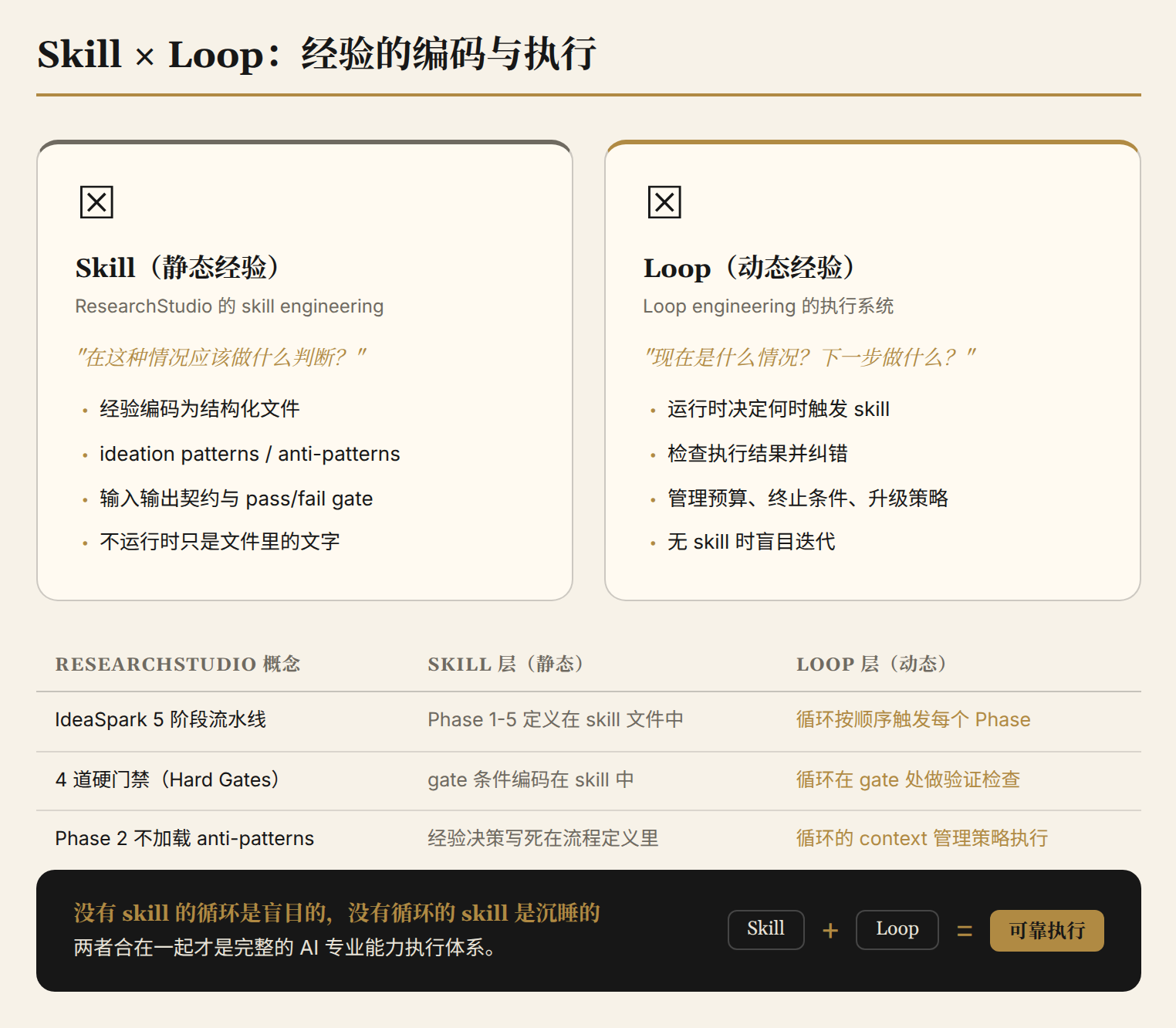
ResearchStudio's Paper2Assets skill is essentially an experience unit invoked by a loop. It defines 5 stages of paper extraction, each stage's input/output contract, and pass/fail gates. The IdeaSpark 5-phase pipeline and 4 hard gates from the previous article map precisely in the loop engineering framework: each Phase corresponds to an execution step in the loop, each hard gate corresponds to a verification checkpoint in the loop, and Phase 2's decision not to load anti-patterns corresponds to a context management strategy in the loop. Making these stages run in sequence, retrying on failure, and delivering results when complete—that's the loop's job.
This perspective also explains why 88% of agent projects fail: they have a model (knowledge layer), maybe some prompts (context layer), but lack skills (experience layer) and loops (reliable execution layer). They're trying to make a stateless, experience-less, error-correction-less system accomplish tasks that require continuous judgment.
VIII. The Economics of Loop Engineering: Token Compounding in Loops
When discussing loop engineering, the most easily ignored but most decisive constraint is token cost.
The cost of a single prompt is controllable—you send a request, the model returns a response, you know what it cost. But loops change the cost structure: token consumption is no longer one-time but compound.
Let's do the math. Assume a typical scenario:
- A loop runs every 5 minutes (288 times per day)
- Each loop triggers a triage agent (~2,000 tokens)
- If triage finds actionable work, it triggers an implementer agent (~8,000 tokens)
- After the implementer finishes, it triggers a verifier agent (~5,000 tokens)
- Assume 30% of loops trigger the implementer
Daily cost:
- Triage: 288 × 2,000 = 576,000 tokens
- Implementer: 288 × 0.3 × 8,000 = 691,200 tokens
- Verifier: 288 × 0.3 × 5,000 = 432,000 tokens
- Total: ~1.7 million tokens/day
At July 2026 public pricing (official provider pricing pages):
- GPT-5.2 Pro: $21/$168 per MTok → ~$17.8/day (input) + potentially more in output costs
- Claude 4.6 Opus: $5/$25 per MTok → ~$4.2/day
- DeepSeek V4-Flash: ¥1/¥2 per MTok → ~¥1.7/day (under $0.25)
- GLM-4-Flash: ¥0.1/MTok → ~¥0.17/day
Flagship model loop costs run about $18–50/day, $540–1,500/month. And this is a conservative estimate—real-world loops are often more complex, with more sub-agents and longer contexts.
With open-source models (DeepSeek, GLM), costs can be one to two orders of magnitude lower. This is why Cobus Greyling repeatedly emphasized in his loop engineering practice guide: "triage should be cheap; sub-agents should spawn only when state says actionable."
Cost isn't a side effect of loop engineering—it's one of the primary inputs to architectural decisions. Good loop design, like good system design, minimizes resource consumption while meeting functional requirements.
IX. Unresolved Questions and Assessment
Loop engineering in mid-2026 sits at an awkward inflection point: the concept is clear, tools have shipped, but engineering practice is far from mature. Several key questions remain open.
The "Democratization" Threshold
Today, developers who can run loop engineering are essentially those already deeply using Claude Code or Codex—early adopters fluent in command-line tools, agent architecture, worktree design, skill file authoring, and permission configuration.
But the real value of loop engineering lies in benefiting more people—including those who can't write loops. Osmani's article, Steinberger's post, Cherny's interview all aim to turn this from "insider code" into "a method everyone can use."
Where's the barrier? You need to understand several concepts: worktree (Git worktree isolation), sub-agent (delegation and verification separation), context engineering (background management), budget gate (budget control), skill file (experience encoding). Each is individually approachable, but combined they require systems thinking.
Cobus Greyling open-sourced a loop-engineering repository on GitHub with CLI tools like loop-init, loop-audit, loop-cost, attempting to package best practices into executable commands. This is the right direction—encapsulating engineering wisdom into tools rather than relying on everyone's intuition.
"Stopping" and "Success" Are Two Different Problems
In the comments of Osmani's Substack, a reader named Penelope Lawrence wrote: "backpressure just tells you the loop stopped, not that it worked. had a triage loop exit clean this week and fix exactly nothing. stopping condition and success condition are completely different problems."
This pinpoints a deep challenge in loop engineering: exit conditions are easy to define (budget exhausted, time's up, N rounds without improvement), but success conditions are extremely hard to define. In traditional automated testing, success = tests pass. But test coverage is never complete—passing tests doesn't mean the code is correct. An agent can introduce a subtle security vulnerability or performance regression while all tests are green.
The deeper question: what success signals are sufficient? Automated tests, lint, and type checking are the easiest to automate. But code style, architectural consistency, business logic correctness—these require human or higher-level judgment. Introducing human approval in the loop (human-in-the-loop) is one approach, but it breaks the loop's autonomy, returning to the "human online" model.
Governance: When Loops Gain Operational Authority
In subsequent discussions on LinkedIn, Osmani introduced an important dimension: runtime governance.
Once loops can operate across tools, repositories, ticket systems, APIs, and production systems, the question is no longer just "did the loop complete its task," but "is every operation in the loop within authorized scope, supported by evidence, and permitted to have consequences."
The governance layer includes:
- Authorization boundaries: What the loop can and cannot do. Not a vague "don't mess up," but specific: can file PRs but not merge them, can read production logs but not write, can create tickets but not modify priority.
- Audit trails: Every agent decision's input, output, and reasoning process during the loop must be recorded. Not just for debugging (though that's valuable too), but so that when things go wrong, you can trace back.
- Escalation strategies: What gets handled automatically vs. escalated to humans. The escalation strategy itself needs to adjust dynamically based on risk level: low-risk operations can execute automatically; high-risk operations require human confirmation.
This is identical in requirements to traditional software IAM (Identity and Access Management) and audit systems—except the agent's autonomy expands the risk surface significantly. A loop that can operate autonomously, if misconfigured, fails faster and with wider impact than any human operator.
X. Assessment: The True Position of Loop Engineering
Not a New Concept, but a New Practice
The underlying ideas of loop engineering—replacing manual operations with loops, driving iteration through feedback signals, controlling systems with budgets and termination conditions—have existed for decades in control engineering, CI/CD, and DevOps. Simon Willison clearly described the design principles of agentic loops in September 2025, before the June 2026 naming wave.
But what turned it from "concept" to "practice" in 2026 was tool maturity. Claude Code and Codex shipped similar primitives (worktree, sub-agent, skill file, scheduled automation), making loops no longer theoretical models but things you can run in a terminal. This is the turning point from "discussing how to design" to "starting to design."
Core Value Isn't Just Automation—It's Reliability
Many people focus on "automation" when understanding loop engineering—letting humans stop doing repetitive manual operations. Automation is the means, not the end. The real value is reliability: transforming agent behavior from "occasionally right, frequently wrong, no idea when it's wrong" to "mostly right, can recover when wrong, with clear boundaries."
This is exactly what the 88% failure rate demands. The capabilities agents demonstrate in demos get dragged down by seven failure modes in production. Loop engineering's six building blocks (automations, worktrees, skills, connectors, sub-agents, memory) aren't adding features to agents—they're building fences: making errors bounded, recoverable, and observable.
Who Should Pay Attention, Who Can Wait
The most direct users of loop engineering today are engineers already using Claude Code, Codex, or similar tools for daily development. If you're manually prompting agents every day to write code, fix bugs, and run tests, designing a loop to replace your "scheduling" role delivers immediate returns.
But if you haven't yet entered the agent-assisted development workflow, loop engineering isn't your entry point—context engineering and harness engineering are. Before jumping to loops, you need to answer: does your agent have sufficient context? Is the runtime environment safe? Are the tool set and permissions reasonable? If these three layers aren't solid, loops will only make errors happen faster.
Industry Assessment
Tool convergence is the strongest signal. When Anthropic and OpenAI—two companies competing fiercely on model capability—converge on loop primitives, it signals that this engineering paradigm isn't one company's product strategy but the necessary path for agents to reach production at scale.
In the second half of 2026 through 2027, I'll be watching three signals:
- Standardization of loop primitives: Will worktrees, sub-agents, and skill files move toward cross-tool standard formats (like Docker did for containers)?
- Productization of the governance layer: Will authorization boundaries, audit trails, and escalation strategies shift from "design it yourself" to built-in product features?
- The failure rate inflection point: Will the 88% failure rate start to decline? If it does, that validates loop engineering's maturity.
Until these signals are clear, loop engineering is a practice worth understanding but not worth rushing to all-in on. Understanding it tells you where agents are going next; not rushing to all-in is because the tool stack, best practices, and governance frameworks are all still shifting rapidly.
Disclaimer: This article is based on publicly available information, synthesizing Addy Osmani's original "Loop Engineering" article, public interviews and posts by Boris Cherny and Peter Steinberger, Simon Willison's "Designing agentic loops," Datadog's State of AI Engineering report, Fiddler AI and Digital Applied's agent failure rate analyses, and multiple arXiv papers and industry reports. It does not constitute investment advice. Data in this article is current as of July 10, 2026.