
The Photonic P4 Moment Hasn't Arrived, but the Language Has: λλ and the Photonic Software Stack
1. The Claim
SIGCOMM 2026's Best Paper went to a programming language: λλ ("lambda lambda" — one λ for the λ-calculus, one for an optical wavelength; the footnote explains the pun). A five-person Cornell team designed it for silicon photonic switches, encoding the physical constraints of optics into a linear type system so that physically unrealizable circuits are rejected at compile time — not discovered after tape-out or deployment.
Placed in industrial context, the signal is loud. Optical switching is becoming a deployment story: OCS is in production ML datacenters (the paper cites Google/Meta deployments), and silicon photonics integrates optical components into PICs (photonic integrated circuits) at foundry scale — with demonstrated functions beyond "vanilla" circuit switching: topology engineering, even analog in-network computation (matrix operations in the optical domain).
But a crack separates the hardware's capability from its programmability: implementing even a simple intent on a commercial silicon photonic switch today requires manually routing paths through the waveguide mesh, configuring every 2×2 switching element, and then verifying physical realizability. The physics is subtle and unforgiving: optical signals cannot be arbitrarily copied; same-wavelength signals cannot share waveguide segments; a port cannot be driven by multiple sources. At mesh scales of 10⁵ programmable elements, the manual workflow collapses.
λλ's answer is to hand the crack to a language: as photonic devices grow more capable, the limiting factor will not be the physics of switching but the software stack that makes the capabilities usable (a paraphrase of the paper's own framing). This is P4's history with electrical switches — replayed on a different type-system foundation.
2. What the Papers Actually Do
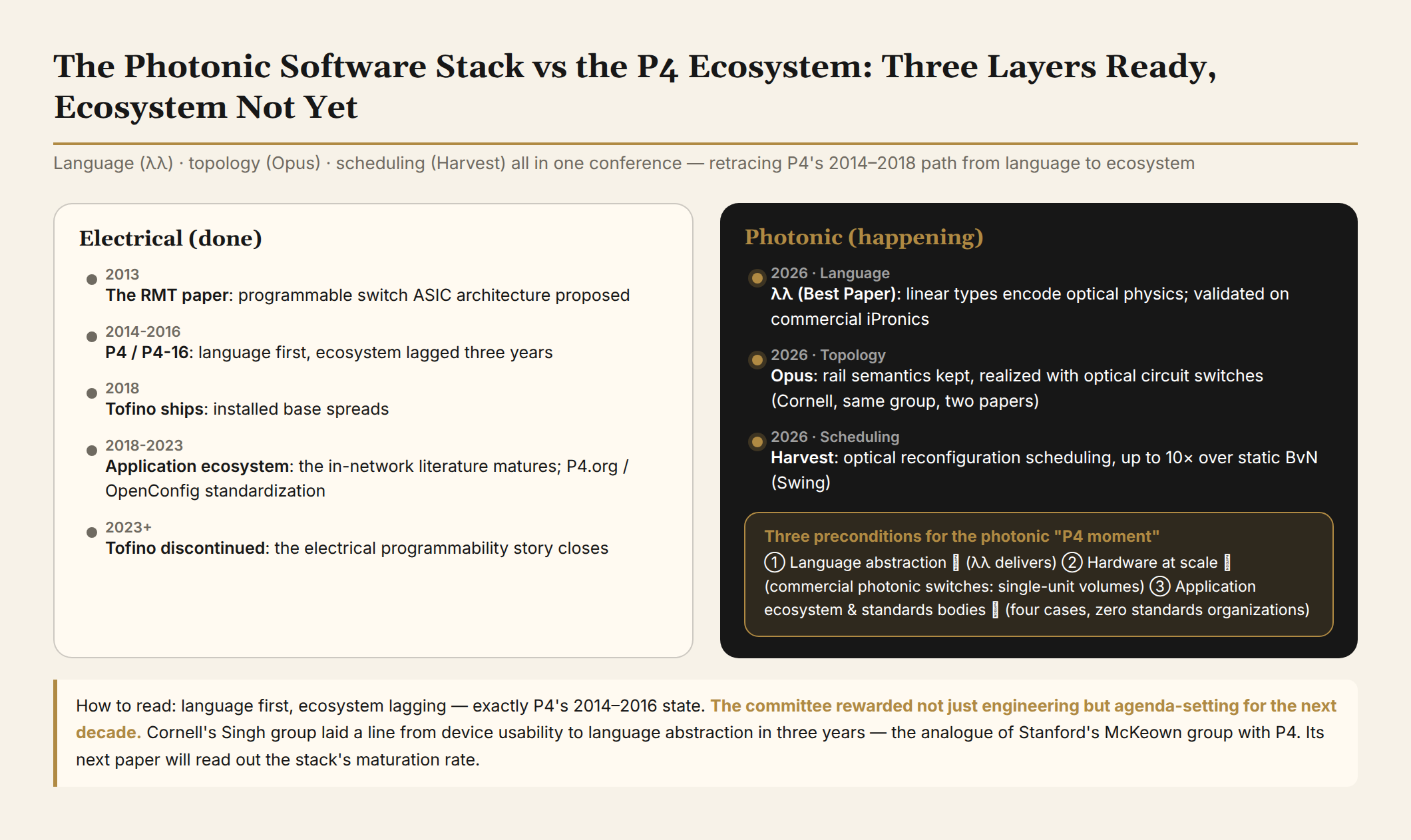
RS9 (Optical & Photonic Fabrics) plus Harvest in RS17 cover exactly three layers of a photonic software stack: lambda-lambda for language, Opus for topology, Harvest for scheduling.
2.1 lambda-lambda: optical physics, written into the type system
The problem lambda-lambda solves is precisely that crack: silicon-photonic meshes keep growing (10^5-scale programmable elements) and gaining capability (from pure switching to topology engineering to analog computation), yet configuring them remains manual — plan waveguides, configure elements, verify physical realizability item by item. Worse, the physics is unintuitive: copying an optical signal, letting two same-wavelength signals share a waveguide segment, or driving one port from two sources are all routine in the electrical domain and impossible in optics. Manual configuration survives on care at modest scale; at 10^5 there is only one way out — let the machine guarantee physical realizability.
The approach encodes those physical constraints into the rules of a type system. The weapon of choice is linear types: every value must be used exactly once. The correspondence with optical physics is precise to the point of elegance — light cannot be copied, so types cannot be duplicated; ports cannot be multiply driven, so linear resources cannot be aliased. The three easiest configuration errors — copying light, wavelength conflicts, port oversubscription — turn from "failures discovered after deployment" into "compile-time errors". The safety net sits at the correct layer.
The full language system has four components. The core language provides optical primitives (routing, phase shifting, splitting) and linearly typed signals and ports. The compiler lowers well-typed programs to a graph IR, then solves a constrained embedding problem (integer linear programming, ILP) to map onto an arbitrary target mesh: enforcing wavelength-conflict and path-disjointness constraints while minimizing signal loss — loss accumulates along paths, so routing and optimization are naturally coupled. A synthesizer auto-generates lambda-lambda programs from high-level specs, for users who never write optical code. And hardware validation: four cases on a commercial iPronics photonic switch — circuit switching, time-varying rotor switching, broadcast, and in-network analog AllReduce (outputs are normalized sums and differences of inputs); the compiler scales to 10^5 programmable elements and 128 input-output pairs, with 10Gbps bidirectional links verified.
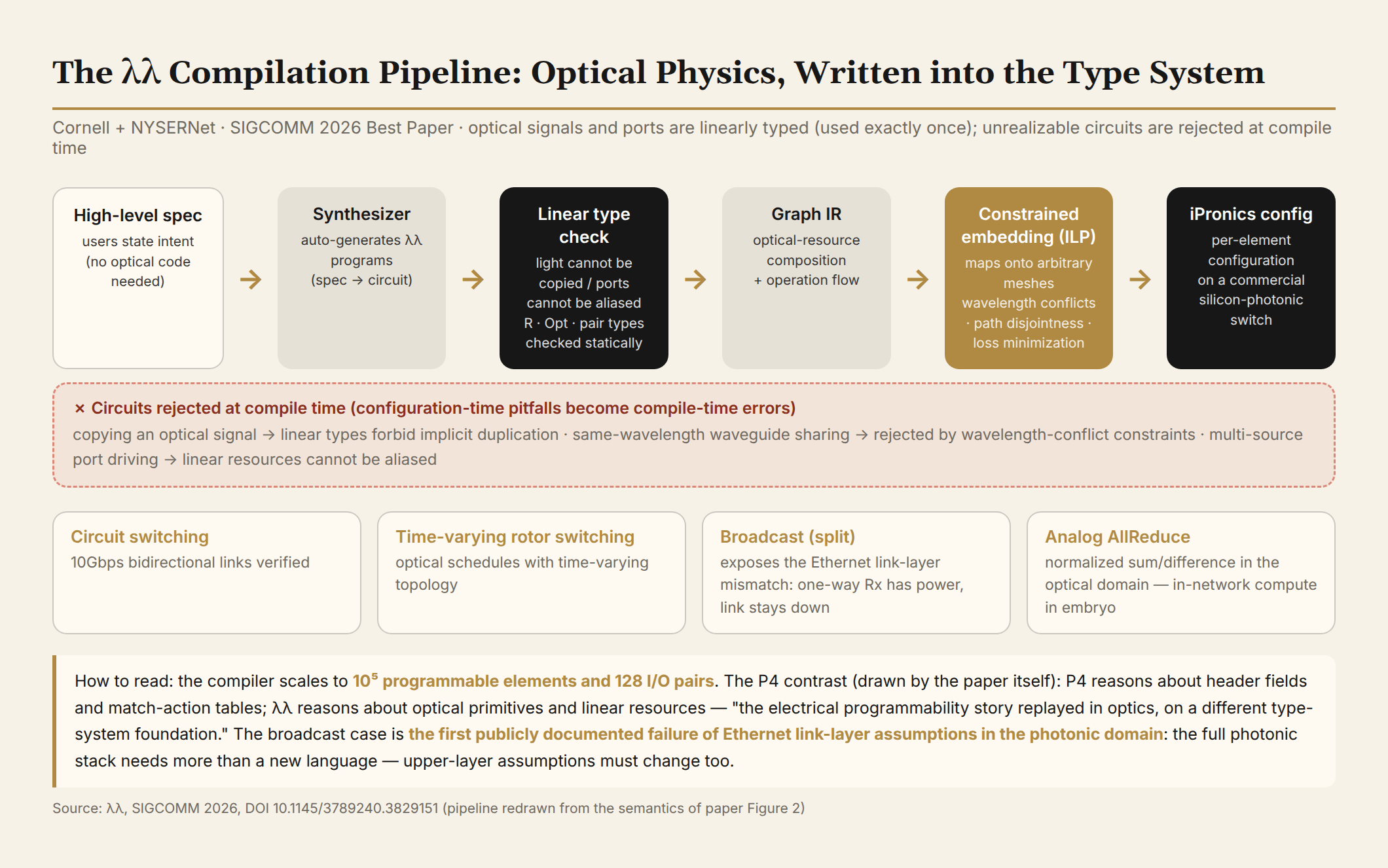
Among the four cases, broadcast exposes an engineering finding beyond the language layer: standard Ethernet link-layer protocols only recognize links with both Tx and Rx present; after the mesh splits one sender's light across two receivers, the second receiver has optical power but the link stays down at the link layer. Ethernet protocol-stack assumptions fail in the photonic domain — the first publicly documented case. It hints that the full photonic stack needs more than a new language: upper-layer assumptions must change too.
The effectiveness boundary is equally clear: compile latency (ILP solve time) is not quantified in the sections read; 10^5-element scalability is stated in terms of successful solving and configuration correctness; the validation platform is a single commercial switch, far from production volumes. The language is established; the engineering is just beginning — which is exactly the definition of a "language first" phase.
2.2 Opus: keep the rail semantics, change the implementation to optics
Rail-optimized fabrics are the de facto topology of ML training clusters: same-slot NICs of every GPU land on the same rail switch, and the traffic pattern is regular. But the economics bite: realizing full rail-to-rail connectivity on high-radix electrical switches gets expensive fast — GPUs double every generation and the full-mesh cost keeps rising.
Cornell + U Michigan's Opus restructures the abstraction layer: keep the rail's communication semantics, realize the rails themselves with optical circuit switches. Once the abstraction and the physical implementation decouple, the cost curve of topology changes its base. The same group (Rachee Singh) placing two papers in one session (lambda-lambda for language, Opus for topology) is itself the institutional act of a "photonic software stack": language and topology claimed together.
2.3 Harvest: when to reconfigure the topology
Once optical circuit switching enters the scale-up domain (detailed in Piece 3), "when to reconfigure" becomes a scheduling problem: reconfiguration has a latency cost (10-100us) and buys reductions in congestion and propagation delay — whether the trade pays needs computing. Purdue + MSR's Harvest synthesizes reconfiguration schedules, beating static BvN schedules by up to 10x (Swing collectives; RD 7.3x, pA2A 5.3x, and 3.0-4.8x at 10-100us reconfiguration delays). The three layers together: lambda-lambda defines how optical circuits are expressed; Opus defines what the topology looks like; Harvest defines when to switch.
3. Route Analysis: The Electrical→Optical Stack Analogy
Mapping 2013–2023 programmable electrical networking onto the photonic domain:
| Layer | Electrical (done) | Photonic (happening) |
|---|---|---|
| Hardware | commercial programmable switch silicon (Tofino, 2018) | commercial silicon photonic switches (iPronics et al.) |
| Language | P4 (2014) / P4-16 | λλ (2026) |
| Compiler | P4 compilers + backend constraint solving | λλ constrained embedding (ILP) |
| Abstraction diffusion | RMT paper (2013) → P4 → ecosystem | photonic mesh → λλ → ? |
| Applications | the in-network application literature | four cases (switching / rotor / broadcast / analog compute) |
Three structural judgments:
Judgment 1: linear types are the correct abstraction for the photonic domain — this is now established. The no-copy physics of light and linear type discipline (each value used exactly once) mirror each other exactly — a structural correspondence, not an engineering coincidence. Successors may change the syntax and the compilation strategy, but "linear resource constraints in the type system" will become consensus the way "match-action in P4" did. And the programs λλ rejects — copying light, oversubscribing ports — are precisely the most dangerous configuration errors; the safety net sits at the right layer.
Judgment 2: the photonic P4 moment needs three preconditions; λλ delivers the first. P4's success was not the language alone: deployed hardware at scale (Tofino's installed base), an application ecosystem, and a standards body. Photonics today: commercial hardware just emerging (single-vendor scale), four application cases, no standards body. Language first, ecosystem lagging — exactly P4's 2014–2016 state, with the ecosystem filling in over the following three years. Photonics will plausibly follow the same curve, likely longer.
Judgment 3: analog in-network computation is the photonic dark horse. λλ already runs analog AllReduce on iPronics — proof of concept only. The energy advantage of optical matrix operations (interference instead of transistor switching) is physical; the binding constraint is precision (analog bit depth). The paper cites prior work on analog in-network computation — the line has academic stock; what's missing is a full system. When silicon-photonic phase control matures, in-network aggregation of training gradients may get a photonics-native option — and the competitive landscape would be Turbo (digital lookup tables in switches) versus photonic analog (λλ-compiled meshes).
4. Evidence Check
| Claim | Number | Source |
|---|---|---|
| λλ compiler scale | 10⁵ programmable elements, 128 I/O pairs | λλ abstract |
| Hardware platform | commercial iPronics switch, 10Gbps bidirectional | λλ §5 |
| Four cases | circuit / rotor / broadcast / analog AllReduce | λλ §5 |
| Harvest vs BvN | RD 7.3× / Swing 10× / pA2A 5.3×; 3.0–4.8× at 10–100μs reconfiguration delays | Harvest §6 |
| Three optical constraints | no arbitrary copying; no same-wavelength sharing; no multi-source ports | λλ §1 |
| Ethernet link-layer failure case | broadcast: second Rx has power, link stays down | λλ §5.3 |
Provenance note: λλ's ILP compile latency is not clearly quantified in the sections read; "scales to 10⁵ elements" is stated in terms of successful solving and configuration correctness. The precision ceiling of analog computation is not quantified in the paper's sections read — the piece accordingly makes no numeric claims about it.
5. Assessment and Predictions
1. Why λλ won Best Paper: it extends the "programmable networking" research program. The P4 story in the electrical domain is finished (Tofino's discontinuation is the full stop); the community needs the next frontier for programmability. λλ moves the story to optics, and the choice of linear types carries mathematical necessity — the committee rewarded not just engineering but agenda-setting for the next decade.
2. Cornell's Singh group is becoming the crucible of the photonic software stack. λλ (language) + Opus (topology) in the same session, on top of prior work in photonic measurement — a complete narrative from device usability to language abstraction in three years. The analogue is Stanford's McKeown group with P4. Watch their next paper (compiler optimization or application ecosystem) to read the stack's maturation rate.
3. The CPO/OCS debate is resolving into layers. Our CPO-vs-NPO judgment — "no final answer, only layered answers" — gets three-layer confirmation here: Opus on the OCS/rail side (scale-out photonics), λλ on the programmable-mesh side (arbitrary optical domains), Harvest on scale-up scheduling. The positions of optical-module vendors, switch-silicon vendors, and hyperscalers are clarifying.
4. Deployability: nearly zero today, starting in three years. λλ's code is open, but the installed base of commercial silicon photonic switches (iPronics-class single units) is far from production. The leading indicator to watch: the first production report of a programmable photonic mesh in an ML cluster (analogous to Google's OCS paper as catalyst). Until then λλ's value is research agenda and researcher tooling.
5. Ledger against earlier locsic analysis. The optical-shuffle supplement (June) judged that "optical shuffle bypasses the transceiver bottleneck" — λλ pushes it further: the optical shuffle can also compute. The CPO/NPO "layered answer" judgment is confirmed as above. And the KV trilogy's "optical interconnect as one exit from the memory wall" — λλ's analog AllReduce is that exit's embryonic form.
Disclosure: Based on a full close read of the lambda-lambda paper (25 pages, including the compiler sections and four case studies) plus abstracts and key sections of Opus and Harvest, and Piece 0's workshop-structure analysis. lambda-lambda's ILP compile latency is not quantified in the sections read; no numeric claim is made. OCS deployment facts are as cited by the paper (primary source not independently verified). Data as of August 22, 2026.
Piece 4 of the SIGCOMM 2026 close-reading series. Previous: overview, KV cache, collectives, scale-up. Final piece: protocol stacks at 1.6T ports.