
DeepSeek Harness and China's Big Six Agent Harness Landscape
Six vendors, three routes: DSH's architecture reconstructed within China's Agent Harness landscape. Written on the eve of the August 13 open-sourcing, with a post-open-source publication note.
When a veteran quantitative trader starts building an Agent workbench, he faces not an empty market, but a track already crowded with six vendors and 13 million DAU.
Publication note (2026-08-17): This article was written on the eve of DSH's open-sourcing on August 13; the original judgments are preserved as written. Late that same night, DSH was officially open-sourced under the MIT license (github.com/deepseek-ai/deepseek-harness)—14K stars on day one, 39.7K within three days. For a source-level verification and expansion, see the companion piece "DeepSeek Harness Architecture Analysis."
Prologue: A Leaked Report and a Timeline
On August 11, 2026, two pieces of news broke on the same day.
The first: Zhipu's ZCode announced it had surpassed 1 million users, simultaneously launching four major features—Goal Mode, Subagents, Remote Control, and Idle-Time Tasks. The second: DeepSeek's WeChat Official Account "DeepSeek Harness Team" (registered on July 6, avatar a black whale) was picked up by media at scale. That same night, all repositories under the dsh-external organization on GitHub were urgently set to private. (The suspense resolved within 48 hours: late on the night of August 13, DSH was officially open-sourced under the MIT license under the deepseek-ai organization.)
This was no coincidence. The focal point of China's AI competition has shifted from model parameters to Harness and product prowess.
DeepSeek Harness (hereafter DSH) is an Agent workbench under internal development at DeepSeek, led by Cui Tianyi—six-time ACM-ICPC Asia Regional gold medalist at Zhejiang University, nine-year Jane Street Hong Kong quantitative systems veteran. He joined DeepSeek in March 2026, the project was greenlit in May, entered small-scale internal testing in July, and the WeChat Official Account was registered as early as July 6. A leaked technical report v2.1 (based on 6 evidentiary screenshots + 4 repository source codes + an ecosystem tracking sheet) gave the outside world its first comprehensive look at the full picture.
But DSH does not face a blue ocean. During the six months it spent in internal testing, Alibaba's Qoder had already captured 47.6% of IDC's China AI Coding market share and 5 million users, Zhipu's ZCode had raced to 1 million users and $1 billion ARR, and Tencent's WorkBuddy had reached 13 million DAU.
This article deconstructs DSH's technical architecture and places it within the full Chinese Harness landscape for horizontal comparison—six vendors, three technical routes, and a closing window of opportunity.
I. Reconstructing DSH's Technical Architecture
1.1 The Official Evidence Chain
The hardest evidence comes from DeepSeek's own API documentation. In the V4-Flash-0731 release notes, the Change Log states:
"For the Code Agent tasks in the public benchmark sets, the official DeepSeek-V4-Flash was tested using the DeepSeek Harness minimal mode (to be released soon) as the framework."
A single sentence confirming four things: DSH exists; the current version is called minimal mode; official benchmarks run on DSH; and it had not yet been released (as of that late-July Change Log). Cui Tianyi had previously stated that Harness would be released alongside V4—V4 Pro 0813 quietly went live late on August 12, and the very next night DSH was open-sourced under the MIT license (github.com/deepseek-ai/deepseek-harness), hitting 14K stars on day one and 39.7K within three days. The draft's "a matter of weeks" was cashed in within a single day.
1.2 Foundation Choice: Deep Fork Modifications to Cordis 4.0
The leaked report reveals that DSH chose Cordis 4.0 as its foundation framework. Cordis is the dependency injection core of the Koishi chatbot framework, authored by shigma, a core contributor in China's frontend community. The logic behind choosing Cordis is straightforward: from project kickoff in May to internal testing in July was only two months; building a framework from scratch would take at least half a year. Cordis provided complete plugin registration, dependency injection, configuration tree, and hot reload capabilities—ready to use out of the box.
But the price was three core modifications that had to be made.
Modification One: Precise call chain traceability. Native Cordis was designed for chatbots, with service injection only tracking the origin registration source. Agent Loops involve nested tool calls—when Tool A calls Tool B and B throws an error, the trace needs to reach back to A. DSH introduced a symbols.caller interceptor that hijacks the Proxy's get/set, allowing errors from the innermost child tool to penetrate the shadow context and attribute responsibility to the real caller.
Modification Two: High-frequency event loop performance. During CoT reasoning and continuous Tool Calls, Agents generate extremely dense lifecycle events. Native Cordis uses callback.bind(thisArg), creating a new closure each time, causing GC pressure to spike under high-frequency scenarios. DSH deprecated closure binding entirely, switching comprehensively to Reflect.apply(callback, thisArg, args) for dynamic invocation, eliminating closure allocations across the entire dispatch/emit/serial/waterfall chain.
Modification Three: Ghost Fiber state consistency. DSH makes extensive use of the EntryTree configuration tree for plugin hot reload. Race conditions between old service unloading and new service loading caused IoC container state fragmentation. The fix was to force operations on the real this.ctx.fiber within restart()/update().
The common thread across all three modifications: Cordis was originally designed for low-frequency, flat chatbot interactions. Agent workloads are characterized by high-frequency events, deeply nested calls, and long-running tasks—the two design assumptions are fundamentally different. Cui Tianyi's team bridged this gap in two months, but long-term, if DSH succeeds, the core engine will most likely need to be rewritten.
1.3 Dual-Surface Architecture: The Most Important Design Decision
DSH implements a thorough separation of Host (Node.js runtime) and Client (browser Web GUI).
The Host side uses ctx.tools.register(defineTool) and ctx.systemPrompt.section(), handling tool registration, Prompt segment injection, MCP bridging, and schemastery configuration validation. The Client side uses ctx.slots.inject() and ctx.theme, handling UI slot injection, the --dsw-* CSS Design Token theming system (100+ semantic variables), and defineStore optimistic updates.
The plugin lifecycles on both sides are completely independent. A Host plugin can register tools without touching UI; a Client plugin can inject UI without touching the tool chain. This means third-party developers can write a plugin that registers debugging tools on the Host side while injecting a call stack visualizer on the Client side—this extensibility is unique among current competitors.
A trident partitioning system has formed within the community: dsh-hub (production plugins, core functionality and productivity tools), toybox (experimental plugins, community exploratory work), and dsh-skins (skin themes, GUI theme registration). From the dsh-skins repository, you can see that skins like Nord need only override the alias layer tokens to achieve global recoloring, with zero intrusion into the core UI.
1.4 Telemetry as a First-Class Citizen
A real-world screenshot from the leaked report (Figure 5) provides golden evidence of DSH's Web runtime. The bottom status bar displays:
1 turns · 3 steps | Tool call 14.5s | Context 1% of 1M | Cache hit 66% | Input 39.2K tok · Output 447 tok
Exposing KV Cache hit rate as a first-class UI citizen is not a random design choice. 66% means that of the 39.2K input tokens, approximately 25.9K hit the server-side cache. Third-party Harnesses (Cursor, OpenCode) calling DeepSeek via API cannot access this data, nor can they control server-side caching strategies. DSH exposing it signals that DeepSeek is productizing its inference engine advantage—not just competing on price, but making users perceive that "this platform is faster and cheaper."
The separation of Turns and Steps is also noteworthy. 1 turn is one round of conversation from the user's perspective; 3 steps means the Agent looped internally three times (Bash search → view_image visual parsing → Markdown summary). This is the correct granularity for Agent Loop observability.
1.5 llm-pi-ai: The Inference Strategy Control Layer
The leaked directory tree shows two parallel packages under DSH's packages/llm/: llm-deepseek and llm-pi-ai. The latter contains adapter.ts, config.ts, context.ts, replay.ts, and stream.ts. The functionality of llm-pi-ai is noted as "subject to uncertainty" in the leaked report.
Process-of-elimination reasoning (the following is inference based on filenames, without source code verification): if it were merely an external model adapter, it would not need replay.ts (session replay) or an independent context.ts (context construction). Naming it "pi-ai" rather than "llm-openai" also breaks naming convention. The most likely explanation is—"pi" (π) in ML context refers to policy functions or policy iteration; llm-pi-ai is DeepSeek's inference strategy control layer, responsible for Flash/Pro model routing, inference intensity switching (low/high/max), automatic <think> block stripping, session deterministic replay, and streaming output control.
If this inference is correct, DSH is architecturally deeply bound to DeepSeek's own models. llm-pi-ai and llm-deepseek together form an end-to-end optimization loop for DeepSeek's inference engine—but it must be emphasized that this is process-of-elimination reasoning based on leaked directory tree filenames, not confirmed fact.
1.6 Cui Tianyi's Quantitative DNA
Understanding DSH's engineering philosophy requires understanding Cui Tianyi's background. He did not come from an AI background.
2008 NOIP bronze medal, admitted to Zhejiang University Computer Science. During university, six ACM-ICPC Asia Regional gold medals. Graduated in 2013, joined Jane Street Capital Hong Kong as an assistant quantitative researcher, for nine years. Covered software development and research in equities and fixed income, working in both the Hong Kong and New York offices. In 2022, co-founded TSY Capital (天市垣资本), systematic quantitative trading. Left TSY in February 2026, joined DeepSeek in March.
Jane Street's quantitative trading execution systems have several core principles: execution speed is money (a millisecond slower and someone else takes the profit); reliability is a survival condition (system downtime doesn't mean making less, it means losing money); full-chain traceability (when something goes wrong, you must know exactly which step); deterministic replay (when a bug occurs, you must be able to reproduce it precisely).
These principles map almost perfectly onto DSH's design: each Agent Loop inference-tool-feedback cycle must be fast (Reflect.apply event dispatch optimization); long-running stability without crashes (Fiber state consistency fix); Telemetry exposing turns/steps/cache hit/tokens in the UI (full-chain traceability); llm-pi-ai's replay.ts providing session replay (deterministic reproduction).
This is no coincidence. This is Jane Street's engineering discipline mapped onto the Agent domain.
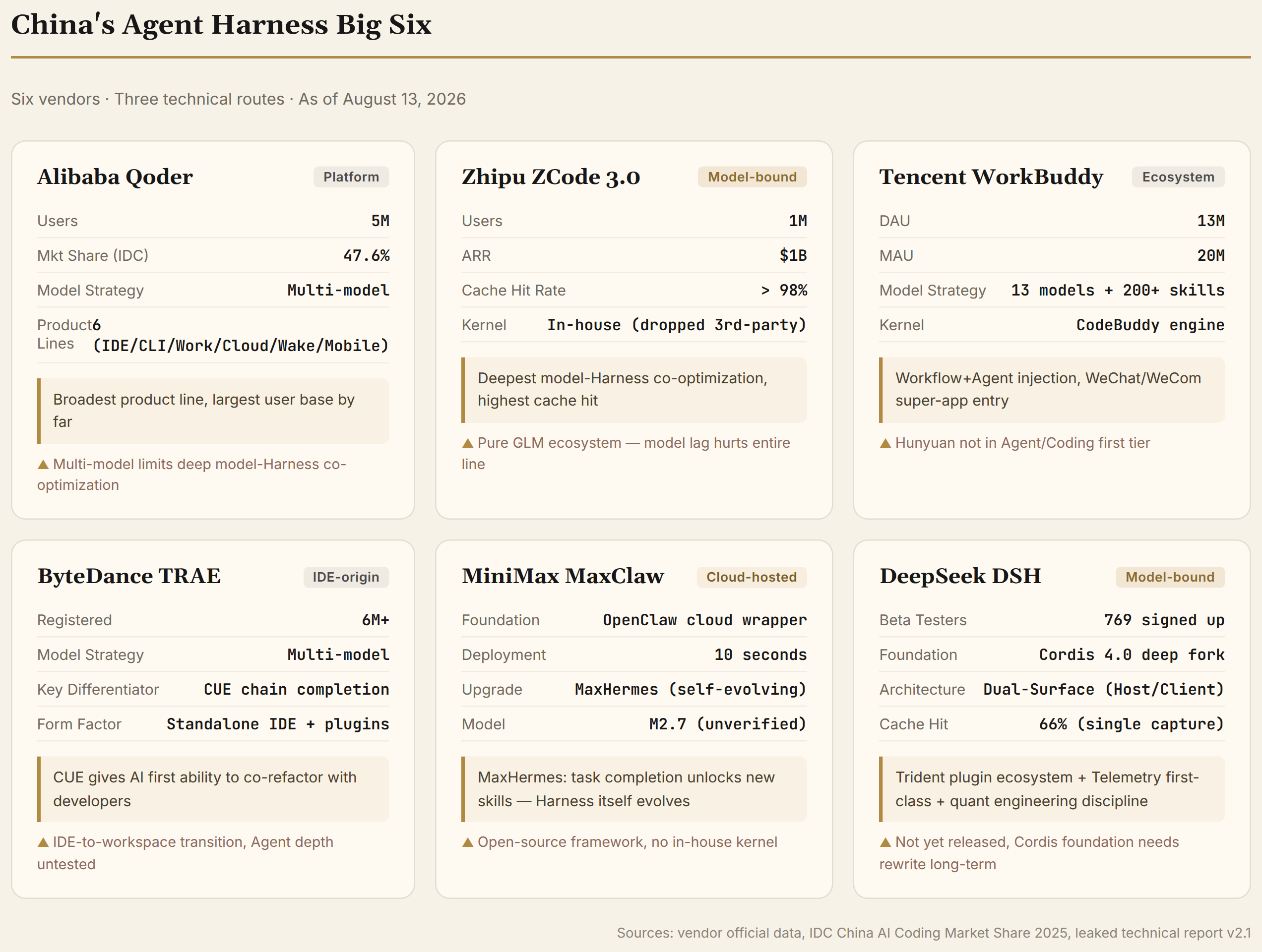
II. China's Big Six Agent Harness Landscape
DSH was not born in a vacuum. Zooming out to the entire Chinese market, the Agent Harness track became highly crowded in the first half of 2026.
2.1 Alibaba Qoder: The Platform Player with the Broadest Product Line
Alibaba released Qoder in August 2025, upgrading it to a 1.0 autonomous agent development workbench in May 2026. The product matrix covers six lines: Qoder IDE (desktop IDE / JetBrains / VS Code plugins), Qoder CLI (command line), QoderWork (desktop office automation), Qoder Cloud Agents (Alibaba Cloud fully managed), QoderWake (7×24 digital employee), and Qoder Mobile (mobile).
QoderWork's technical architecture is a three-layer design. The interaction layer provides three tiers of autonomy—Ask (read-only Q&A), Agent (multi-turn iterative with confirmation), and Quest (one-shot delegation with full permissions within preset boundaries). The decision layer includes Agent planning and orchestration, a consciousness system (memory + reflection + skill evolution), and MCP tool discovery with auto-orchestration. The execution layer handles file operations, shell snapshots, and session-level isolation within a local sandbox.
Qoder 1.0 underwent a systematic Agent Harness重构, transforming the traditional chat-based conversational mode into a structured task runtime. Official claims include the ability to retrieve 100,000 code files at once, with Repo Wiki code knowledge graphs and team-level knowledge engines integrated into a unified knowledge base.
The foundation adopts a multi-model compatibility strategy (Qwen/GLM/DeepSeek/Kimi/MiniMax), not locking to a single model. IDC reports a 47.6% market share and 5 million users. The advantage is the broadest product line and the largest user base; the shortcoming is that multi-model compatibility means it cannot perform model-Harness deep co-optimization.
2.2 Zhipu ZCode 3.0: Deep Binding with a Self-Built Kernel
ZCode's pivotal decision came in version 3.0—a complete switch to the self-developed ZCode Agent kernel, no longer maintaining other Agent adapters. This is a subtraction-to-addition decision: giving up multi-Agent compatibility (previously supported Claude Code, Codex, Gemini) in exchange for end-to-end deep optimization for GLM-5.2.
The most visible result of the self-built kernel is a cache hit rate exceeding 98%. This is the highest among all Harnesses. Compared to DSH's 66% (from a single real-world screenshot), the gap stems from the self-built kernel's ability to precisely control context structure, ensuring maximum prefix caching hits. In Zhipu's self-developed Z.ai Code Bench, GLM-5.2 + ZCode's overall task pass rate is 2.39% higher than GLM-5.2 + Claude Code.
ZCode's functional architecture became quite complete after the August 11 upgrade: Goal Mode (set acceptance-testable goals, auto-decompose/modify/test/iterate), Subagents (general-purpose execution + read-only exploration + custom agents), Remote Control (WeChat/Feishu mobile access to desktop), Idle-Time Tasks (auto-execute during off-peak, no point deduction), Zread smart project knowledge base, and visual Git branch graph.
Zhipu went from ¥100M to ¥1B ARR in just 5 months (10 months faster than Anthropic), primarily driven by Coding. ZCode users have surpassed 1 million. The advantage is the deepest model-Harness co-optimization; the shortcoming is that abandoning multi-model support turns it into a pure GLM ecosystem—if GLM model capability falls behind, the entire product line suffers.
2.3 Tencent WorkBuddy: CodeBuddy Kernel
WorkBuddy's foundation is Tencent's internal CodeBuddy kernel, integrated alongside products like QClaw into its current form (not a simple linear evolution). According to Tencent's official data, the company started building AI coding tools in 2022. CodeBuddy covers 90% of Tencent's engineers, AI-generated code accounts for over 50%, and overall coding time has been reduced by 40%.
WorkBuddy's DAU has reached 13 million, MAU 20 million—first among domestic efficiency agents. Its three work modes (Craft: direct execution / Plan: propose first / Ask: Q&A only) are similar to Qoder's tiered autonomy.
The enterprise version's architectural design deserves special attention: "Workflow backbone + Agent flexible injection"—using Workflow to guarantee determinism, traceability, and retryability for production-grade business, while injecting Agent's long-chain reasoning capability where flexible judgment is needed. This is one of the best engineered designs seen so far, more reliable than a pure Agent Loop.
According to Tencent's official information, it ships with 13 mainstream large models built in, and is compatible with the OpenClaw skill ecosystem (200+ custom skill plugins). The enterprise version has been released, supporting everything from SaaS to private on-premises deployment (including domestic trusted computing environments). Full Tencent ecosystem integration (Documents/Drive/WeChat/Meetings/Pay) is its biggest differentiator.
The shortcoming is equally apparent: under a multi-model strategy, there is no self-developed model as the foundation. Tencent's Hunyuan is not in the first tier for Agent/Coding.
2.4 MiniMax MaxClaw/MaxHermes: OpenClaw Cloud Hosting
MaxClaw is essentially a cloud gateway wrapper around OpenClaw. It uses MiniMax cloud compute to complete the OpenClaw underlying deployment—users need no local installation, no API configuration, no Docker management. Deploy in 10 seconds. It has already joined the first tier of similar services.
MaxHermes is the upgraded version, built on the Hermes Agent, featuring an "autonomous self-evolution" mechanism—unlocking new skills after completing each task, continuously expanding capability boundaries. The underlying model is officially stated as MiniMax M2.7 (independent verification pending), supporting 50+ Skills and a complex environment of 60-150 Feature lists.
MaxHermes's "self-evolution" logic is unique—the Harness itself is evolving. After task execution, it automatically learns, expands its skill library, and can handle more complex tasks next time. This points in the same direction as DSH's plugin hot reload: the Harness is not a static framework, but a system that grows.
The shortcoming is that it is based on the OpenClaw open-source framework, with no self-developed kernel. Model-Harness co-optimization depth is limited.
2.5 ByteDance TRAE: The Full-Route Player Starting from IDE
According to official information, ByteDance's TRAE has accumulated over 6 million registered users. Its dual-mode design: IDE Mode preserves the traditional editor workflow, while SOLO Mode lets AI take the lead in autonomous task planning. CUE is the core differentiating feature (chain completion + multi-line modifications + modification point prediction jumping), giving AI the ability to refactor code alongside developers for the first time.
The product has expanded from a developer tool to TRAE Work workspace. It ships with multiple built-in models (Doubao/DeepSeek/Kimi/Qwen/GLM), in two form factors: standalone IDE + VS Code/JetBrains plugins.
2.6 DeepSeek DSH: Open Ecosystem on Deep Fork Modifications to Cordis
Returning to DSH itself. Its core differentiation lies in its open plugin ecosystem. Trident partitioning (dsh-hub / toybox / dsh-skins) + physical-level Host/Client decoupling gives it the potential to become "the VS Code of Agent Harnesses"—not locking in models (though deeply bound to DeepSeek), not locking in users, but locking in the ecosystem.
Cui Tianyi's quantitative engineering DNA brings a unique engineering discipline: Telemetry as a first-class citizen (full-chain observability), Reflect.apply event dispatch optimization (millisecond-level execution), replay.ts for deterministic replay. These are engineering habits forged over nine years at Jane Street.
But the time window is tight. 769 people registered for internal testing vs. ZCode's 1 million users vs. WorkBuddy's 13 million DAU. Entering half a year late, competitors already have million-level user stickiness and mature product iteration experience.
III. The Fundamental Divergence of Three Routes
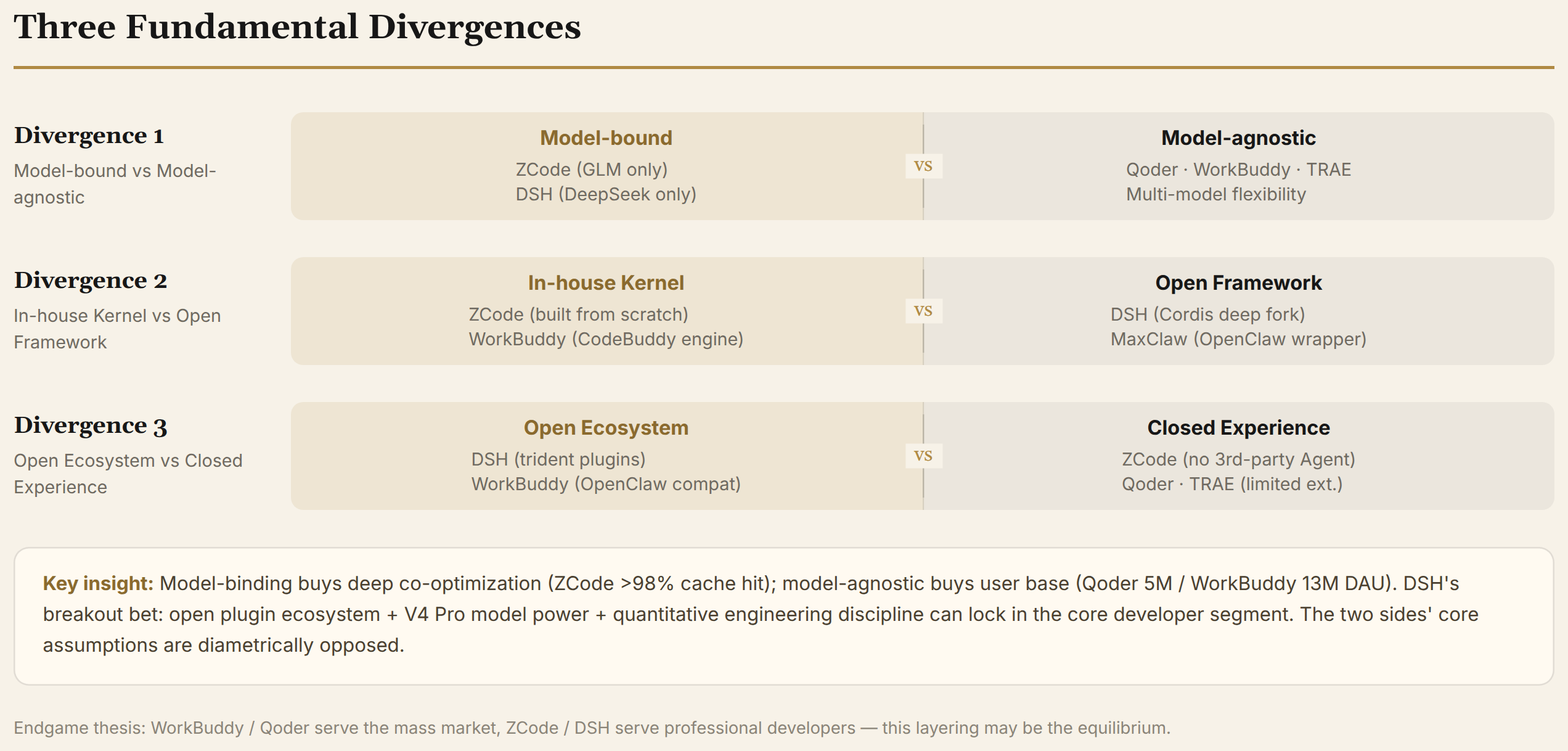
The competition among six vendors is superficially a feature contest; at its core, it is a divergence of three routes.
Divergence One: Model-bound vs. Model-agnostic. ZCode (GLM only) and DSH (DeepSeek only) bet that model-Harness deep co-optimization outweighs flexibility—the 98% cache hit rate and KV Cache as a UI first-class citizen are evidence of this co-optimization. Qoder, WorkBuddy, and TRAE bet that multi-model flexibility plus user base outweighs co-optimization depth. The core assumptions on both sides are diametrically opposed.
Divergence Two: Self-built kernel vs. Open-source framework. ZCode (written from scratch) and WorkBuddy (CodeBuddy, four years of accumulation) take the self-built route—slow to start but controllable long-term. DSH (Cordis deep fork modifications) and MaxClaw (OpenClaw wrapper) take the framework route—fast to start but technical debt accumulates. DSH's three Cordis modifications have already proven that a chatbot framework's foundation cannot bear Agent workloads; a core rewrite within 12-18 months is highly likely.
Divergence Three: Open ecosystem vs. Closed experience. DSH (trident plugins) and WorkBuddy (OpenClaw skill compatibility) take the open route. ZCode has explicitly dropped third-party Agent support—betting that the self-developed experience is good enough that users will accept the lock-in. Qoder and TRAE fall in between, with MCP and skill extension capabilities but limited depth.
IV. DSH's Path to Breakthrough
The core question DSH faces: in a market already occupied by a 5-million-user competitor (Qoder) and a 1-million-user competitor (ZCode), what is the basis for winning?
Differentiator One: Plugin ecosystem openness. ZCode has gone closed (no longer supporting third-party Agents); Qoder and WorkBuddy have skill extensions but lack the physical-level Host/Client decoupling design. DSH's dual-Surface architecture lets third-party developers register tools on the Host side while injecting UI on the Client side—this extensibility is currently unique to DSH. If the trident ecosystem takes off, DSH could become "the VS Code of Agent Harnesses."
But the risk is equally real—before open-sourcing, only 769 people had registered for internal testing, and the plugin ecosystem was still a paper plan. The open-source release ships with 100+ built-in plugins, and community plugins began appearing around August 15 (dsh-agent-teams, Better Sidebar, and others)—but there is a long road from "people writing plugins" to WorkBuddy's scale of 200+ skill plugins running in production.
Differentiator Two: V4 Pro model capability. V4 Pro 0813 went live late on August 12. If V4 Pro surpasses GLM-5.2 and Qwen3.8-Max on Agent tasks, DSH has a model advantage. The fact that DeepSeek's official API documentation runs all benchmarks on DSH is itself a signal—DeepSeek dares to publish scores measured on its own Harness.
Differentiator Three: Cui Tianyi's quantitative engineering philosophy. This is the hardest thing to replicate. Nine years of Jane Street execution system discipline—millisecond-level optimization, full-chain traceability, deterministic replay—cannot be filled by hiring a few engineers. DSH's Telemetry first-class citizen design (cache hit rate / context usage / turns-steps separation) carries strong quantitative trading execution system DNA. In long-running, high-reliability Agent scenarios, this engineering discipline becomes genuine competitive advantage.
Window assessment (written on the eve of open-sourcing, preserved as written): DSH's optimal release window is the next 2-4 weeks—V4 Pro 0813 just launched, and market attention is concentrated on DeepSeek. If the release slips past the next major version of Qoder or ZCode, the attention dividend evaporates. In hindsight, the window cashed in even faster than expected: less than a day after this was written, DSH went open source, and 14K stars on day one suggests the attention dividend was harvested in full.
V. Industry Direction
Harness Self-Evolution: From Framework to Living System
The most frontier direction in this competition is not model capability (which is converging across players), but the Harness's own capacity for evolution. MaxHermes's "task completion → unlock new skills" and DSH's "plugin hot reload + Cordis Fiber state consistency" point toward the same trend—the Harness is not a static framework, but a system that grows.
This echoes a forming technical consensus: the next evolution of Agent Harnesses is self-evolution. Not "the model gets stronger so the Harness automatically gets stronger," but the Harness itself possessing learning capability—recording execution patterns, optimizing tool call chains, auto-generating new skills. Whoever breaks through first in this direction secures the next ticket of admission.
Productization of Inference Infrastructure Competition
DSH making KV Cache hit rate a first-class UI citizen, ZCode achieving over 98% cache hits—these numbers point to the same judgment: the competition over inference cost is moving down from model pricing to the inference infrastructure layer.
Third-party Harnesses (Cursor, OpenCode) calling large models via API cannot access server-side cache data, nor control caching strategies. Model companies building their own Harnesses (ZCode, DSH) inherently possess this advantage—they control the full chain from model weights to inference engine to Harness, enabling end-to-end optimization.
This creates structural pressure on independent Harness vendors. When model companies start binding the best Harness experience to their own models, independent vendors' optimization ceiling gets locked at the API interface layer.
Special Variables in the Chinese Market
In an article, Huxiu defined Harness competition as a battle for three rights: capability distribution power (Skill entry points), tool supply power (Tool calls), and ultimate settlement power (Token billing). Whoever controls the Harness controls the distribution and settlement channel between developers and models.
This framework is more precise than "Model + Harness = Agent." The particularity of the Chinese market is that—Tencent has the super-entry-points of WeChat and Enterprise WeChat, Alibaba has the enterprise channels of DingTalk and Alibaba Cloud, and ByteDance has the distribution power of Feishu and Douyin. WorkBuddy integrating WeChat Pay to form a payment loop, Qoder connecting to DingTalk to link enterprise workflows—these ecosystem advantages are things that DeepSeek and Zhipu do not possess.
Pure technology companies (DeepSeek, Zhipu) need to answer an additional question with their Harnesses: when competitors have locked in super-app distribution channels, how do you reach non-technical users?
The answer might be: DSH and ZCode don't need to reach everyone. They only need to lock in the core developer demographic—those professional users most sensitive to model capability, cache performance, and Agent reliability. WorkBuddy and Qoder serve the mass market; ZCode and DSH serve professional developers. This layering may well be the endgame.
Notes and Data Sources
- DeepSeek API Change Log: api-docs.deepseek.com/updates (V4-Flash-0731 release notes)
- DSH leaked technical report v2.1 (based on 6 evidentiary screenshots + 4 repository source codes + ecosystem tracking sheet)
- IDC "China AI Coding Market Share, 2025": Alibaba Qoder 47.6% market share
- Zhipu ZCode official data: 1 million users, cache hit rate exceeding 98%, Z.ai Code Bench evaluation
- Tencent Cloud Developer Community WorkBuddy technical breakdown: 13 million DAU, CodeBuddy four-year accumulation
- MiniMax MaxClaw/MaxHermes official information: M2.7 model, OpenClaw cloud implementation
- Cui Tianyi biography: Baidu Baike, Phoenix Tech, Every Economic News cross-verification
- Huxiu, "After Models Converge, the Agent's 'Hands, Workbench, and Ledger' Become Valuable" (2026-08-11)
This article does not constitute investment advice. Data cutoff: 2026-08-13; publication note updated 2026-08-17.