
From AI Compute Infrastructure to AI Context Infrastructure
——Enterprise Infrastructure Software Architecture Evolution in the AI Era
Executive Summary
Why now? The number of agents inside organizations is surpassing the number of employees. Human-agent collaboration density already exceeds human-human collaboration by one to two orders of magnitude. Agents have no tacit understanding, no implicit memory — the only thing they can work from is context that is explicitly provided. Context is becoming the bottleneck resource for intelligent organizational operations.
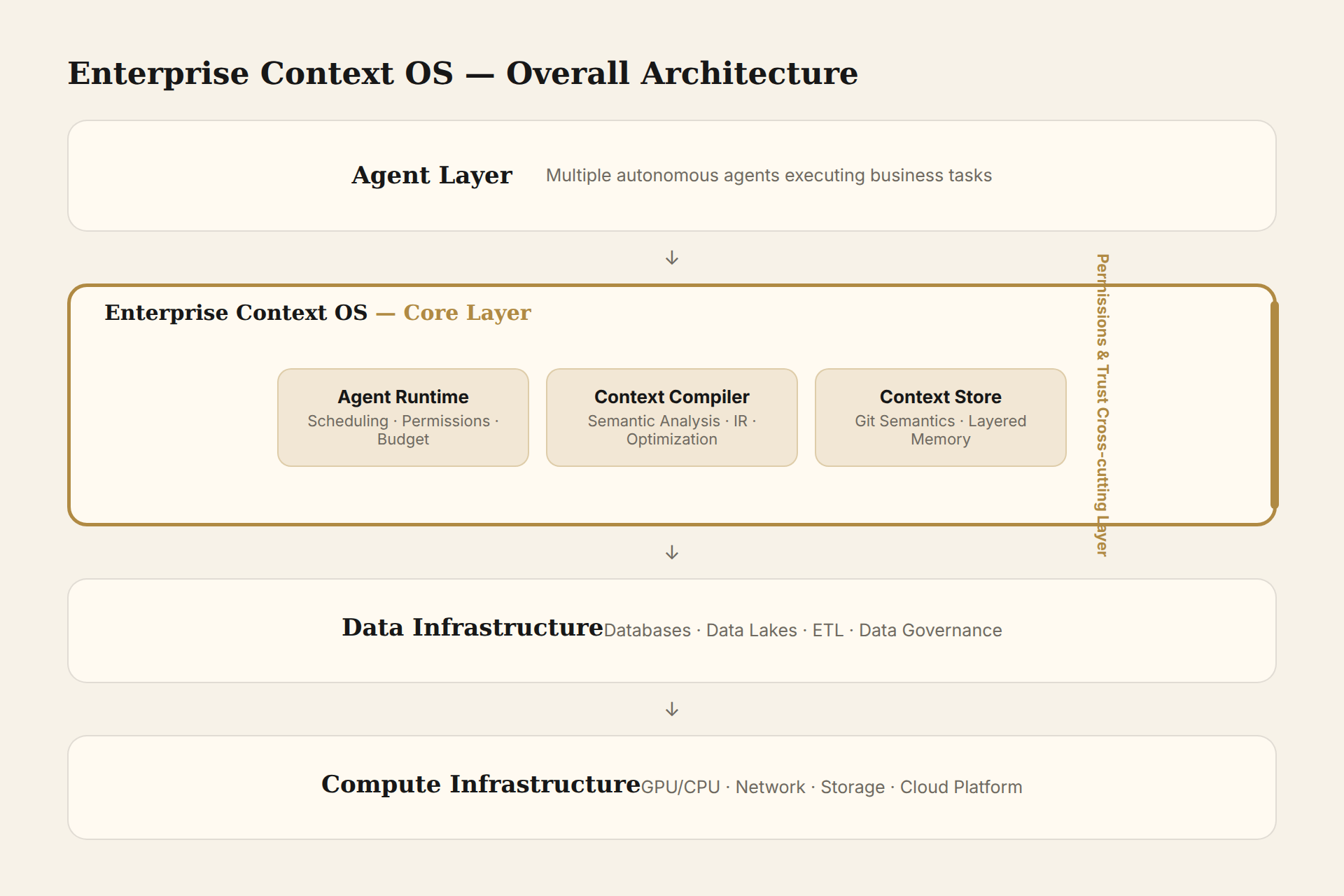
What is the new system? Enterprise Context OS: a new infrastructure software layer situated between Agents and Data Infrastructure, comprising three components:
Enterprise Context OS = Context Store + Context Compiler + Agent Runtime
These components answer three questions: Where does the organization's cognition reside? How is it compiled into agent working sets? How does it drive human-agent collaboration?
Why does it matter? The previous generation of IT systems managed organizational data. This generation must manage organizational cognition. This is the largest category-creation opportunity in enterprise infrastructure software since the database.
Chapter 1 Why Enterprise Context OS Is Needed
1.1 The Fifth Infrastructure Revolution: Defined by Resource Management Paradigms
Every generational shift in enterprise IT infrastructure has a dividing line that is not "the technology got faster." The line is the emergence of a new, scarce resource that must be explicitly managed. The framework of this paper is based on resource management paradigms rather than industry technology eras — whenever a new scarce resource must be explicitly managed, it gives rise to a new layer of infrastructure software.
| Resource Paradigm | Scarce Resource | Infrastructure |
|---|---|---|
| Compute Paradigm | Compute tasks | Operating systems |
| Data Paradigm | Data records | Databases |
| Connection Paradigm | Information connections | The Web |
| Collaboration Paradigm | Parallel evolution of documents / code | Git / collaboration platforms |
| Agent Paradigm | Context | Enterprise Context OS |
Context is the third resource — after compute and data — that enterprises must manage as a first-class resource.
Boundary statement: Enterprise Context OS does not replace Linux or Windows. It sits between Agents and Data Infrastructure as a new infrastructure software layer. We call it an OS because it assumes operating-system-like responsibilities — abstracting, scheduling, isolating, and authorizing access to a scarce resource. We prefix it with Enterprise because what it manages is organizational cognition, not the context of a single model session.
1.2 Overall Architecture
1.3 First Principle: The Read-Write Cost Inversion
For forty years, information systems were built on an implicit assumption: writing is expensive, reading is free. A document is written once and read by a hundred people at near-zero marginal cost, so the entire architecture is optimized around "reducing the cost of writing."
In the Agent era, this assumption inverts. A piece of knowledge is produced once, then invoked 10,000 times by 10,000 agents. Each invocation costs tokens, incurs inference latency, and consumes window space. Read volume has exploded by three to four orders of magnitude, and read quality directly determines work quality — stuffing 20,000 tokens of irrelevant content into a window wastes money and dilutes attention.
From this we derive the first principle that runs through the entire paper:
AI-era information infrastructure is fundamentally about optimizing the cost of machines reading organizational cognition.
Structuring is not for human readability — it is to compress machine read cost. Versioning is not for archiving — it is to enable incremental reads. Indexing is not for a search box — it is to surface the minimum sufficient set within a bounded window. Every design decision that follows can be traced back to this principle.
Chapter 2 Why Existing Systems Fail
2.1 Four Verbs and Five Gaps
High-density collaboration requires solving four verbs: understand (a new agent acquires complete task cognition within minutes), share (multiple agents access the same cognition at appropriate granularity and permission levels), hand off (transfer becomes a system operation rather than an alignment meeting), and continue (work builds on existing cognition, with increments automatically merging into history). The gaps in current systems are structural:
| System | What It Does | Structural Deficiency |
|---|---|---|
| Document platforms | Store conclusions | File-centric, not context-centric; loses "how the conclusion was reached" |
| Knowledge bases | Accumulate knowledge | Depends on after-the-fact manual distillation; cannot keep pace with collaboration |
| RAG | Find information | Answers "what," not "why"; no evolution history or causal chain |
| Agent Memory | Per-agent memory | No version semantics, no permission model, no cross-agent merge |
| Git | Version text | Manages textual diffs, not cognitive diffs |
The common deficiency points to a single void: no system treats the organization's cognitive process as a first-class resource to model, store, and govern.
2.2 Boundary Clarification: Enterprise Context OS Is Not an Agent Platform
The most common market misconception is "Isn't this just an Agent Platform?" We must draw the boundary explicitly:
| Agent Platform | Enterprise Context OS | |
|---|---|---|
| Core object | The agent | Organizational cognition |
| Problem solved | How tasks execute | How cognition is managed |
| Memory | Session memory | Organization-level context |
| Collaboration model | Agents calling agents | Context Git (versioned cognitive collaboration) |
| Knowledge source | Bolted-on RAG | Native Context Model |
| Core capability | Workflow orchestration | Context Compiler |
| Lifecycle | Disappears when the task ends | Grows with the organization |
In one sentence: Agent Platforms solve "who does the work"; Enterprise Context OS solves "on what basis, for what reason, and how does it continuously evolve." The relationship mirrors that of application servers and databases: Agent Platforms run agents; Enterprise Context OS supplies cognition to all agent platforms. There will be many Agent Platforms, and they will churn rapidly. Enterprise Context OS needs only one instance, and it accumulates value over the long term — this is precisely the line between infrastructure software and application software.
Chapter 3 Context Model: The Five-Level Object Hierarchy for Organizational Cognition
3.1 The Cognitive Promotion Chain
The core design decision: do not model context as a single object type, but as a cognitive promotion chain — information is progressively promoted from raw events to formal organizational cognition, with each level carrying different confidence, merge rules, and lifecycle characteristics.
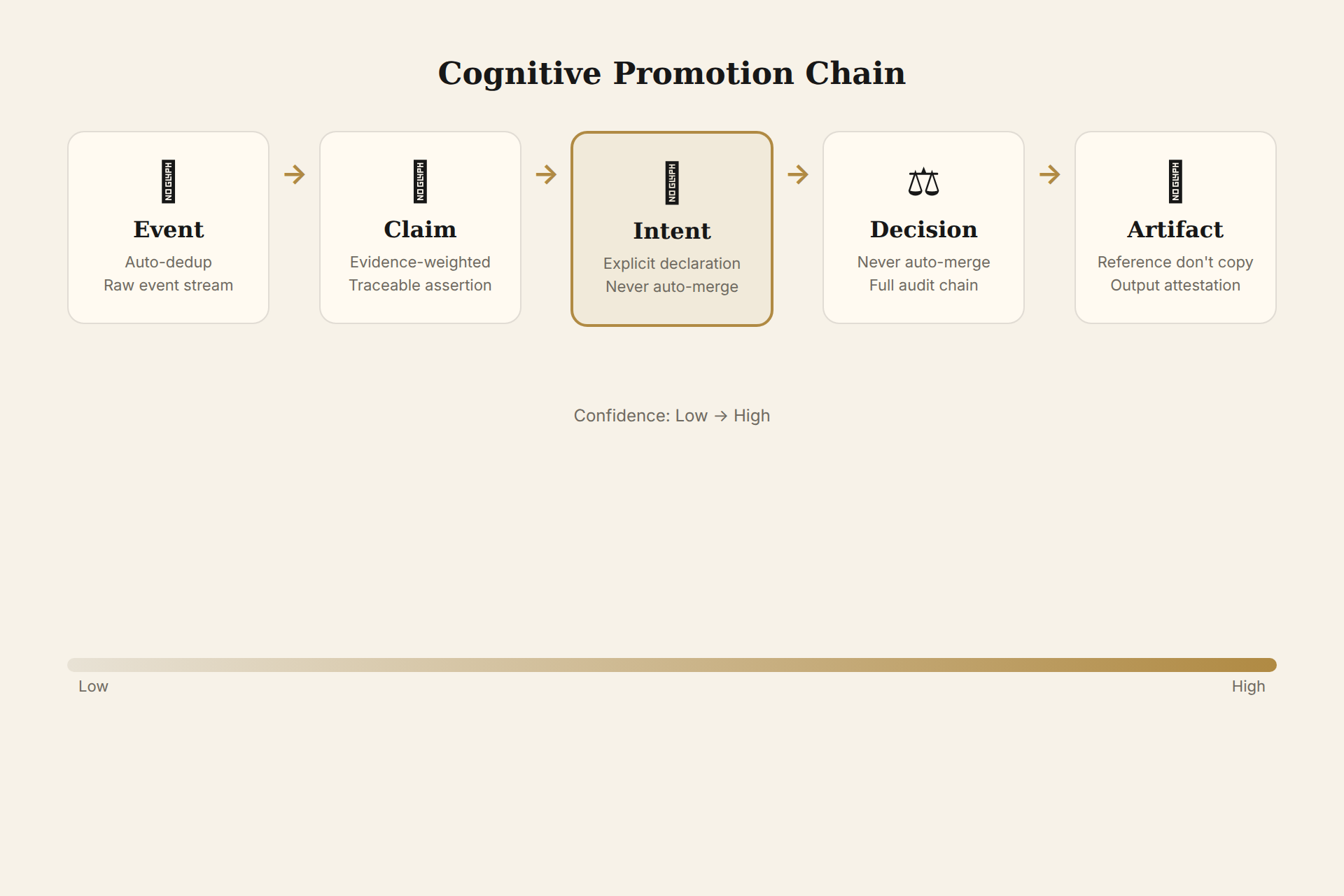
Event: A spoken sentence, an edit, an agent inference step — append-only, immutable, signed by the actor, and the ground-truth source of the entire system. Claim: An assertion extracted from events, carrying provenance chains and confidence annotations, distinguishing "confirmed facts" from "an agent's speculation." Intent: The reason a task exists — its goals, constraints, and acceptance criteria. It is the sole basis for an agent to judge "what is relevant to me" and "what counts as done"; a Context Package without Intent is an incomplete deliverable. Decision: The organization's formal stance — it must be explicitly confirmed by a person with decision authority and is never auto-merged. Artifact: Code, documents, or data, existing as references rather than copies.
3.2 Entity Graph: The Relationship Layer
Entities (people, customers, products, technologies, projects) do not enter the main chain — they are not cognitive lifecycle objects; they are mounting points for cognition. The five-level objects interconnect through the Entity Graph:
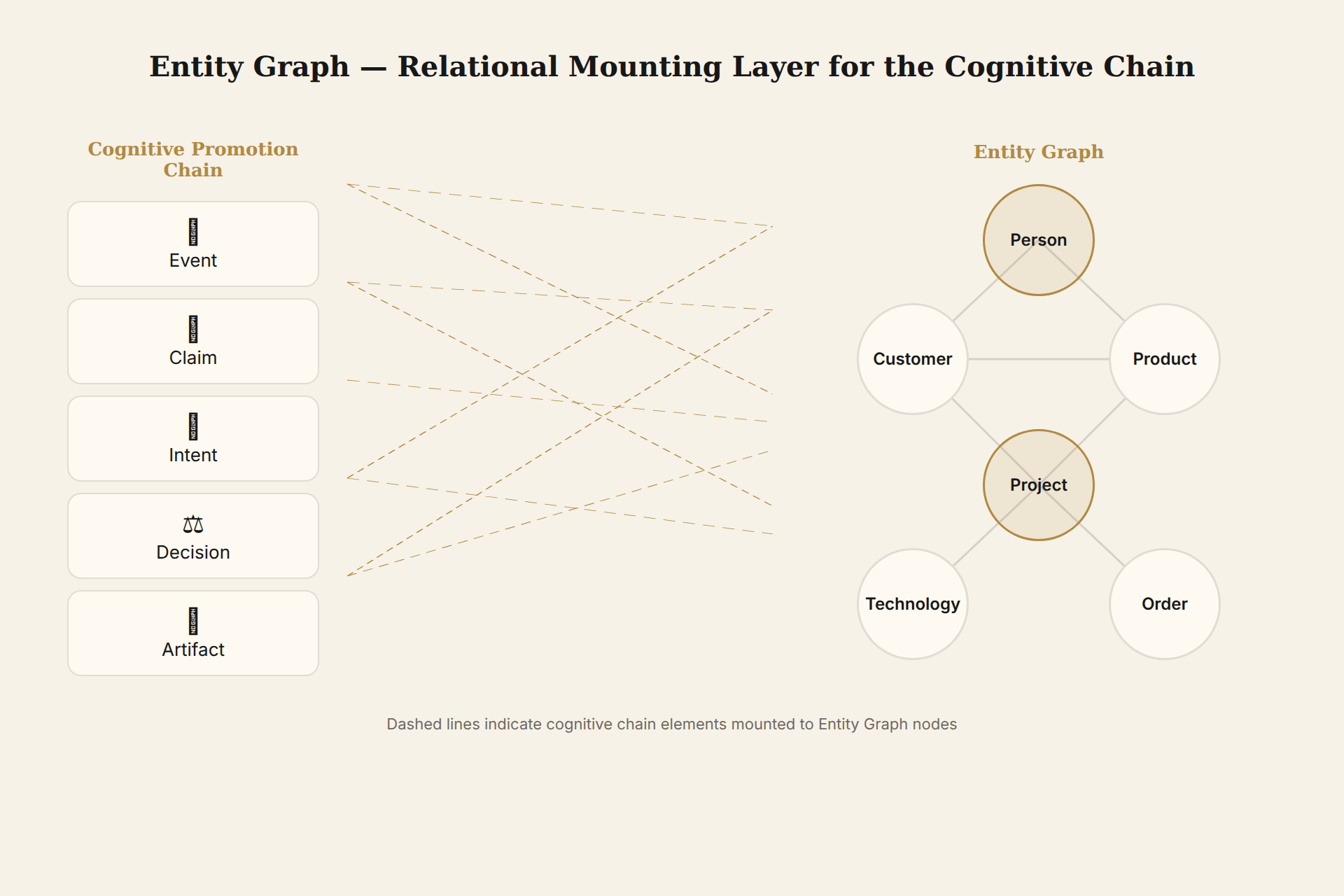
The five-level objects are organized within Context Spaces: one task maps to one Space. Inside a Space, objects form a graph; the whole Space supports versioning. This chain draws a clear boundary from documents — merging two chat transcripts is meaningless; merging Claims, Intents, and Decisions is meaningful.
Chapter 4 Context Store = Context Git + Memory Hierarchy
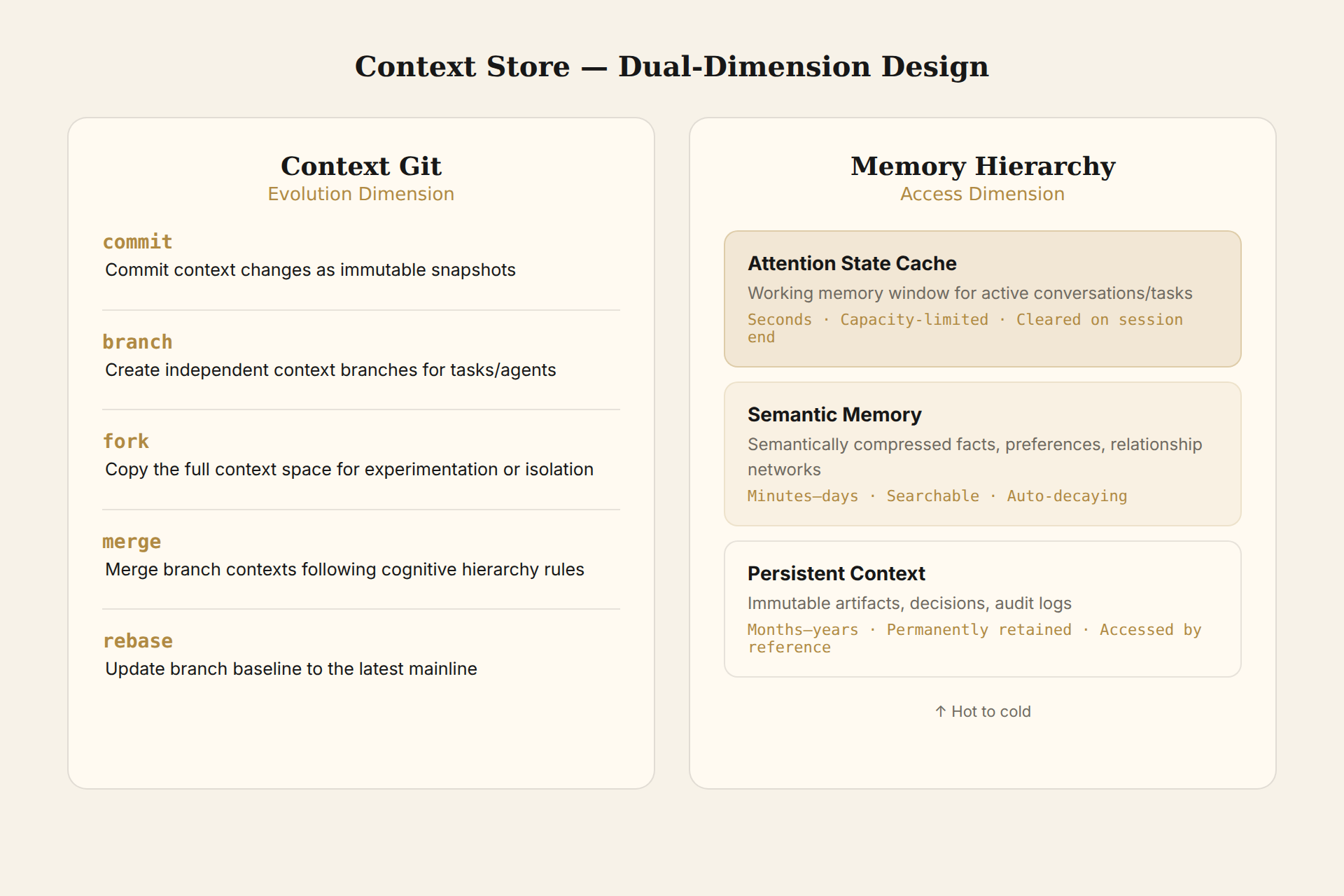
Context Store is a new storage category, on par with file systems, databases, and object stores. It is defined by two orthogonal dimensions: Context Git manages the evolution of cognition, and Memory Hierarchy manages the access efficiency of cognition.
4.1 Context Git: The Evolution Dimension
This is what fundamentally separates Context Store from databases, knowledge bases, and RAG. Five primitives fall into two categories: the daily cycle consists of commit / branch / merge — organizational work manifests as a context tree that constantly forks and converges; event-triggered primitives are fork / rebase — fork is triggered by cross-boundary collaboration (suppliers, partners, with automatic desensitization when crossing trust boundaries), and rebase is triggered by premise changes.
Version topology is a first-class structure at the storage layer, not application-layer metadata. All object contents are content-addressed and immutable. Hot/cold lifecycle is semantically driven — once a task is archived, procedural details cool down, while key decision nodes remain permanently warm.
4.2 Memory Hierarchy: The Access Dimension
Persistent Context (source of truth): The five-level objects, version topology, and Entity Graph are stored as an integrated whole and persisted permanently. Semantic Memory (acceleration layer): Vector indices, entity graphs, and multi-resolution summaries for each Space (one-sentence version / one-page version / full version, automatically updated as the Space evolves). This layer can be fully rebuilt from the persistent layer — just as a database index can be rebuilt from its table. Attention State Cache (Computational Memory Tier): KV Cache and other attention states — non-persistent, rebuildable, with lifetimes ranging from seconds to hours. Scale varies enormously with model architecture and precision, so we avoid giving fixed numbers; however, under long-context, high-concurrency workloads, aggregate volume entering the TB range is a clear trend. The reason to incorporate this tier is economics: when multiple agents share a context prefix, reusing attention states directly offsets the explosion in read cost — the first principle manifested at the most microscopic scale.
Chapter 5 Context Compiler: The Compiler of the Agent Era
5.1 From Retrieval to Compilation
The Store answers "where does cognition reside." The Compiler tackles a sharper question: given a finite context window, generate the optimal cognitive working set for a specific task. This is not a retrieval problem. It is a compilation problem. What an agent needs is not "the top 20 relevant documents" but a precise, window-fitting working set ordered by attention efficiency.
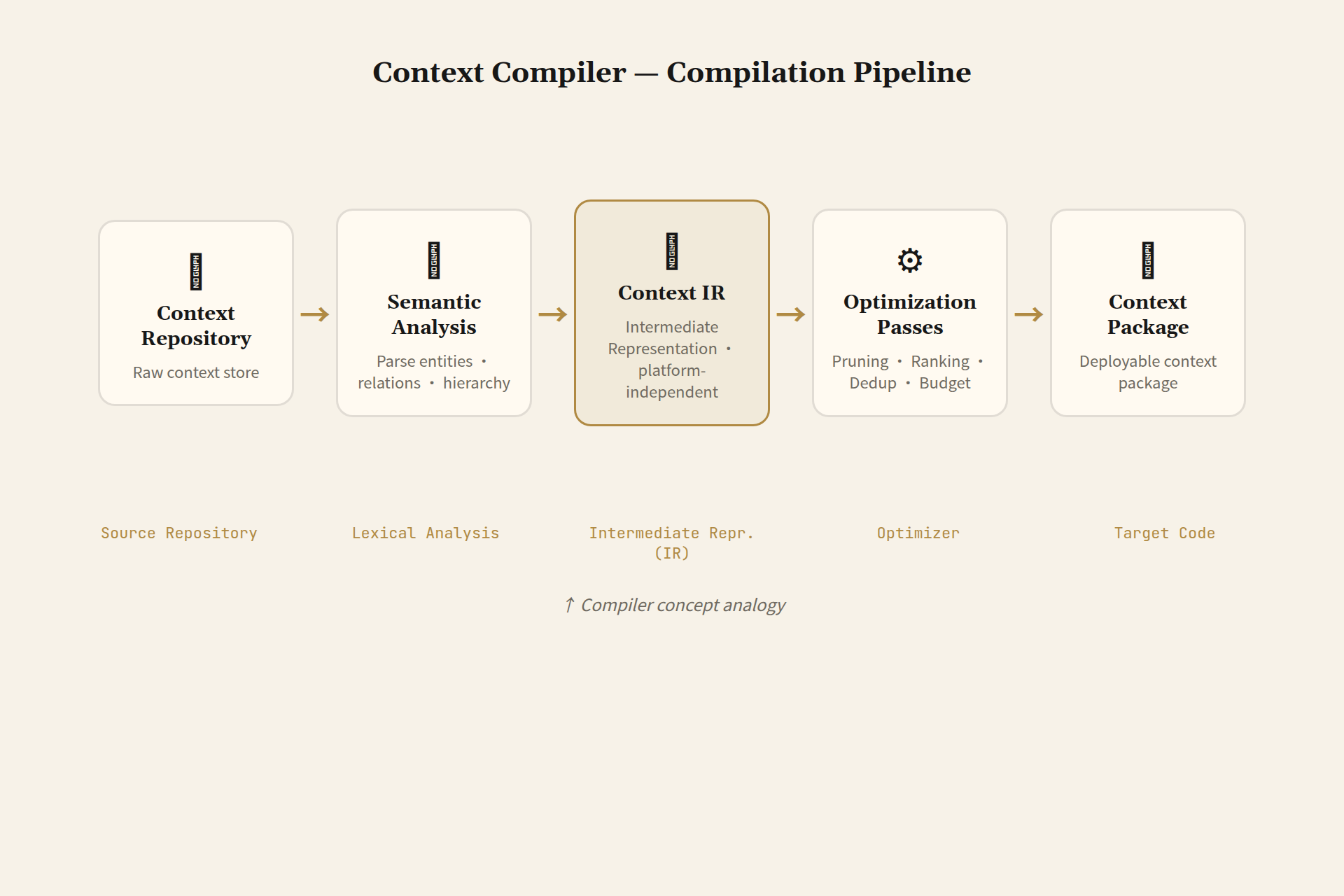
Prompts go from handcrafted artifacts to compiled outputs.
5.2 Context Package: The Standard Compilation Output
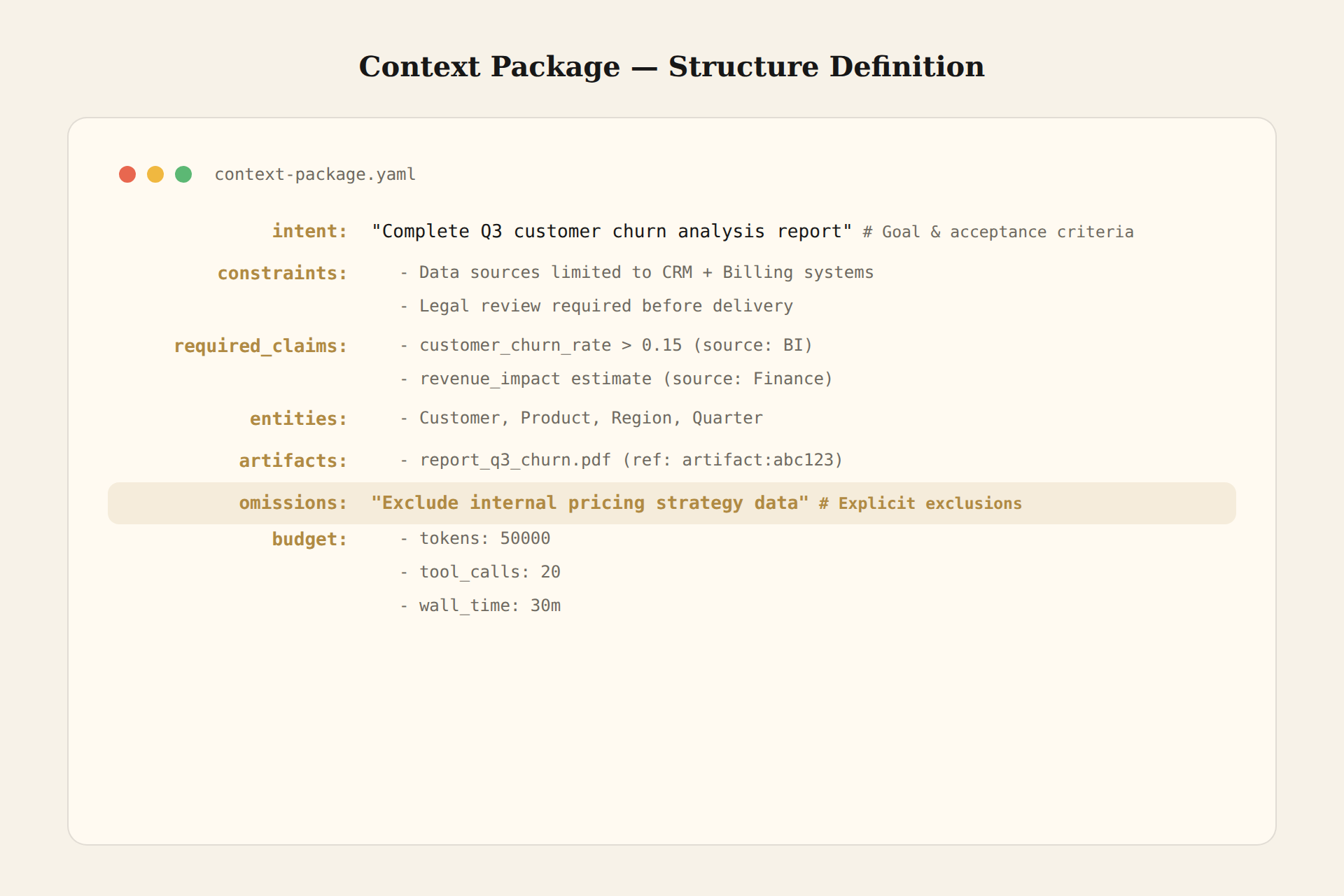
The omissions field is especially critical: the compiler must explicitly state what it omitted, so the agent knows the boundaries of its own cognition. This is the mechanism that prevents "confident ignorance."
5.3 Context Compilation as Competitive Advantage
In the CPU era, the compiler determined software performance on the same hardware. In the AI era, the Context Compiler determines agent efficiency on the same model. Future gaps between organizations will not come from who has more data — data will commoditize — but from who can compile smaller, more accurate, and cheaper working sets from the same cognitive repository. Compilation quality is multiplied across every agent call, amplified by four orders of magnitude in call volume. The Context Compiler is the most intelligence-dense and hardest-to-replicate component in Enterprise Context OS. Enterprise competition will move from data competition to Context Compilation competition.
Chapter 6 Agent Runtime: Control Plane and Execution Plane
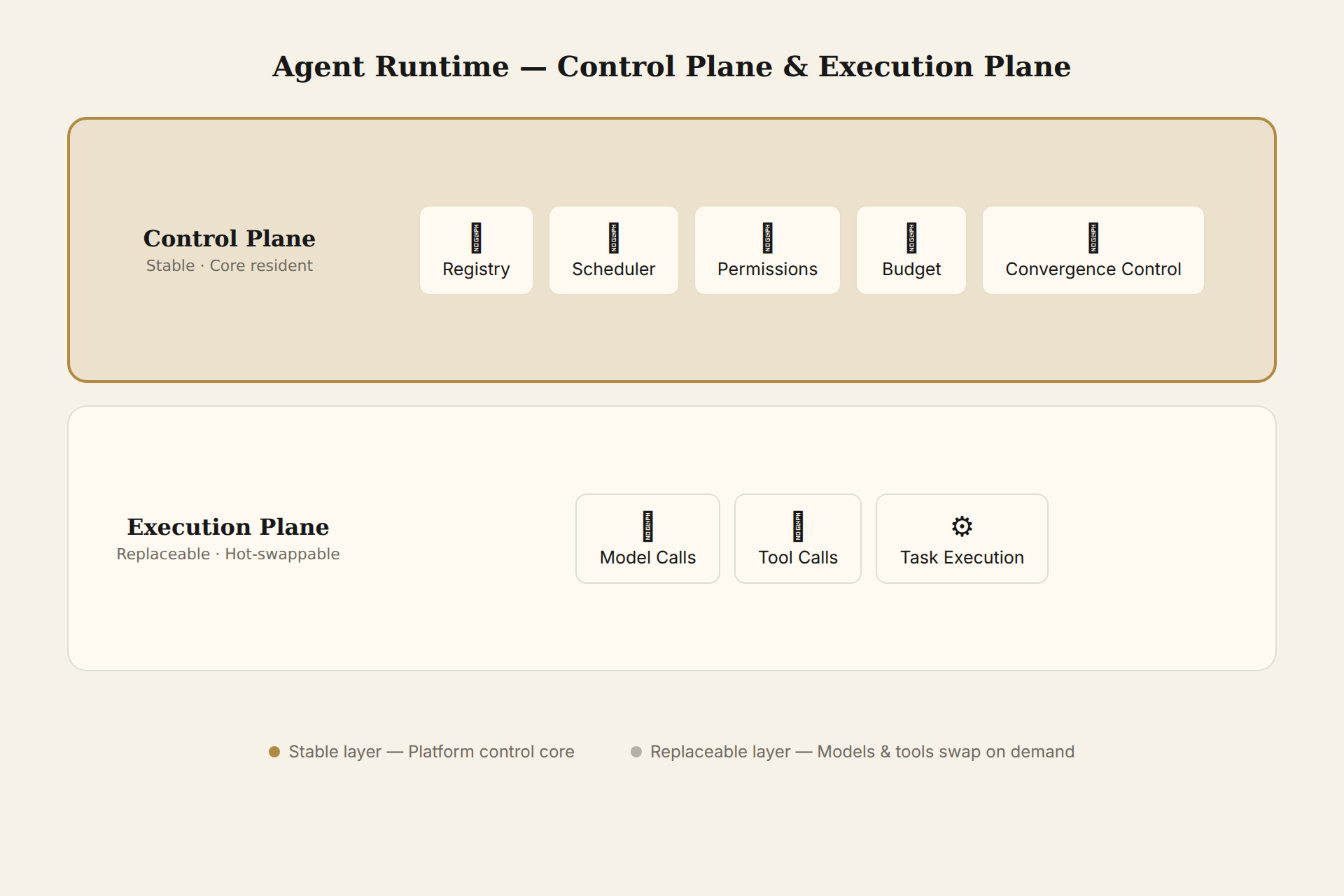
6.1 Dual-Plane Architecture
Drawing from the Kubernetes control-plane / data-plane separation:
| Kubernetes | Agent Runtime |
|---|---|
| Pod | Agent Task |
| Scheduler | Agent Scheduler |
| Controller (desired state convergence) | Agent Controller (Intent attainment convergence) |
| Namespace | Context Space |
| RBAC | Capability (down to context slices) |
| Resource quotas | Token / compute budget |
The Control Plane continuously compares the task's Intent against the current State, driving the agent toward acceptance criteria convergence. The Control Plane is stable while the Execution Plane churns fast — this separation lets the Runtime both accumulate value and keep pace with model evolution.
6.2 Personal Agent and Agent Ownership Model
Each person's Personal Agent is their interface and trustee within the system: internally, it counteracts information overload ("three branches await your review, one has a cognitive conflict"); externally, it can be queried within authorized scope to represent the person. Its underlying asset is a continuously growing Personal Context Graph.
Ownership clarification: enterprises will never "own" an employee's agent — they will only own "the authorized portion of a personal agent."
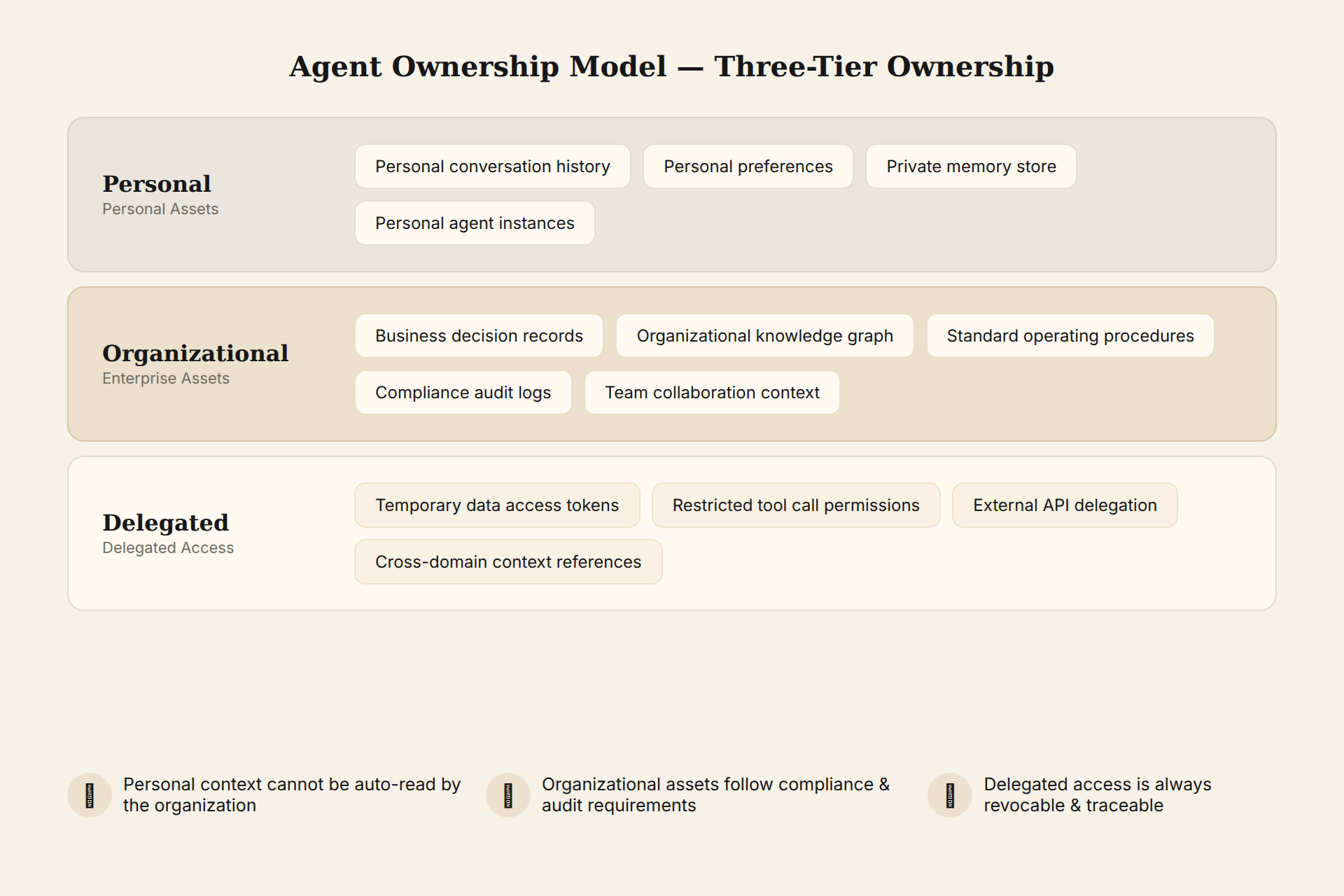
Three non-negotiable principles: Accountability chains must be traceable — every action is traceable along the delegation chain to a specific person; "my agent did it" is not a defense. Informed consent precedes agentification — authorization must be explicit and revocable. The graph must not be reverse-engineered for surveillance — prohibited for performance evaluation; enforced through hard technical guarantees in the permission layer, not policy promises.
Chapter 7 Cognitive Collaboration: Merge, Conflict, and Premise Propagation
Chapter 4 defined the structure of Context Git. This chapter defines its collaboration semantics — where the fundamental difference between cognition and code becomes visible.
7.1 Cognitive Merge: Surfacing Conflict, Not Eliminating It
The design philosophy must be unequivocal: the goal is to surface conflicts early, explicitly, and unavoidably, rather than to auto-resolve them. The biggest risk in the Agent era is not that agents fail to work — it is that the system quietly auto-generates a false consensus. An incorrect conclusion entering the organization's formal cognition under the guise of "merged" is far more destructive than any single-point error.
Merge rules are tiered by object level: Events are auto-deduplicated; Claims auto-merge when evidence is sufficient and non-contradictory, escalating to Cognitive Conflict — a first-class status analogous to a Git merge conflict, entering an adjudication queue — when contradictions exist; Intent changes must be explicitly declared and trigger a rebase; Decisions are never auto-merged. The system's role is to "prepare the case file, not to act as judge": present the divergence points, the evidence and strength on each side, and available synthesis options — then stop, and hand the adjudication to a human. The process itself is sedimentation; conflict itself is signal.
7.2 Context Rebase: Premise Propagation
Rebase is the most widely overlooked yet highest-value primitive. The biggest waste in enterprises is not lack of knowledge — it is old assumptions continuing to drive new work: an upstream decision has changed, yet ten parallel downstream tasks continue for weeks on invalidated premises. Context Rebase makes premise changes propagate automatically — when a Decision is overturned, the system traverses the dependency graph to identify all affected active branches, flags the invalidated Claims and Intents, and notifies the relevant agents to re-validate. This is a capability entirely absent from traditional collaboration systems, and a direct payoff of storing the Entity Graph and version topology as an integrated whole.
Chapter 8 Three Phases of AI Infrastructure: Three Resource Types, Three Infrastructure Layers
The three phases of AI Infrastructure are, in essence, the sequential takeover of three resource types' management — closing the loop with the resource paradigm table in Chapter 1:
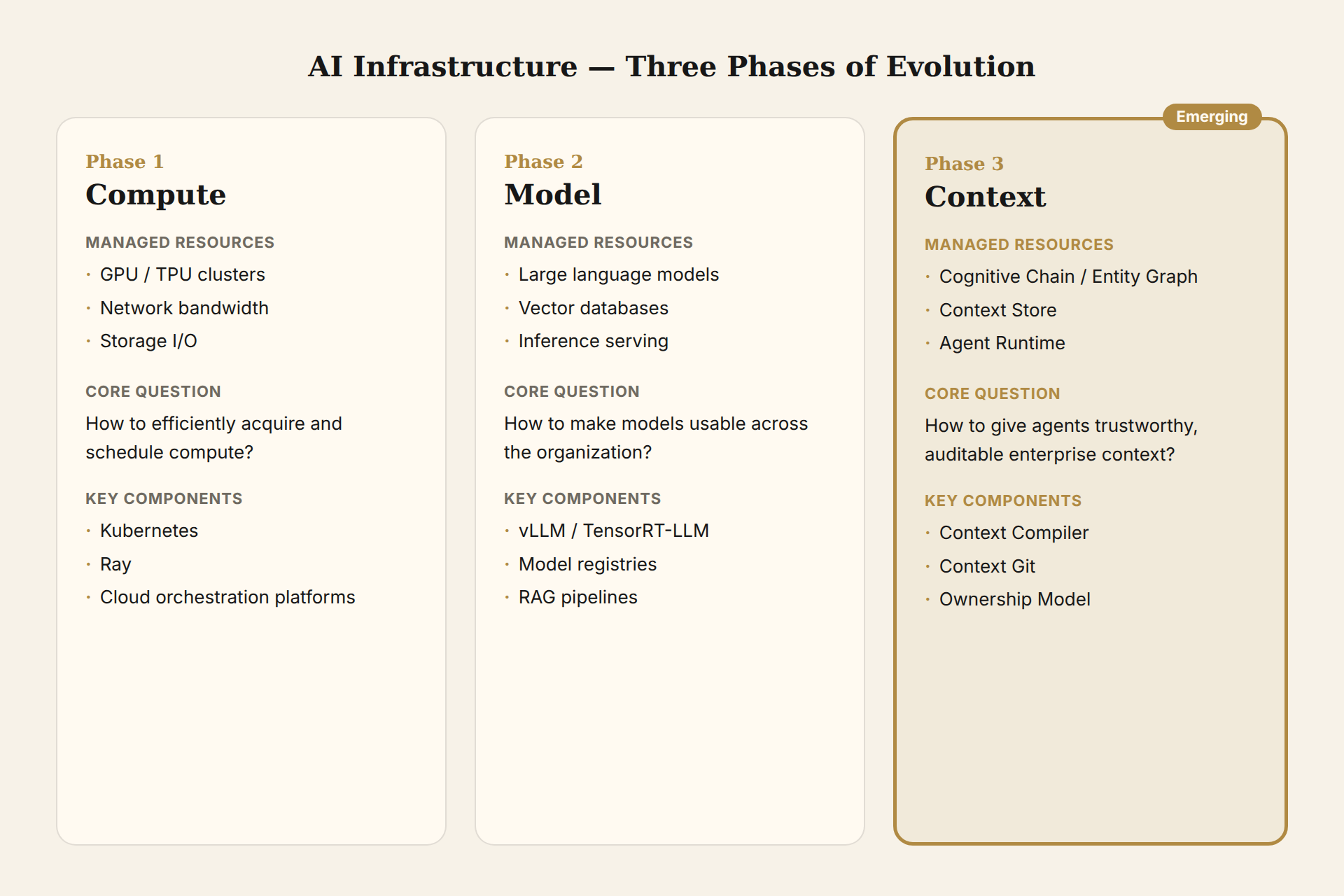
The first two phases optimize the price-performance ratio of model capabilities. Yet an awkward truth is emerging: model capability utilization is extremely low — organizations pay for powerful models but, unable to supply high-quality context, they extract only a fraction of the value. The bottleneck is migrating from "is there enough compute, is the model strong enough" to "how accurately can context be supplied." Compute management gave rise to Phase 1; model capability management gave rise to Phase 2; organizational cognition management will inevitably give rise to Phase 3 — three unfoldings of the same evolutionary logic.
The three phases are additive, not substitutive, and they share a single technical thread:
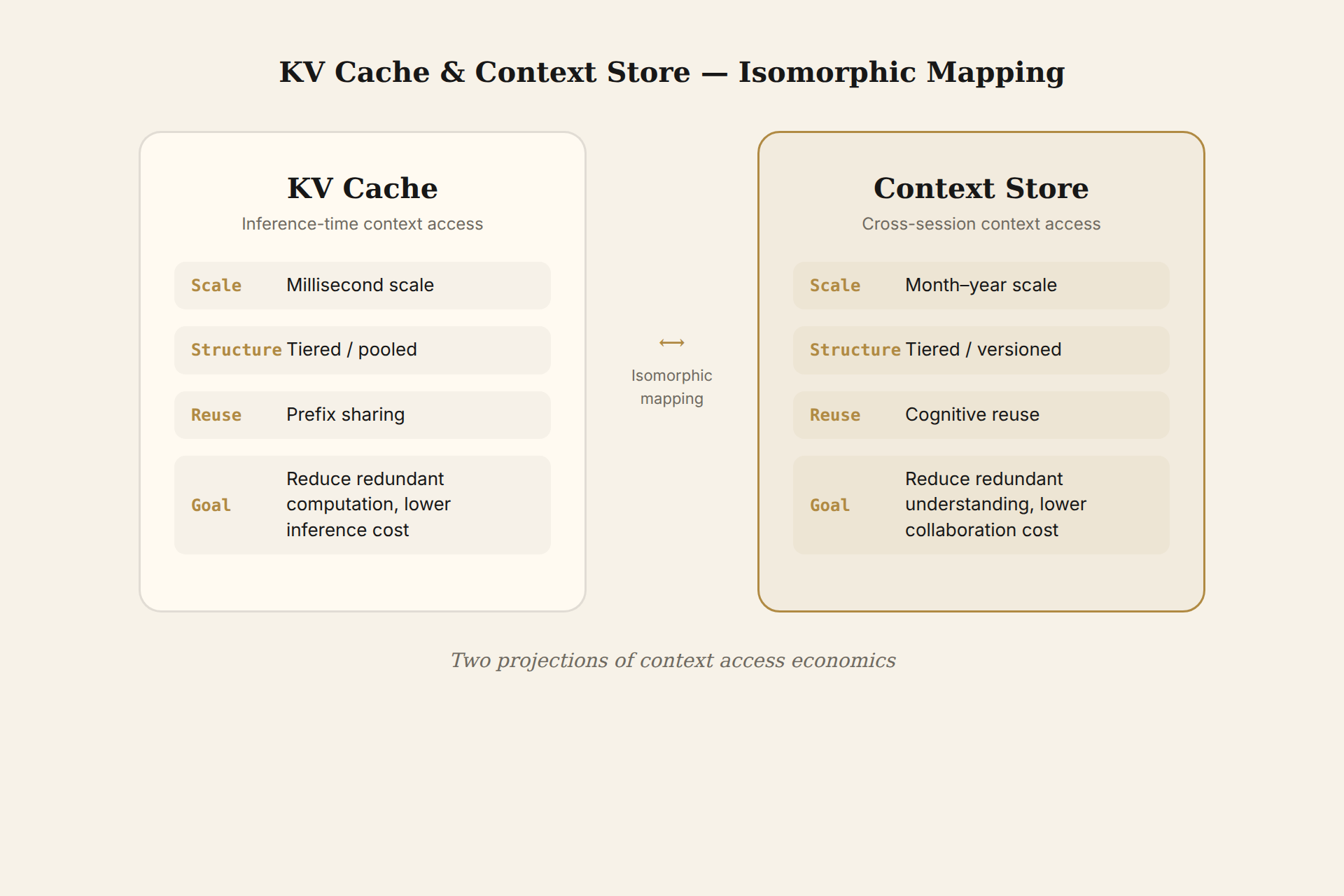
For teams already building super-nodes, converged storage, and KV Cache pooling, extending upward to Context Store and Context Compiler is the natural continuation of the same technical line — from compute intelligence infrastructure to organizational intelligence infrastructure.
Chapter 9 Deployment Roadmap and Endgame
9.1 Three-Step Evolution
Step 1 (Pilot): Complete capture and five-level object modeling in three high-density scenarios — meetings, development, and documentation. Make "branch a task with an Intent contract to an agent, review, then merge back" work locally. Introduce the explicit cognitive conflict surfacing mechanism from day one. Step 2 (Platformization): Build the first versions of the Memory Hierarchy and Compiler. Context Packages become the standard consumption interface for agents. Personal Agents cover core roles. The Ownership Model and authorization system launch in parallel. Step 3 (Ecosystem): Open protocols to accept multi-source agent platforms. The context tree expands into an organization-wide cognitive graph, with controlled fork extending to supply chains and partners. The iron law remains unchanged: permissions, audit, and personal data boundaries precede scaling.
Stability dividing line: Context Model, Context Store, Context Compiler, and Control Plane are the foundation — they should be standardized and evolve slowly. Execution Plane and experience layers iterate rapidly with model capabilities. Get the foundation right, and the upper layers can be rewritten as many times as needed.
9.2 Endgame
The future enterprise technology stack has four layers: Agent — Enterprise Context OS — Data Infrastructure — Compute Infrastructure. The new layer comprises three components: Context Store answers where organizational cognition resides, Context Compiler answers how cognition is compiled into working sets, and Agent Runtime answers how collaboration is driven. Its significance to the Agent era equals that of the operating system to the computing era and the database to the data era — this is the largest category-creation opportunity in enterprise infrastructure software since the database.
The previous generation of IT systems managed organizational data. This generation must manage organizational cognition. When the cost of reading inverts, when cognition needs versioning, when premise changes need rebase, when conflicts need to be surfaced rather than buried, when every person's agent needs an authorizable memory — a new category of infrastructure software becomes inevitable. Whoever first turns context into a storable, compilable, authorizable, and continuable first-class resource will be the first to gain the ability to make a thousand agents and a hundred people truly collaborate. And the company that defines this category will stand at the center of the enterprise software landscape in the AI era.
Disclaimer: This article is based on publicly available information, drawing on the MCP protocol specification (Anthropic, 2024–2026), Karpathy's Context Engineering concept (June 2025), Claude Code context management architecture analyses, the Agent Harness Engineering survey (CMU/Yale/Amazon et al., 2026), the Fetch.ai Agentverse seven-layer Agent Cloud Stack paper (arXiv, July 2026), and multiple industry analyses of Agent infrastructure. This article does not constitute investment advice. Data herein is current as of July 25, 2026.