
On July 24, 2026, Jensen Huang posted his first-ever tweet. Not about GPUs. Not about earnings. It was for an open-letter defending open-source AI. The same day, Sam Altman wrote on X that he "supports open source." Then the NYT reported what he was doing in Washington behind closed doors.
Kimi K3 Detonates
On July 16, Moonshot AI released Kimi K3: a 2.8-trillion-parameter MoE model with a one-million-token context window, priced at $0.30 per million input tokens and $15 per million output tokens—roughly one-third of OpenAI's pricing.
Demand surged so fast that Moonshot had to pause new signups. On Arena AI's crowdsourced benchmarks, K3 ranked first in web-development tasks and fourth in agentic tasks, behind only Anthropic's Fable and Opus 4.8 and OpenAI's GPT 5.6. Artificial Analysis placed it third on its intelligence index.
This is not "cheap but worse." This is "cheap and approaching the frontier."
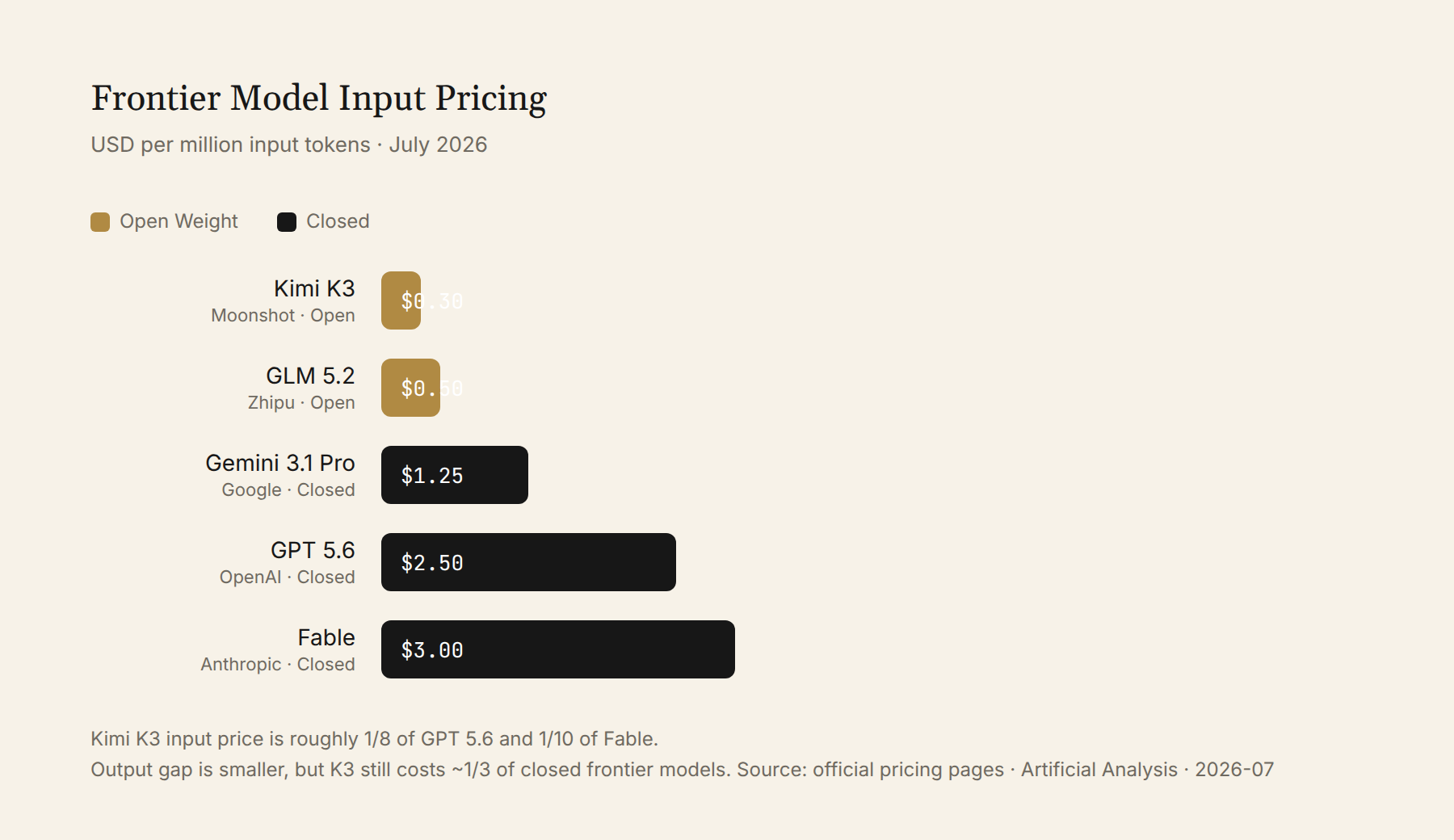
K3 is not an isolated case. In June, Zhipu released GLM 5.2. On July 22, Alibaba released Qwen 3.8. Three Chinese open-weight model releases in one month. Moonshot also announced that K3's weights would be publicly published on July 27. A 2.8-trillion-parameter model, runnable locally, about to be free for the entire world.
This triggered a fracture in Washington that few saw coming.
Two Fault Lines
The first fault line runs between sellers and buyers in the AI industry.
OpenAI and Anthropic have business models that depend on model-capability moats. Their revenue comes from API pricing power—you pay per token. If someone gives away a comparable model for free, the moat is gone.
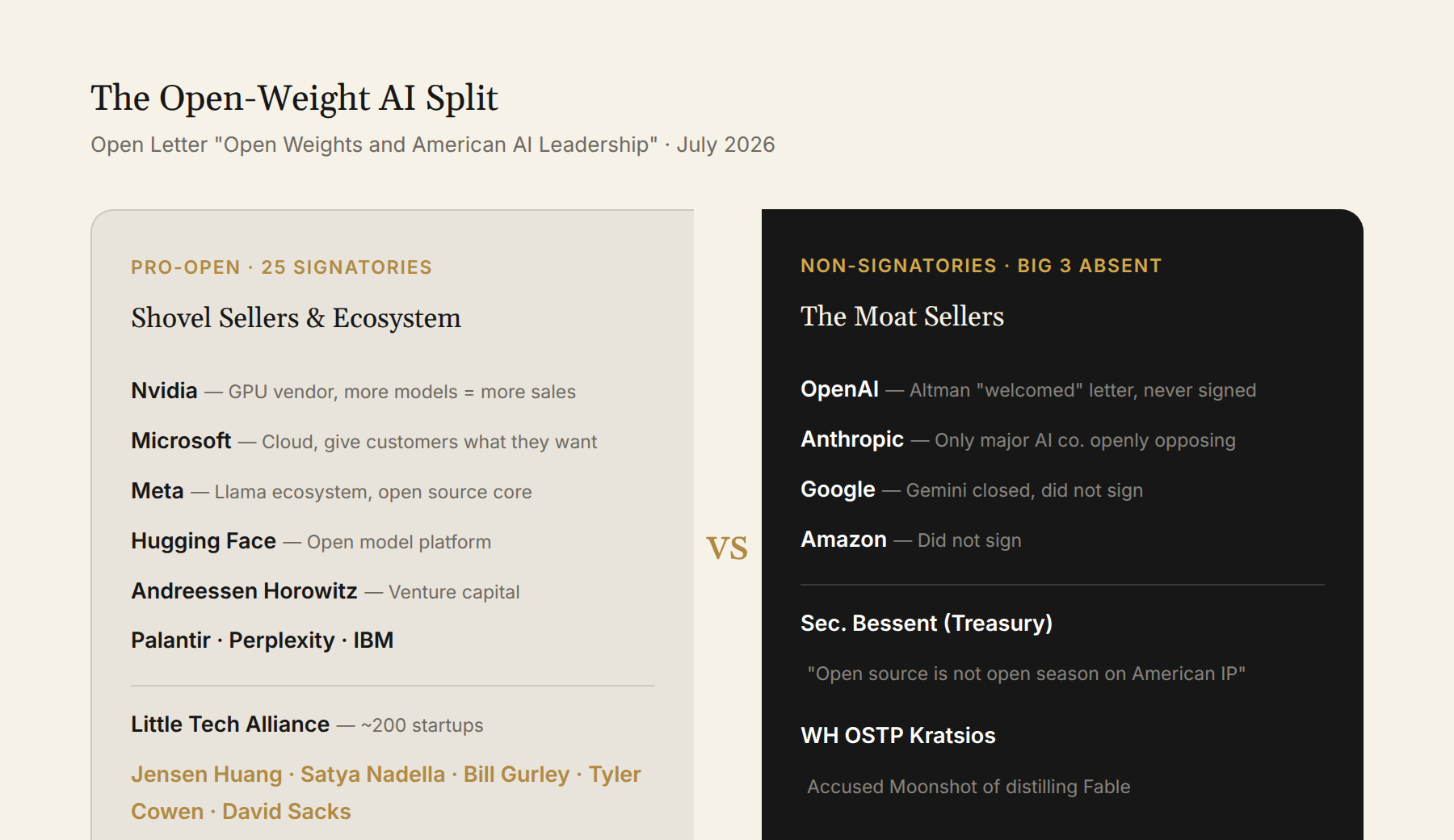
Nvidia's interests point the opposite direction. Jensen Huang doesn't care whose model is better. He cares how many models are running and whose GPUs they run on. More models, more GPU sales—regardless of who made them. Microsoft sells cloud; it gives customers whatever models they want. Meta's strategy is the Llama ecosystem; open source is the core.
The buyers' side is louder. Nearly 200 startups and investors formed the "Little Tech Alliance," and their first act was to write to the Trump administration opposing any ban on Chinese open-weight models. Particle founder Suhail Doshi put it bluntest: "Hundreds of companies would instantly die" under a blanket ban.
The numbers back him up. OpenRouter's business with Chinese models grew so large that Stripe is now in talks to acquire it for $10 billion. Baseten, Fireworks, and other inference startups all depend on low-cost Chinese models. Ban Chinese open-weight models, and a large chunk of the American AI startup ecosystem shrinks overnight.
The second fault line runs between protectionism and free markets. Treasury Secretary Scott Bessent declared that "open source is not open season on American IP." Michael Kratsios, director of the White House Office of Science and Technology Policy, directly accused Moonshot of distilling Anthropic's Fable to build K3. But former White House AI czar David Sacks was blunt about OpenAI's strategy: Dean Ball, OpenAI's head of strategic futures, had publicly called for the government to use "every agency to issue soft law that creates FUD" against Chinese models. Sacks called that "completely unacceptable." Secretary of State Marco Rubio told American diplomats to "tone down" language about an AI "kill switch." Economist Tyler Cowen's verdict: "Open source is coming and is here. The attempt to outlaw it, ban it, or use sanctions against it is going to fail miserably."
Who's Standing Up for Open Source
This is not a debate without faces.
Jensen Huang (Nvidia CEO) used his first-ever X post to draw a historical parallel: in the 1980s, people feared open-source software would destroy commercial software. Instead, it became the foundation of the internet. "The world needs both frontier closed models and frontier open models," he wrote.
Satya Nadella (Microsoft CEO) publicly backed the letter. Microsoft was a signatory from day one. Notably, Google, Amazon, and Anthropic all declined to sign—the three largest closed-model companies abstained.
Clement Delangue (Hugging Face CEO) posted "Open models for the win!" and organized a march in San Francisco.
Bill Gurley (Benchmark) framed the dispute most precisely: "It's a war between people who want OpenAI and Anthropic to own everything, and everyone else." He called for American companies to invest in their own open-weight models rather than fear Chinese ones.
Tyler Cowen (economist) was the most decisive: banning open source "is going to fail miserably."
David Sacks (former White House AI czar) slammed OpenAI's FUD strategy as "completely unacceptable."
The open-weights letter gathered 25 signatories, including Nvidia, Microsoft, Meta, Palantir, Hugging Face, Andreessen Horowitz, Perplexity, and IBM. Google, Amazon, and Anthropic all declined to sign.
The other direction is equally clear. Sam Altman publicly welcomed the open-weights letter on X but never actually signed it. Dario Amodei's Anthropic also abstained. The three largest closed-model companies—OpenAI, Anthropic, and Google—are all absent. Treasury Secretary Bessent and the White House's Kratsios are the most aggressive officials pushing for restrictions.
The irony is thick. OpenAI and Anthropic trained their models on the entire internet's public data, then claim IP rights over their models' outputs. Hex CEO Barry McCardel wrote a widely-circulated post on X: "They've speedrun the journey from 'beloved nerd heroes' to 'evil anti-competitive behemoths.'" Rippling CEO Parker Conrad was more direct: "Politically-connected growth investors are mobilizing to protect their bag in Anthropic."
OpenAI's Two-Faced Game
The timing of the NYT report is instructive.
On July 24—the same day Jensen Huang posted his tweet—Sam Altman wrote on X: "I want the US to win in AI both in open source and proprietary models." But the NYT's report the following day, citing five people familiar with the discussions, revealed that OpenAI and Anthropic had been privately lobbying Washington regulators to restrict Chinese open-weight models in the United States.
Dean Ball (OpenAI's head of strategic futures and a former White House AI adviser) didn't disguise his position. He called K3 "a very good model" but noted it seemed "very token-hungry"—implying that low per-token prices don't necessarily mean lower total costs. More revealingly, he wrote on X that he didn't expect the government to ban Chinese models outright but rather to direct "every agency to issue soft law that creates FUD"—a fog of regulatory uncertainty that would make enterprise customers afraid to use Chinese models.
Anthropic's strategy is more direct. Sarah Heck, its head of public policy, called distillation "IP theft and industrial espionage that supports adversary military and intelligence capabilities." Last month, Anthropic told the Senate Banking Committee that Alibaba had conducted the "largest known distillation attack" against it. The White House's Kratsios followed up by accusing Moonshot of using Fable to distill K3.
Is distillation "theft"? The question is more complicated than OpenAI and Anthropic want the public to believe. The industry broadly considers distillation a legitimate research technique, and the open-weights letter explicitly defends it. Nathan Lambert, an independent AI researcher in Seattle who recently visited Moonshot's office, told WIRED that Anthropic had "overhyped the risks." University of Washington professor emeritus Pedro Domingos offered the counterargument: American companies spend heavily on models that then travel to China and lose their value there—their anger is understandable.
But if distillation is theft, then what is training on the entire internet's copyrighted content? When OpenAI and Anthropic claim that "others using our models' outputs is theft, while our using everyone's content is fair use," their moral high ground is not stable.
Washington's Real Position
The government's actions are more cautious than its rhetoric.
Bessent said on Fox Business that the government could sanction foreign companies found to have stolen from American providers. He claimed that U.S. model "watermarks" had been found in Chinese systems. But four people familiar with the policy discussions told the NYT that the administration was leaning toward reviewing individual Chinese models as national security cases rather than imposing a blanket prohibition. No final decision had been made.
In mid-June, the Commerce Department took one concrete action: it barred foreign nationals from using Anthropic's Fable 5 and Mythos 5. Anthropic disabled both models worldwide because shared clouds couldn't verify nationality. The ban was lifted 18 days later after Commerce Secretary Lutnick signed off. But the EU remained unhappy—tech chief Henna Virkkunen told the FT that AI had become a geopolitical weapon and that Brussels feared being "dependent on third countries."
Europe is in the most awkward position. Reuters reported from Paris in June that Siemens, Renault, Orange, and ChapsVision are already mixing U.S., Chinese, and European models. OVHcloud CEO Octave Klaba said European open-source models are "not impressive," American suppliers are moving toward closed systems, and Chinese models are the only realistic open option left. Orange's metaphor was earthier: "Like buying a painting in China and bringing it home."
U.S.-China AI talks are scheduled for September. Bessent will represent the United States. Major policy shifts before then are unlikely.
Beijing's Geopolitical Narrative
On July 17, Chinese President Xi Jinping personally appeared at the World Artificial Intelligence Conference (WAIC) in Shanghai, delivering a video keynote. He called for "a symphony of global cooperation" rather than "a solo performance by any single country" and urged the world to "jointly oppose overstretching the national security concept in the field of AI"—widely read as a direct jab at U.S. export controls.
Twenty-nine countries—including Russia, Pakistan, Indonesia, Brazil, and Kazakhstan—signed an agreement in Shanghai establishing the World Artificial Intelligence Cooperation Organization (WAICO), headquartered in Shanghai, with UN Secretary-General António Guterres in attendance. China also pledged 5,000 AI training slots for developing countries.
This creates a genuine problem for OpenAI and Anthropic's policy narrative. When Jensen Huang's letter in Washington says "openness is the foundation of American leadership" and Xi Jinping says the same thing in Shanghai—using identical rhetoric (openness, cooperation, opposing the abuse of security concepts)—the "open source vs. security" frame mutates into a geopolitical competition over "whose openness." China is using open-weight models as a lever for geopolitical influence. That fact makes the domestic policy debate in Washington much harder to resolve cleanly.
Three Scenarios
Scenario 1: Case-by-case review (most likely). No blanket ban. Individual Chinese models are reviewed as national security cases. The review process itself generates uncertainty, but open source isn't cut off. Once K3's weights go public on July 27, banning them is moot—you can't un-download a model.
Scenario 2: The regulatory friction wall (OpenAI's preferred outcome). Don't ban the models. Instead, make using them risky by having agencies issue "soft law" guidance. Large enterprise legal teams won't sign off. Small companies will use them anyway. This is OpenAI's optimal outcome—not prohibition, but FUD.
Scenario 3: Blanket ban (least likely). The political cost is too high. 25 tech companies signed a public letter against it. Microsoft and Meta are on the other side. Over 200 startups formed a lobbying alliance. Jensen Huang and Satya Nadella will not let this happen on their watch.
What OpenAI and Anthropic truly want is not a ban on Chinese models. It's time. A window of regulatory uncertainty during which enterprise customers still feel that "using Chinese models is risky," sustaining premium pricing for their own models. K3's $0.30 input price is closing that window. The next wave—Qwen 3.8, whatever follows GLM 5.2—will close it tighter.
Open source isn't coming back. China won't stop releasing models. Nvidia won't stop selling shovels. Startups won't voluntarily pay three times more. The only question is how much time OpenAI and Anthropic can buy with FUD.
Kimi K3's million-token context window and $0.30 price tag is the sound of that window closing.
Disclaimer: This article is based on public reporting from the New York Times (July 25, 2026), Bloomberg (July 24–25, 2026), Newcomer (July 24, 2026), Implicator.ai (July 25, 2026), Fortune (July 24, 2026), Reuters, and the Financial Times. This is not investment advice. Data in this article is current as of July 26, 2026.