
2026-08-15 · ~13 min read
On the evening of August 14, Z.ai released GLM-5.3. The same day, Alibaba open-sourced the full weights of Qwen3.8. Interconnects headlined the day "how Chinese labs keep stride." A more accurate reading: they are starting to set the pace.
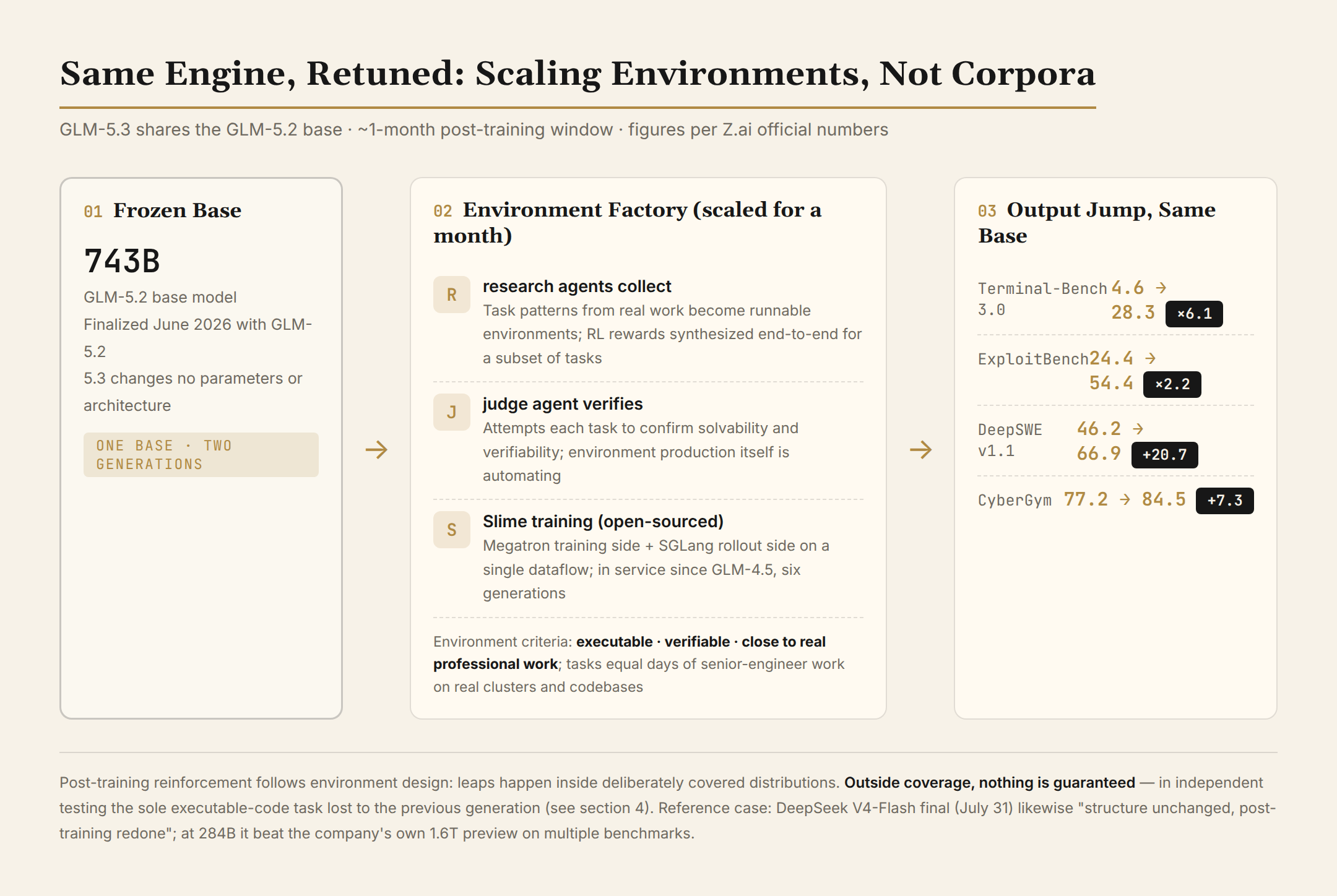
Two flagship releases in one day is the surface story. The genuinely unusual fact is how GLM-5.3 shipped: the version number jumped a generation, but the parameter count and the base model stayed the same. The official blog states it plainly — all improvements come from post-training, the phase of engineering where you keep polishing a pretrained base with reinforcement learning and its relatives.
A flagship model that changes no engine, only the tuning, and still lands near the closed-source frontier. This matters more than "another new model," because it points to a shift in progress: the axis of model iteration is moving from "build a bigger base" to "refine the same base to its limits."
1. The Numbers: How Far the Same Base Can Jump
Start with magnitude. All figures below are Z.ai's official numbers.
| Benchmark | GLM-5.2 | GLM-5.3 | What it measures |
|---|---|---|---|
| Terminal-Bench 3.0 | 4.6 | 28.3 | Complex tasks in real terminal environments |
| DeepSWE v1.1 | 46.2 | 66.9 | Long-horizon software engineering |
| Agents' Last Exam | 23.8 | 28.5 | General agent capability |
| CyberGym | 77.2% | 84.5% | White-box code review and vulnerability discovery |
| ExploitBench | 24.4% | 54.4% | Vulnerability exploitation |
Terminal-Bench is up six-fold. ExploitBench more than doubled. On GDPval-AA v2 (a task evaluation covering 44 occupations), the model scored 1,769 points — capability spilling beyond coding into professional task execution.
The "approaching Claude Fable 5" claim deserves unpacking. CyberGym is the only benchmark where all three players have comparable public numbers: GLM-5.3 at 84.5%, Mythos 5 at 83.8%, GPT-5.6 Sol at 83.6% — tightly bunched. On Terminal-Bench and DeepSWE, Fable 5 has no published scores; "approaching" is Z.ai's own framing. The official material also cites a token-efficiency figure: at the High reasoning tier, GLM-5.3 exceeds Claude Opus 4.8's top-tier accuracy while consuming fewer tokens. That claim is likewise vendor-reported.
An improvement of this magnitude without touching the base has been rare in same-parameter-scale generational updates. That is the factual foundation for everything below.
2. Mechanism: What Post-Training Scaling Actually Scales
Post-training scaling is not a new term, but GLM-5.3 pushes its meaning a step further.
Z.ai's own account: over the past month, they kept scaling on the stack GLM-5.2 had already built — more environments, more diverse tasks, more training compute. Note the time frame: one month for the final training window of a flagship release. That is not the workload of pretraining a foundation model; it is a fast-iterating pipeline.
The object being scaled is environments, not corpora. The official criteria for a good environment: executable, verifiable, and close to real professional work. And they need many of them, not a handful of hand-built ones.
Two details deserve more attention than they have gotten.
First, the shape of training tasks changed. Tasks are no longer isolated coding problems; they span the full workflow — find the problem, analyze, implement, verify, deliver. Some tasks equal several days of a senior engineer's work. The model gets real compute clusters, storage systems, internal documentation, codebases, even experiment results. In one ML-infrastructure task, the model receives the same working environment an engineer would and must diagnose bottlenecks across the training stack, implement fixes, and verify them.
Second, environment production itself is being automated. Per the official blog: research agents collect task patterns from real work and turn them into runnable environments; a judge agent attempts each task to verify it is actually solvable; for a subset of tasks, the RL reward signal is synthesized end-to-end by the environment too. Making environment generation and verification more autonomous is, officially, "one of the next steps." In other words, the bottleneck of post-training is shifting from humans building environments to agents building environments.
The framework underneath is called Slime, open-sourced alongside this release. Per the official blog and the repository README, it uses Megatron on the training side and SGLang on the rollout side, keeping training, rollout, and the data buffer on a single dataflow, designed for long-horizon RL scaling. The README states explicitly that slime is the RL framework behind GLM-4.5 through GLM-5.2. GLM-4.5 shipped in July 2025 — meaning this pipeline has been in service for over a year and six model generations. Open-sourcing a production-grade post-training framework is a move we saw from DeepSeek Harness: when a company turns its infrastructure into a public good, it compresses the differentiation space for followers at the engineering layer.
Condensed: post-training environment engineering is becoming a craft of its own. Its "data" is executable environments rather than text corpora, and the craft's key operations — environment generation, verification, reward synthesis — are being taken over by agents themselves.
3. Economics: The Logic of Base Reuse
GLM-5.2 shipped in June; GLM-5.3 in August. Same base, two generations, two months apart. The official quote is blunt: "We keep pushing reinforcement learning efficiently on the exact same base as GLM-5.2 — we may be far from exhausting the intelligence ceiling of this base."
The economic logic is not hard to see: pretraining is a heavy, front-loaded investment; post-training is fast iteration. If one pretraining run can be amortized across two or three generations, the per-generation cost structure changes completely. GLM-5.3's parameter count is 743B. Kimi K3 in the same period is 2.8T; Qwen3.8-Max is heading past a trillion. With under a third of the parameters, Z.ai sits at the same benchmark table.
And Z.ai is not alone. A more extreme case is DeepSeek: V4-Flash's official release on July 31 states in the update log that "model structure and size are identical to the preview (284B total, 13B active); only post-training was redone." In that three-month window, DeepSWE went from 7.3 to 54.4 and CyberGym from 38.7 to 76.7. This "small" base — about a sixth of V4-Pro's parameters — outperformed the company's own 1.6T Pro preview on multiple benchmarks. 284B beating 1.6T, per official accounting, entirely through post-training.
Honesty requires boundaries, though. First, "amortization" is currently a direction, not an accomplished fact: GLM's sample is two generations over two months; DeepSeek's is preview-to-final over three months. Second, the big-base race is not dead — Qwen and Kimi build trillion-parameter bases while doing heavy post-training on top. This is not either/or; the difference is whether you also refresh the base. Third, "far from exhausting the ceiling" is a qualitative claim with no quantitative support — closer to a declaration of intent than a measurement.
On the commercial side, the moves have already landed. The GLM Coding Plan switched to a credit system: input, cached input, and output each accrue credits separately; weekday 14:00–18:00 counts as peak at standard rates, everything else including weekends at 50% — textbook off-peak pricing. The official coding agent ZCode claims a 98%+ cache hit rate, with repeated context billed at cache rates, effectively ~30% more usable tokens. TraeWork, Coze, OpenCode and other platforms integrated on Day 0. Worth noting: GLM-5.3 is currently available only to Coding Plan subscribers; the general API is listed as "coming soon," and weights are scheduled for release within two weeks after safety evaluation and hardening.
Model, toolchain, quota system — put together, the point of monetization is shifting from "weights" to "workflow." For every vendor still selling raw models by the token, that is a stress test.
4. The Dark Side: Uneven Capability Distribution
That was the official narrative. Independent testing tells the other side of the story.
A public real-API evaluation (third-party endpoint, all 12 responses checked against the requested model IDs) ran six hard tests: extreme math, causal calibration (Simpson's paradox), constraint reasoning (UNSAT core), nested JSON, multi-stage physics, and executable optimization code. GLM-5.3 completed four on first attempt in 334.1 seconds: causal calibration (correctly identified the reversal and distinguished standardization from causal identification), constraint reasoning (valid JSON with a rigorous proof of the position conflict), multi-stage physics (all four values in plausible ranges), and nested JSON (valid content under strict format constraints). GLM-5.2 completed two in 665.0 seconds: nested JSON, and the single executable code task. The completion sets overlap and are counted independently; extreme math defeated both generations (9,000 reasoning tokens exhausted with no output; 5.3 still empty at 20k).
The code task deserves its own paragraph. The goal: implement a release-plan optimizer handling transitive dependencies, per-day capacity, value maximization, risk minimization, lexicographic tie-breaking, invalid references, and cycle detection — a typical engineering constraint-satisfaction problem. GLM-5.2's code passed all hidden tests unmodified on the first run. GLM-5.3 produced no output within the 16k token cap, and on a 24k retry chose a suboptimal plan worth 24 against a correct answer of 29.
Sample size, stated plainly: six tests, one executable-code task, n=1. A separate five-scenario media review is qualitative corroboration: the same model delivers professional-grade work when the prompt is thorough, and rough work when it is not.
A single counterexample cannot overturn the aggregate jump, but the DeepSWE surge and this single-task regression are not contradictory — the tension dissolves once you look at task distributions. DeepSWE measures environment-based, long-horizon engineering: exactly the distribution those RL environments in section 2 were designed to cover. The optimizer task is one-shot constraint-satisfaction code generation, outside the covered core. Post-training reinforcement follows environment design: within coverage, leaps; outside it, possibly standing still.
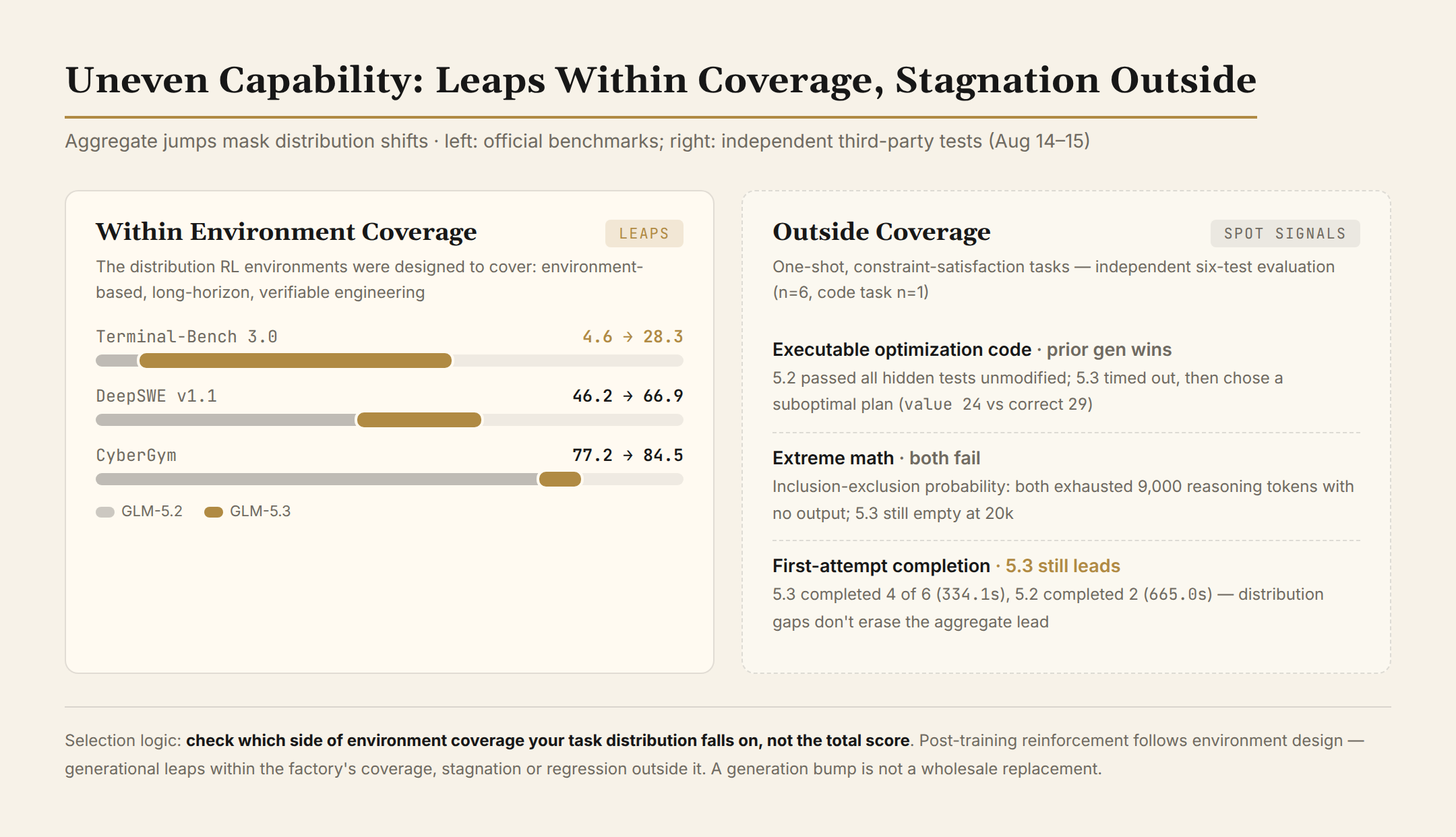
That is the selection logic that actually matters: check which side of the environment coverage your task distribution falls on, not the total score. A generation bump is not a wholesale replacement — at least not for this GLM generation.
5. Security: Emergence Beyond Training Intent
GLM-5.3's second keyword is security, and the story structure here is entirely different from coding.
Z.ai put vulnerability-discovery data and environments into training, expecting a model better at finding and reasoning about bugs. What surprised them, per the official blog, was "how quickly the capability continued to develop as training scaled." Offense was not the design goal; it was a spillover of long-horizon environment expansion.
The numbers, official: in the two weeks before release, Z.ai ran red-team testing with Tsinghua, Nankai, and a cohort of companies and labs — 2,436 vulnerabilities found across 269 projects, 1,097 of them medium-to-high severity. The range spans system kernels, operating systems, browser engines, open-source infrastructure components, internet applications, and protocols. The age distribution is telling: on average a vulnerability lived 26.6 years in a codebase before discovery; the oldest dates to 1981 — 45 years of latency.
CyberGym 84.5% is the best score among open-weight models on this benchmark, ahead of Mythos 5's 83.8%. But Z.ai draws its own boundary: the advantage concentrates in the front end of the exploitation chain (discovery, localization, initial reasoning); deeper exploitation and full offense-defense tasks still have room to improve. That self-assessment is more worth recording than the 0.7-point lead.
The governance response is a template taking shape: the most sensitive cybersecurity functions are gated to verified users; weights are delayed two weeks pending safety evaluation and hardening (not yet released at publication). Pre-release red teaming, tiered gating, and delayed open-weight release, combined — GLM-5.3 is among the most systematic open-weight security-distribution cases in public view. Not necessarily the first, but its completeness will become a reference point for whoever follows.
Emergent capability cannot be planned; distribution strategy can. That sentence may become the standing logic of open-weight safety governance.
6. Judgments
Three, ordered by confidence.
First, multi-generation extraction from a single base is becoming standard practice. Two public samples so far: GLM-5.2 to 5.3, two months, same base; DeepSeek V4-Flash preview to final, three months, same base and parameters. Both post-training windows are measured in months, not years. The big-base race continues in parallel, but the price-performance ceiling of post-training has exceeded the industry's prior expectations — which will change everyone's iteration rhythm: pretraining investment front-loaded and amortized, post-training rolling on a monthly cadence.
Second, uneven capability distribution is the new normal. Aggregate jumps mask distribution shifts: leaps within coverage, stagnation outside it. Selection logic should move from "check the leaderboard" to "check the overlap between your task distribution and the training environment distribution." This in turn demands new evaluations: scorecards sliced by distribution, not single totals.
Third, security governance is turning from compliance gesture into product capability. When offensive capability can emerge unexpectedly with scale, pre-release red teaming, tiered gating, and delayed open-weight release stop being postures and become product decisions — directly determining which capabilities reach whom. GLM-5.3's two-week buffer is an experiment the whole industry will watch.
One open question: of GLM-5.3's gains, how much comes from RL environment expansion, and how much from inference-side engineering (caching, long-context optimization)? A ready-made confounder is the reasoning-effort ladder: official data shows accuracy rising with token budget, but the ladder itself cannot distinguish "a stronger model" from "more spent on inference." Weights ship in two weeks; independent replication becomes possible then. Until that, everything in this article about mechanism rests on the intersection of official narrative and third-party spot tests, not on examination of the model itself.
Two months ago, the export-controls analysis recorded Z.ai's promise to match Mythos. In August, CyberGym parity-plus: 0.7 points, at the edge of measurement error, saying little by itself. What actually says something is the other set of moves — off-peak pricing, Day 0 ecosystem binding, two flagship releases in one day. The benchmark-catching-up narrative has been told for two years; it is now being replaced by the rhythm of pricing. The labs' "keep stride" is turning into "set the price."
Sources: Z.ai official blog and technical documentation (verified 2026-08-15), Slime repository README (2026-08-15), DeepSeek official API update log (July 31, cross-checked across multiple reports), three independent NetEase evaluations (Aug 14–15, win-set reconstructed by cross-reference), Photon Planet hands-on (2026-08-14). Official figures have not been independently replicated; community replication after the weight release will be authoritative.