
On August 5, Google simultaneously reshuffled several of the most important figures in its AI organization. Demis Hassabis stepped down as CEO of Google DeepMind, becoming Chairman and Alphabet Chief Scientist; Jeff Dean, Chief Scientist with 27 years at the company, departed—taking Sanjay Ghemawat, Quoc Le, and Oriol Vinyals with him to found Discovery Loop; CTO Koray Kavukcuoglu took over day-to-day operations—not with the title of CEO, but as Senior Vice President, reporting directly to Sundar Pichai.
Alphabet shares dropped over 4% that day, wiping out approximately $186 billion in market cap.
The market read this as a "talent crisis." That reading isn't deep enough. What actually happened is that Google is proactively transforming its AI from a "lab" into a "delivery machine"—research leaders moved out of daily execution, engineering delivery leaders pulled into the core chain of command. Behind this move lies a cold fact: AI competition is shifting from "who is smarter" to "whose system is stronger."
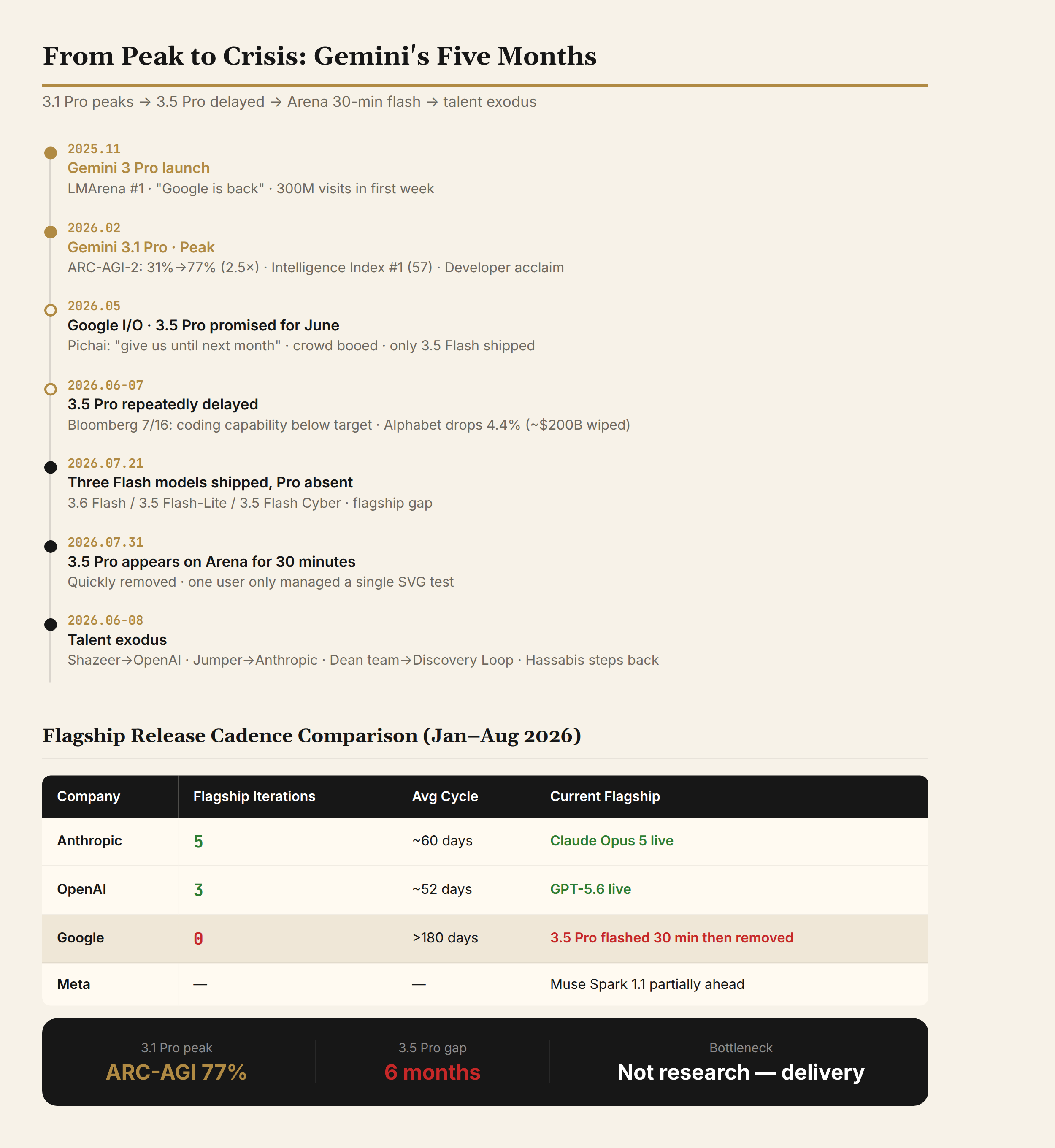
1. From Peak to Crisis: Gemini's Five Months
To understand this leadership earthquake, you need to look back at Gemini's trajectory. This curve tells the story better than any personnel change.
November 2025: Gemini 3 Pro launches. Seen by the industry as Google "returning to the AI first tier." Ranked #1 on LMArena, leading in multimodal capabilities, with over 300 million visits in the first week. Even Sam Altman and Elon Musk offered immediate congratulations. The prevailing narrative: "Google is awake."
February 2026: Gemini 3.1 Pro launches. The peak. ARC-AGI-2 (the hardest abstract reasoning benchmark currently recognized) jumped from 31.1% in the previous generation to 77.1%—a 2.5× leap. It topped the Artificial Analysis composite intelligence index with a score of 57, surpassing Anthropic's Claude Opus 4.6 (53). The 2-million-token context window was finally "actually usable." The developer community cheered; Cursor users found in real testing that tool-call failure rates had plummeted, and cross-file refactoring and complete frontend projects succeeded on the first try. Gemini led simultaneously across reasoning, coding, and multimodal dimensions.
This was the highest point for Google DeepMind.
May 2026: Google I/O. Pichai launched Gemini 3.5 Flash (mid-tier) and promised the flagship 3.5 Pro would come "next month." There was no applause from the audience—only boos.
June passed. The API changelog showed no gemini-3.5-pro model ID.
July 16: Bloomberg reports. Citing 10 current and former employees, Gemini 3.5 Pro had been delayed for months because its coding capabilities hadn't met internal targets, with the team still adjusting training data in June. Alphabet shares fell 4.4% that day, erasing about $200 billion in market cap.
July 21. Google released three Flash models (3.6 Flash, 3.5 Flash-Lite, 3.5 Flash Cyber), but the flagship Pro was still absent. The incremental updates only made the flagship's absence more glaring.
July 31. Gemini 3.5 Pro briefly appeared on the Arena evaluation platform for about 30 minutes before being pulled. Some users only had time to run one SVG rendering test before it vanished. A release two months late ended with a "flash appearance" lasting less than half an hour.
Meanwhile, talent started leaving.
From the peak of 3.1 Pro to the struggles of 3.5 Pro, only five months passed. This curve tells you something more fundamental than any personnel change: Google's bottleneck is not research capability—it's engineering delivery capability. 3.1 Pro proved that Hassabis's team could still produce world-class research breakthroughs. But the repeated delays of 3.5 Pro proved that the distance from research breakthrough to product delivery was something Google covered far too slowly.
This is the real reason Koray moved up—not swapping in a smarter person, but swapping in someone better at delivery.
2. Release Cadence Comparison: Google Is Falling Behind
Gemini 3.5 Pro's struggles are not an isolated case. Place them against the release cadence of the four leading companies, and Google's delivery shortfall becomes even clearer.
OpenAI: August 2025 GPT-5 launched; April 2026 GPT-5.5 (codename Spud, the first next-gen model retrained from scratch, with major agentic capability gains); July 2026 GPT-5.6 has appeared on leaderboards. Iteration interval compressed from ~8 months (GPT-5→5.5) to ~2-3 months (5.5→5.6), clearly accelerating. Terminal-Bench 2.0 at 82.7%, SWE-bench Pro at 58.6%.
Anthropic: February 2026 Claude Opus 4.6; April 2026 Claude Opus 4.7; May 2026 Claude Opus 4.8; June 2026 Claude Fable 5; July 2026 Claude Opus 5. Five flagship-tier iterations in six months, averaging ~42 days per cycle. Claude consistently leads in coding and agent tasks; Fable 5 entered the Mythos tier (long-cycle autonomous operation). Meanwhile, Anthropic secretly filed IPO paperwork in 2026, with a expected fall listing.
Google: November 2025 Gemini 3 Pro; February 2026 Gemini 3.1 Pro (peak); May 2026 Gemini 3.5 Flash (mid-tier); flagship 3.5 Pro still unreleased. Six months since the 3.1 Pro peak with no flagship update. Pichai confirmed on the Q2 earnings call that Gemini 4 has begun pretraining, with the goal of "releasing a new model almost every month"—a target that sits in stark contradiction to the repeated delays of 3.5 Pro.
Meta: In 2026, Muse Spark 1.1 surpassed Gemini 3.6 Flash on several leaderboards. Meta Chief AI Officer Alexandr Wang replied on X with just two words: "gemini who?"
Putting all four side by side:
| Company | 2026 Flagship Iterations | Average Cycle | Current Flagship Status |
|---|---|---|---|
| OpenAI | 3 (5→5.5→5.6) | ~2-8 months (accelerating) | GPT-5.6 online |
| Anthropic | 5 (4.6→4.7→4.8→Fable 5→Opus 5) | ~42 days | Claude Opus 5 online |
| 0 (3.5 Pro unreleased) | >180 days | 3.5 Pro appeared for 30 minutes then pulled | |
| Meta | — | — | Muse Spark 1.1 surpassing in some areas |
This table makes the point more directly than any analysis. OpenAI's iteration interval has compressed from 8 months to 2-3 months, while Anthropic has delivered five flagship updates in six months—averaging just 42 days. Yet Google has not shipped a single new flagship model in six months. Gemini 3.1 Pro's 80.6% on SWE-bench Verified once led, but Claude Opus 5 and GPT-5.6 have already matched or surpassed it on the same benchmark. The capability window is shrinking—if you stay at the peak for more than three months, others catch up.
Google's problem is not the inability to build good models. 3.1 Pro proved that. The problem is that after building one, the delivery speed for what comes next can't keep up. Model training, data optimization, post-training alignment, product integration, infrastructure scaling—each step requires engineering execution. Research breakthroughs can rely on the inspiration of a few geniuses, but continuous delivery depends on systems.
This is the real reason Koray moved up—not swapping in a smarter person, but swapping in someone better at delivery.
3. Not Sudden—Google's AI Talent Drain Has Been Going On for Two Years
First, a timeline.
| Time | Event | People |
|---|---|---|
| 2024 | Google spent $2.7 billion to bring back Noam Shazeer (Transformer paper co-author) from Character.AI, co-leading Gemini | Shazeer |
| June 2026 | Shazeer leaves Google again, joins OpenAI | Shazeer |
| June 2026 | John Jumper (AlphaFold, 2024 Nobel Prize in Chemistry) announces joining Anthropic | Jumper |
| June 2026 | Gemini researchers Jonas Adler and Alexander Pritzel reported planning to join Anthropic | Adler, Pritzel |
| August 2026 | Jeff Dean, Sanjay Ghemawat, Quoc Le, and Oriol Vinyals collectively depart to found Discovery Loop | Dean et al. (4) |
In less than two years, the talent departing Google DeepMind spans the Transformer architecture (Shazeer), protein structure prediction (Jumper), Gemini model design (Vinyals), and all of Google's distributed infrastructure (Dean and Ghemawat). This isn't about the success or failure of any single project—each departure points in a different direction. But the underlying motivation is the same: top researchers are trading the stable resources of a large corporation for the control and upside of a startup.
Google's response isn't simply to raise salaries. It is simultaneously tightening Gemini's delivery cadence (models, applications, and developer business consolidated into a shorter chain of command) while investing in the departing founders' companies (Discovery Loop received backing from Alphabet, Radical Ventures, and Khosla Ventures, with Google committing to provide compute for at least a year). Employment relationships are being converted into investment relationships—the people are outside, but the compute stays in Google's hands.
4. The CEO Position Is Gone—This Is the Key Detail
Media coverage focused on Hassabis and Dean. But the most important organizational signal was overlooked: Google DeepMind no longer has a CEO position.
Koray Kavukcuoglu's title is Senior Vice President (SVP), not CEO. He reports directly to Pichai, with no "DeepMind CEO" as an intermediary layer. This means Google DeepMind is no longer a relatively independent lab—it has been formally absorbed as a core Google business unit, on the same level as Search, Cloud, and YouTube.
This structural change reveals three things.
First, Google's positioning of AI has shifted from "exploration" to "delivery." The CEO title implies independence and a long-term perspective. SVP implies execution and delivery. Google is now asking the Gemini team to operate like the Search team: with a clear release cadence, revenue targets, and competitive benchmarks.
Second, Hassabis moving to "AGI strategy" means he is no longer responsible for near-term delivery. His new role as Alphabet Chief Scientist focuses on AGI and long-term scientific research. In management language: Google has split AI into two tracks—near-term models and products that must be delivered (Koray's domain), and long-term exploratory research (nominally Hassabis's). The priority ordering is clear.
Third, Google Cloud broadly welcomes Koray's appointment. According to media reports, compared to the research-oriented Hassabis, Koray has already been deeply involved in DeepMind's commercial collaboration with Google Cloud. His ascension means Gemini will focus more on commercialization and product integration, converting to cloud revenue faster.
5. Discovery Loop: Research "Released" to the Outside
Jeff Dean's Discovery Loop deserves a closer look on its own.
The four co-founders' backgrounds cover two generations of Google's core technology. Dean and Ghemawat designed MapReduce, BigTable, and Spanner—the distributed systems underpinning Google Search's global infrastructure. Both are Google's only two Senior Fellows (the highest technical level). Dean founded Google Brain in 2011; Quoc Le was a co-founding member (co-author of the seq2seq paper); Vinyals was Gemini co-lead (also involved in AlphaStar and AlphaFold).
Discovery Loop's mission is to research Recursive Self-Improvement (RSI)—enabling AI to participate in hypothesis generation, experiment execution, and model improvement with minimal human intervention, then applying the same methodology to chip design, drug discovery, and new materials research. The company is registered as a public benefit corporation (like Anthropic and OpenAI), and has received investment from Radical Ventures, Khosla Ventures, and Alphabet.
RSI is one of the most cutting-edge directions in current AI research. Anthropic published a long-form essay in 2026, "When AI builds itself," discussing this very topic. If Dean's team's direction proves viable, AI will be able to achieve exponential self-acceleration across science and engineering.
What's interesting is Google's approach. Rather than keeping Dean's team inside to pursue this direction, it let them spin out independently, then maintained the connection through investment and compute supply. This is a "division of labor": near-term models and products that must be delivered stay in Google DeepMind (Koray's domain), while long-term exploratory research goes outside (Dean's team). Google is both an investor in Discovery Loop and its cloud service provider—the people left, but the money and compute remain in Google's hands.
For a company long criticized for "strong research, slow products," this is a smart split: keep delivery pressure inside and solve it with engineering management; give researchers exploration freedom through the independent company structure. The cost: if Discovery Loop's RSI direction actually works, the biggest beneficiary may not be Google.
6. The Engineering Delivery Phase: What's at Stake
"AI competition has entered the engineering delivery phase"—this claim needs unpacking. It's not a slogan; it's a structural shift that can be decomposed.
The success logic of the research phase and the engineering delivery phase is fundamentally different.
The core output of the research phase is "capability breakthroughs"—a new architecture, a training trick, a leap in benchmark scores. Success in this phase depends on talent density and compute investment. The leaders are researchers (Hassabis, Sutskever, Dean); the key resources are GPUs/TPUs and data. Timelines are unpredictable—you never know when the next breakthrough will come. The organizational form is the lab: small teams, long cycles, tolerance for failure.
The core output of the engineering delivery phase is "products shipped on time"—a usable API, a stable inference service, a continuously iterating model family. Success in this phase depends on process, tooling, and infrastructure. The leaders are engineering managers (a Koray-style SVP); the key resources are training pipelines, data pipelines, evaluation systems, and inference optimization. Timelines are predictable—or rather, they must be predictable. The organizational form is the product division: clear release cadence, revenue targets, competitive benchmarking.
Four focal points determine the speed of the engineering delivery phase.
① Training pipeline reliability. Frontier model training is not a one-shot effort—each iteration requires experimentation with data mixtures, architectural adjustments, and reinforcement learning strategies. A mature training pipeline should process these experiments "like a factory": submit configuration → automatic training → automatic evaluation → output results. OpenAI demonstrated this capability in the GPT-5.5 release—it had planned the complete experiment matrix before training even began. Google's Gemini 3.5 Pro was delayed, according to Bloomberg, because coding capabilities hadn't met internal targets and the team was still adjusting training data in June—this suggests the training pipeline isn't yet mature enough to close the data → training → evaluation → release loop within a predetermined cycle.
② Inference optimization and cost control. Once a model is trained, inference efficiency and cost determine whether it can be deployed at scale. OpenAI made token efficiency a core metric of GPT-5.5—"fewer tokens consumed per task than 5.4." Google also began emphasizing Gemini's inference cost advantages at I/O. When model capabilities converge, inference cost becomes a key variable in purchasing decisions. This is not a research problem; it's a systems engineering problem: quantization, KV cache optimization, speculative decoding, model distillation—each step requires sustained investment from engineering teams.
③ Evaluation and feedback loops. Before a model is released, it must pass extensive evaluation—not just benchmark scores, but safety, hallucination rates, and real-world performance. OpenAI and Anthropic have already built automated evaluation pipelines: model training completes → automatically run hundreds of evaluations → generate reports → human review of key metrics → decide whether to release. If the evaluation system is immature, a model may require repeated rework even after training is complete. Gemini 3.5 Pro's delay was reportedly partly due to coding ability tests falling short of targets—suggesting that the feedback loop between evaluation and training isn't efficient enough.
④ Product integration and developer ecosystem. Models don't exist in isolation—they need to become products. Claude Code's rapid iteration (over 10 versions in half a year), OpenAI Codex's developer toolchain, Cursor's integration support for multiple models—these are all engineered product capabilities. Google has four entry points—Search, Cloud, Workspace, and Android—but its model-to-product integration speed is actually slower than that of smaller companies. Koray's previous role was precisely the commercial partnership liaison between DeepMind and Google Cloud—his ascension signals that product integration priority is rising.
These four focal points together answer one question: Why can OpenAI and Anthropic iterate flagship models in ~42 days, while Google cannot?
It's not because OpenAI and Anthropic have smarter researchers. It's because their engineering delivery systems are more mature—training pipelines are more automated, inference optimization is deeper, evaluation loops are shorter, and product integration is tighter. The research phase is about "who can make the breakthrough"; the engineering delivery phase is about "who can turn breakthroughs into products, and then repeat that process."
Jeff Dean leaving Google to found Discovery Loop validates this judgment from another angle. His chosen research direction is RSI (Recursive Self-Improvement)—this is pure frontier research, requiring the free exploration of a small number of top researchers, not engineering delivery. His departure from Google DeepMind says it all: Google DeepMind is becoming an engineering delivery organization, no longer the best place for frontier research.
7. The Bigger Picture: A Paradigm Shift in AI Competition
Place Google's leadership earthquake in an industry context, and a larger trend emerges.
AI competition is shifting from research-driven to engineering-driven. Over the past three years (2023–2026), leading AI companies competed on who had the smarter model and the more cutting-edge research breakthroughs. In that era, research leaders (Hassabis, Dean, Sutskever) were the core assets. But in 2026, the competitive focus has shifted: the capability gaps between models are narrowing (Claude, GPT, and Gemini are neck and neck on most benchmarks), and the real differentiators are inference cost, delivery speed, product integration, and infrastructure efficiency.
In this new phase, the marginal value of research leaders is declining, while the marginal value of engineering delivery leaders is rising. Koray replacing Hassabis isn't because Koray is the better researcher—it's because Google needs Gemini to deliver and commercialize faster.
Vertical integration among AI companies is accelerating. On the same day (August 5), Anthropic publicly confirmed for the first time that it is assembling an internal chip team to design custom AI chips for Claude, with salaries of $320,000–$485,000 per year. Add OpenAI's Jalapeño (in partnership with Broadcom), Google's TPU, Amazon's Trainium, and Meta's MTIA—every leading AI model company is moving toward "model + chip + infrastructure" vertical integration.
But Google's distinction is that it is simultaneously tightening engineering delivery (Koray's ascension) and pushing research outward (Dean's departure). While other companies are still building up research capability, Google is already executing a "research–engineering" division of labor.
The market pricing of research talent is being rediscovered. Over the past three years, the value of top AI researchers inside large corporations was inflated—big companies were willing to pay astronomical sums to retain them. But the reality of 2026 is this: a Koray-style engineering delivery leader may be more valuable to winning the competition than a Hassabis-style research leader. Dean's choice to start a company rather than stay at Google may stem precisely from this insight: frontier research like RSI is easier to advance in a startup than inside an engineering-managed corporation.
8. Three Judgments
Judgment One: Under Koray, Google DeepMind will become more of a product division than a lab. Gemini's release cadence will accelerate, commercialization will be more aggressive, but the long-term momentum of research breakthroughs may weaken. If the next-generation Gemini falls behind Claude/GPT in capability, Google may rebalance.
Judgment Two: Discovery Loop's RSI direction is the next big bet in AI. If "AI using AI to improve itself" produces real breakthroughs within 2–3 years, Dean's independent company structure is more likely to get there than an internal corporate lab—less bureaucracy, less delivery pressure, more focus on long-term goals. Google locking in the relationship through investment + compute is a reasonable hedge.
Judgment Three: The talent flow model in the AI industry is shifting from "big companies retain talent" to "big companies invest in talent." Google investing in Discovery Loop, Microsoft investing in OpenAI, Amazon investing in Anthropic—leading companies increasingly prefer to bind top research capability through capital and compute rather than employment. This means more "independent AI research companies" will receive strategic investment from big tech. For researchers, the path of startup + big-tech compute support is becoming more attractive than the big-tech tenured track.
Sources: Axios (2026-08-05 Demis Hassabis role change / Jeff Dean departure); SiliconANGLE (2026-08-05 Google AI reorganization analysis); DeepTech / Sina Tech (2026-08-06 Discovery Loop team background and organizational timeline); Google Official Blog / Sundar Pichai internal memo (2026-08-05); Artificial Analysis (2026-02 Gemini 3.1 Pro intelligence index #1 / ARC-AGI-2 77.1% / 2026-07 model leaderboard); Tencent Tech / Cloud Dev Community (2026-02 Gemini 3.1 Pro review roundup); BloombergLaw (2026-07-16 Gemini 3.5 Pro delay / coding capability below target / citing 10 current and former employees); TMTPost (2026-07-31 Gemini 3.5 Pro Arena 30-minute flash appearance); Sohu / Bloomberg (2026-07 Gemini 3.5 Pro "difficult labor" background / Alphabet Q2 earnings call Pichai confirms Gemini 4 pretraining); Sina Finance (2026-07-28 Pichai "nearly monthly model" target / TPU compute priority for AGI); CSDN (2026-07-24 Meta Alexandr Wang "gemini who?" / Muse Spark 1.1 vs Gemini 3.6 Flash); Baidu Baike (GPT-5 series release timeline / Claude series release timeline / Anthropic IPO filing); Tencent Tech (GPT-5.5 Terminal-Bench 2.0 82.7% / SWE-bench Pro 58.6%); CLS (2026-08-05 Anthropic confirms chip team); Zhitong Finance / Tonghuashun (2026-08-06 Alphabet market cap loss ~$186B / Koray appointment details); Xueqiu (2026-08-06 Discovery Loop funding: Radical Ventures + Khosla Ventures + Alphabet). This article does not constitute investment advice. Data as of August 6, 2026.