
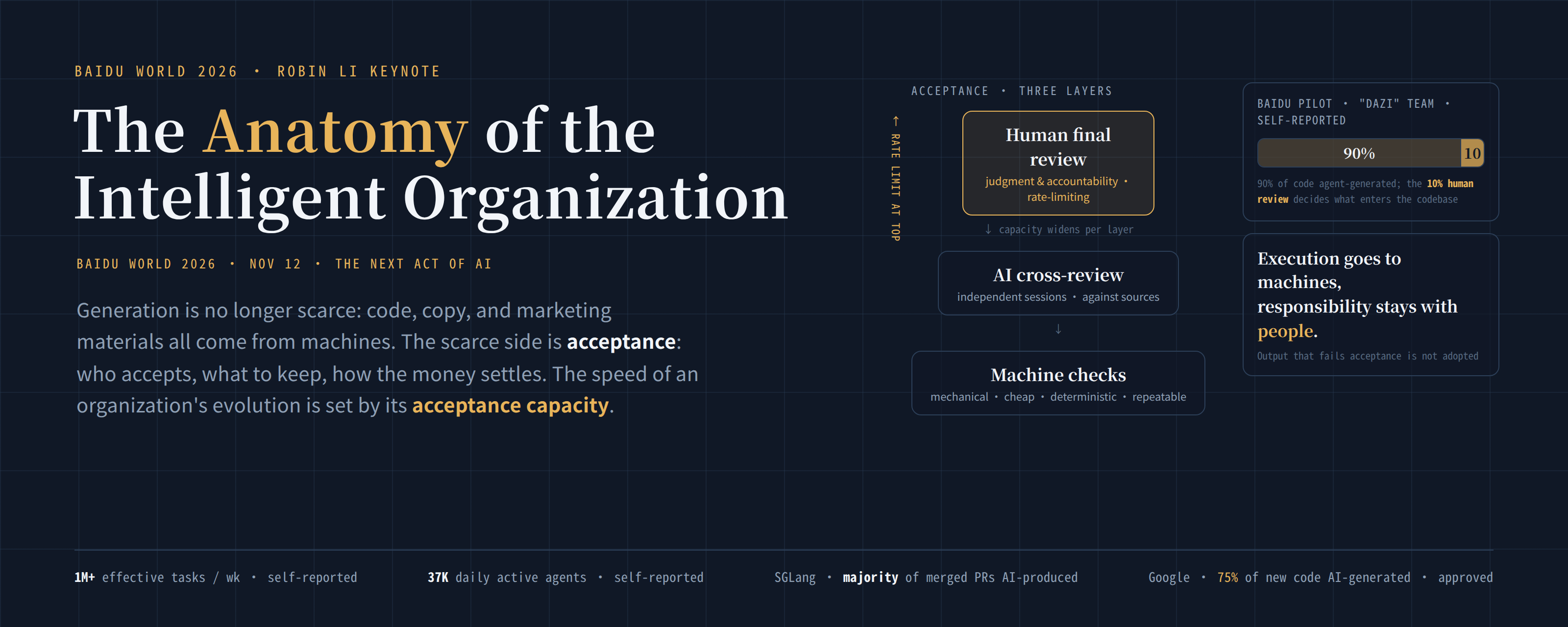
At Baidu World 2026, Robin Li called the next act of AI the intelligent organization. His reasoning: companies have replaced the electric motor without redesigning the factory. The claim has an economic-history basis: electrification's productivity dividend took roughly forty years to arrive, and what it waited for was the rearranged factory. But in every dimension the speech covered only the generative side and left out acceptance. Fill that side in, and the intelligent organization is four layers and three roles: Builder, Seller, and the Steward the speech never named, the acceptor who answers for machine work. It also needs four subsystems: measurement and incentives, memory, acceptance, and access and safety. Execution goes to machines; acceptance and accountability stay with people. How fast an organization evolves depends on its acceptance capacity.
On November 12, in his keynote at Baidu World 2026, Robin Li relayed a question executives keep asking: "Why does my token spending keep rising while my revenue and profits don't?" He answered with industrial history: "AI has failed to deliver the expected economic returns because we have only replaced the electric motor without redesigning the factory." From there he called the next act of AI: the intelligent organization, an org system native to AI rather than another layer of hierarchy. Agents should enter core work in sales, support, engineering, and operations, and the organization and its workflows should be redesigned around AI.
The judgment has a solid economic foundation, and the mechanisms are already running. But the speech offered design principles. What an intelligent organization actually looks like, and how it runs, becomes clear when you take it apart along four dimensions: form, collaboration, mechanisms, and architecture. Taken apart, one thread runs through the whole piece: in every dimension the speech covered the generative side and left the acceptance side unspoken. Who fills that side in, and how, will decide where the intelligent organization goes over the next two or three years. Our July piece, "The Future of AI Native Organizations: A Topology Rewrite," answered why. This one answers what it becomes and how it runs.
1. The Claim and Its Foundation: What He Said
His framework runs upstream and downstream. Upstream is energy. In his telling, the AI stack has four layers (chips, cloud infrastructure, models, and agent-based applications), and there is the industry's "five-layer cake" theory, represented by Jensen Huang, who added an energy layer on top of that four-layer stack. Downstream, his answer is organizational capability; models and applications are intermediate steps. The most quotable line of the keynote: "If AI is the new electricity, the intelligent organization is the new factory of the AI era, the place where productivity actually happens."
The methodology, announced for the first time, is three principles of organizational evolution:
- Break job boundaries. The job is the unit of the industrial age, the task is the unit of the intelligent age, and the organization becomes a network of tasks.
- Crystallize tacit knowledge. Turn personal experience into explicit assets on a platform, cumulative and callable. In his words, "too hard to copy, poach, or buy."
- Design closed loops. Make processes measurable first, then let what he calls the "iterative closed loop" keep evolving them.
For individuals, he predicted that jobs will not disappear but will converge into two types: Builders, who create new things, and Sellers, who communicate, connect, and hold trust. For opportunity, he named three: asset-light operation (one person leading a fleet of agents), a new moat (tacit experience becoming a digital asset), and concurrent market exploration (the whole organization running experiments at once).
Backing the judgment are Baidu's internal numbers, all self-reported in the keynote. Over the past year, daily active internal agents grew from 5,000 to 37,000, and effective tasks completed by agents per week grew from 84,000 to over one million. More than 4,300 internal Workspaces were built, holding more than 20,000 company-level organizational Skills. The pilot is Baidu's "Dazi" team: over 160 iterations in half a year, with 90% of its code and 50% of its external materials produced by agents. It should be noted that the definition of "effective task" has not been published.
The motor analogy holds up academically. In 1990, the economic historian Paul David studied the same puzzle: American manufacturing began commercial use of electricity in the early 1880s, yet its productivity acceleration did not arrive until the 1920s, roughly forty years. The bottleneck was the factory. A plant designed around steam delivered power from a central engine house through a web of line shafts and belts. An electric motor installed in such a plant could only accommodate the old transmission. The power changed; the layout did not; the gains never came. Only when factories were redesigned around the motor, each machine carrying its own motor and the floor laid out by process, did electrification pay off. This is standard general-purpose technology theory: the dividend waits for complementary innovation in the organization. Li's motor metaphor describes exactly where most companies stand today.
The three principles, however, stay at the level of direction. What an organization rebuilt on them actually looks like, and how it runs day to day, is what the next four sections cover.
2. Form: Stability and Flow Trade Places
In a hierarchy, the stable things are people and reporting lines; the pyramid barely moves. Tasks flow, moving between departments. The intelligent organization inverts the relationship. The stable thing is the capability platform: models, agent fleets, the Skill library, Workspaces, and organizational memory. The flowing thing is the task network, formed around a goal and dissolved on completion. When Li says the organization is a network of tasks, the full implication is that the organization's fixed asset shifts from human capital to the capability platform, and tasks only draw on those capabilities temporarily.
The meaning of headcount changes with it. Organization size can no longer be described by "how many people" alone; it also has to count resident agents and concurrent task rings. A task ring is one task's complete loop through delegation, execution, and acceptance. Baidu's internal daily active agents are already in the five digits.
The most underrated change in form is the middle layer. A hierarchy's middle management is essentially an information relay: aggregating up, decomposing down. Agents can carry full context straight across layers, and once the relay function is absorbed into the system, the middle layer is left with two things: judgment and accountability. Neither can be relayed, and neither can be generated; both must be concentrated. So the intelligent organization is not a flatter pyramid but a dumbbell, thick at both ends and thin in the middle. One end is the capability platform and governance, few people but heavy weight; the other end is a large number of concurrent task rings, numerous, with most of the execution done by agents; the information-relay layer in between is hollowed out.
3. Collaboration: Task Contracting and the Artifact Flow
In the personal-productivity context, "human-AI collaboration" is the copilot mode: one person with one assistant, the human always present, AI as an amplifier. In an intelligent organization the structure is different, and it can be drawn as a triangle:
- the principal: defines the task's goal, boundary, and acceptance criteria;
- an agent fleet: executes;
- a verifier: decides whether the output can be used.
The human leaves the execution floor and stands at both ends.
Two samples from completely different sources arrived at the same structure. One is open source. At the SGLang summit it was disclosed that a majority of the project's merged PRs are produced by AI, while technical decisions and code acceptance stay with human maintainers (see our SGLang summit piece for the full breakdown). The other is the speech's own example: Baidu's pilot team has 90% of its code generated by agents. But whether that 90% enters the codebase depends on the remaining 10% of human review. The capacity and cost of review is exactly what the speech did not address.
The medium of collaboration changes too. People stop collaborating through meetings and email; they collaborate through artifacts: task briefs, Skills, spec documents, acceptance checklists, and the code and copy themselves. Collaboration is the production, flow, review, and archiving of artifacts. Two people who have never met can work together efficiently around one artifact, because they are examining the same object and do not need to spend time aligning their impressions first.
Concurrency is a direct consequence. Tasks no longer queue up waiting for a person. The same question can spawn several task rings running small experiments at once; a human judges, and the ones that perform poorly are simply closed. What Li calls "asset-light operation" comes down to this: what the organization really saves is the time spent waiting in line.
4. Mechanisms: The Four Subsystems the Speech Left Unfinished
A complete operating mechanism needs four subsystems. Of the three principles, "design closed loops" maps to measurement, and "crystallize tacit knowledge" covers only the accumulation half of memory. Acceptance and access-and-safety the speech never mentioned.
Measurement and incentives. Measurable plus looping is the right direction. But whatever is measured gets optimized immediately; that is Goodhart's law. In the era of agents the problem only gets worse: with a loose enough definition of "effective task," letting agents spawn agents can inflate the count. So the measurement loop needs built-in anti-gaming: public task definitions, traceable attribution (who reported this number), and independent rechecking. Our own review chain has seen this happen: six rounds of review caught an unsourced claim in a draft: a vendor's launch-day support statement that appeared nowhere in the archives. That chain does exactly the anti-gaming work inside the measurement loop.
Measurement connects to incentives, because what gets measured is, in the end, what gets settled. How people in task rings are paid, what a Builder's income tracks, whether the organization needs internal price signals; the speech said not a word about any of these, and the industry has no settled answers either. History offers precedent. Paul David recorded that electrification's payoff in the 1920s came not only with rearranged factories but with rebuilt worker training and employment contracts. Internal price signals have had one complete practice: Kazuo Inamori's amoeba management at Kyocera, which split the company into small, independently accounted units trading with each other at internal prices. The lesson is clear: internal pricing breeds recurring bargaining, and Kyocera needed "shared philosophy," a soft constraint, to counteract local interests. When the intelligent organization takes this incentive class, a similar accounting mechanism will most likely appear. The difference: the unit of account shifts from labor-hours to accepted output, and the counterweight to local interests shifts from management philosophy to auditable event streams. Rewriting incentives was always part of complementary innovation.
Memory. Crystallizing tacit knowledge is the most insightful of the three principles, but the real difficulty is forgetting. Twenty thousand organizational Skills, without usage weights, decay, and retirement, turn the moat into a drag on the organization itself. For an agent, the signal-to-noise ratio of retrieving one Skill matters far more than the total count. Half the value of personal experience is knowing what not to do again. Organizational memory that only accumulates and never retires loses that half. Accumulation is cheap; curation is expensive.
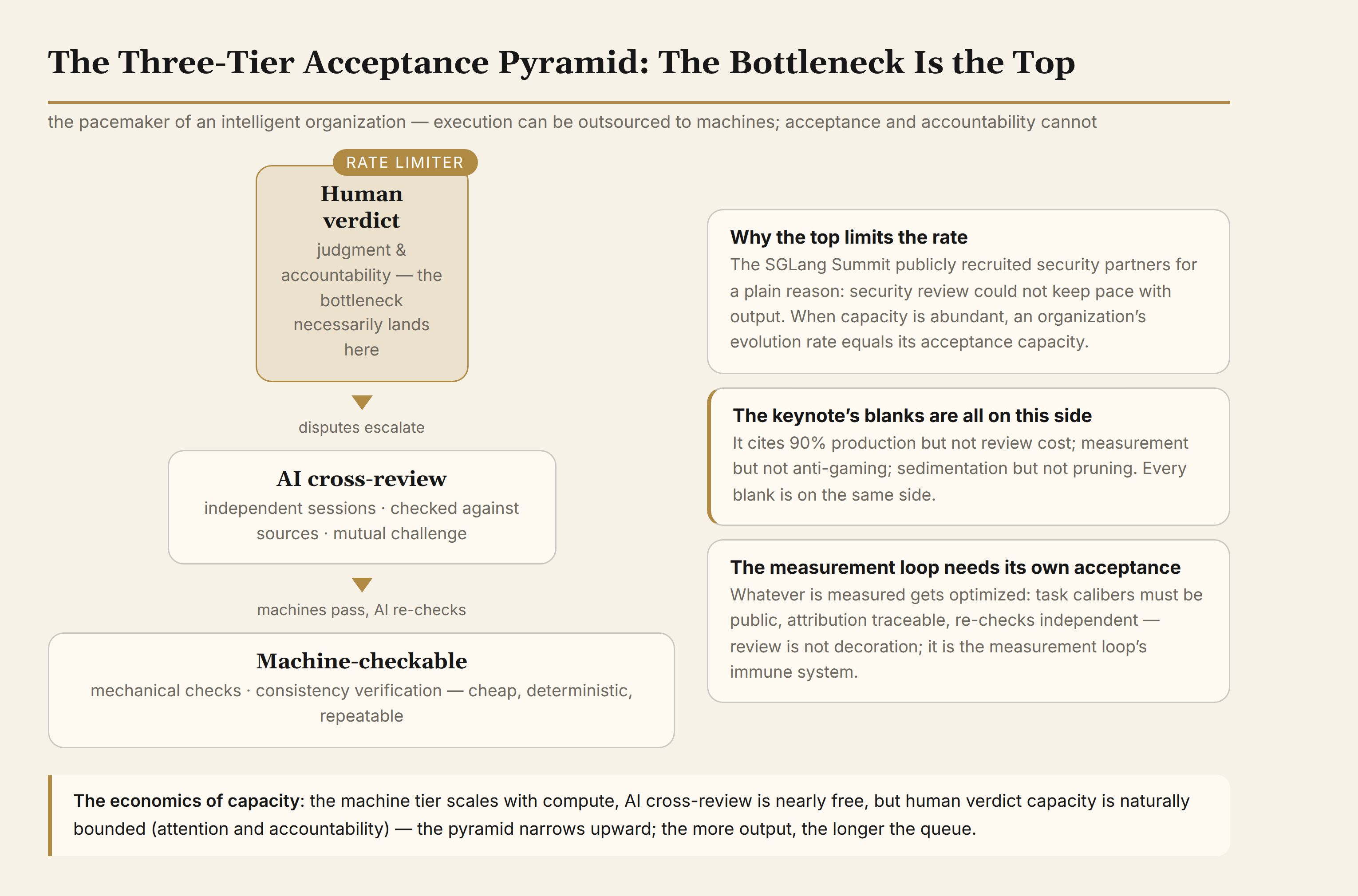
Acceptance. Acceptance sets the tempo of the whole organization, and it is the biggest blank in the speech. A workable acceptance system is a three-layer pyramid:
- the base is machine checking: mechanical checks and consistency validation: cheap, deterministic, repeatable;
- the middle is AI cross-review: independent sessions, checked against sources, catching each other's errors;
- the top is human final review: judgment and accountability.
The bottleneck lands on the top layer. The SGLang example again: its public call for security partners at the summit exists because security review could not keep up with the pace of output. Figure 1 draws the pyramid; the layer that limits the speed is the one at the very top.
Acceptance and trust are in fact present in Li's thinking; they just never entered his organizational narrative. What his platform product, the model marketplace, is building is exactly trust infrastructure between organizations: model verification and vendor credit records.
Access and safety. Every agent action must have its scope of impact controlled. Which files it can write, which systems it can call, how much budget it can spend; these boundaries are written into the task brief up front. Irreversible operations such as deleting data, making external payments, or publishing content must keep human approval. Every action leaves a full audit trail, replayable and attributable when something goes wrong. This subsystem runs against the direction of the other three: the more automatically the organization runs, the more this layer must be written by hand. These rules cannot be learned from data; they must be designed, one by one.
Of the four subsystems, the speech covered one and a half. The missing parts all sit on the acceptance side.
5. Architecture: Four Layers, Three Roles
Assembling the previous sections, an intelligent organization's architecture has roughly four layers:
- Capability-asset layer: models, agent fleets, the Skill library, and organizational memory: the organization's fixed assets.
- Task-network layer: task rings form around goals and dissolve on completion; value is produced here.
- Governance layer: acceptance, audit, access, and data discipline concentrate here, and so does human accountability.
- Relationship layer: customers, partners, and regulators connect here: the interface through which the organization exports trust.
Figure 2 draws the four layers and three roles together. Governance is the heavy end of the dumbbell, and what is hollowed out in the middle is the information relay.
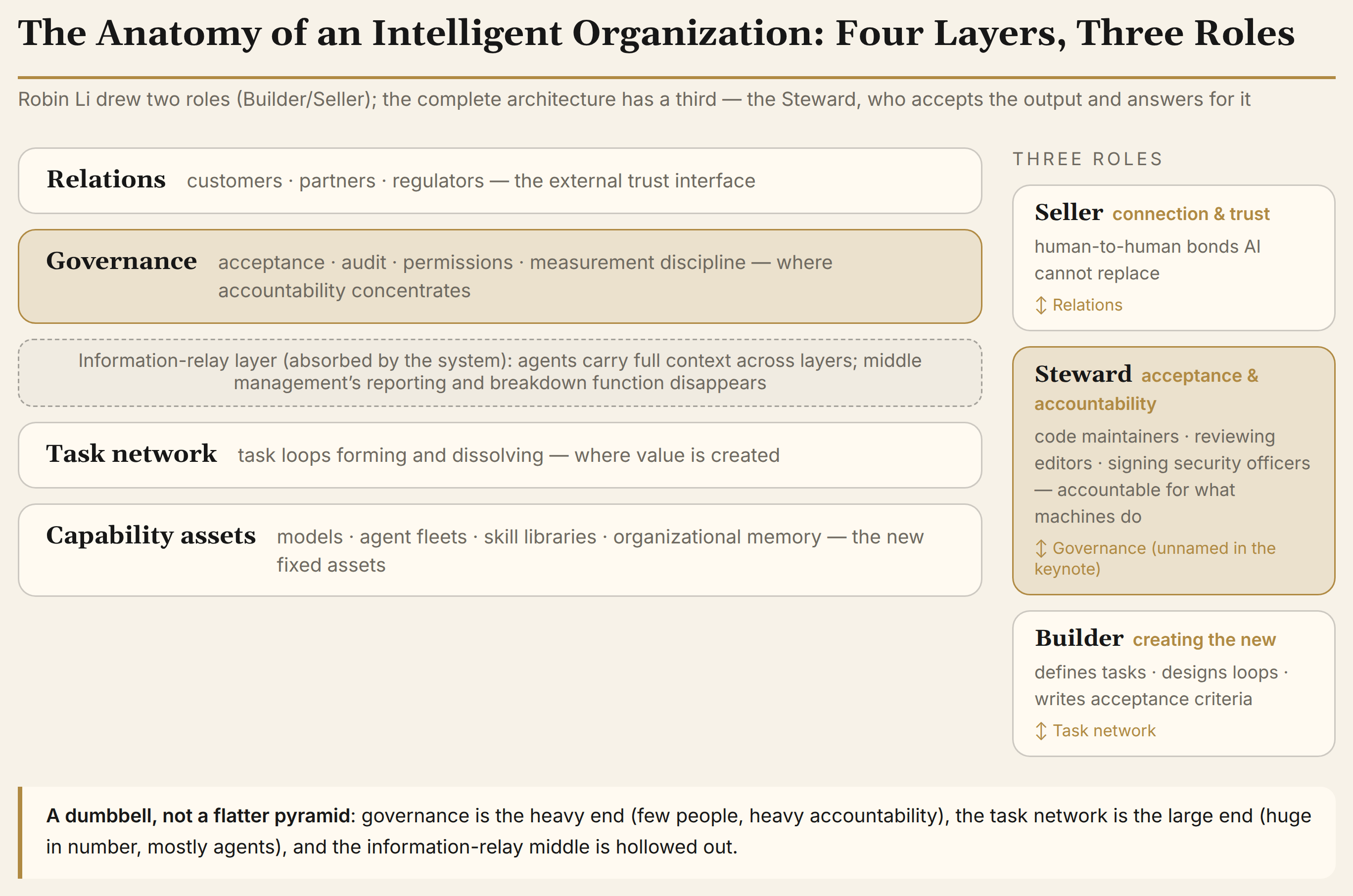
Roles converge into three, one more than the speech's two:
- Builder: creates new things: defining tasks, designing rings, writing acceptance criteria.
- Seller: holds the human connections and trust. Both Li and his onstage guest Yang Yuanqing considered this type irreplaceable. Yang said AI does not understand customers, and the human emotional connection still matters greatly.
- Steward: the type the speech did not mention: the acceptor and the accountable party. The maintainer reviewing code, the editor reviewing copy, the security officer signing off, the person willing to stake professional reputation on saying no. Machines do the work; these people answer for what the machines do. The quality of the organization is set by their capacity.
Two deeper changes sit in this architecture.
First, reporting lines are replaced by event streams. Information stops moving up level by level; every task's initiation, output, acceptance, and rollback is recorded in an auditable ledger. The organization's information flow moves from "meetings plus reports" to event streams.
Second, span of control is rewritten. By the classic rule of thumb, one manager directly manages five to ten people. A Steward can verify far more agent output than a person could directly manage. Span moves from "a few people" to "a few dozen task rings." The number is illustrative, but the direction is clear: the governance layer is naturally thin.
In shape, this is the dumbbell from Section 2. Governance is the heavy end, the task network is the large end, and the two are connected by artifact flow and event streams.
6. Practice and Outlook: Who Becomes an Intelligent Organization First
Organizational practice is already underway, and the gap between old and new companies is beginning to show.
Code output is the fastest mover. Google has disclosed the trajectory in stages: in autumn 2024, CEO Sundar Pichai said AI-generated code exceeded a quarter of all new code; by autumn 2025, the share had risen to half; at Cloud Next in April 2026, Pichai gave 75%. Three points make a steep curve. But the definition carries more weight than the numbers: 75% counts code "AI-generated and approved by engineers"; autonomous submission is not included. In other words, Google handed generation entirely to machines while the decision to commit stayed with engineers. That is the triangle from Section 3, running at the scale of a large company. Microsoft's framing is far more conservative. In 2025, Satya Nadella said that maybe 20% to 30% of the code in Microsoft's repositories is probably written by software, and he admitted he could not say for sure. Part of the gap between the two numbers is real; part comes from "AI-written" having no industry-standard definition: counting generated drafts or only approved merges can double the ratio. For numbers like these, read the definition first, the trend second, and skip absolute comparisons.
Changes to organizational rules are more direct, because they alter the organization's defaults. Shopify's 2025 internal memo flipped the burden of proof: to add headcount, a team must first demonstrate that AI cannot do the work; AI usage also entered performance reviews. The change is heavier than it looks. Adding people used to be the default that needed no reason; now headcount is the exception that needs justification, and the default resource switches from people to AI. Duolingo went further. It announced that as contractor contracts expire, AI takes over the work, while AI usage entered performance and hiring considerations. Starting with contractors makes sense: outsourced roles are built for elastic capacity and meet the least resistance. It points to a general path: AI adoption starts at the organization's periphery and elastic layers and works inward toward the core.
The most instructive case is Klarna, which walked the entire road of "replacing the motor without redesigning the factory." Our July piece covered its first half, written then from public reports as "AI replacing 700 customer-service agents"; the more precise definition: 700 was an equivalent of outsourced seats, and the company did not lay off 700 employees. In early 2024, Klarna announced that its OpenAI-powered assistant was doing the work of 700 full-time agents, handling 2.3 million conversations a month and cutting average resolution time from eleven minutes to under two, and it became the benchmark of "AI customer service." Just over a year later, the same CEO publicly admitted they had gone too far: cost had overwhelmed every other consideration in decisions, and quality slid with it. The company rehired human agents and put engineers and marketing staff on the phones.
Looking back at the reversal, the problem was not the AI itself. Customer service is high-frequency, structured, and tolerant of error, about the best fit for AI there is. The problem was that the organization did not move at all: the service process, the pricing, and the metrics were all unchanged, and AI was simply stuffed into the old seats as cheaper labor. Costs dropped immediately; the quality debt caught up later, all at once. Li's line about "replacing the motor without redesigning the factory" named no company; Klarna confirmed it with its own experience.
For traditional companies the difficulty is concrete, and it sits in three places.
- Legacy process. In a large company, every process has an owner, and every job is tied to headcount, performance metrics, and budget. Touching a process means touching power and vested expectations; the resistance is structural.
- Measurement systems. Old KPIs were designed for human labor: seat counts, hours, per-head efficiency, all measuring people. After AI arrives, these metrics distort first and fail second, while new measures such as acceptance capacity and task-ring quality have not yet been established. In this gap, management can only keep assessing AI with the distorted old metrics. Klarna's cost dominance came from exactly this.
- The accountability interface. This is the deepest layer. Hand an entire department's execution to agents, and when an accident happens, who answers? No role in a traditional organization's job descriptions can absorb that responsibility; there is no Steward in the headcount.
So for incumbents, moving to an intelligent organization is not a tool upgrade; it means rebuilding process, metrics, and the accountability interface wholesale.
Economic history provides another parallel here. In Paul David's data, electrification's productivity gains landed first in factories newly built around the motor, and retrofitted old plants lagged behind. The reason is simple: new plants had no line shafts to remove and could be laid out around unit drive from day one. The AI era will most likely repeat this order.
New companies have exactly this advantage: no legacy processes to change. The organization can be designed from day one around triangular collaboration and artifact flow, hiring Builders and Stewards directly instead of hiring executors first and figuring out the transformation later. The most complete sample comes from open source. At SGLang, a majority of merged PRs are produced by AI; the code production flow is itself the principal-executor-verifier triangle, and it has run that way from the start, with no hierarchy to dismantle. Company-shaped attempts are emerging too. Our July piece sorted them into two types: the pod, three to eight people each leading agent fleets and accountable for complete outcomes; and the factory, two to five people supervising fifty to a hundred agents running highly structured processes. Smaller than both is this article's own extrapolation: one person with a single agent fleet, serving as Builder and Steward at once, at the cost of capping the organization's evolution speed at one person's acceptance capacity. These forms point to the same conclusion: organizational scale is no longer defined by headcount but by acceptance capacity.
Looking forward, three new patterns are likely to appear.
First, the organization itself becomes a product. Once Workspaces, Skill libraries, acceptance chains, and event streams are structured into saved assets, an organization design refined by one company becomes copyable: takeable whole like an open-source project, even tradable. Today's competitive assumption is that talent and process are hard to replicate. Once processes become explicit assets, what remains impossible to replicate is judgment and trust. The quality of an organization's design becomes directly comparable, the way software architecture is, and that will push every company to rewrite its own organization, the way open source once pushed every software company to change.
Second, a trust layer grows between organizations. Ciyuan, his model marketplace, is doing verification and credit records for model trading; the same mechanism will extend to agent-service markets. When one organization's agents need to work with another's, who guarantees that the output on the other side has been accepted, and who is traceable when things break? The answer is platform-level trust infrastructure. Inter-organization collaboration will be backed by platform guarantees and records, not by personal familiarity. That layer does not exist today; whoever builds it first holds the gateway to inter-organization collaboration.
Third, the Steward becomes a profession. Once acceptance capacity becomes the organization's bottleneck, people who can verify become the new scarce resource. They must know the business standard, understand where agents fail, and be willing to sign, and willing to say no. This compound capability has no name today, no training system, and no career ladder, but it will most likely be among the fastest-growing roles of the intelligent-organization era. In the electric age, good electricians were easy to find; the engineers who could sign the acceptance form were hard to get.
The organization really is the next act of AI. On that point the speech is right: the economics is real, and so are the working samples. But the side the speech talked about does not decide success. Generation is no longer scarce: code, copy, and marketing materials all come from machines. The scarce side is the other one: who accepts the output, what knowledge to keep and what to retire, and how the money inside a task ring is settled. The speech said nothing about these three questions, the industry has no ready answers either, and the speed of an organization's evolution is stuck exactly here. Execution goes to machines; responsibility stays with people. No matter how fast machines produce, output that fails acceptance cannot be used.
The term "intelligent organization" will most likely be remembered. The first intelligent organizations will most likely be new companies, because they are built this way from day one, with no legacy processes or reporting lines to dismantle. Large incumbents will have to tear out existing processes, metrics, and reporting lines and rearrange them first, so they will arrive a step behind.
Disclaimer: This article draws on Robin Li's keynote at Baidu World 2026 on November 12, 2026 (full transcript via Sohu), Paul David's "The Dynamo and the Computer" (1990, AER P&P), public statements by Google CEO Sundar Pichai (Q3 2024 earnings call; Cloud Next, April 2026), the Klarna and OpenAI announcements (February 2024), and Bloomberg and CX Dive reporting on Klarna (May 2025), cross-checked against each other. Nothing here is investment advice. Data are current as of November 20, 2026.