
The coding agent competition is shifting from "whose model is stronger" to "whose runtime is more reliable, whose cost structure is lower." Meta's Muse Code is their answer.
Introduction
On August 5, 2026, Meta released Muse Code, its first AI coding agent, powered by the purpose-built Muse Spark 1.2 model. Its Terminal-Bench 2.1 score of 82.9% edges out OpenAI Codex (81.8%) but trails Anthropic's Claude Code (86.7%). Performance isn't the strongest — but that isn't the point.
Muse Code's real value lies in three runtime architecture decisions: persistent background agents, event-log-driven crash recovery, and an aggressive pricing model that trades developer data for radical cost reduction. Together, these choices point to one conclusion: the agent execution environment competition has entered the runtime layer.
1. Three Roadmaps for Agent Runtime
The three giants of AI coding agents have each chosen different architectural paths:
| Dimension | Anthropic Claude Code | OpenAI Codex | Meta Muse Code |
|---|---|---|---|
| User scale | ~20M users | ~8M weekly active | Just launched |
| Driving model | Claude Opus 5 / Sonnet 5 | GPT-5.6 Terra / Sol | Muse Spark 1.2 |
| Terminal-Bench 2.1 | 86.7% (Opus 5) | 81.8% | 82.9% |
| Output price $/M tokens | $15 (standard) / $10 (limited discount) | $12–30 | $0.20–4.25 |
| Architecture philosophy | Model capability first | Scale flywheel first | Runtime reliability + aggressive pricing |
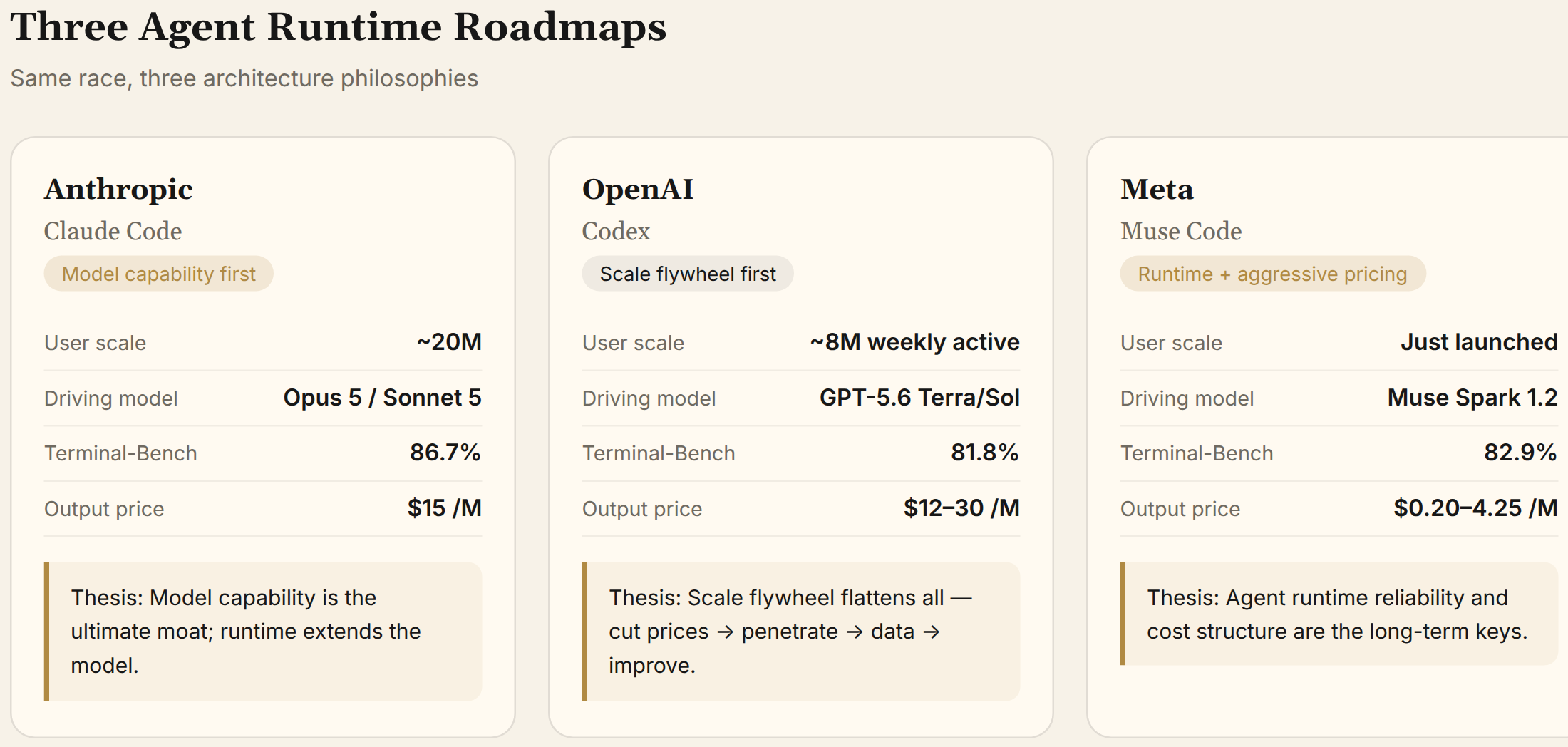
These three paths reflect three different judgments: Anthropic believes model capability is the ultimate moat; OpenAI believes the scale flywheel (model price cuts → product penetration → data回流 → model improvement) will flatten everything; Meta believes agent runtime reliability and cost structure are the long-term competitive keys.
2. Muse Code's Three Architecture Choices
2.1 Persistent Background Agents
Most competing agent harnesses work in a "task-driven" mode: a developer makes a request → the system spawns a batch of helper agents → they are destroyed when the task completes. Every new request starts from scratch to understand the codebase.
Muse Code flips this. It maintains a set of asynchronous background agents that stay alive throughout the entire session. In Meta's own words:
"These agents stay active throughout the session rather than being spawned for individual tasks, avoiding redundant information gathering."
These background agents autonomously pursue follow-up steps and decide for themselves when to report results back to the main agent. The practical effect: an agent that already "knows" the code repository doesn't need to re-explore the terrain with each new request. Lower latency, less hand-holding.
The deeper logic of this design choice is the accounting of context costs. In agent systems, the most expensive operation is not generating tokens — it's rebuilding context. Forcing a new agent to understand a million-line codebase from scratch every time consumes far more tokens and time than the actual coding task. Turning context construction from "recompute every time" to "amortize once" is the critical step from "disposable tool" to "sustained collaborator."
2.2 Event Log + Crash Recovery
Muse Code's second core design is auditability. Every model call, tool execution, approval action, and code edit is appended to a local event log before execution. Meta calls this runtime "replay-exact and restart-safe."
This means if a 20-hour long-running task crashes mid-way, the agent resumes precisely from the checkpoint on restart — no lost work, no re-prompting, no manual confirmation of completed steps.
The implications for enterprise adoption are significant. The fundamental reason enterprises hesitate to use agents for long-horizon tasks isn't capability — it's uncertainty: when a 20-hour agent crashes, you don't know which step it reached, which files it modified, whether it already introduced errors. A complete local audit trail targets this pain point directly.
From an engineering perspective, "write log before execute" is the classic WAL (Write-Ahead Log) pattern from databases and distributed systems. Muse Code bringing this pattern into agent runtime signals that agent execution environments are undergoing the maturation from "experimental scripts" to "production-grade systems."
2.3 Parallel Sub-Agents + git worktree Isolation
When tasks are large enough, Muse Code fans out work to parallel sub-agents. Each sub-agent runs in an independent git worktree; the developer's working copy is never directly modified. Zuckerberg personally demonstrated an internal test: building six features for a game simultaneously, with six sub-agents working in parallel without conflicts.
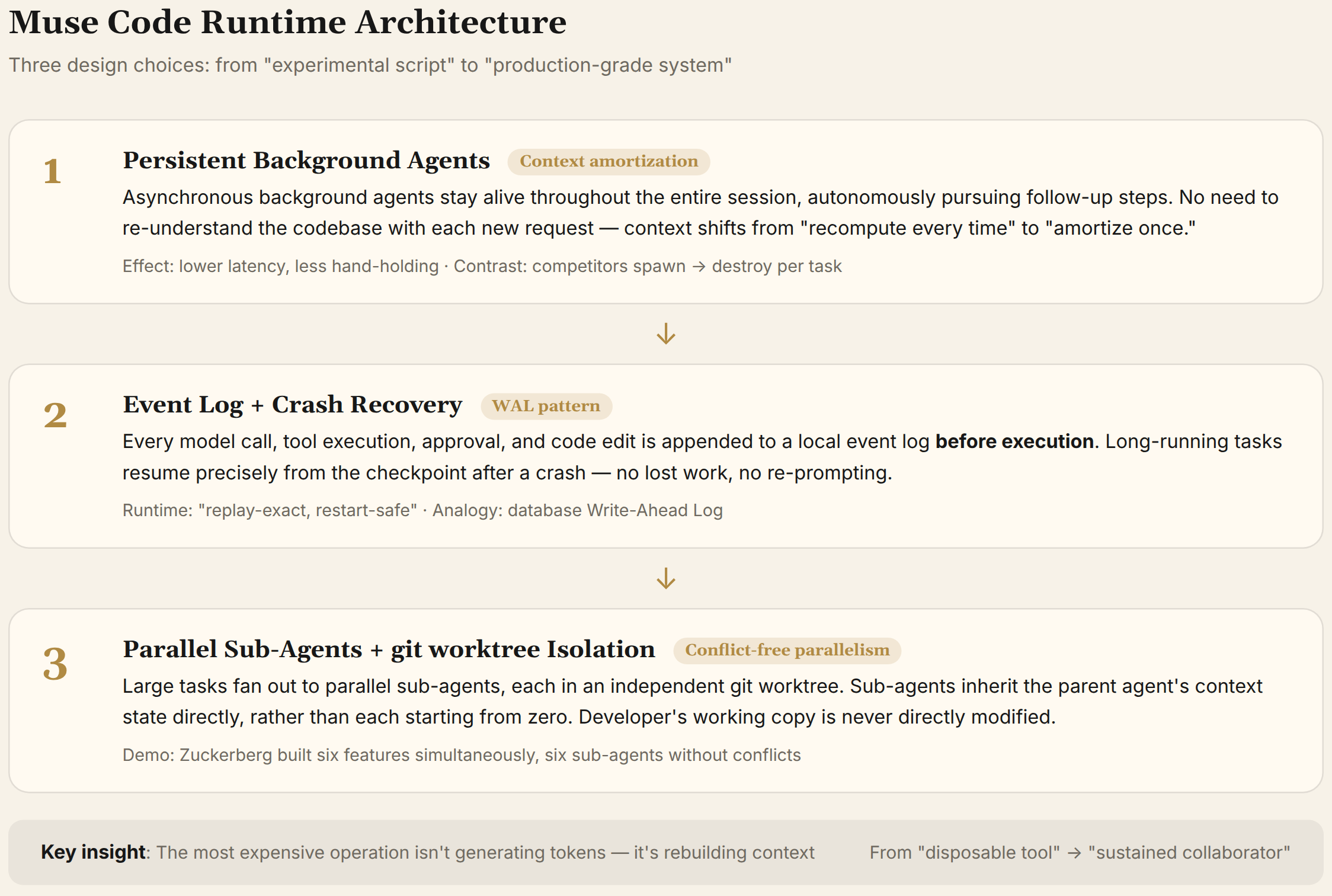
git worktree isolation isn't a new concept — Claude Code and other tools have similar mechanisms. But Muse Code's difference is combining "persistence" and "parallelism" as a joint value proposition: background agents have already accumulated codebase context, and when tasks parallelize, each sub-agent can directly inherit the parent agent's context state rather than starting from zero.
3. Built-in Skills: Loop Engineering Codified as Commands
Muse Code ships with three command-level skills:
| Command | Function | Corresponding Loop Pattern |
|---|---|---|
/plan |
Turn a task into a plan with approval gates | Planning loop |
/grill |
Stress-test the plan until it holds up | Validation loop |
/goal |
Drive the agent toward goal completion | Execution loop |
These directly correspond to the loop patterns defined in Anthropic's Loop Engineering guide. Muse Code codifies three of them into one-key commands.
More importantly, Muse Code's model Muse Spark 1.2 was co-trained with the Muse Code tool. Meta states that code execution traces and agent interaction optimization recipes were injected into training to specifically fit this runtime's interaction patterns.
This is an extension of the "model-as-product" philosophy — not building a general model and then wrapping tools around it, but designing model and tool together, training them together.
4. Pricing: Trading Data for Price Cuts
Muse Code's pricing strategy is too aggressive to explain with traditional cost-based pricing:
| Tier | Input $/M | Cached input $/M | Output $/M |
|---|---|---|---|
| Standard pay-as-you-go (no data retention) | $1.25 | — | $4.25 |
| Contributor tier (data training allowed) | $0.10 | $0.002 | $0.20 |
| Claude Sonnet 5 (standard) | $3 | — | $15 |
| Claude Sonnet 5 (limited discount) | — | — | $10 |
| GPT-5.6 Sol | — | — | $30 |
| DeepSeek V4 Flash | ~$0.14 | ~$0.003 | ~$0.28 |
Contributor tier vs. standard tier: output price is 21× cheaper, input price is 12.5× cheaper, plus an extremely low cache price ($0.002/M) that widens the effective cost gap further. Compared to Claude Sonnet 5's standard output price of $15, Muse Code's contributor output at $0.20 — a 75× gap.
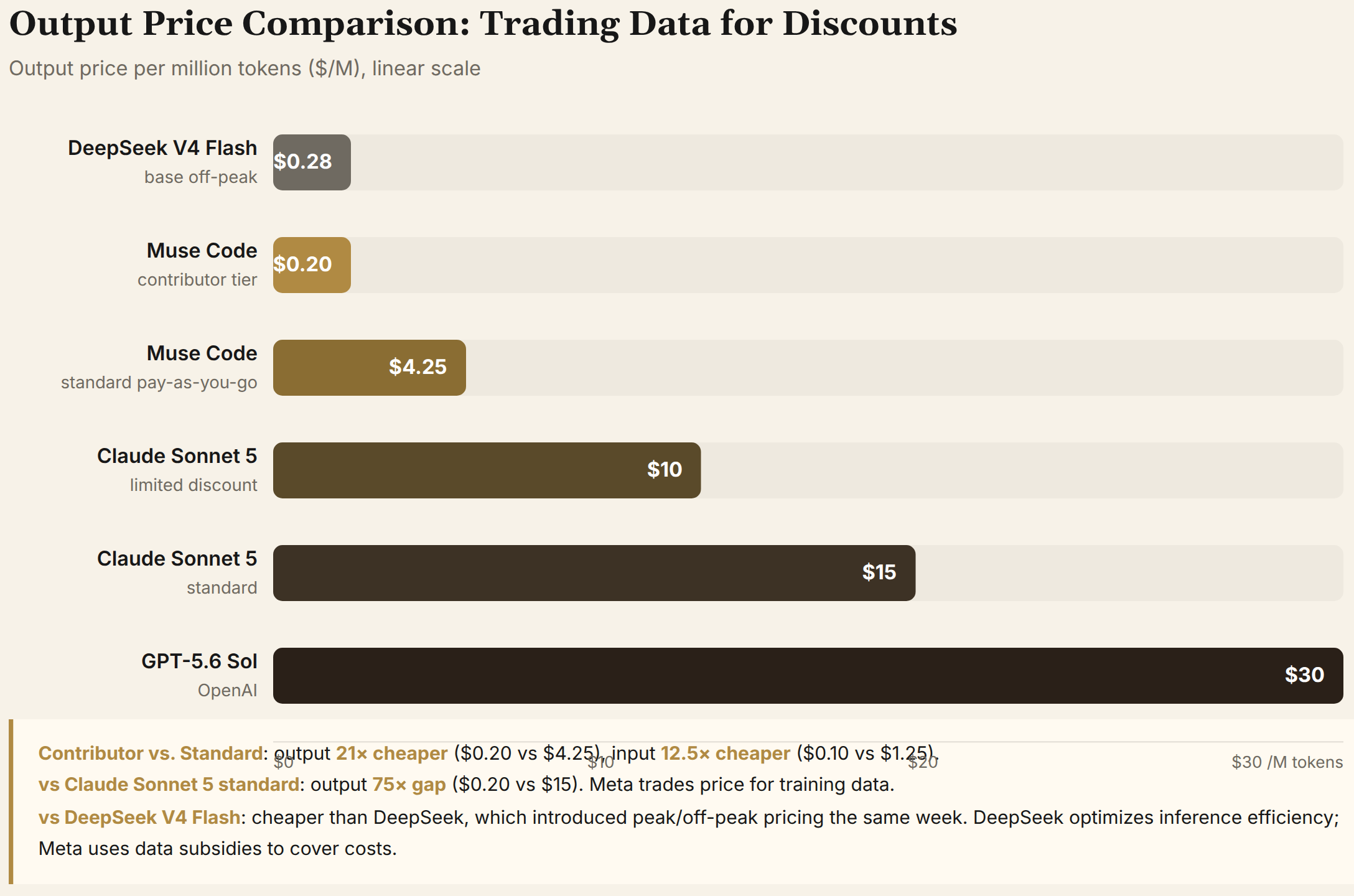
Even cheaper than DeepSeek V4 Flash, which introduced peak/off-peak tiered pricing in the same week. This is no longer normal pricing strategy. Meta's strategy is clear: trade price for data.
What Meta lacks most right now isn't compute (it has one of the world's largest GPU clusters) or talent (Meta Chief AI Officer Alexandr Wang leads the Superintelligence Lab) — it's high-quality coding data. Public code datasets (GitHub, StackOverflow) have already been trained on by every model, with diminishing marginal value. What's genuinely valuable: real developer interaction traces during agent usage — how tasks get decomposed, which solutions are rejected, which modifications are accepted, how errors are fixed.
The contributor tier's substance is using massive price cuts to purchase these interaction traces. If enough developers accept this trade, the training data quality and diversity Meta gains will far exceed any public dataset. This creates a flywheel: low prices attract developers → developer usage generates data → data improves the model → the model gets better → attracts more developers.
Notably, DeepSeek introduced peak/off-peak tiered pricing in the same week (2× during peak hours), with base prices unchanged. This is a different direction from Meta's price cut — DeepSeek is optimizing inference cost efficiency, while Meta is using data subsidies to cover costs. The two cost structures are fundamentally different.
5. A New Phase in Agent Execution Environment Competition
Placing Muse Code in the industry context, the agent execution environment competition is migrating across three dimensions. These three dimensions are not strictly sequential — every player is investing across all three simultaneously, but with different weights.
Dimension 1: Model capability (primary battlefield from early 2025 to mid-2026). Whose model is stronger, whose agent is more useful. Anthropic won this phase — Claude Opus 5's advantage in coding ability and instruction following directly translated into Claude Code's market leadership.
Dimension 2: Runtime architecture (accelerating from mid-2026). As model capabilities converge, differentiation shifts to agent runtime reliability. Muse Code's event log, crash recovery, and persistent agents are runtime-level innovations. Anthropic's skill system and OpenAI's Codex sandbox are moving in the same direction.
Dimension 3: Cost structure (now arriving). When model capability and runtime both converge, price becomes the decisive dimension. Meta is using cost-dimensional pricing to attack the runtime-dimensional market — not waiting for runtime maturity to justify a premium, but pressing prices down to the floor immediately.
This strategy mirrors e-commerce platform price wars: short-term losses for long-term lock-in. The difference is that Meta isn't trading for market share — it's trading for training data.
6. Judgments
6.1 Will persistent agents become an industry standard?
Most likely yes. Context rebuilding is the biggest waste in agent systems. Any team that has done agent engineering will realize that having an agent understand a codebase from scratch every time is unworkable. Muse Code making persistence the default behavior rather than an option is a clear product judgment. Expect Claude Code and Codex to follow with similar mechanisms in subsequent releases.
6.2 Will event logs become an enterprise adoption threshold?
Possibly. The biggest enterprise concern about agents isn't capability — it's auditability. In compliance-heavy industries (finance, healthcare, defense), an unauditable agent simply won't be allowed into production systems. Muse Code's "replay-exact, restart-safe" runtime targets this need directly. If Meta standardizes this log format, it could even become the agent industry's audit baseline.
6.3 How fast can the data-for-price flywheel spin?
It depends on developer privacy acceptance. Individual developers and startups may happily trade code data for major price cuts. Enterprise legal and security teams will almost certainly reject the "contributor tier" — code is a core asset, and data retention policies are non-negotiable. So Meta's flywheel will spin fast on the individual/small-team side, but on the enterprise side it needs to compete with the "zero data retention" tier (standard pay-as-you-go pricing), where the price advantage narrows dramatically.
Two frictions are also worth noting: first, the training value of developer interaction traces is not yet publicly validated — interaction data may contain significant noise (failed attempts, invalid paths), and Meta has not published quantitative results on how much this data improves models. Second, Anthropic and OpenAI's pay-as-you-go billing models are themselves collecting interaction data — they don't need a separate "contributor tier" to obtain training data. Meta needing to use explicit low-price incentives suggests its regular user base isn't large enough yet.
6.4 The deeper signal for Meta
Against the backdrop of slowing ad business growth and surging AI infrastructure investment, Meta urgently needs to demonstrate AI commercialization capability. Muse Code is a new revenue pipeline — though it may operate at a loss in the short term, it simultaneously serves two goals: opening an AI tools revenue line and acquiring high-quality training data. Of these two goals, the latter has far greater long-term strategic value for Meta than the former.
If Muse Code's data flywheel starts spinning, Meta's next-generation coding model (Muse Spark 2.x) could approach or even match Claude and GPT in performance — because it will possess something competitors don't: massive real developer interaction traces. By then, the model capability gap would be erased by data advantage, and Meta would have already established positions in both runtime and cost dimensions.
7. The Bigger Picture
This article continues locsic.com's agent infrastructure series and can be read alongside previous pieces:
- Loop Engineering ("When Loop Becomes the Engineering Unit"): Defined agent loop patterns and token management levers. Muse Code's three skill commands directly correspond to planning, validation, and execution loops.
- Agent Execution Environment War ("When AI Agents Need a Desk"): Argued that execution environments would become a new competitive dimension. Muse Code's runtime design is validating that judgment.
- MCP Protocol Revision ("From Tool-Calling Protocol to Infrastructure"): MCP lets agents standardize access to external tools. Muse Code's built-in skills and event log are upper-layer runtime in the MCP ecosystem, complementary to MCP's lower-layer connection protocol.
Agent infrastructure competition is shifting from single-point innovation (stronger models, better completions) to systems integration (runtime + model + data flywheel + cost structure). Muse Code is the first product to explicitly bundle all dimensions together. It may not be the ultimate winner, but it defines the new baseline for competition.
Sources: Meta official blog, Zuckerberg X platform announcement, CNBC, TechCrunch, Artificial Analysis, Zhidx. Benchmark data from Meta official announcements. Pricing data as of August 7, 2026; Claude Sonnet 5 limited discount through August 31, 2026. Not investment advice.