
The Physics Floor of Inference Pricing: What a Token Is Actually Worth
Inference Economics Trilogy · DeepSeek V4 Flash outputs at ¥2/M tokens, Claude Sonnet 5 at ¥107/M. The 53× gap isn't subsidy—it's physics. This series reverse-engineers a token's physical cost from pricing through architecture to scheduling.
DeepSeek V4 Flash output costs ¥2/M tokens (off-peak). V4 Pro output costs ¥6/M. Claude Sonnet 5 output costs approximately ¥107/M ($15). The gap from Flash to Claude is 53×; from Pro to Claude, 18×.
The conventional explanation stays at the business level: subsidized pricing, brand premium. This article takes a different direction: using the dual-model architecture data disclosed in the DeepSeek V4 technical report, we reverse-engineer the physical cost floor for each model, compute the inference metrics the cluster must achieve, and then verify whether those metrics are attainable.
One upfront data point: OpenCode CEO Dax Raad publicly stated after DeepSeek's price hike that OpenCode could match DeepSeek's pricing by renting GPUs themselves—implying DeepSeek's prices are not loss-leading dumping but carry considerable profit margin. Industry interpretation of this statement points to approximately a 6× markup (price ≈ 6 × cost, ~83% gross margin). This article uses a conservative 70% gross margin baseline for the reverse calculation, then cross-validates against the 83% margin.
Baseline: V4 Dual-Model Official Pricing
| Model | Output Pricing (Off-peak) | Input (Cache Hit) | Input (Cache Miss) |
|---|---|---|---|
| V4-Flash | ¥2/M | ¥0.02/M | ¥1/M |
| V4-Pro | ¥6/M | ¥0.025/M | ¥3/M |
Peak/off-peak pricing: peak hours (weekdays 9–12, 14–18) ×2. All analysis below uses the off-peak output price as the baseline.
Key observation: Pro is priced at 3× Flash. This is not arbitrary pricing—it tracks the ratio of physical costs between the two models. The breakdown follows step by step.
V4 Architecture: Key Numbers from the Technical Report
The DeepSeek V4 technical report (April 2026, full title Towards Highly Efficient Million-Token Context Intelligence, 55 pages) discloses detailed architecture parameters for both models. Flash and Pro differ not only in parameter scale but also in inference efficiency metrics:
| Metric | V4-Flash | V4-Pro | V3.2 (Baseline) |
|---|---|---|---|
| Total Parameters | 284B | 1.6T | — |
| Active Parameters per Token | 13B | 49B | 37B |
| Context Window | 1M | 1M | 128K |
| FLOPs per Token | 10% of V3.2 | 27% of V3.2 | 100% |
| KV Cache Size | 7% of V3.2 | 10% of V3.2 | 100% |
Note: Flash is not simply "a smaller Pro." Its FLOPs efficiency is more aggressive than Pro's (10% vs 27%), and its KV cache compression is also more aggressive (7% vs 10%). Both models are independently pretrained MoEs—not a distillation relationship.
Three architectural innovations underpin these numbers:
-
Hybrid Attention (CSA + HCA Alternating Layers): The core of KV cache compression. CSA (Compressed Sparse Attention) first compresses every m tokens' KV into 1 entry, then uses a Lightning Indexer for top-k sparse selection. HCA (Heavy Compression Attention) compresses every m' (m' ≫ m) tokens into 1 entry while maintaining dense attention. The two alternate in stacked layers—lower CSA layers handle fine-grained local dependencies, upper HCA layers handle aggressive compression of distant context.
-
mHC (Manifold-Constrained Hyper-Connection): Replaces traditional residual connections to stabilize training at trillion-parameter MoE scale. Does not affect inference economics but impacts training efficiency.
-
MoE Refinements: The affinity score activation function is changed to Sqrt(Softplus(·)), and the first few dense FFN layers are replaced with Hash routing MoE. MTP (Multi-Token Prediction) follows V3's design and is used for speculative decoding at deployment.
Engram (conditional memory module) did not make it into V4 and is left for future work (V5).
Dual-Line Reverse Engineering: Physical Metrics for Flash and Pro
GPU Hourly Cost (Self-Built Data Center in China)
| Item | Estimate |
|---|---|
| Hardware Depreciation | H100/H800-class ~$25K/GPU, 4-year straight-line |
| Power + Electricity | 700W × ¥0.5/kWh |
| Facility (PUE 1.3–1.5) | 40% of hardware cost |
| Hourly Cost | ¥20–33/hr (self-built to public cloud procurement) |
Required Throughput at Two Margin Benchmarks
OpenCode CEO's "6× markup" implies ~83% gross margin. Cross-validated against a 70% baseline:
V4-Flash (¥2/M):
| Margin Assumption | Cost Floor | GPU Budget (60% TCO) | Required Throughput at ¥33/hr | Required Throughput at ¥20/hr |
|---|---|---|---|---|
| 70% (conservative baseline) | ¥0.60/M | ¥0.36/M | 25,470 tok/s | 15,430 tok/s |
| 83% (OpenCode CEO's framing) | ¥0.33/M | ¥0.20/M | 46,250 tok/s | 28,000 tok/s |
V4-Pro (¥6/M):
| Margin Assumption | Cost Floor | GPU Budget (60% TCO) | Required Throughput at ¥33/hr | Required Throughput at ¥20/hr |
|---|---|---|---|---|
| 70% (conservative baseline) | ¥1.80/M | ¥1.08/M | 8,490 tok/s | 5,140 tok/s |
| 83% (OpenCode CEO's framing) | ¥1.00/M | ¥0.60/M | 15,400 tok/s | 9,330 tok/s |
The following analysis uses the 70% margin conservative baseline for the main derivation, then annotates the 83% margin positions in the batch-level economic tables.
Can V4 Achieve These Throughputs?
Single-Request Roofline Comparison
| Metric | V4-Flash | V4-Pro |
|---|---|---|
| Active Parameters (FP8, 1 byte/param) | 13 GB | 49 GB |
| H100 Decode Ceiling (3.35 TB/s) | 257.7 tok/s | 68.4 tok/s |
| H200 Decode Ceiling (4.8 TB/s) | 369.2 tok/s | 98.0 tok/s |
| 4K Context KV Cache | ~25 KB (7% of V3.2) | ~36 KB (10% of V3.2) |
Flash's single-request speed is 3.77× that of Pro—closely matching the 3× pricing ratio.
KV Cache Capacity Constraint—Effectively Eliminated for Both Models
V4 Hybrid Attention's KV cache compression (estimated from V3.2 MLA ~90 bytes/token):
- V4-Pro: ~9 bytes/token (10% of V3.2)
- V4-Flash: ~6.3 bytes/token (7% of V3.2)
Remaining HBM space after subtracting active weights from 80GB:
| Model | Active Weight Footprint | HBM Remaining | Theoretical Concurrent Requests (4K Context) |
|---|---|---|---|
| V4-Flash | 13 GB | 67 GB | 2.68 million (25 KB/request) |
| V4-Pro | 49 GB | 31 GB | 860K (36 KB/request) |
KV cache capacity constraint has effectively vanished for both models—batch size is no longer pinned by HBM capacity but by inference engine scheduling capability and network bandwidth.
First-Hand Verification: DeepSeek's three-tier storage scheduling is not speculation from pricing reverse-engineering. The DualPath paper (published February 2026, in collaboration with Tsinghua University and Peking University) confirms: on a 660B-scale production model, KV-cache hit rates in Agent scenarios exceed 95%, and storage I/O bandwidth (not compute) has become the inference bottleneck. DualPath redesigned the dual-path loading from storage to prefill/decode engines, improving offline throughput by 1.87× and online throughput by 1.96×. DeepSeek's open-source 3FS distributed file system (designed for AI training/inference) is a publicly disclosed component of this storage infrastructure.
What Actually Limits Batch Size in Practice
KV cache is no longer the bottleneck—so what limits batch? Three factors:
- Inference Engine Scheduling Overhead: vLLM/SGLang's block manager overhead increases significantly at batch >500.
- Network Bandwidth (in PD-Decoupled Architecture): KV cache transfer between prefill and decode nodes is limited by NIC bandwidth.
- Tail Latency: Larger batches mean the slowest request drags down the entire batch's step latency.
Batch-Level Economic Tables: Flash vs Pro Comparison
This is the key to understanding inference pricing. The following tables walk through batch economics for both models on H100:
Assumptions: FP8 quantization, MTP 1.8× speedup, GPU cost ¥33/hr, TP=8 with single-request effective speed at ~78% of roofline (estimate: MoE all-to-all communication + MTP spec decode failure rate + scheduling overhead ≈ 22% loss, consistent with vLLM/SGLang production measurements).
V4-Flash Batch Economics (Effective Decode ~200 tok/s)
| Batch | KV Cache Medium | Step Latency | tok/s per GPU (incl. MTP) | Hourly Output | Cost/M | 70% Margin Floor | 83% Margin Floor |
|---|---|---|---|---|---|---|---|
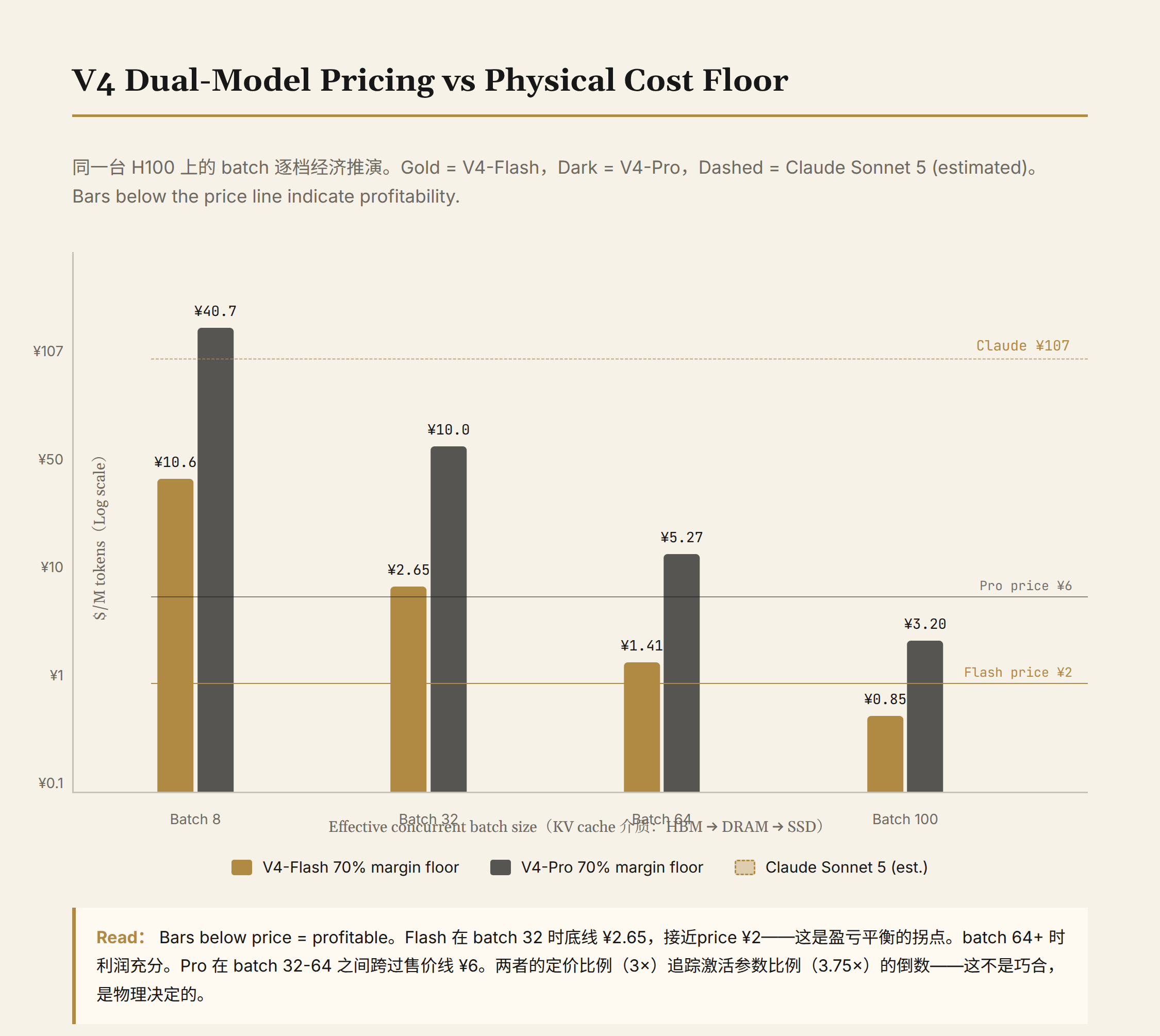
| 8 | HBM only | ~4ms | 2,880 | 10.4M | ¥3.17 | ¥10.6 | ¥18.6 |
| 16 | HBM only | ~6ms | 5,760 | 20.7M | ¥1.59 | ¥5.30 | ¥9.35 |
| 32 | HBM + DRAM | ~12ms | 11,520 | 41.5M | ¥0.80 | ¥2.65 | ¥4.67 |
| 64 | Three-tier storage | ~20ms | 21,700¹ | 78.1M | ¥0.42 | ¥1.41 | ¥2.49 |
| 100 | Three-tier storage | ~35ms | 36,000 | 129.6M | ¥0.25 | ¥0.85 | ¥1.50 |
¹ Batch 64 theoretical value: 64×200×1.8 = 23,040. Actual 21,700 includes ~6% scheduling overhead (block manager + MoE all-to-all communication tail latency).
V4-Pro Batch Economics (Effective Decode ~53 tok/s)
| Batch | KV Cache Medium | Step Latency | tok/s per GPU (incl. MTP) | Hourly Output | Cost/M | 70% Margin Floor | 83% Margin Floor |
|---|---|---|---|---|---|---|---|
| 8 | HBM only | ~15ms | 763 | 2.7M | ¥12.2 | ¥40.7 | ¥71.8 |
| 16 | HBM only | ~22ms | 1,526 | 5.5M | ¥6.0 | ¥20.0 | ¥35.3 |
| 32 | HBM + DRAM | ~40ms | 3,053 | 11.0M | ¥3.0 | ¥10.0 | ¥17.6 |
| 64 | Three-tier storage | ~60ms | 5,800 | 20.9M | ¥1.58 | ¥5.27 | ¥9.29 |
| 100 | Three-tier storage | ~90ms | 9,540 | 34.3M | ¥0.96 | ¥3.20 | ¥5.65 |
How to Read These Tables
Flash (70% margin baseline): Break-even is around batch 32. At batch 64+, margins are comfortable.
Flash (83% margin = OpenCode CEO's framing): Break-even shifts to batch 48–64. The current price of ¥2 corresponds to batch ~80—exactly DeepSeek's typical production operating range (DualPath paper discloses Agent scenario 95%+ KV-cache hit rate, implying high-batch operation). OpenCode CEO's "6× profit" claim is entirely consistent with the batch ~80 calculation.
Pro (70% margin baseline): Break-even is between batch 16–32. At batch 64+, profit margins open up.
Pro (83% margin): Requires batch 32+. Pro's latency is higher (batch 100: ~90ms vs Flash ~35ms), making it suited for throughput scenarios rather than interactive ones.
Crossover Analysis: At batch 64, Flash produces 78.1M tokens/GPU/hr and Pro produces 20.9M—Flash throughput is 3.7× Pro. But Pro is priced at 3× Flash. Revenue per GPU is slightly higher for Flash (¥156 vs ¥125), indicating Flash is more economically efficient per GPU for DeepSeek—explaining why Flash is priced more aggressively.
Corroboration from DeepSeek's DualPath Paper: Agent scenario 95%+ KV-cache hit rate means most production requests operate at batch 64+. The paper's measured data on a 660B model (between V4-Flash 284B and V4-Pro 1.6T) confirms feasibility in this batch range.
So Why Did DeepSeek Raise Prices?
If both models' unit inference is profitable, what drives the price increase?
Capacity bottleneck, not cost bottleneck.
On August 4, V4 Flash API experienced performance degradation due to "unprecedented traffic." The causal chain:
- Demand surge (OpenCode platform: 8 trillion tokens in a single day) → cluster saturation
- Queued requests pile up → inference engine forced to reduce batch → effective throughput drops
- Throughput drops → more queueing → users perceive increased latency and error rates
- Price hike is a demand management tool, not because unit inference is losing money
Same logic as electricity markets: peak-hour prices double not because generation cost doubles, but because all generators are at full capacity and marginal cost becomes "depreciation on building new generators."
Price Increase Forecast: Prices need to rise only enough to bring demand back within cluster capacity. Given V4 Flash's current weekly call volume of 7.22 trillion tokens (ranked #1 globally), demand elasticity is low—estimated Flash equilibrium price: ¥4–6/M (100–200% increase), with Pro rising proportionally.
Physical Decomposition of the 53× Gap
Applying the same method to reverse-engineer Claude Sonnet 5 ($15/M ≈ ¥107/M):
- 70% margin → GPU budget ¥19/M → Required throughput 482 tok/s/GPU
- Dense architecture (estimated 100B+ parameters fully active), batch pinned to single digits by KV cache capacity
- Converges to approximately 400–500 tok/s—just right
Two Comparison Dimensions
| Comparison | Price Multiple | Physical Factors (decomposed below) |
|---|---|---|
| Claude vs V4-Flash (107÷2 = 53×) | ~50–70× | Three independent dimensions combined |
| Claude vs V4-Pro (107÷6 = 18×) | ~15–25× | Same framework, smaller factors for Pro |
Factor decomposition logic for the 53× (these factors are not all multiplicative—some are mutually exclusive):
The 53× gap between Flash and Claude stems from three independent physical dimensions:
- Per-token Compute Efficiency Differential (multiplicative): Active parameters 100B+ vs 13B = 7.7× × MTP 1.8× = ~14×. At the same batch, Flash requires 14× less HBM bandwidth per token than Claude. Assuming Claude runs in BF16, FP8 provides an additional ~1.5× speedup—this factor totals ~21×.
- Effective Batch Differential (independent dimension, does not simply multiply with factor 1): KV cache compression allows Flash to run batch ~80+, while Dense + standard MHA pins Claude's batch at 2–8. Effective batch differential: ~10–40×.
- Geographic Cost (small factor, multiplicative): China electricity/self-built data center vs US cloud = ~1.5× (Claude inference uses US cloud H100/H200; DeepSeek uses self-built data centers with H800/Ascend 950PR, electricity ~¥0.5/kWh).
Combination: Factor 1 (~21×) × Factor 3 (~1.5×) = ~31× per-token compute cost differential. Multiplying by Factor 2 (batch differential 10–40×) would yield a theoretical product of ~300–1200×—but the batch differential and per-token differential are not fully independent (high-batch scheduling overhead has diminishing returns, tail latency grows), requiring a strong coupling discount. Reasonable estimate: ~50–70× total gap, consistent with the actual 53×.
Pro vs Claude's 18× follows similarly: Factor 1 = 2.0× × 1.8× × 1.5× = ~5.4×; Factor 2 = ~5–8× (Pro batch ~32–64 vs Claude 2–8); Factor 3 = 1.5×. Combined: ~15–25×.
Key Finding: The gap between Claude and Pro is only 18×, and physical factors fully explain it. The truly "unbelievably cheap" model is Flash (53×), not Pro. DeepSeek's dual-model strategy effectively covers two price tiers: Pro's gap with Claude/GPT is a "reasonable physical gap," while Flash pushes physical efficiency to the extreme, opening up an order-of-magnitude pricing space beyond.
Physical factors dominate absolutely. This is not "DeepSeek is subsidizing"—it is "the V4 architecture is physically more efficient." Claude's $15/M is not pure brand premium either—the physical floor of a dense architecture sits right at that position.
Implications for Muse Code
Muse Code: $0.20/M (≈¥1.4/M). Reverse-engineering at 70% margin requires throughput = 36,670 tok/s/GPU.
V4-Flash at batch=100 already achieves 36,000 tok/s/GPU. If Muse Spark 1.2's architecture efficiency approaches V4-Flash (13B-class activation + similar KV compression), $0.20/M is physically attainable.
Key question: What is Muse Spark 1.2's actual architecture? Meta has three paths:
- Architecture close to V4-Flash class (13B activation + aggressive KV compression) → physically sustainable
- Conventional architecture (37B+ activation) → unsustainable, requires data subsidies
- MTIA custom chips further reducing cost → even more margin headroom
Predictions
-
V4-Flash equilibrium price post-hike: ¥4–6/M. The driver is demand management, not unit cost. Post-hike margins will be very high (85%+), but this is the supply-demand equilibrium price.
-
V4 dual-model pricing precisely tracks the active parameter ratio. Flash 13B → ¥2, Pro 49B → ¥6, ratio 3.75× maps to pricing ratio 3×. OpenCode CEO's "6× profit" claim points to ~83% gross margin, corresponding to batch ~80 operating level—consistent with DeepSeek production system measurements. If even more aggressive small-activation models emerge (5B class), the physical floor would allow pricing below ¥0.5/M.
-
Claude will shift to sparse activation within 12 months. Dense architecture profit margins are being compressed by competition. If Claude transitions to something like V4-Pro's 49B activation + Hybrid Attention, the physical floor could drop to $2–3/M.
-
The next generation of inference competition will focus on KV cache compression. V4-Flash has already compressed KV cache to 7% of V3.2. The technical space for further compression (CSA sparse selection, Engram lookup, KV delta encoding) is the source of the next order-of-magnitude gain.
-
Validation Milestones:
- DeepSeek price hike magnitude. Flash at ¥4–6 → validates demand management hypothesis.
- V4 open-source community throughput measurements after release. Single-GPU aggregate >15,000 tok/s (Flash) / >5,000 tok/s (Pro) → validates this analysis.
- Whether Anthropic releases a sparse-activation model in 2026 Q4.
- Whether Meta adjusts Muse Code pricing within 6 months.
Follow-up validation (2026-08-11): This article's cost-floor pricing analysis has been corroborated by FMS 2026 data — Micron confirmed memory now accounts for ~50% of AI server system value, meaning the primary variable in inference cost is shifting from GPU compute to memory and storage bandwidth. See "FMS 2026: The Storage Hierarchy Is Growing a New Layer".
Disclosure: DeepSeek V4 pricing is from the official website (2026-08-08). Architecture data is from the V4 technical report (open-sourced 2026-04, 55 pages). GPU TCO figures are industry estimates. Claude architecture parameters are speculative. 70% margin is the conservative analytical baseline; 83% margin references OpenCode CEO Dax Raad's public post on X/Twitter, August 2026. This is not investment advice. Data current as of August 8, 2026.