
Windows is shifting from "an OS that runs apps" to "a platform that runs agents"—this isn't just a change in technical direction; it's a trillion-dollar company redefining its core identity.
June 2–3, 2026, Fort Mason Center, San Francisco. Microsoft moved Build from Seattle to San Francisco—not a random venue choice, but a geographic declaration: Microsoft is planting itself in the heart of AI territory, competing with Google, OpenAI, and Meta for developer mindshare.
Satya Nadella opened with a line that the entire Build revolved around: "Windows is the best platform for building agents."
Note what he didn't say—"running apps," "developing software." He said "building agents."
That word choice reveals Microsoft's bet: the future of development isn't just writing apps, but writing agents; not just deploying to servers, but deploying to everyone's PC. And Microsoft intends to be the operating system for this new world.
This article answers three questions:
- What products is Microsoft using to turn Windows into Agent OS? How is the entire product stack laid out, from the low-level runtime to the Office suite?
- What has Microsoft done on the developer ecosystem front—with OpenClaw native integration, Visual Studio becoming an Agent IDE, and the developer toolchain evolving?
- What are the odds of this gamble paying off?
I. Product Layout: The Five-Layer Architecture of Agent OS
Build 2026 wasn't a scatter of point AI feature releases. Microsoft is effectively building a complete vertical stack—from chips to cloud, from OS to Office apps—where every layer is redesigned around agents.
This stack can be divided into six layers:
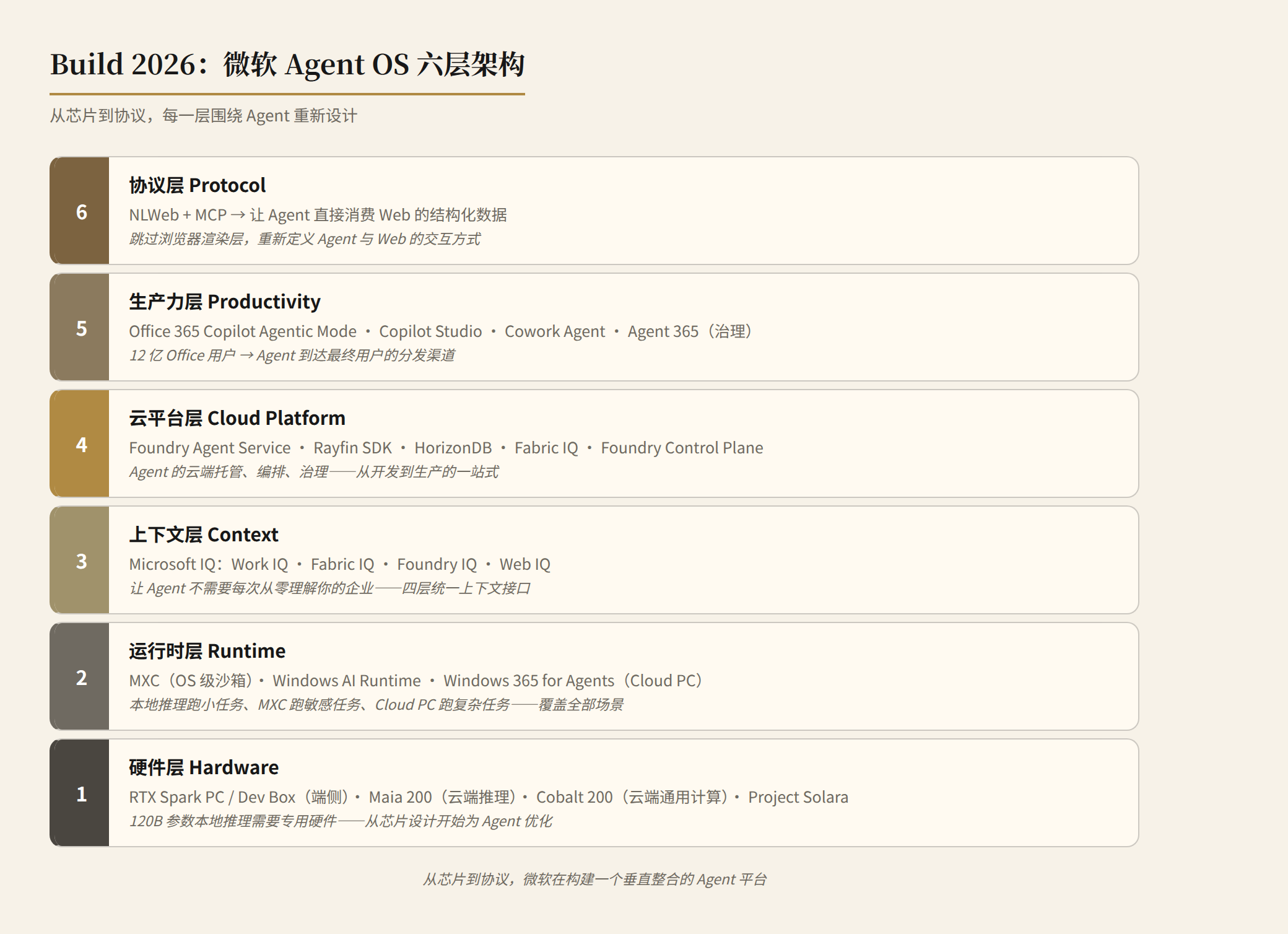
| Layer | Product | Responsibility |
|---|---|---|
| Hardware | RTX Spark PC / Dev Box / Solara + Maia 200 / Cobalt 200 | On-device and cloud AI compute vehicles |
| Runtime | MXC + Windows AI Runtime + Windows 365 for Agents + Foundry Agent Service | Security sandboxes, local inference, and cloud-hosted execution environments for agents |
| Context | Microsoft IQ (Work/Fabric/Foundry/Web) | Enabling agents to understand enterprise context and real-time information |
| Cloud Platform | Microsoft Foundry + Rayfin + HorizonDB | Cloud hosting, orchestration, and database for agents |
| Productivity | Office 365 Copilot + Agent 365 + Copilot Studio | Agents executing tasks in productivity scenarios, unified enterprise governance |
| Protocol | NLWeb + MCP | Enabling agents to consume structured data from the entire Web |
1.1 Hardware Layer: RTX Spark and Solara
Microsoft showcased two hardware form factors for Agent OS at Build.
The Surface RTX Spark Dev Box is the developer edition: NVIDIA RTX Spark chip (Arm architecture), 1 PFLOPS AI compute, 128GB unified memory. It can run a 120B-parameter LLM locally with 1M token context, WSL2 native GPU passthrough with CUDA.
Why build a local large model Dev Box instead of having developers use cloud GPUs? Two reasons: First, cost—developers frequently call APIs when debugging agents, and token fees add up fast. Local inference can absorb that cost. Second, privacy—enterprise agent debugging involves internal data and code, and running locally is easier to clear through compliance review than running in the cloud.
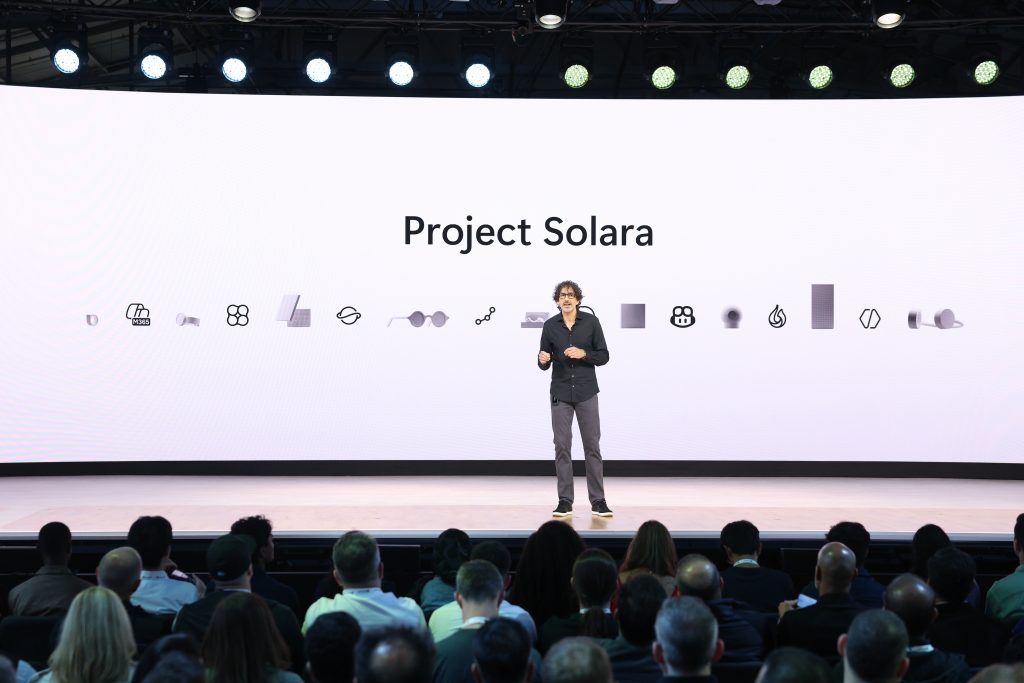
Project Solara is a concept device, a chip-to-cloud agent-first platform. These two concept devices aren't development tools but vision showcases—Qualcomm CEO Cristiano Amon took the stage to imagine agent-specific hardware. ASUS, Dell, HP, Lenovo, and MSI are all launching RTX Spark devices this fall.
The signal Microsoft is sending at the hardware layer is: The compute power agents need is beyond what current PCs offer—120B parameters, 1M token context requires purpose-built hardware. And the energy efficiency advantages of the Arm architecture (RTX Spark is NVIDIA's first Arm superchip) make local large model inference feasible in terms of power consumption and thermal management.
1.2 Runtime Layer: MXC, Local Inference, and Cloud PC
This is the core layer of Agent OS. Three products address agent execution in different scenarios.
Microsoft Execution Containers (MXC)
What MXC does in one sentence: Provide OS-level isolation sandboxes for agents.
MXC is not Docker, not WSL, not a traditional VM. It's an OS-level sandbox purpose-built for agent runtimes—agents inside can read/write files, call APIs, and execute code, but cannot break out to the host system. Nadella demoed this live on stage: an agent attempted to delete user files and was blocked by MXC.
Current agent framework security models are essentially application-layer—tool call permissions, guardrails, prompt restrictions, all checks at the application logic level. MXC's message is: I don't trust application-layer checks. I'm building isolation into the OS kernel.
MXC is currently in Early Preview, with the SDK open-sourced on GitHub. But several key details weren't addressed at Build: What's the performance overhead of OS-level sandboxing? How do you control isolation granularity—is it the entire agent process, or can you isolate individual tool calls? These are engineering questions that must be answered before the product can ship.
Windows AI Runtime
Windows AI Runtime expands local inference hardware coverage: no longer limited to NPUs—CPUs and GPUs can now participate too. Local SLM support covers more device types.
The surface-level reading of this is "more devices can use AI features." The deeper message is: Microsoft is turning inference capability into operating system infrastructure. An analogy—in 2006, Windows Vista built desktop search into the OS as Windows Search, absorbing what had been a third-party tool category. Now Microsoft is doing the same thing with AI inference, absorbing it from third-party applications into the operating system.
Windows 365 for Agents
This is an easily overlooked but critically important product. Windows 365 for Agents gives agents Cloud PCs—assigning agents a complete Windows desktop environment where they can operate apps, browsers, files, and enterprise systems just like a human would.
In the official documentation's words: "When an agent discovers a task cannot be completed through APIs, it can invoke Windows 365 for Agents to get a Cloud PC and execute operations within a full Windows session."
The implication of this design is: Agents are no longer confined to the API-accessible world. When encountering legacy systems without APIs (ERP, internal tools, outdated enterprise applications), agents can open the interface and operate it like a person. And these operations happen within enterprise boundaries—the Cloud PC's security policies, network isolation, and data protections all apply.
The three runtime layers combined: Local inference for small tasks (Windows AI Runtime), local sandbox for sensitive tasks (MXC), cloud desktop for complex tasks (Windows 365 for Agents). This covers every execution scenario an agent might encounter.
1.3 Context Layer: Microsoft IQ
MXC solves the "can agents run safely" problem. Microsoft IQ solves the "can agents understand your enterprise" problem.
Microsoft splits enterprise context into four layers:
| Layer | Name | Coverage |
|---|---|---|
| 1 | Work IQ | Email, meetings, documents, professional relationships—capturing "how work happens" |
| 2 | Fabric IQ | Structured business data semantic layer—unified data, business intelligence, ontologies |
| 3 | Foundry IQ | Cross-source knowledge retrieval and planning—enabling agents to discover and reuse knowledge |
| 4 | Web IQ | Real-time Web search, MCP-native—giving agents real-time global information |
The engineering ambition of the four layers: let agents not need to understand your enterprise from scratch every time. The biggest bottleneck for agents today isn't model capability—it's context. You give an agent a task, and it doesn't know what tools your team uses, where project documents live, what meetings happened recently, or who the decision-makers are. This information is scattered across email, Teams, SharePoint, databases, and wikis. Agents either gather it from zero each time or rely on humans feeding prompts.
Microsoft IQ's bet: if the OS layer can turn these four layers of context into a unified, agent-consumable interface, agent utility will improve dramatically.
But there's a fundamental engineering question here: How do you ensure data quality and consistency across the four layers of context? Is "项目 A" mentioned in email the same as "Project A" tagged in Fabric? Are the professional relationships captured in Work IQ in sync with the actual organizational chart? If the context itself is noise, the smarter the agent, the more dangerous it becomes.
Microsoft showed polished demos but didn't discuss this consistency problem. This may be the hardest engineering challenge in the productization phase.
1.4 Protocol Layer: NLWeb
NLWeb (Natural Language Web) is the most ambitious and most controversial announcement at Build.
The core idea: Let any website respond to natural language queries, without search engines as middlemen. Built on top of MCP, once a website adds NLWeb support, agents can query it directly and get structured answers—rather than scraping HTML and parsing it.
The subtext of this protocol: if agents can directly consume website content, the browser's raison d'être changes.
Microsoft proposed NLWeb at Build 2025 and began real-world testing at Build 2026. But several key questions remain unresolved:
- Who pays for NLWeb's traffic costs? High-frequency agent queries are pure cost for websites.
- Where are the privacy boundaries? When an agent queries a website on behalf of a user, what can the website track?
- Why would websites voluntarily join a protocol that might weaken their traffic gateways?
Microsoft's answer is "open protocol, community-driven," but commercial dynamics are unlikely to be resolved by goodwill alone. NLWeb's fate depends on whether Microsoft can get enough major websites on board first to create network effects.
II. Productivity Layer: Turning the Office Suite into Agents
If the previous four layers are infrastructure, then turning the Office suite into agents is Microsoft's path to putting agents in front of every user. This is the most critical product layer of Agent OS—because most enterprise users won't care about MXC or NLWeb, but they use Word, Excel, Outlook, and Teams every day.
2.1 Copilot Agentic Mode: From "Help Me Write" to "Help Me Do"
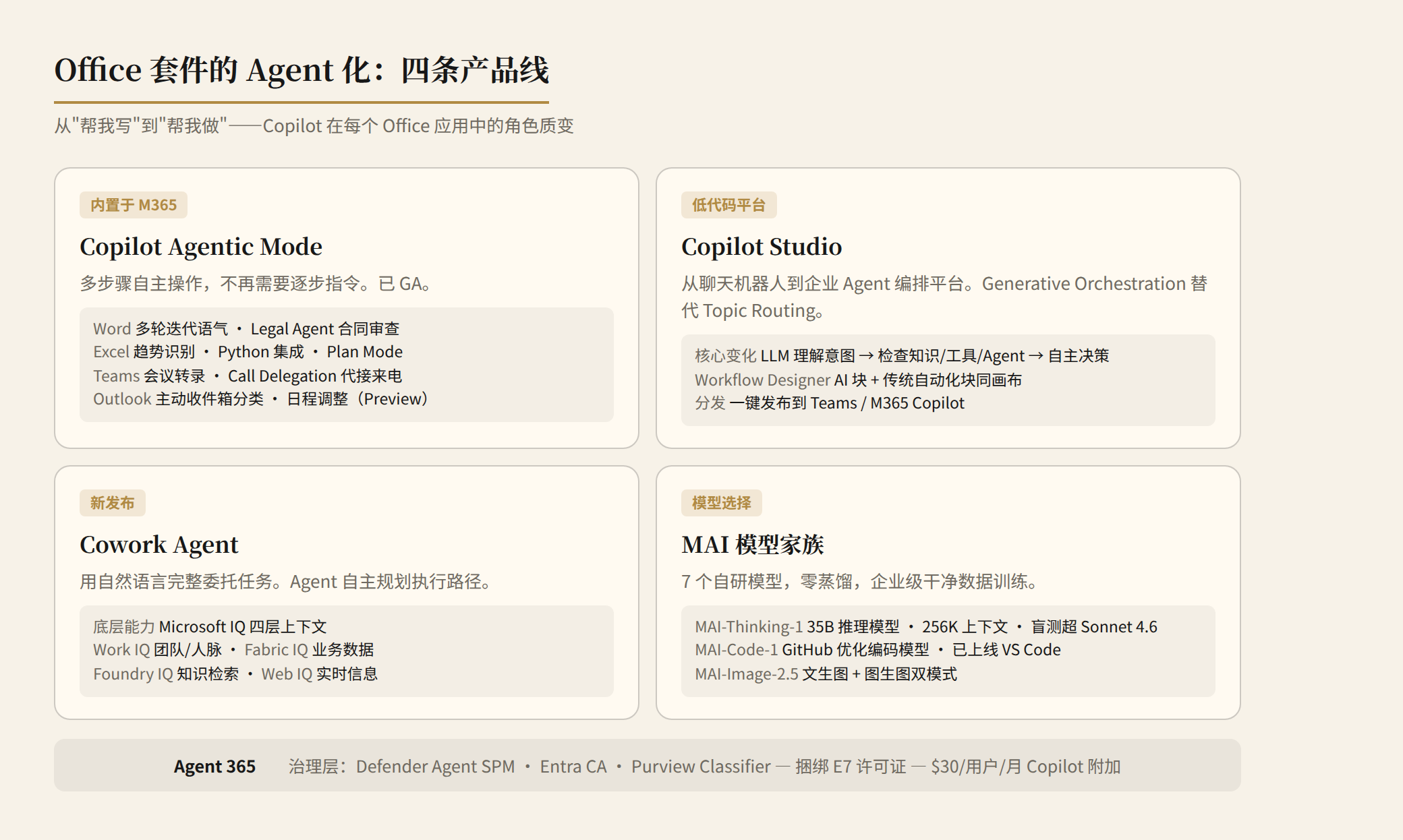
On April 22, 2026, Copilot Agentic Mode officially reached GA in Word, Excel, and PowerPoint. This isn't the early "help me draft an email" capability—Agentic Mode means Copilot can execute multi-step, autonomous operations within documents without step-by-step instructions.
The changes in Word illustrate this best. Copilot is no longer just a text generator—it can iteratively refine document tone across multiple rounds, synthesize proposals from multiple source files, and extract action items from long reports. Even more notable is the Legal Agent: specifically handling contract review, redlining, and negotiation with tracked changes. Word even added a Claude model option (from Anthropic) alongside OpenAI models—Microsoft is giving users model choice inside Office.
In Excel, Copilot goes beyond formula suggestions. It can identify trends, generate formulas, create automatic pivot tables, and supports Python integration for advanced analysis. Plan Mode lays out an operation plan first, waiting for your confirmation before touching the data—this is a paradigm shift from "AI auto-executes" to "AI plans first, then executes."
In Teams, Copilot handles real-time meeting transcription and action item extraction, plus a new feature: Call Delegation—Copilot answers Teams calls on your behalf, collects caller information, and schedules follow-up meetings.
Outlook (Frontier Preview) goes even further: proactive inbox classification, priority sorting, and schedule adjustments, all without user triggers. This is Microsoft testing the boundary of "letting agents read your email for you"—also the feature most likely to trigger user anxiety.
2.2 Copilot Studio: From Chatbot to Agent Orchestration Platform
Copilot Studio (formerly Power Virtual Agents) completed a qualitative transformation around Build: from a low-code chatbot designer to an enterprise-grade Agent orchestration platform.
The core change is the shift of the "center of gravity." The old Copilot Studio used topic routing—user input matched a preset topic, then followed a dialog tree. The new version uses generative orchestration—the LLM understands user intent, checks the Agent's available knowledge, tools, topics, and connected Agents, then decides how to proceed.
The May update's Workflow Designer materializes this shift: a single canvas holds both AI-native blocks (Agents, Prompts, knowledge retrieval) and traditional automation blocks (Power Automate flows, conditional branches, human approvals), orchestrated through the same pipeline.
This means enterprises can build complete Agent workflows in a low-code way: Agents handle reasoning and decisions, Power Automate handles deterministic execution, and human approval nodes provide oversight. All three connect within the same canvas.
2.3 Cowork Agent: Delegating Tasks to Agents
Cowork Agent is a new product announced at Build—an Agent that accepts fully delegated tasks via natural language. You don't need to instruct it step by step; just say "compile this quarter's sales data into a presentation and send it to the team," and it plans and executes on its own.
Under the hood, Cowork Agent leverages Microsoft IQ's four-layer context: it knows who your team is (Work IQ), where the sales data lives (Fabric IQ), how to retrieve relevant documents (Foundry IQ), and what the latest market information is (Web IQ). The four context layers finally have a concrete product embodiment here.
2.4 Agent 365: Enterprise Governance Layer
When an enterprise starts building more than five custom Agents, governance questions emerge: who has the right to create Agents? What data can Agents access? Where are Agent audit logs? Who's responsible when something goes wrong?
Agent 365 is designed to solve these problems. It's not a new Agent product—it's a governance plane:
- Defender Agent SPM (Security Posture Management): Security posture management for Agents
- Entra Conditional Access: Conditional access policies for Agents, integrated with the enterprise identity system
- Purview Classifier: Data classifier controlling which sensitive data Agents can access
- Bundled with the Microsoft 365 E7 license
Agent 365's positioning is to transform Agents from "IT department risks" into "enterprise-controllable infrastructure." This mirrors the historical progression from "each department buying its own SaaS" to "IT centrally managing SaaS"—first wild growth, then centralized governance.
Windows 365 for Agents is also integrated into Agent 365. When an Agent needs a full Windows desktop environment to execute tasks, it gets a Cloud PC under Agent 365's governance framework, with all operations staying within enterprise boundaries.
2.5 Pricing: The Business Model for Agents
Copilot's pricing model deserves a dedicated discussion.
Microsoft 365 Copilot is a $30/user/month add-on license (requiring E3/E5/Business Standard or Premium as the base). When launched in 2023, this price was widely considered "too expensive"—but now Microsoft bundles Agentic Mode, Cowork Agent, and Copilot Studio basic functionality into it. The $30 has become the entry fee for an Agent platform, no longer the cost of a chat assistant.
Copilot Studio standalone is $200/month (25K credits), suited for teams that need to build custom Agents but don't need M365 Copilot.
The subtext of this pricing strategy: Microsoft is using Office's licensing system to distribute Agent capabilities. The billing relationship with 1.2 billion Office users is already established. Agents don't need to re-educate users to pay—it simply adds a line item to the existing bill.
III. Development Ecosystem: OpenClaw on Windows and the Agent IDE
3.1 OpenClaw Natively on Windows
At Build 2026, Microsoft made an announcement that sent shockwaves through the open-source AI community: OpenClaw officially became a first-class citizen on Windows.
From the official Windows Developer Blog:
"OpenClaw runs natively on Windows leveraging MXC. You can easily install and use OpenClaw in Windows with its own companion app." "We are invested in continuing to make OpenClaw run securely on Windows."
Peter Steinberger (OpenClaw's creator) was at Build in person, demonstrating how OpenClaw runs within the MXC sandbox.
This is not a "compatibility support" statement. Microsoft is saying: OpenClaw is one of the core runtimes for the Windows Agent ecosystem. It sits alongside NVIDIA's OpenShell—also an open-source Agent runtime based on MXC, jointly advanced by NVIDIA and Microsoft.
Why would Microsoft bring an open-source Agent framework into native Windows support? Three reasons:
First, ecosystem coverage. OpenClaw is one of the fastest-growing open-source Agent frameworks today, with an active developer community and a rich Agent tooling ecosystem. Bringing OpenClaw to Windows means pulling those developers directly onto the Windows platform.
Second, the security narrative. OpenClaw runs inside the MXC sandbox, so Microsoft can say "even third-party open-source Agent frameworks are secure on Windows." This is far more persuasive than "we have our own security model."
Third, developer mindshare. When developers choose an Agent framework, "natively supported on Windows + MXC sandbox + companion app" becomes a differentiating advantage for OpenClaw. Microsoft is using platform capabilities to endorse a specific framework—something that has recurred throughout operating system history. Windows' native support for Node.js and investment in WSL follow the same strategy.
3.2 NVIDIA OpenShell
NVIDIA OpenShell is another Agent runtime based on MXC. NVIDIA's official blog puts it clearly:
"Top agentic apps are looking to leverage MXC and OpenShell to strengthen their security in Windows, including the popular open source agents OpenClaw and Hermes Agent."
The OpenShell + MXC combination provides Agents with two layers of security: MXC handles OS-level isolation, while OpenShell handles runtime security policies.
The significance of OpenClaw and OpenShell sitting side by side on MXC is this: Microsoft isn't betting on a single Agent framework—it's providing an Agent runtime platform where multiple frameworks share the same security substrate. This aligns with Windows supporting both .NET and Java—the platform doesn't pick sides, but the capabilities it provides make frameworks more inclined to stay on the platform.
3.3 Visual Studio 2026: Agent IDE
Visual Studio 2026 (v18) is the biggest version jump since VS 2022. But its significance lies not in being a "new IDE"—it's that GitHub Copilot has gone from a plugin to the core of the IDE.
Performance improvements: UI lag reduced by 50%, large solution load times improved by 40%. These improvements are necessary—VS 2022 frequently stalls for minutes when opening large C++ projects, and developers have been complaining about this for three years.
But what's truly worth watching is Copilot's deep integration:
Adaptive Paste—when you paste code, AI automatically adapts it to the project's style and context. Copilot analyzes the pasted code against the target project's naming conventions, indentation style, and code structure, then transforms it automatically. Copy code from Stack Overflow or GitHub and paste it into your project, and variable names will automatically adopt the project's style.
Planning Mode—let Copilot explore the codebase in read-only mode first, formulate an implementation plan, then switch to Agent Mode for execution. This is especially important for C++ projects—header dependencies and build system complexity are far greater than in scripting languages. Planning before execution avoids an Agent changing one header file and triggering recompilation of hundreds of files.
Cloud Agent—launch a cloud Agent session directly from VS, automatically creating GitHub Issues and Pull Requests. Copilot's workflow extends from the local editor across the entire CI/CD pipeline.
Agent Skills + MCP + Custom Agents: three extensibility mechanisms turn Copilot into a customizable Agent platform:
- Agent Skills (SKILL.md files): define reusable Agent capabilities. Format paths include
.github/skills/,.claude/skills/,.agents/skills/—note the presence of.claude/skills/, indicating Microsoft is actively maintaining compatibility with Anthropic's format - Custom Agents (
.agent.mdfiles): define team-specific Copilot Agents that perform code reviews, enforce coding standards, and understand codebase architecture - MCP Support: Copilot connects to external tools and knowledge sources via MCP, with unified management UI and enterprise governance policies
VS 2026 supports VS 2022 solution compatibility, 4000+ extension compatibility, and side-by-side installation.
3.4 MSVC Build Tools: Major C++ Update
C++ developers may not get excited about Agent OS, but MSVC's updates represent serious engineering investment.
Full C++23 support—std::expected, std::print, deducing this, multidimensional operator[], and other features are all landed. MSVC had previously lagged behind Clang and GCC in C++23 conformance; v14.50 finally catches up.
Sample Profile Guided Optimization (SPGO)—uses hardware performance counter sampling to collect data directly on release binaries, no instrumentation needed. 5-15% runtime performance improvement with no code changes—just an extra compiler flag. For game engines, quantitative trading, and AI inference engines, this is "free" performance.
Copilot C++ toolchain:
@Modernize: automatically upgrades projects to the latest MSVC version, fixing compilation errors and warnings@BuildPerfCpp: uses Build Insights to analyze build bottlenecks, creates precompiled headers, optimizes include paths, configures parallel builds- Context-aware multi-file refactoring: tracks class inheritance hierarchies and function call chains
- Debugger Agent: validates bugs based on runtime behavior, not static analysis
416 C++ bug fixes.
3.5 .NET 10 + Blazor
.NET 10 is an LTS release, bundled with VS 2026.
Blazor is officially the primary investment direction for ASP.NET Core Web UI. Microsoft stated this explicitly at Build—MVC and Razor Pages are entering long-term maintenance mode.
Blazor 10's key improvements: Kestrel supports memory trimming for the first time (meaningful for high-concurrency scenarios), Native AOT for Web API templates defaults to OpenAPI 3.1 document generation, and Passkey support.
.NET MCP Support: SDK has a built-in MCP server; Agents can directly invoke .NET tools and services.
3.6 Windows Developer Experience: Systematically Reducing Friction
Several changes are worth noting:
- Coreutils for Windows (GA): 75+ common Linux CLI commands run natively on Windows 11, no WSL needed.
ls,grep,curlwork out of the box - WSL Containers (GA): Windows 11 has built-in Linux container management, no need to install Docker Desktop separately
- Intelligent Terminal: terminal with built-in context-aware AI that understands the current directory, recent commands, and environment variables
- Windows Developer Configuration (WinGet-driven): set up a complete development environment with a single command
What Microsoft is doing: turning Windows into an out-of-the-box developer workstation, rather than an environment that requires half a day of configuration.
3.7 Arm Ecosystem: Three-Pronged Approach

- Hardware: Next-generation Arm PCs powered by RTX Spark, launching this fall from ASUS, Dell, HP, Lenovo, MSI
- Toolchain: VS 2026 Arm64 native version, MSVC Arm64 toolchain, .NET Arm64 SDK
- AI-assisted migration: Copilot can help port x86 applications to native Arm Windows
3.8 Rust: Steady Progress
Build 2026 had no major Rust announcements, but infrastructure-level work continues: windows-drivers-rs driver framework, ongoing windows crate updates, find-msvc-tools 0.1.5 supporting VS 2026. Microsoft's positioning for Rust remains "a second language for system-level secure code."
IV. Cloud Strategy: Foundry, Rayfin, and the Agent Supply Chain
The Agent OS story isn't just about Windows locally. Microsoft is simultaneously building a complete Agent cloud infrastructure on Azure—Microsoft Foundry. If MXC is the security sandbox for Agents on local PCs, then Foundry Agent Service is the secure runtime for Agents in the cloud.
4.1 Microsoft Foundry: 11,000+ Model Agent Hosting Platform
Microsoft Foundry had already GA'd before Build 2026, but a series of updates at Build transformed it from a "model supermarket" into a complete Agent lifecycle platform.
Model catalog: 11,000+ foundation models, open-source models, reasoning models, multimodal models, and industry-specific models. Several heavyweights were added at Build:
- GPT-5.5 GA (officially launched on Day 2)
- Claude Opus 4.8 (preview)
- Fireworks AI (GA, third-party inference engine)
- MAI-Image-2 / MAI-Image-2e (Microsoft's in-house image generation)
- NVIDIA Nemotron (enterprise-grade Agentic AI workloads)
11,000+ models sounds like a numbers game, but the underlying logic is: Microsoft doesn't pick sides on models—it's the distribution and governance platform for models. Whether you want OpenAI, Anthropic, Meta, Mistral, NVIDIA, or Microsoft's own—Foundry gives you access to all of them, but billing, security policies, content safety checks, and compliance audits all live within Microsoft's control plane.
Foundry Agent Service is the core product. GA at the end of June, offering:
- Hypervisor-level isolated sandbox: each Agent runs in an independent virtualized environment—not container-level isolation, but VM-level. This is heavier than MXC's OS-level sandbox, but also more secure
- Per-agent Entra ID: each Agent has independent authentication, integrated into the enterprise Entra identity system. Agents no longer share a single service account
- Source code deployment: deploy Agent code directly via
azd(Azure Developer CLI), similar to the Web App deployment experience - Built-in content safety: Content Safety API automatically checks Agent inputs and outputs
- Voice Live + WebSocket: Agents support real-time voice interaction via low-latency WebSocket connections
Foundry Control Plane is the governance layer. Enterprises can use it to:
- Discover and manage all Agents across subscriptions
- Centrally set security policies and access controls
- Publish Agents to Teams and Copilot with one click
- Connect enterprise AI Gateway (preview)
- Configure high availability and disaster recovery
Microsoft Agent Framework 1.0 GA. This is Microsoft's own Agent development framework, open-sourced on GitHub. Its positioning differs from OpenClaw—Agent Framework is more of an "enterprise-grade Agent's .NET-native development framework," while OpenClaw is more of an "open-source Agent runtime." The two can be used in parallel.
4.2 Rayfin: From Prompt to Production Backend
Rayfin is a new product announced at Build, positioned as an Agent-first SDK—turning Agents into backend services.
Traditional backend development: write APIs → deploy → monitor. Rayfin's approach: write Agent behavior descriptions → Rayfin automatically generates backend services → deploy to Foundry → built-in monitoring.
Microsoft describes Rayfin as "the Express.js of Agent development." The analogy means: Rayfin doesn't try to solve everything—it provides a minimal, efficient Agent backend development experience.
Rayfin's actual value depends on whether it can make Agent backend development as simple as writing Express.js. If it can, it becomes an entry-point product—developers start with Rayfin, then naturally enter the Foundry ecosystem.
4.3 HorizonDB and AI-Native Databases
At Build, Microsoft released a database product line for AI applications, collectively called Microsoft Databases. The most notable is HorizonDB—a new database designed for Agent memory and state management.
Agents need two types of memory: short-term memory (current session context) and long-term memory (cross-session knowledge accumulation). Most current Agent frameworks use vector databases for long-term memory, but vector databases only support semantic retrieval, not structured queries. HorizonDB's positioning is to support both semantic retrieval and structured queries—an Agent can "recall" the conclusions from last week's meeting (semantic) and also "query" all approvals processed in the past 30 days (structured).
4.4 Foundry IQ + Fabric IQ: Data Becomes Context
Foundry IQ and Fabric IQ are the concrete manifestations of the Microsoft IQ context layer in the cloud.
Fabric IQ's architecture has three layers:
- Unified Data (base): unified data assets, breaking down data silos
- Business Intelligence (middle): semantic models, transforming raw data into business terms
- Operational Intelligence (top): ontologies, defining relationships between entities
The core problem these three layers solve: when an Agent queries "last quarter's East China sales," it doesn't need to know which table or field the data is in—Fabric IQ maps business semantics to data sources, and the Agent just asks in natural language.
Foundry IQ handles the knowledge layer: letting Agents discover and reuse existing knowledge assets—analyses already compiled by other Agents, indices already built, data cleansing pipelines already validated.
4.5 Agent 365 SDK GA
The Agent 365 SDK is officially GA, free, and framework-agnostic. This means you can build Agents with OpenClaw, LangChain, Microsoft Agent Framework, or any other framework, then use the Agent 365 SDK to plug into Microsoft's governance system (Defender + Entra + Purview).
Build also announced Local Agents Public Preview: Claude Code, Copilot CLI, and OpenClaw can all run locally while connecting to Agent 365's cloud governance.
4.6 The Big Picture of Cloud Strategy
Putting these products together, Microsoft's cloud strategy picture becomes clear:
| Layer | Product | Problem Solved |
|---|---|---|
| Models | Foundry Model Catalog (11,000+) | Model selection, distribution, billing |
| Runtime | Foundry Agent Service | Secure cloud hosting for Agents |
| Development | Agent Framework + Rayfin | Agent development and backend-ification |
| Data | HorizonDB + Fabric IQ | Agent memory and business semantics |
| Knowledge | Foundry IQ | Cross-Agent knowledge reuse |
| Governance | Foundry Control Plane + Agent 365 | Enterprise security and compliance |
| Distribution | Teams + Copilot one-click publishing | Agents reaching users |
The design philosophy of this stack: developers only need to focus on Agent business logic—everything else—security, identity, data, deployment, monitoring, compliance—is provided by the platform.
Compared to AWS Bedrock, Microsoft's advantage lies in end-to-end completeness: from Office desktop to Azure cloud, from Windows local to Cloud PC, fully connected. AWS is stronger at the IaaS layer, but lacks Office as a user-facing distribution channel.
V. AIDC Infrastructure: In-House Chips and Data Centers
Running Agent OS requires compute. Microsoft dedicated a Build 2026 session to "Silicon to Systems," showcasing Azure's AI infrastructure stack—from chips to racks to data centers.
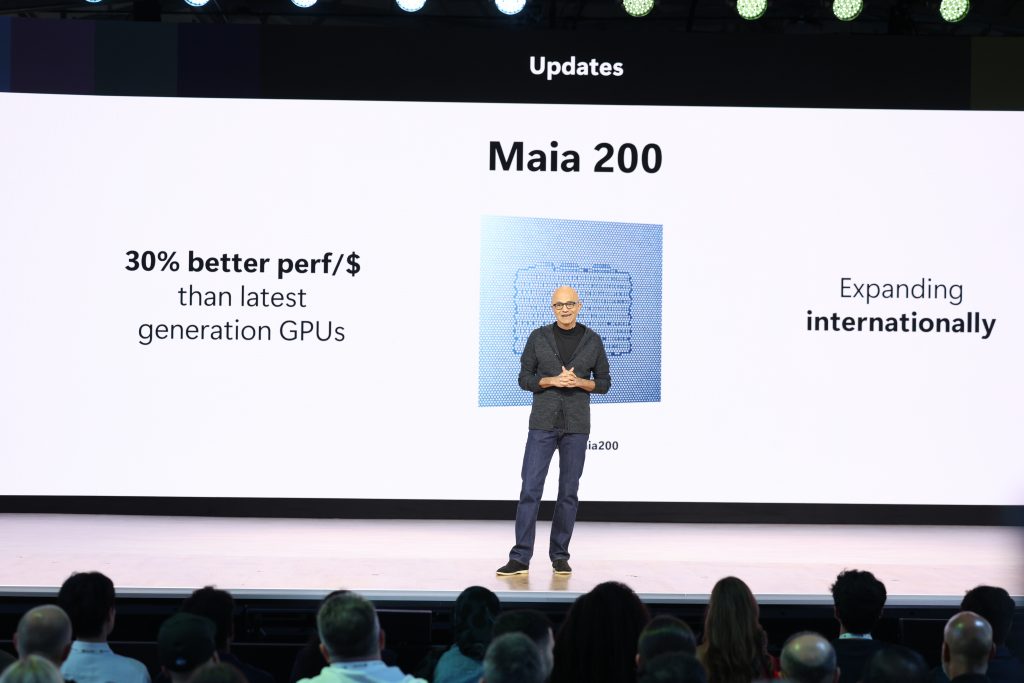
5.1 Maia 200: In-House Inference Accelerator
Maia 200 is the second generation of Microsoft's in-house AI chip (announced January 2026), specifically designed for inference workloads. Key specs:
- TSMC 3nm process
- Native FP8/FP4 Tensor Cores: optimized for low-precision inference
- 216GB HBM3e, 7 TB/s bandwidth
- 272MB on-chip SRAM
- Supports both air-cooled and liquid-cooled deployment, including a second-generation liquid-cooling sidecar design
Maia 200's positioning is clear: not a training chip, but an inference chip. Microsoft EVP Scott Guthrie said at launch it will "dramatically improve the economics of AI token generation."
This positioning choice reveals Microsoft's judgment on the AI compute market: inference costs are surpassing training costs. As Copilot rolls out to 1.2 billion Office users and Agents begin running continuously, inference token volume will grow exponentially. Running inference on NVIDIA GPUs is cost-unsustainable. In-house inference accelerators are a necessity.
Progress showcased at Build 2026:
- Maia 200 deployed across multiple Azure regions
- Supports both air-cooled and liquid-cooled data centers, with the liquid cooling solution designed for high-density racks
- Microsoft is in discussions with Anthropic about supplying Maia 200 chips—this is the first time Microsoft has considered selling its in-house AI chips to a third party. If the deal closes, Maia becomes more than Azure's internal chip—it becomes a competitor to NVIDIA GPUs
- Microsoft also showcased a "Community-First AI Infrastructure" initiative at Build: committing to community benefits when building data centers, attempting to ease local opposition to hyperscale data centers
5.2 Cobalt 200: Second-Generation Arm CPU
Cobalt is Microsoft's in-house Arm server CPU. Cobalt 100 was announced at Ignite 2023; Cobalt 200 is the upgrade.
Cobalt's role isn't running AI workloads (that's Maia and NVIDIA's job) but general-purpose cloud workloads—web servers, microservices, databases, Agent orchestration layers. Arm architecture's energy efficiency advantage makes Cobalt more power-efficient and cost-effective than x86 in these scenarios.
At Build, Microsoft showcased the complete server architecture from Cobalt 200 to Maia 200: Cobalt 200 handles general computing and orchestration, Maia 200 handles AI inference, and the two cooperate within the same server. This embodies Microsoft's "silicon to service" philosophy—not buying chips to assemble servers, but considering whole-system synergy starting from chip design.
5.3 Data Center Expansion: 1 GW in a Single Quarter
Microsoft FY2026 Q2 (October–December 2025) numbers illustrate the scale of infrastructure investment:
- Quarterly revenue of $81.3 billion, with Microsoft Cloud surpassing $50 billion in a single quarter for the first time ($51.5 billion, +26% YoY)
- Quarterly capital expenditure of $37.6 billion, a record high, with roughly two-thirds going to short-lived assets like GPUs and CPUs
- Nearly 1 GW of data center capacity brought online in a single quarter
What does 1 GW mean? A typical data center campus is about 50–100 MW. 1 GW equals 10–20 data center campuses brought online in one quarter.
But this expansion rate also creates problems: Azure capacity constraints extend into 2026, with some US core regions restricting new subscriptions to prioritize existing customers and critical workloads. Microsoft didn't shy away from this issue at Build—infrastructure growth is racing to catch up with demand.
5.4 Multi-Vendor Silicon Strategy
Microsoft's AI chip strategy isn't "in-house replacing NVIDIA"—it's multi-vendor in parallel:
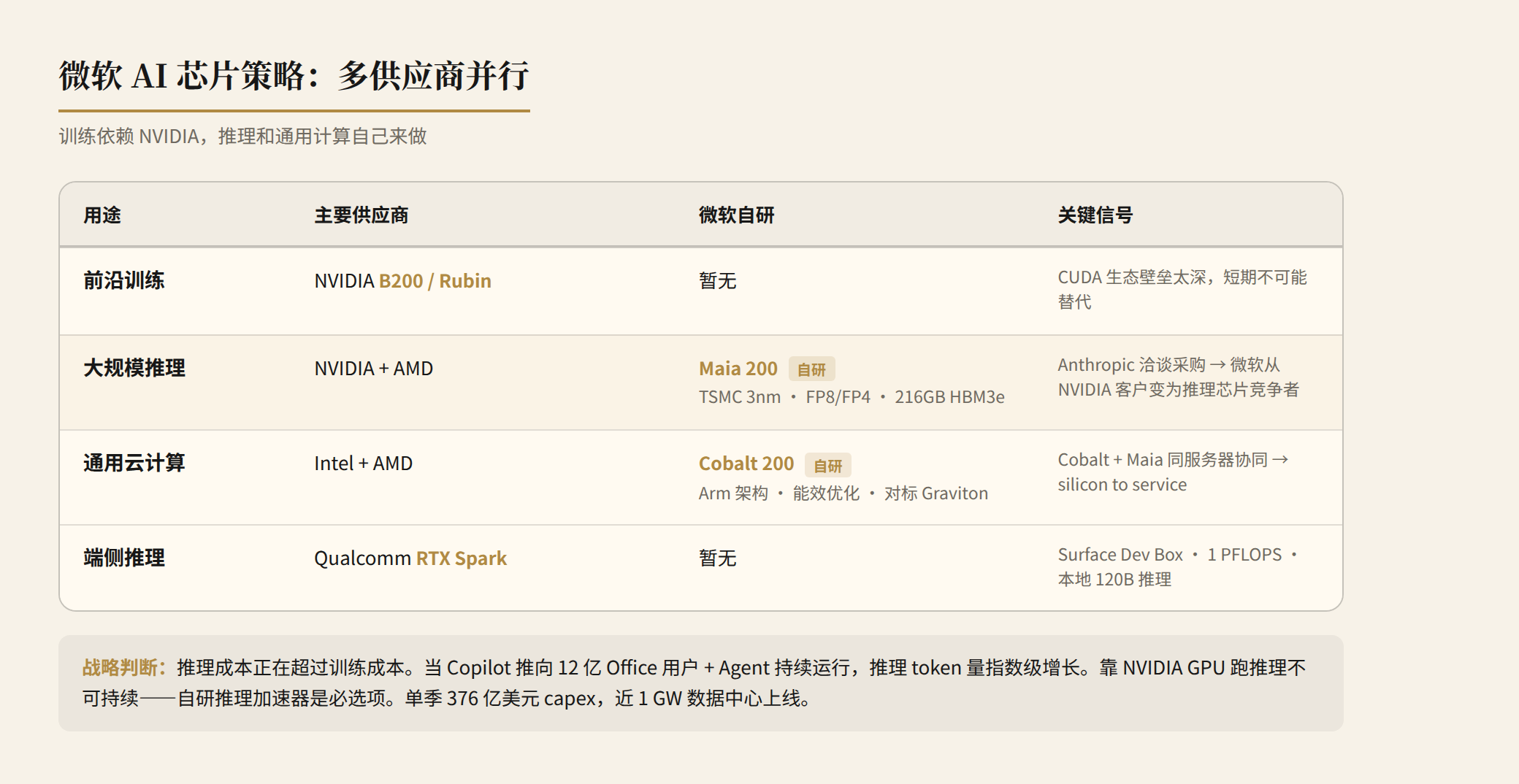
If the Anthropic Maia 200 procurement deal materializes, this strategy upgrades to: Microsoft not only uses in-house chips to serve its own cloud, but also sells in-house chips to third-party AI companies. This would make Microsoft evolve from NVIDIA's customer to NVIDIA's competitor—at least in the inference chip domain.
VI. MAI In-House Model Family
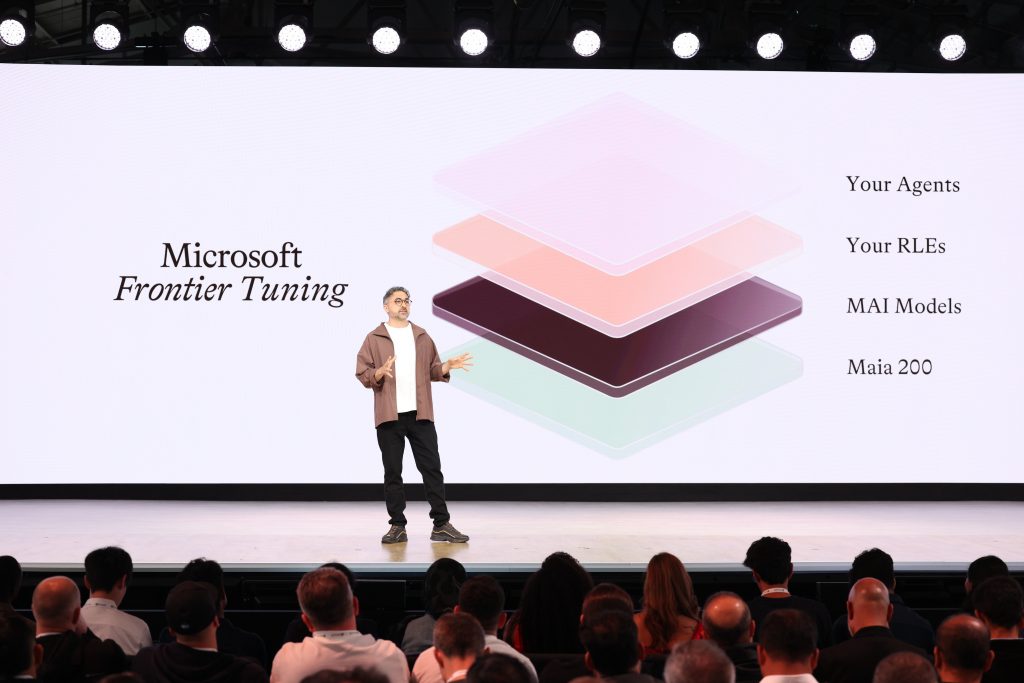
Mustafa Suleyman announced 7 new models, collectively called the MAI (Microsoft AI) family.
MAI-Thinking-1 is the most noteworthy: a 35B-parameter reasoning model with a 256K context window. Microsoft claims it beats Claude Sonnet 4.6 in blind preference tests and matches Claude Opus 4.6 in coding. The key point is zero distillation—trained on enterprise-grade clean data with no distillation from OpenAI models. This is Microsoft deliberately cutting ties with the "distilling OpenAI models" controversy.
MAI-Code-1 is a coding model optimized for GitHub, already live in VS Code.
MAI-Image-2.5 is a dual-mode text-to-image and image-to-image model.
Suleyman claimed on stage that a new model is 10× more efficient than GPT-5.5—only one person in the audience clapped.
Strategic significance of the MAI family: Microsoft owns 49% of OpenAI and exclusive cloud deployment rights, yet it's simultaneously building its own model capabilities. Two tracks run in parallel—GPT series as premium models distributed through Azure and Copilot, MAI as the efficiency and cost-optimized choice covering coding, reasoning, and images. The division of labor resembles AWS's Anthropic + in-house Titan strategy.
VII. Security Framework
Three Agent security-related open-source projects released simultaneously:
- MDASH: A 100+ Agent multi-model safety system that automatically discovers exploitable vulnerabilities
- ASSERT: An Agent security evaluation framework
- Agent Control Specification: A standard for Agent runtime governance
At this stage, it's more "standards first." Microsoft is telling the market: we're not just building Agents, we're defining how Agents should be securely managed.
VIII. Quantum Computing: Majorana 2
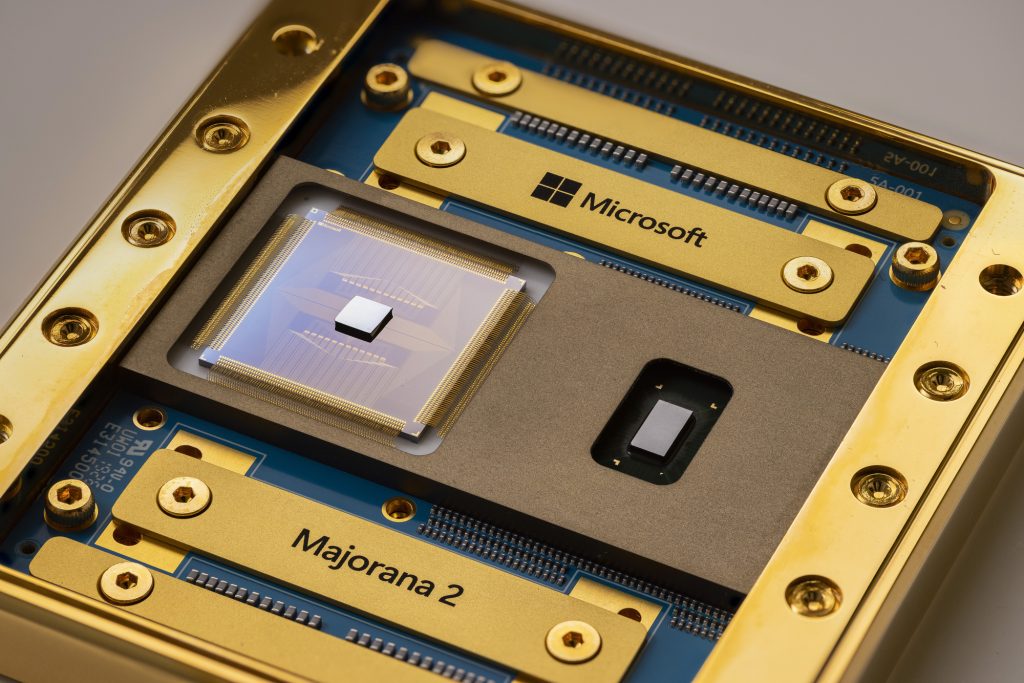
The closing note of Build was a quantum chip. Majorana 2: 20-second average lifetime, 1-microsecond operation time, targeting a million-qubit single chip.
This has nothing to do with Agent OS, but it relates to Microsoft's long-term technology narrative—simultaneously positioning across classical computing (Windows/Azure), AI computing (Copilot/MAI), and quantum computing (Majorana). Showcasing a quantum chip at Build is saying "we're not betting solely on AI."
IX. What Are the Odds on This Bet?
Returning to the opening question. All of Microsoft's announcements at Build 2026—the five-layer product stack, Office suite Agent-ification, OpenClaw onboarding, Agent IDE—point to the same bet: Agents are the next application paradigm, and Windows will be the default platform for running them.
The Bull Case
1. Microsoft owns all the infrastructure Agents need. Operating system (Windows), cloud (Azure), developer tools (VS/GitHub), models (MAI + OpenAI), productivity (Office 365), enterprise relationships (M365/Entra/Defender/Purview). No other company holds all six layers simultaneously.
2. Office is the strongest distribution channel. Copilot Agentic Mode doesn't require users to download a new app—it's right there in Word, Excel, and Teams, ready to use out of the box. Billing relationships with 1.2 billion Office users are already established; Agents just add another line to existing invoices. This distribution channel is something OpenAI, Anthropic, and Google all lack.
3. Agent 365's governance narrative hits a real enterprise pain point. When enterprises start deploying multiple Agents, governance and security are the top concerns. Agent 365 integrates Defender, Entra, and Purview into a unified governance plane—the completeness of this story has no competitor in the market.
4. OpenClaw onboarding is smart ecosystem strategy. Instead of building its own Agent framework, Microsoft brings the fastest-growing open-source framework onto the platform. Developers use familiar tools, but run on Windows' security substrate.
The Bear Case
1. MXC's security model needs real-world validation. Windows' security history is far from perfect—UAC bypasses, kernel vulnerabilities, and supply chain attacks are all precedents. The security of an OS-level sandbox depends on implementation quality, not conceptual design.
2. Microsoft IQ's context consistency is a hard problem. The four-layer context architecture is technically sound, but enterprise data consistency and quality are governance problems, not technical ones. Is "项目 A" in an email the same thing as "Project A" in a database? This inconsistency will directly lead to Agent misjudgments.
3. The pacing risk of Office Agent-ification. Outlook's proactive inbox categorization, Teams' Call Delegation—these are technically advances, but user acceptance is another matter entirely. "Let AI read your email" may face resistance in privacy-sensitive enterprise environments. Microsoft needs to prove that Agents aren't just capable of doing things, but that users are willing to let them.
4. NLWeb's commercial power struggle. Persuading major websites to voluntarily adopt a protocol that could weaken their own traffic gateways is no easier than getting Facebook to adopt ActivityPub.
5. The $30/month pricing threshold. For large enterprises, $30/user/month isn't an issue, but for SMBs and individual users, this price remains a barrier to Copilot adoption. Google's Gemini for Workspace is more aggressive on pricing.
6. Competitors won't sit still. Apple will almost certainly announce a competing strategy at WWDC. Google is already pushing an Agent runtime on Android. OpenAI and Anthropic still lead on model capability. Microsoft has no exclusive lock on any of this.
My Assessment
Microsoft's Agent OS bet is a directionally correct, solidly executed, but outcome-uncertain grand strategy.
Directionally correct because: Agents are indeed evolving from experimental tools into productive infrastructure. Someone needs to provide the runtime, developer tools, security framework, context layer, and governance plane. Microsoft investing across all these layers simultaneously isn't spreading resources thin—it's building a vertically integrated Agent platform.
Solidly executed because: Build 2026's announcements cover the full stack from chips to Office applications. The five-layer product stack isn't a scatter-shot release; it's a systematic platform strategy. OpenClaw onboarding and the Agent 365 governance layer show Microsoft tackling developer tooling and enterprise trust in parallel.
Outcome uncertain because: Microsoft is fighting six battles simultaneously—Agent runtime (MXC), Office Agent-ification (Copilot), developer toolchain (VS 2026), in-house models (MAI), Arm ecosystem migration (RTX Spark), and web protocol (NLWeb). A failure in any one battle drags down the whole. And Microsoft's historical track record of fighting multiple battles at once isn't great—the Windows Phone + Surface RT + Bing lesson still lingers.
Next observation point: WWDC 2026. Apple will very likely announce its own Agent runtime and AI device strategy at WWDC. If Apple does better on on-device inference and privacy protection, Microsoft's "Windows is the best Agent platform" narrative will be challenged quickly.
Disclaimer: This article was written based on cross-verification of Microsoft Build 2026 official releases, Microsoft Developer Blog, reporting from The Verge / Engadget / CNET / Thurrott / Directions on Microsoft / PCMag / Firstpost / WindowsForum / Context Studios, NVIDIA Developer Blog, r/cpp and Reddit community discussions, and public GitHub repository information. This is not investment advice. Data in this article is current as of June 3, 2026.