
1. The Shape of the Conference
The 40th ACM SIGCOMM (the homepage reads "40th edition of the conference series"; archived), August 17–21, 2026, Colorado Convention Center, Denver.
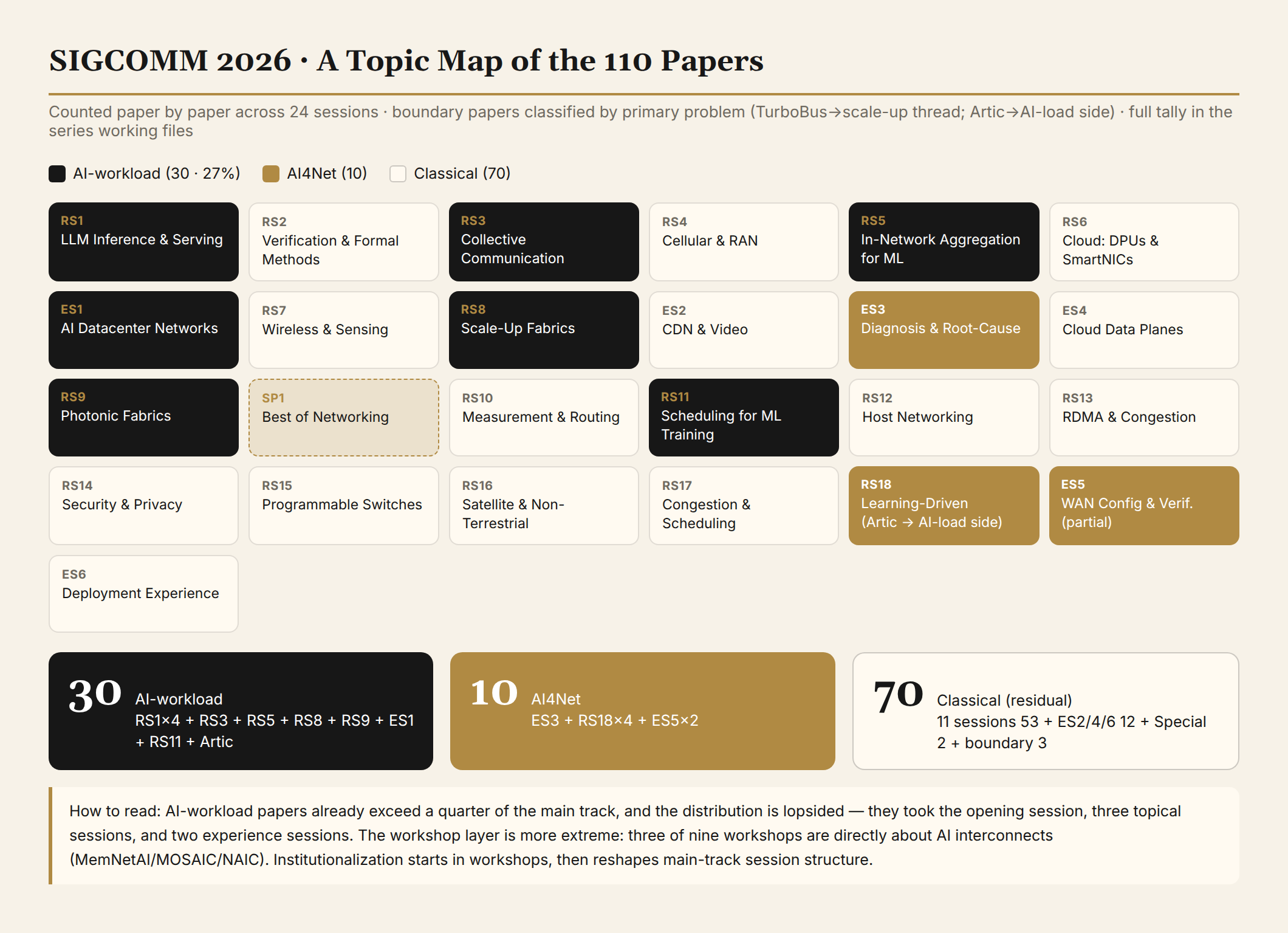
The structural numbers first. The official accepted list carries 110 main-track papers (public reports say 109; the official count wins). Classified by the 24 sessions of the detailed program:
- AI-workload papers (LLM Inference & Serving, Collective Communication, In-Network Aggregation for ML, AI Datacenter Networks, Scheduling for ML Training, Scale-Up Fabrics, Optical & Photonic Fabrics — plus Artic, which sits in the Learning-Based session but whose subject is AI-load traffic) — 30 papers, 27% (counted session by session; see provenance note at the end)
- AI4Net papers (Learning-Based & Data-Driven, Diagnosis & Root-Cause, parts of WAN Configuration) — 10
- Classical areas (verification, measurement, wireless/cellular/satellite, security, congestion control, etc.) — 70 — though a good fraction of these have had their problem statements rewritten by AI workloads (30+10+70=110)
Conference statistics (via the "HPC Networking" WeChat account's synthesis of the official site and business-meeting material; direction credible, exact figures held with reservation): 513 submissions (+11.3% YoY), 109–110 accepted (109/513 = 21.2%), 577 registrants; Chinese authors 55.7% of submitting authors (1,682); mainland-China institutions 59 papers by that account's count (53.6% against the official 110 — different denominators, do not divide across them), with Tsinghua 17, Alibaba 12, PKU 11 as the top three submitters (that account's tally).
The workshop structure is a stronger signal than the main track: of nine workshops, three are directly about AI interconnects — MemNetAI (memory-semantic networking), MOSAIC (memory-system-interconnect co-design), NAIC (networks for AI computing) — plus HotOptics on optical technologies. That "memory-semantic networking" exists as a workshop theme says the direction has moved from inchoate ideas to institutionalization — a five-year signal.
Awards (provenance tiers: the first two verified against the official program page; lifetime award and keynote verified against official keynote/overview pages; Test-of-Time and networking-system award winners have no official page yet and rest on public reports):
- Best Paper: λλ: A Programming Language for Silicon Photonics (Cornell)
- Best Student Paper: Presto: A Match-Action TCP Stack for the Terabit Era (UW + MPI-SWS)
- Lifetime Achievement + keynote: Walter Willinger (pioneer of Internet traffic measurement and modeling; Northwestern University and University of Oregon), "All Models Are Wrong — Some Are Useful, Some Are Harmful"
- Test of Time: the 2014 buffer-based and 2015 control-theoretic ABR papers (public-report provenance)
- Networking Systems Award: Google Jupiter (public-report provenance)
Two best papers, one "optical" and one "electrical," one building a language and one rebuilding a protocol stack. The combined message: the next leap in network performance is gated at the abstraction layer, not bandwidth. Piece 4 develops this.
2. Five Threads: This Year's Coordinate System
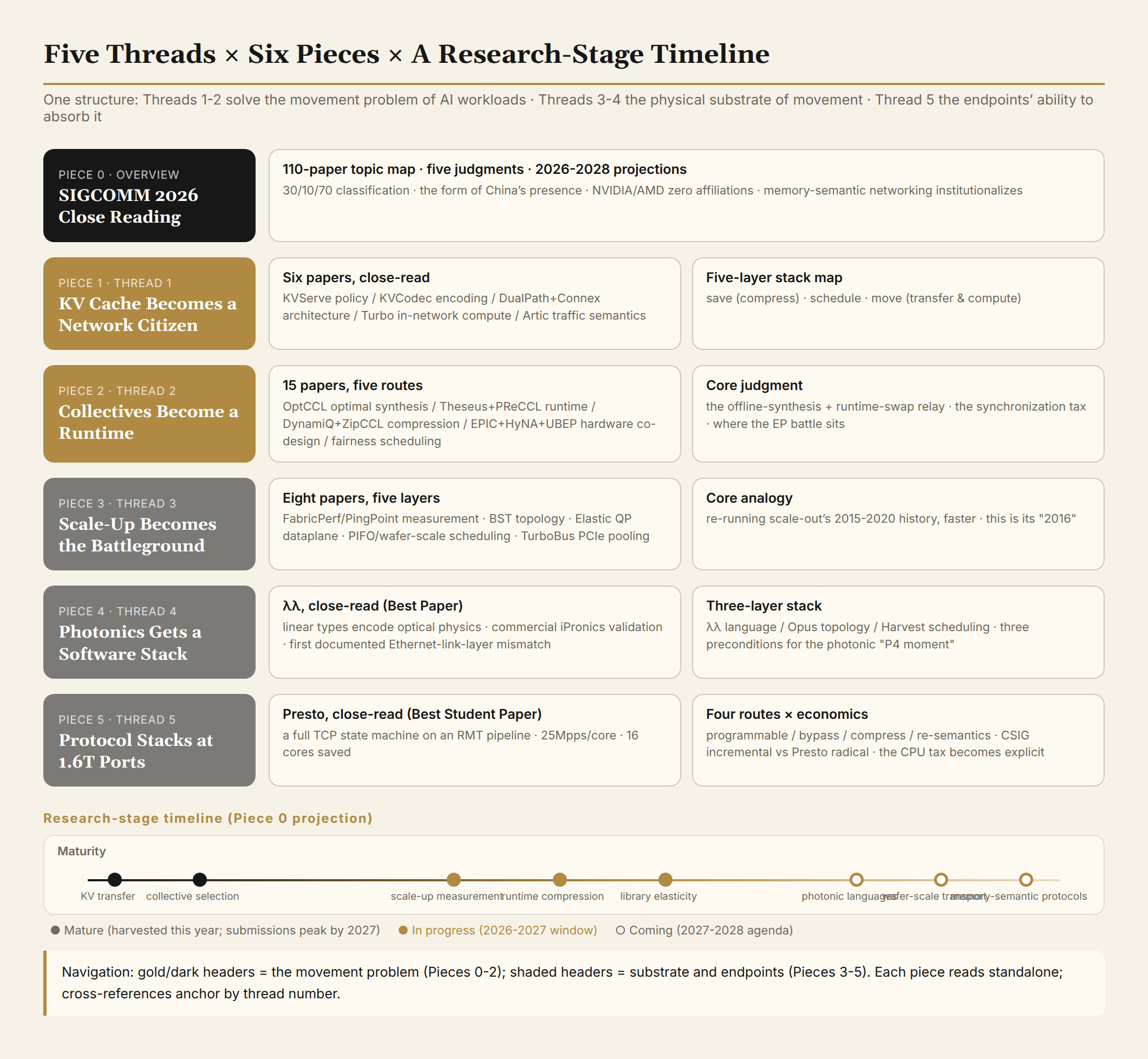
From the 110 papers we read out five threads, each mapped to one deep-dive piece:
Thread 1: KV cache becomes a network citizen. After PD disaggregation, KV cache turned from GPU-internal state into explicit network payload. The tighter the bandwidth and the longer the context, the more KV transfer dominates — in measured long-context loads, communication reaches 82%-90% of total JCT. Three sessions, six papers, five layers (policy/encoding/architecture/in-network-compute/traffic semantics), from runtime-native compression policy all the way to attention aggregation inside switches. This is the opening of "state movement" as a new traffic category. (Piece 1, published the same day.)
Thread 2: Collectives become a runtime. Three forces break the static-algorithm era: MoE/expert parallelism explodes communication patterns; superpod + DCN dual planes make topologies heterogeneous; multi-tenancy makes fairness a first-class concern. ~15 papers (OptCCL's optimal synthesis, Theseus' hot-swappable scheduling, UBEP's re-architected EP library for Huawei superpods, EPIC's Ethernet in-network-collectives protocol, MonkeyTree/LEVELLER on fairness...) converge on collectives evolving from "pick an algorithm at compile time" to "a runtime system." (Piece 2)
Thread 3: Scale-up becomes the main battleground. Intra-rack fabrics, supernodes, chiplets, wafer-scale networks are re-running the 2015–2020 research history of scale-out: measurement first (FabricPerf reverse-engineers NIC-less fabrics through GPU kernel profiling; PingPoint profiles chiplet networks), then topology (Huawei's Balanced Sparse Tree), then dataplanes (Elastic QP), then scheduling (TurboBus PCIe pooling, Harvest optical-switch scheduling). The density of measurement papers says the field is young — the toolchain isn't fixed yet. This is scale-up's "2016." (Piece 3)
Thread 4: Photonics gets a software stack. The device story (CPO/OCS commercialization) is told; the software story begins: λλ encodes photonic physics in a linear type system (light cannot be copied → every value used exactly once) and rejects unrealizable circuits at compile time — a P4 for photons; Opus rethinks the rail abstraction optically; Harvest synthesizes reconfiguration schedules. Language/topology/scheduling all covered in one year: the "P4 moment" for optics is being staged. (Piece 4)
Thread 5: Terabit-era host stacks. As single ports head to 1.6Tbps, per-packet kernel processing becomes the wall at hundreds of millions of packets per second. Presto brings match-action to the transport layer (first full TCP state machine on an RMT pipeline); Flow.ZIP compresses headers; PacketExpress exploits large MTUs; Capybara migrates TCP connections in microseconds; SMC-R contributes four years of Alibaba production lessons. Four routes: programmable / bypass / compress / re-semantics. (Piece 5)
The five threads are not parallel "hot topics" but one structure: Threads 1 and 2 solve the movement problem of AI workloads (state and operators), Threads 3 and 4 the physical substrate of movement (intra-domain interconnect and optics), Thread 5 the endpoint's ability to absorb it. Together, a complete cross-section of the AI-era networking stack.
3. Structural Judgments
Judgment 1: China's presence is structural, and takes the form of production-system experience.
More telling than the counts is the form. Of Alibaba's papers (12 by the WeChat tally), roughly half are production-system papers: Nimitz→NetPila's decade-long container-network evolution, SMC-R's transparent TCP replacement lessons, AliYANG configuration management, Anytest root-causing hardware-transport anomalies, verifying non-deterministic convergence on the global production WAN, Spillway (with Zhejiang U). Tencent×Tsinghua's Pegasus (bare-metal AI cloud networking), DistDPU, and ByteDance's Gryphon (multi-Petabit multi-tenant gateway) follow the same pattern. Scale itself has become a source of research problems — not a catch-up narrative, just the normal scientific cycle where large deployments generate large problems.
Note the first authors, though: nearly all from universities — Alibaba-track first authors from Nanjing/Jilin/Sun Yat-sen, Tencent-track from Tsinghua/Fudan/CAS. The joint pipeline (NJU–Alibaba, THU–Tencent, PKU–ByteDance) is fully mature: companies supply systems and data, universities supply methods and labor. That division is stable, and it matters for how one reads "Chinese corporate research capability."
Judgment 2: NVIDIA and AMD have zero papers; the power to ask networking questions is migrating to hyperscale users.
Not one of the 110 papers lists NVIDIA or AMD as an author affiliation (verified by searching the official accepted list). Chip vendors have long been quiet at academic venues, but zero presence this year is still a signal — when Meta presents the communication stack for 100K+ GPUs, Google presents its next-generation backbone (GGN) and congestion signaling (CSIG, from the Cardwell/Vahdat team), and Microsoft puts Azure SDN policy evaluation on SmartNICs (ROE), "those who use the network" are displacing "those who sell it" as the ones posing the research questions. Consistent with our Tomahawk 6 analysis. NVIDIA's NVLink/NVSwitch appear inside Meta's paper as the deployment environment, not in NVIDIA's own — the ecosystem incumbent doesn't need to publish, which is precisely how agenda-setting power changes hands.
Judgment 3: AI4Net converges on four main forms, all in the operations domain.
Learning-based papers did not land on the data-plane/control-plane critical path; they cluster in root-cause analysis (AIDA), configuration management (AliYANG), simulation (Nüwa), and reproducibility (RepLLM) — with EMA-style learned system adaptation alongside. This echoes the keynote's warning: Willinger named a VPN-traffic CNN with F1≈1.0 that was learning dataset artifacts (shortcut learning) — "understanding how the training data was generated matters more than model complexity." This year's dedicated session (RS18) holds five papers; AI4Net-related work overall runs about 10. The realistic landing zone is far more conservative than the marketing: prove it in offline analysis and operations before talking about the data plane.
Judgment 4: The classical areas all survive, but their problem statements are being rewritten by AI workloads.
In the verification session (RS2, five papers by our count), the objects being verified have shifted from BGP to in-network-computing programs and firewall elasticity specs; in congestion control, Google's CSIG redesigns datacenter congestion signaling and Odin handles all-to-all traffic; in RDMA, PSN-PATH studies multipath RDMA over lossy networks. The classical toolbox is intact, but nearly every tool has a new owner. Not "AI squeezing out the classics" — the classics evolving, as SDN rewrote forwarding questions around 2015.
Judgment 5: Memory-semantic networking is institutionalizing — the strongest structural signal for the next five years.
The existence of MemNetAI + MOSAIC, four papers in the Scale-Up session, and KVServe/DualPath redrawing the storage-compute network boundary all point one way: when memory (KV cache, parameters, activations) becomes the network's first-class citizen, every layer of the stack gets redesigned for memory semantics — transports that understand page granularity, schedulers that understand affinity, hardware that speaks load/store rather than packet. Beyond CXL, a network-native memory-disaggregation route is institutionalizing in academia. Its industrial counterpart is the UALink/UnifiedBus/Ultra Ethernet contest — Piece 3 develops the comparison.
4. Projections for the 2026–2028 Research Agenda
On a timeline:
- Mature (this year is the harvest): PD-disaggregated KV transfer optimization; collective algorithm selection. Dense but with diminishing marginal novelty; submission volume should peak in 2027.
- In progress (2026–2027 window): scale-up measurement and dataplanes; runtime-ized KV compression; communication-library elasticity (Connex/UCCL lineage); RTC adaptation for MLLM traffic.
- Coming (2027–2028 agenda): the language layer of photonic software stacks (λλ is the opener); transport layers for wafer-scale networks; a protocol family for memory-semantic networks; agentic loads at scale (network profiles of 100+-turn agents).
One contrarian projection: the share of pure AI4Net papers will fall over the next two editions — the easy ground (ops RCA, configuration) is taken, and interpretability/correctness on the data path remains unsolved; Willinger's warning will be cited repeatedly. Conversely, Net4AI will expand from "networks for AI" to "networks for memory semantics" — a larger pool.
For Chinese teams: the window for production-experience papers remains open (Alibaba's 12 prove the route), but the next five years' contest is in scale-up and photonic software stacks — Huawei (Balanced Sparse Tree, UBEP), Tsinghua×Tencent (Pegasus), Fudan+China Telecom (Scale-up PIFO) have already placed their positions.
Provenance note (session self-count): the 30/10/70 classification above is counted session by session from the official detailed program (including RS7 Wireless, Backscatter & Sensing, four papers, added after round-one review); boundary papers are classified by primary problem (TurboBus sits in Session 1 but belongs to the scale-up thread; Artic to AI-load traffic). The Special Session counts two papers plus one Rising Star talk. A per-session tally is archived in the series' working files.
Disclosure: The 30/10/70 classification is counted session by session from the official detailed program (tally archived in the series working files). Best Paper, Best Student Paper, the lifetime award, and the keynote were verified against official pages (archived); Test-of-Time and networking-system award winners have no official page yet and rest on public reports (tiered as noted). Conference statistics come from a WeChat-account synthesis of official material — direction credible, exact figures held with reservation. Not investment advice. Data as of August 22, 2026.
Piece 0 of the SIGCOMM 2026 close-reading series, published together with Piece 1, "KV Cache Becomes a Network Citizen." Upcoming: collectives as a runtime, the scale-up battleground, the photonic software stack, and Terabit-era host stacks.