
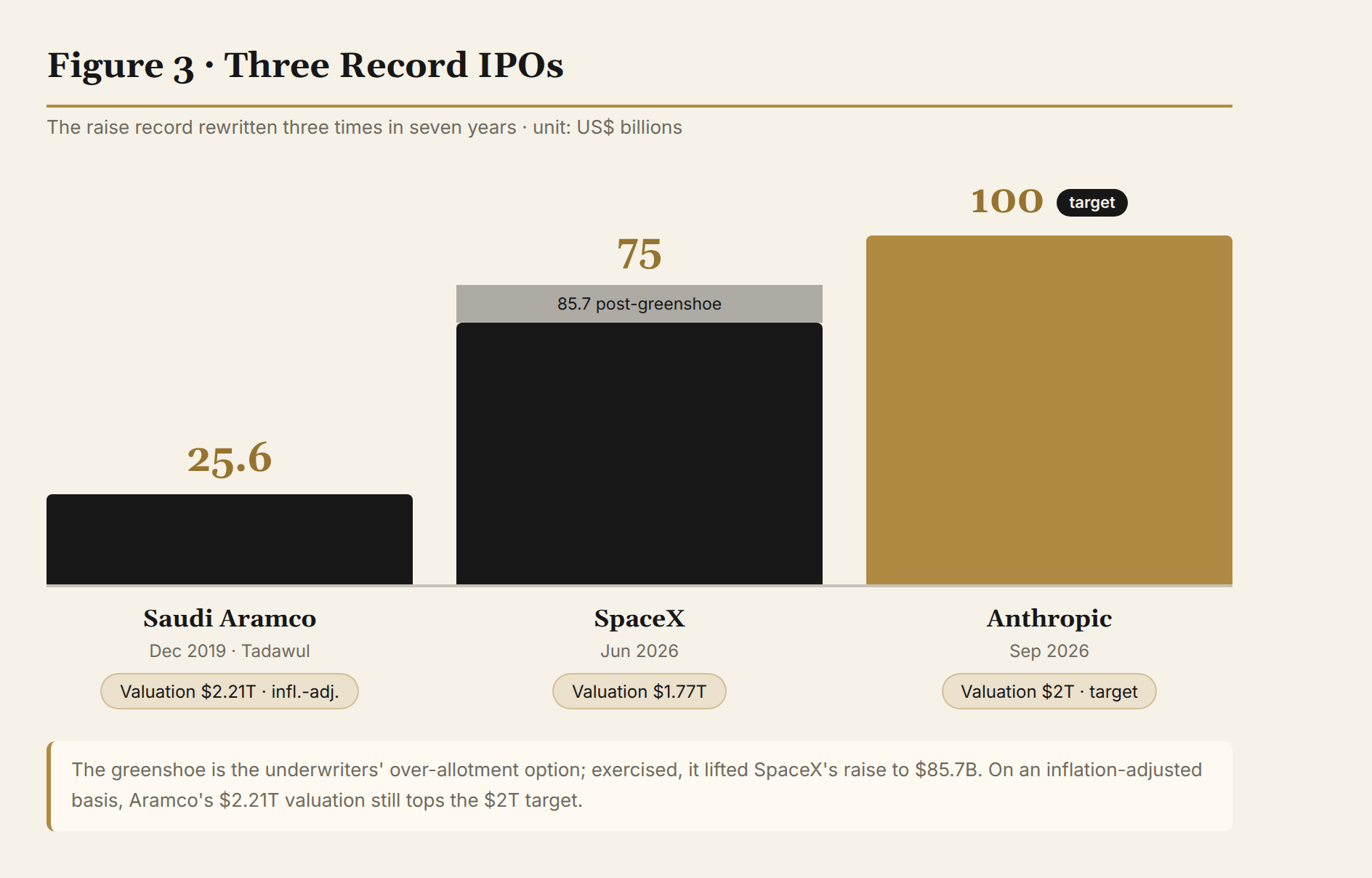
On September 11, last Friday, Reuters reported exclusively that Nvidia is in talks to anchor an investment of up to $10 billion in Anthropic's IPO. With that, the outline of the listing is complete: a raise of up to $100 billion at a valuation of roughly $2 trillion, and a listing window before the US midterm elections in November. On those terms, both the raise and the valuation would pass the records SpaceX set this June ($75 billion raised, $85.7 billion after the greenshoe, at a $1.77 trillion valuation), making it the largest IPO in history. The previous record holder, Saudi Aramco, raised $25.6 billion in 2019; SpaceX's raise was nearly three times that, and Anthropic wants to add another thirty percent on top.
Records will keep falling. The question that matters sits beyond scale: where does the money come from, and where does it go?
1. The financial angle: every investment is tied to a larger purchase
Lay the contracts of the past ten months out on a timeline, and the shape of the loop surfaces on its own.
On November 18, 2025, three parties announced a bundled deal: Anthropic committed to purchasing $30 billion of compute on Microsoft Azure, running on Nvidia chips; Nvidia invested up to $10 billion, with Microsoft adding up to $5 billion. A technical footnote sat in the contract: Anthropic would deploy up to one gigawatt on Grace Blackwell and Vera Rubin. Industry estimates put the procurement cost of one gigawatt of AI compute between $20 billion and $25 billion, so the $30 billion commitment and the one-gigawatt footprint corroborate each other at the same order of magnitude.
In April 2026, the same structure arrived twice more. Google committed to investing up to $40 billion, a first tranche of $10 billion entering at the then-current valuation of $380 billion, with the remaining $30 billion tied to commercial milestones. Amazon injected $5 billion the same day and holds an option to add up to $20 billion more. The consideration, as before, was written as procurement: Anthropic signed a ten-year, at-least-$100-billion commitment to AWS drawing on more than one million Trainium2 chips, and agreements with Google and Broadcom covering multiple gigawatts of TPU compute.
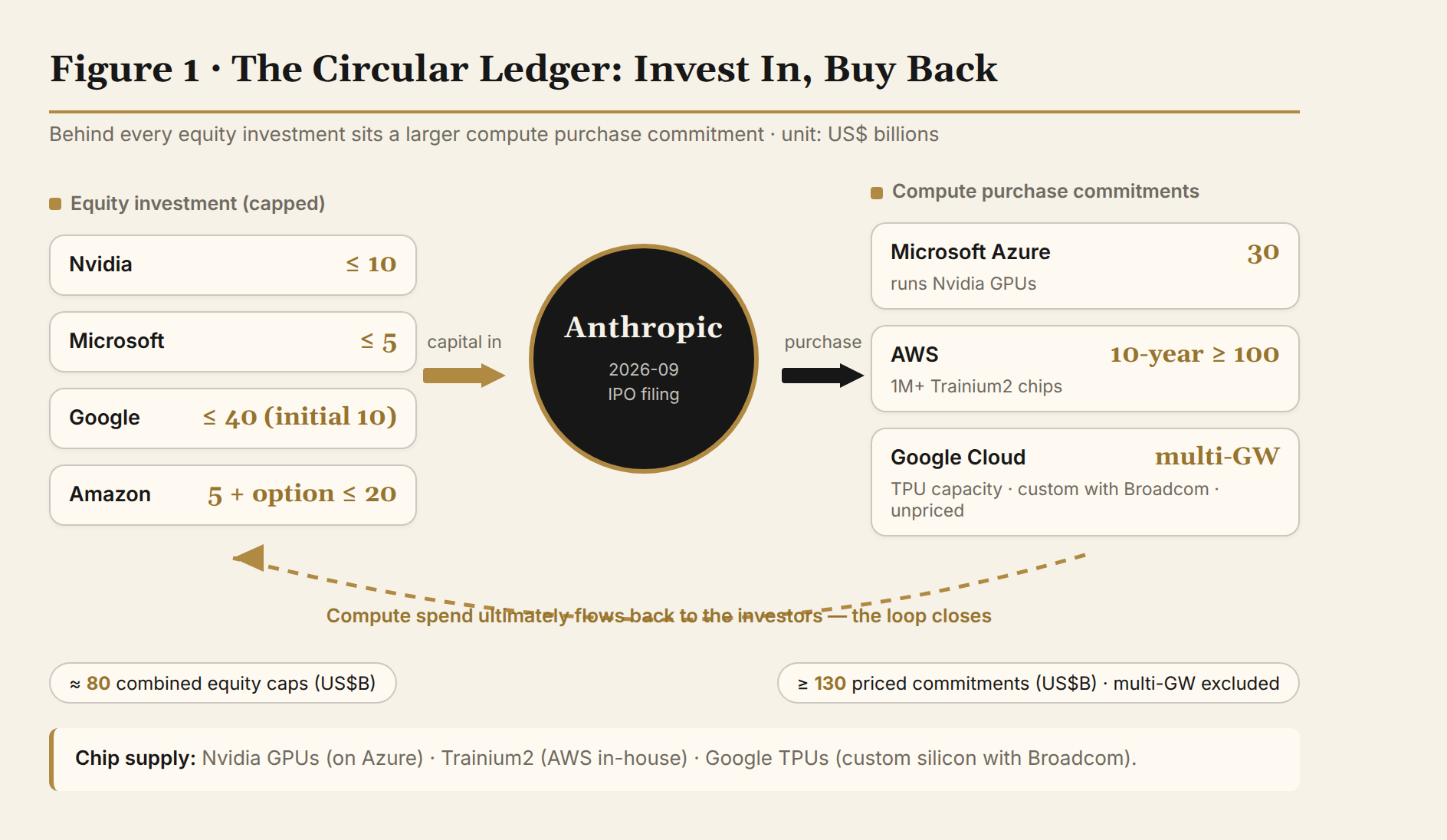
Four investors, and every purchase commitment lands on the clouds of three of them (Azure, AWS, Google). The core semiconductors carrying that compute come from Nvidia, Google, and Broadcom, which sits outside the investor group; the revenue of the fourth investor, Nvidia, is hidden inside those very chips. These contracts share a single shape: behind every equity investment sits a larger purchase commitment.
For now this ledger can only be reckoned roughly. Fortune's accounting in June: the Anthropic position on Amazon's books had reached roughly $74 billion (per its April filing), that is, $42.2 billion in convertible notes plus $32 billion in non-voting preferred shares, a position in the mid-to-high double digits as a percentage. Court filings put Google's holding at about 14 percent, against a contractual cap of 15 percent. The arithmetic is not hard to run yourself: the money the three clouds put into Anthropic comes back once through infrastructure bills, and again through equity appreciation.
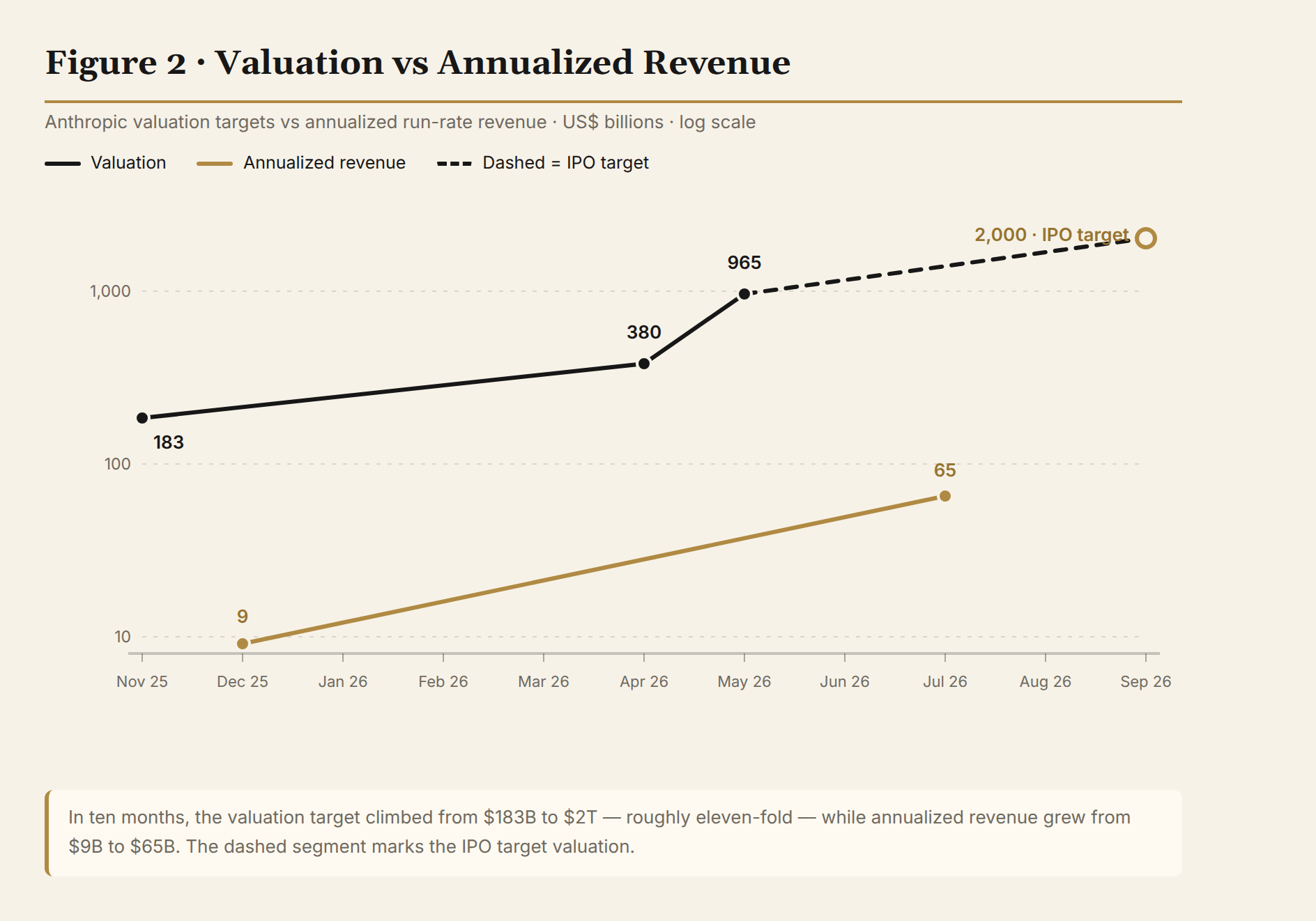
Over those ten months the valuation climbed four steps: $183 billion (November 2025) → $380 billion (April 2026) → $965 billion (May, a single Series H round that raised $65 billion) → $2 trillion (September IPO target), roughly an elevenfold rise. Over the same span, annualized revenue grew from about $9 billion at the end of 2025 to more than $65 billion by the end of July 2026, so the high multiple rests on a real revenue base.
The weak spot sits on the same staircase. On the way to a $65 billion annualized run rate, the compute-purchase commitments the company has signed (Azure $30 billion, AWS $100 billion over ten years, multiple gigawatts with Google and Broadcom) already exceed, on paper, what the largest IPO in history plans to raise; the company has meanwhile assembled an in-house chip design team, trying to grip the slope of its own cost curve. The $2 trillion valuation rests on projected revenue of $190–200 billion in 2028, and that projection holds only if compute cost stays within some bounded share of revenue. What that share is today, no document in the public world has ever disclosed.
SpaceX in June offered a control group, freshly run. When it listed, its prospectus laid the books open for the first time: a net loss of $4.28 billion in the latest quarter, a cumulative deficit of roughly $41.3 billion, quarterly capital expenditure of $10.1 billion with $7.7 billion of it going to AI. The market promptly showed pricing discipline: the offering priced at $135 a share, below the $175 roadshow expectation, and Morningstar publicly challenged the valuation. Demand still ran hot, with oversubscription above $350 billion and the greenshoe lifting total proceeds to $85.7 billion. Every page of a prospectus is negotiating leverage, and Anthropic is walking into the same room.
2. The technical angle: a lead measured in months
Beyond the financial ledger, $2 trillion is first a wager on the substance of Claude's models. The signal at this layer is not one-sided: a solid lead on some benchmarks, a reversal on others, and measurement noise layered on top of the tables themselves.
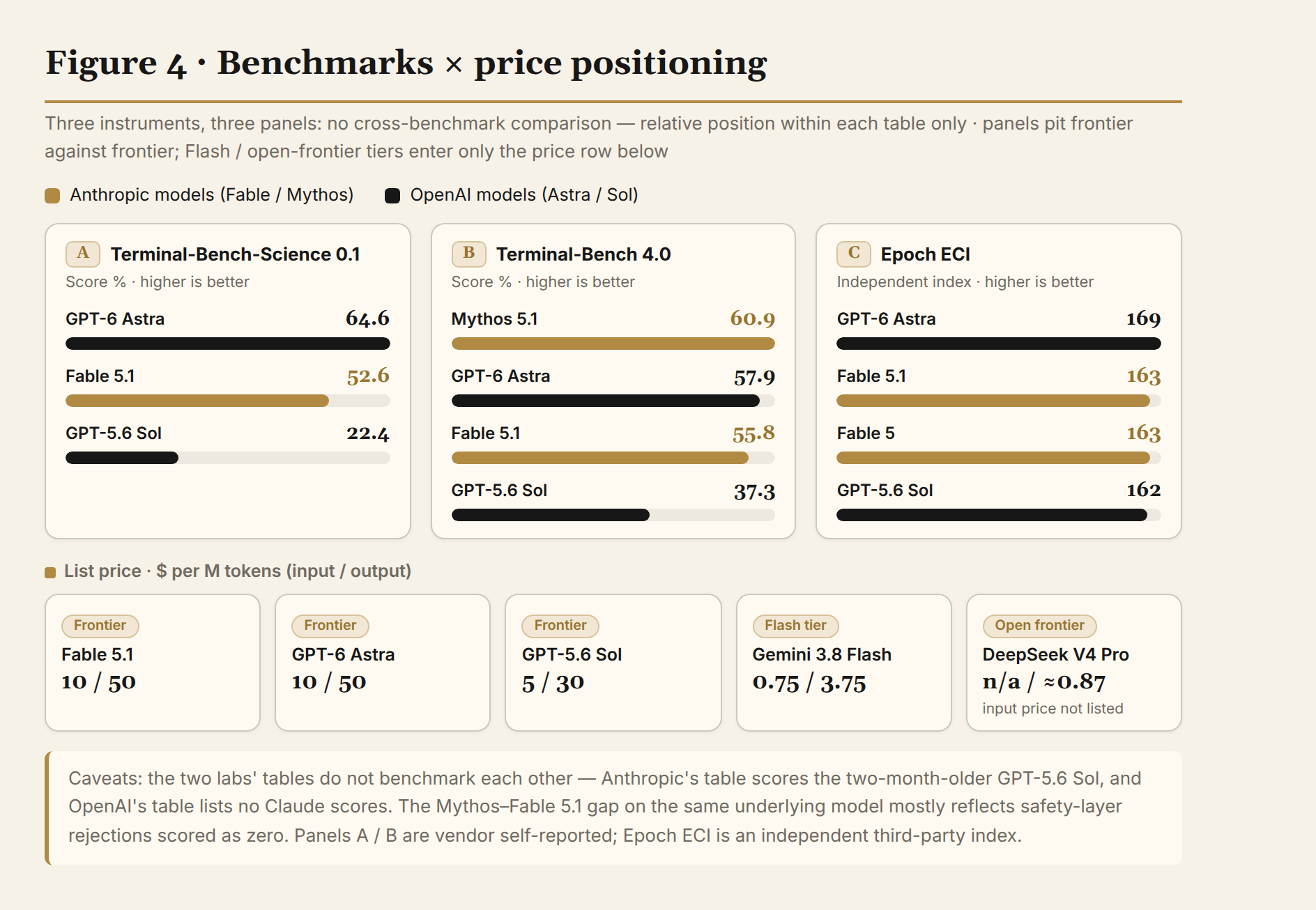
Anthropic's current frontier is Fable 5.1 and Mythos 5.1: one model in two deployments. Fable faces the open market; Mythos ships with lighter safeguards and reaches only vetted organizations through the cyber-security and life-sciences verification programs, US-only for now. On Anthropic's own benchmark table, Fable 5.1 scores 52.6 percent on Terminal-Bench-Science 0.1 against 22.4 for GPT-5.6 Sol on the same table. On long-horizon terminal work and automated workflows, Anthropic's lead is the widest on the board.
The lead did not stay long. OpenAI's GPT-6 Astra then pushed Terminal-Bench-Science to 64.6 percent and Terminal-Bench 4.0 to 57.9, both past Fable 5.1 (52.6 and 55.8), at the same price point ($10 per million input tokens, $50 per million output). An independent index reads the same direction: on Epoch's ECI, Astra stands at 169 while Fable 5.1 and the previous Fable 5 both sit at 163. In Artificial Analysis's accounting, Astra reaches the bar on a third of the tokens GPT-5.6 Sol burns at full effort, and a fifth of Opus 5 at its high setting — the same work, done by a rival on a smaller compute bill.
The benchmark tables themselves deserve a discount. The two labs do not score each other: OpenAI's table carries no Claude numbers, and Anthropic's table benchmarks against Sol, two months older than Astra. The two-door split carries its own measurement noise; the 60.9-to-55.8 gap between Mythos and Fable 5.1 mostly reflects tasks where Fable's safeguards intervened and scored zero. Wring the water out, and the conclusion that survives is the same: Anthropic sits firmly in the first tier on coding and long-horizon work, though its lead is measured in months, not years.
The job of product layout is to convert that model substance into revenue while the window stays open. Anthropic's base is agentic and coding work: on Artificial Analysis's Coding Agent Index, Fable 5.1 running in Claude Code scores 70, first on the board (rivals run in Codex, and part of the gap belongs to the harness). Claude is the only frontier model offered on all three major clouds, and enterprise customers top 300,000 (end-2025 basis). The pricing strategy is no secret: Fable 5.1's input price is twice GPT-5.6 Sol's and thirteen times Gemini 3.8 Flash's, and in September the cache-read price was cut by 75 percent. It does not compete on price; it charges a reliability premium. Whether that model survives is exactly what the valuation argument is about.
The revenue arithmetic, by contrast, looks restrained. Annualized revenue went from about $9 billion at the end of 2025 to more than $65 billion by the end of July 2026, sevenfold in seven months. The 2028 projection of $190–200 billion implies tripling over two years, a deceleration, not an acceleration. The projection is not crazy; it has exactly two preconditions: hold the share, hold the price.
3. The competitive angle: stronger and cheaper, arriving together
Competitive pressure is closing in from three directions at once.
The pressure from OpenAI lands on capability. Astra passed Fable 5.1 on both Terminal-Bench measures, at the same price and higher token efficiency, and leads by 6 points on Epoch's ECI. OpenAI also holds the price weapon: CFO Sarah Friar disclosed at Goldman's Communacopia conference in September that after GPT-5.6 Luna was repriced post-launch, usage rose tenfold and OpenAI's share on OpenRouter climbed to the top (September basis). Stronger and cheaper: OpenAI is inflating on both axes at once.
The pressure from Google lands on price. Gemini 3.8 Flash is priced at $0.75 per million input tokens and $3.75 per million output, one-thirteenth of Fable 5.1, with throughput of 300 tokens per second. It has a known weakness: it burns more tokens per task, so the real cost advantage shrinks. But a tenfold list-price gap sits right at the door, and how long a "still selling at thirteen times" window stays open is the most direct stress test of Anthropic's pricing power.
The heaviest pressure comes from Chinese open-weights: cheaper, and closing.
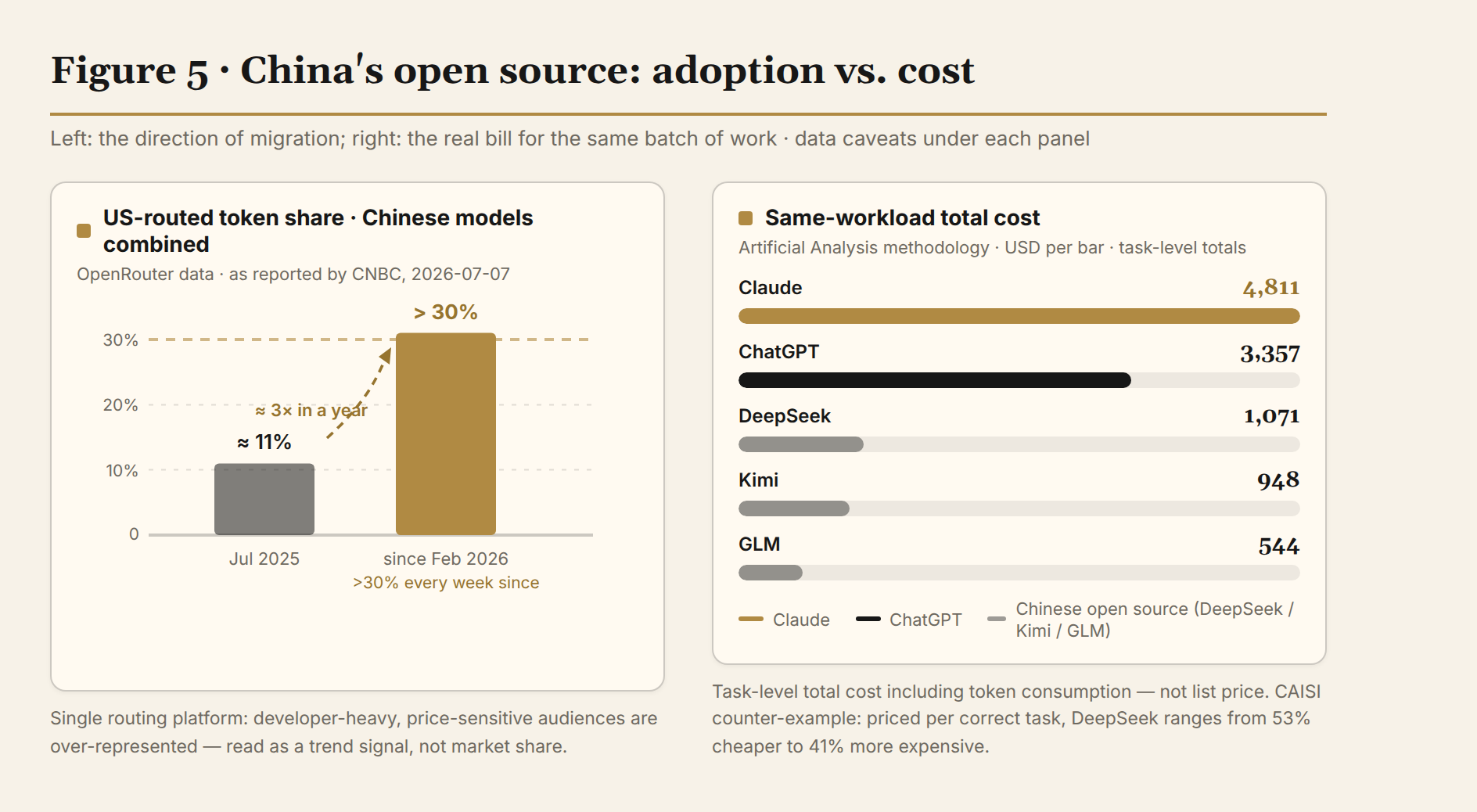
On adoption: OpenRouter data (as reported by CNBC on July 7) shows Chinese models (DeepSeek, Qwen, GLM and others) above 30 percent of US-routed tokens every week since February, against roughly 11 percent a year earlier. This is a single routing platform, developer-heavy and price-sensitive, so read it as a trend signal rather than market share; but a near-tripling in a year leaves the direction beyond dispute.
On economics: Artificial Analysis measured the total cost of the same body of work: roughly $4,811 on Claude, $3,357 on ChatGPT, $1,071 on DeepSeek, $948 on Kimi, and $544 on Zhipu's GLM. Claude runs about nine times the cheapest Chinese model. On list price, OpenRouter estimates Chinese models run 60 to 90 percent cheaper; the two measures should not be read together: the first is task-level total cost including token consumption, the second is sticker gap. A reverse footnote exists too: CAISI's seven-benchmark task-level study found that per correctly solved task, DeepSeek ranged from 53 percent cheaper to 41 percent more expensive, because cheap models sometimes buy their accuracy back with extra rounds.
Quality is the last boundary: CSIS's assessment this autumn puts Chinese models months, not years, behind the US frontier. Under third-party evaluation, the open Flash tier (DeepSeek V4 Flash, GLM-5.3 Flash, Qwen3.8 Flash-Next, all MIT-licensed) trails the closed frontier by 5 to 15 points while costing 5 to 30 times less; DeepSeek V4 Pro has closed to within a point of the closed leader on SWE-bench Verified. Open weights have not caught the frontier, but the floor under the frontier premium is being lifted, layer by layer.
Safety narrative as action is the most unusual layer of the competitive map. Lay out the timeline: on April 7, Mythos arrived as a preview, open only to a handful of partner institutions, on the grounds that it was too dangerous to release publicly; on May 28, in the Opus 4.8 announcement, Anthropic promised to make "Mythos-class" models available to all customers "within weeks"; on June 9 what arrived was Fable 5 public and Mythos 5 gated as before; on September 1 the same structure replayed itself. The promise of wide access has yet to be honored, while the gate has now stood there, unchanged, for the third time. That same month, Fable 5.1 closed off "context editing," a publicly documented distillation channel. And on Saturday, September 12 — the day after the Reuters exclusive, on the eve of the IPO — Dario Amodei published a long essay urging the whole industry to slow the pace of capability gains, complete with a three-step plan, taking care to stress that slowing down forfeits neither commercial advantage nor the American lead. A call for restraint on the capability curve and a steep valuation curve shared the same week. The two do not contradict each other; that they appear in the same frame is itself information.
Every layer of this sequence has a line in the ledger. The money enterprises pay for "the responsible Claude" and the restraint demonstrated by Mythos's gate are two sales channels for the same narrative. The June 2 executive order lets NSA and CISA designate "covered frontier models" through a classified benchmarking process; the designated carry an added layer of compliance cost, the gate grows heavier for every chaser, and the company already standing inside it stands that much steadier. And when pursuers close in by the month, the loudest voice calling for the whole industry to slow down belongs to the one running in front.
4. The valuation verdict: what $2 trillion actually buys
As of September 14, the verifiable chain of facts: Anthropic has raised more than $100 billion across private rounds and confidentially filed to list; Reuters reports Nvidia in talks for a $10 billion anchor position in an IPO seeking up to $100 billion at roughly $2 trillion, with the listing window before the November midterms; the talks are ongoing and the terms may change. Three judgments:
1. The listing documents will lay this circular ledger open in front of everyone for the first time. Related-party transactions, compute cost as a share of revenue, dependence on the four giants: these numbers have existed only inside private markets, with no legal requirement to disclose. Once the prospectus arrives, they must see daylight. SpaceX demonstrated the consequence in June: the finer the disclosure, the cooler the pricing, and the offering priced below roadshow expectations. Anthropic's related-party list runs far longer than SpaceX's, and every page will be read under a magnifier.
2. What this IPO prices is capital-expenditure endurance and the quality of growth. $2 trillion against $65 billion annualized is a price-to-sales ratio of about 31; SpaceX, with under $7 billion of annual revenue on a prospectus-derived basis, carried $1.77 trillion, roughly 260 times sales on the same arithmetic. Whether Anthropic's multiple stands depends on two numbers: compute cost as a share of revenue, and the delivery of the $190–200 billion projection for 2028. Chinese open-weights press that path from three directions: the same work at roughly an order of magnitude less cost, US-routed share up from 11 to over 30 percent in a year, and a quality gap measured in months and shrinking. Two gates hold at the same time: the switching costs and compliance stickiness of 300,000 enterprise customers, and the reliability premium on coding and long-horizon work. The pressure is real; the transmission is not yet written.
3. Governance and the safety narrative become the positive and negative entries together. Anthropic is a public benefit corporation; a Long-Term Benefit Trust holds special Class T shares with the power to elect directors, while Google, Amazon and the other major shareholders carry no voting rights, no board seats, not even observer seats. Whether that structure survives public markets decides whether "responsible AI" acquires a financial expression. And once safety commitments are written into the ownership structure and into the executive order's classification list, they stop being a cost line and become part of the pricing power. That experiment will run far longer than the IPO itself.
What to watch next, in order of verifiability: on the day the S-1 goes public, check three numbers first (aggregate compute-purchase commitments against revenue, the two-way money flows with the four giants, and the Class T terms). Whether Nvidia's anchor investment closes. The pricing window before the November midterms. The monthly share of Chinese open-weights on US routing platforms. The next round between Astra and Fable. And whether Mythos opens self-serve access before year-end: from the April preview to the September replay, the gate has stood there three times, and it is the hardest test of the safety narrative's substance. Finally, OpenAI's parallel listing: put the two labs' prospectuses side by side, and only then do you hold the complete statement of account for the AI capital chain.
(Facts and figures in this piece are current as of September 14, 2026, and are drawn from the public reporting and filings cited; the judgments are editorial opinion and do not constitute investment advice.)