

In the first week of November 2026, two opposite things happened at once. On one side, GPU rental prices kept climbing: a16z's end-of-October charts show H200 rates up roughly 160% year-to-date, B200 up about 120%, and even the six-year-old A100 costs more than it did in January. Amazon CEO Andy Jassy said AWS capacity for 2026 is completely sold out, 2027 is largely booked, and a chunk of 2028 is already committed. On the other side, America's midterm elections handed Democrats both chambers of Congress. On November 5 the Nasdaq fell 5.5% at the close — its worst single day since the April 2025 tariff shock — wiping more than $2 trillion off AI stocks in a day, with Nvidia down 9.3% and Micron down about 17%.
A market so supply-starved that rental rates double, and a market that dropped 5.5% in a single day on political risk, are the same market. This article examines the contradiction: why both of these things are true at the same time, and where that combination points AI compute infrastructure next.
Three trends this article records: first, the form of demand evidence has changed — from "training narratives" to metered consumption data; second, the constraints on the supply side are moving from chips to power and capital; third, the election just concluded added a layer of political friction to both. Extrapolating from current signals, the 2027 compute market is more likely to face "power can't keep up, money gets more expensive, permits slow down" than "nobody wants the chips." This is extrapolation, not a verdict — the evidence and counter-signals for each line are laid out in the text.
1. Demand Has Changed Its Form of Evidence
To judge whether a market reflects real demand or narrative, the hardest evidence is not vendor order books but consumption volume and price. In 2026, both arrived.
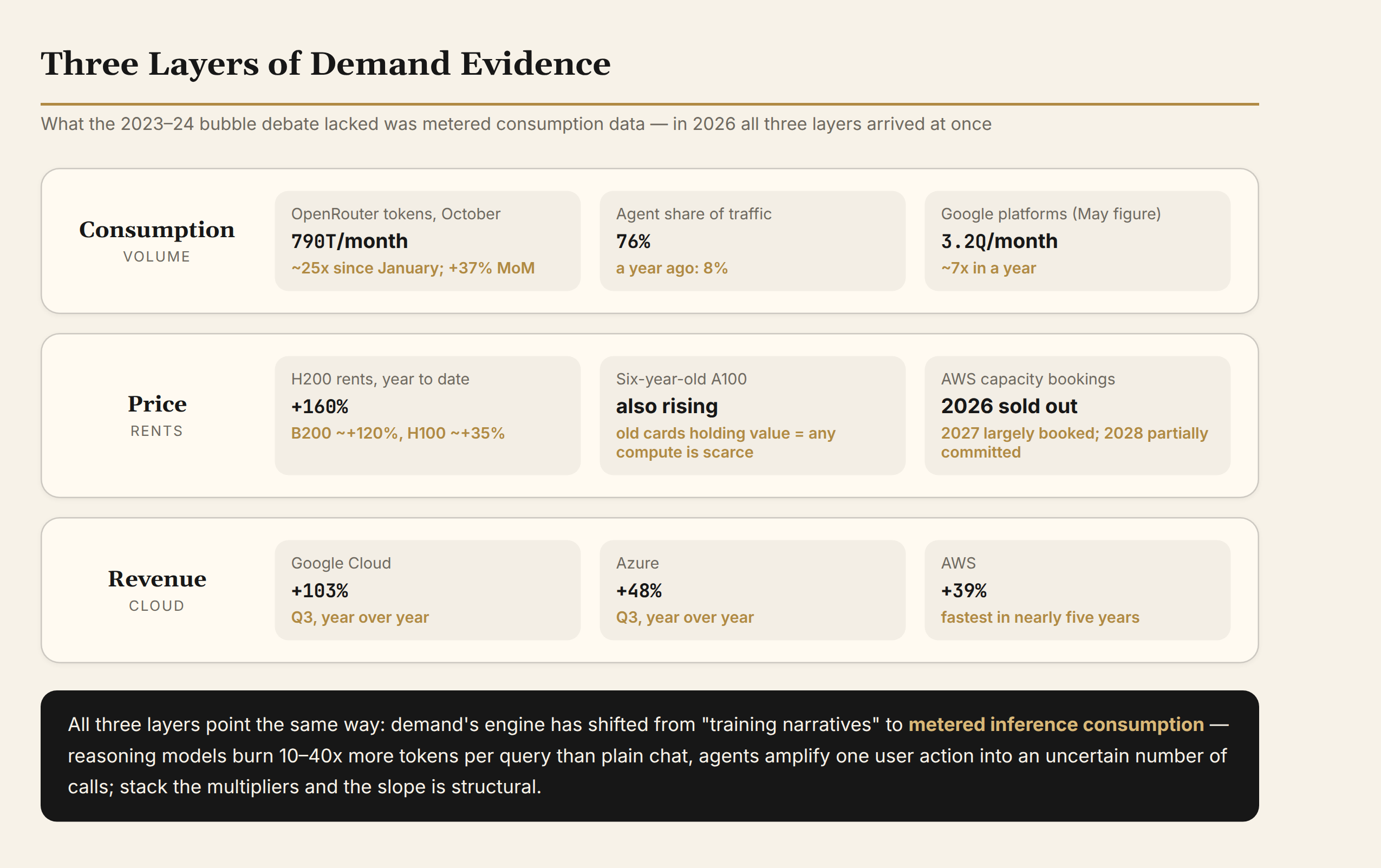
The step-change in consumption comes from inference, not training. OpenRouter, an inference aggregation platform, offers the most complete version of this evidence: 790 trillion tokens processed in October, up 37% month over month and roughly 25x since January; agent traffic now accounts for 76% of the total — a year ago it was 8%. Google's numbers are larger still: at its I/O conference this May, the company disclosed that its platforms already process about 3.2 quadrillion tokens per month (about 3,200 trillion), roughly sevenfold in a year — a May figure, so not contemporaneous with OpenRouter's October data, but the magnitude is clear. Why the slope is so steep: reasoning models burn ten to forty times more tokens per query than plain chat (the chain of thought itself generates tokens), and agents amplify a single user action into an uncertain number of model calls. Stack the two multipliers and the demand curve's slope is structural.
Corporate-side evidence points the same way. After deploying internal multi-agent systems, AT&T's daily token volume grew from about 8 billion to 27 billion. Goldman Sachs Research expects global token consumption to grow to 24x its current level between 2026 and 2030. Each number carries its own margin of error, but the direction agrees: inference consumption has become the primary engine of compute demand, and for the first time there is platform-level ongoing metering of it.
Price is the second witness. If demand were hollow, rents would fall as new capacity came online. The opposite happened: a16z's chart (based on Ornn executed-trade data) shows H200 up about 160% for the year, B200 about 120%, H100 about 35%. On an executed-trade basis, Silicon Data and Ornn put H100 at about $2.81 per GPU-hour, with matching directions of increase. The structural detail matters more: the older the card, the better it holds value. A100s appreciating means the market is short of any inference-capable compute, not of one flagship generation. Cloud bookings tell the same story from another angle: AWS sold out for 2026, mostly booked for 2027. Morgan Stanley's mid-October report added a further perspective: hyperscalers have disclosed more than $1.1 trillion of data center lease commitments that have not yet commenced — off-balance-sheet obligations that never appear in cash capex, meaning conventional measures systematically understate actual investment.
Revenue is starting to close the loop. Third-quarter growth for the three major clouds (quarter ended September): Google Cloud up 103% year over year, Azure up 48%, AWS up 39% — AWS's fastest in nearly five years. Revenue validates the upper half of the chain that turns infrastructure into bills.
Stack the three together — consumption up 25x, rents doubled, cloud revenue accelerating — and you have exactly what was missing from the 2023–2024 "is AI a bubble" debate: metered consumption data. The demand half of that debate now has its data.
2. Three Bottleneck Shifts: Chips, Power, Capital
Metered data behind demand does not mean every link in the chain is healthy. The constraints are moving, and the three bottlenecks have different time windows — which determines what is scarce in 2027 and in 2028.
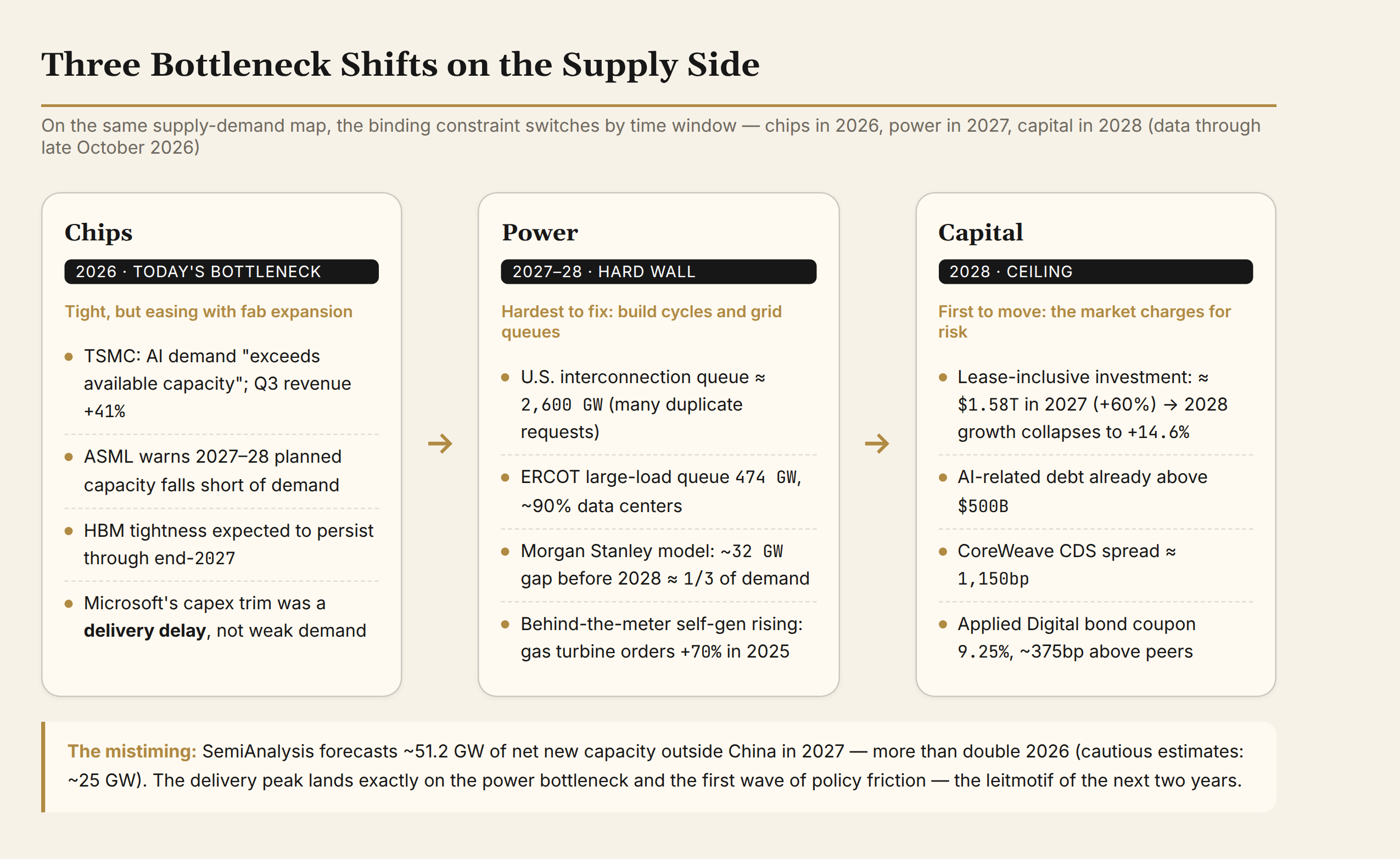
Chips are today's bottleneck, with a clear relief path. TSMC's third-quarter revenue was $46.7 billion, up 41% year over year, with management repeating that AI demand "exceeds available capacity"; ASML warned its planned 2027–28 capacity will fall short of projected customer demand. Memory is tighter: a DRAM shortage has pushed consumer graphics cards to three times list price, enterprise SSD contract prices keep setting records, and high-bandwidth memory (HBM) tightness is expected to persist through the end of 2027. But the chip bottleneck has a property the others lack: it is solved by factory expansion, and expansion is happening. Microsoft's case shows the flip side: at its October 28 earnings call it trimmed calendar-2026 capex guidance from $175 billion to about $170 billion, and the market read a demand slowdown. The actual reason, per CFO Amy Hood, was third-party GPU capacity arriving late, with some deliveries slipping into the first half of 2027. Supply bottlenecks routinely masquerade as demand signals — read the filings twice.
Power is the hard wall of 2027–28, and much harder to fix than chips. The U.S. interconnection queue has swelled to roughly 2,600 GW of generation and storage (with plenty of duplicate and speculative requests). In Texas alone, the state grid operator ERCOT's large-load queue grew from 63 GW at the end of 2024 to 474 GW by mid-2026, about 90% of it data centers (queue definitions vary, and some analyses report much lower figures). Morgan Stanley's own power model, in the same October report, estimates a U.S. data center supply gap of about 32 GW before 2028 — roughly a third of the 97 GW of demand in the same window. In plain terms, about one in three chips could be bought but not powered; the bank's own sketch of the outcome is hoarding and stranded inventory as buyers take cards before they take power. On the conservative end, Sightline Climate estimated in February that 30–50% of the 140 large U.S. projects targeting 2026 completion — about 16 GW — could slip to 2027 or later. The IEA's global ledger in Powering AI: data center electricity grows from about 485 TWh in 2025 to about 950 TWh in 2030 under its central case, and as of May 2026 at least 180 GW of advanced-stage data center projects were still waiting in connection queues. Reliability is sounding alarms too: a July 2026 transmission fault in Northern Virginia forced 3.8 GW of data center load onto backup supply simultaneously — the largest demand-loss event in grid operator PJM's history — prompting a rethink of interconnection standards for large loads.
The industry's response is to route around the grid: behind-the-meter (BTM) self-generation is turning from an optimization into a default. Gas turbine orders rose 70% in 2025; one research house expects about 25.5 GW of new U.S. industrial demand to be served behind the meter by 2030, 88% of it data centers. This is the physical-layer mirror of the supply-demand squeeze — when the grid queue takes years, build your own plant, even if it is dearer and dirtier.
Capital is the 2028 ceiling, and it is the constraint already moving. Under Morgan Stanley's lease-inclusive basis, AI compute investment runs about $980 billion in 2026 (doubling), about $1.58 trillion in 2027 (+60%), and about $1.81 trillion in 2028 — growth collapsing from +60% to +14.6%, a turning point already written into the sell-side model. Where the money comes from: AI-related debt is projected to exceed $500 billion by the end of 2026 across public bonds, private credit and bank lending; J.P. Morgan estimates total data center capex of $5.5 trillion over 2026–2030, requiring five bond markets to absorb. And the bond market has started charging for risk: CoreWeave's five-year credit default swap (CDS — think of it as the price of insuring against bond default) spread reached roughly 1,150 basis points in late October (Oracle around 300, Nvidia around 130 for comparison); Oracle-linked Vantage's $38 billion loan took months and more than twenty banks to distribute; data center developer Applied Digital had to pay a 9.25% coupon on its November bond, about 375 basis points above similarly rated peers. The market is not refusing AI debt — it has started charging for it.
The demand side's weakest link is also coming into focus: the model layer. Anthropic's IPO filing offers the first public unit-economics sample — about $265.6 billion of fixed or minimum compute commitments in the original filing, updated to roughly $895 billion combined purchase and lease commitments in the early-November amendment; third-quarter revenue of $16.96 billion with sequential growth slowing to 47% from the prior quarter's 144%; a return to a GAAP operating loss of $567 million after a profitable second quarter. The filing's own efficiency curve shows revenue per dollar of compute and infrastructure spend rising from $0.40 in early 2025 to $2.08 by mid-2026. The model layer is not burning money for nothing and efficiency is climbing — but profitability is not yet stable, and the slope of revenue growth is not keeping up with the slope of compute commitments. On the OpenAI side, the fundraising target was cut from $30 billion to about $20 billion in late October; of its 36 GW of contracted compute, Epoch estimated in April that less than 0.3 GW was actually running. The gap between committed and operating capacity is the measure of financial fragility on this chain.
Lay the three shifts on a timeline: scarce chips in 2026 (easing), scarce power in 2027 (closing in), scarce capital in 2028 (already repricing). Meanwhile SemiAnalysis's October report forecasts 2027 as the biggest data center delivery year on record — about 51.2 GW of net new IT capacity globally excluding China, more than double 2026 (though some investors think the real number is closer to 25 GW — the gap between committed and delivered is itself the disagreement). The delivery peak lands exactly on the power bottleneck and the first wave of policy friction — that mistiming is the leitmotif of the next two years.
3. China's Parallel Market: Fastest Expansion, Deepest Mismatch
A second compute market exists on the same planet, running on different logic.
Its expansion is the fastest anywhere: per China's Ministry of Industry and Information Technology, intelligent computing capacity reached 2,592 EFLOPS (one quintillion, 10^18, floating-point operations per second) by end-September 2026, up 146% year over year. The chip landscape is being rewritten too: IDC counts 2.008 million AI accelerators shipped in China in the first half of 2026, of which non-GPU accelerators totaled 1.016 million, up 80% — the first time they exceeded GPU shipments (991,000, down 26%). Huawei's share reached 28% on 572,000 units shipped, nearly double, six points behind Nvidia's 34%. Export controls, inference demand and domestic substitution stack into a "de-GPU" path America has not taken.
The other side of the expansion is mismatch. Across more than 500 intelligent computing centers nationwide, average utilization is just 36.8% — three-fifths idle; enterprise general-purpose centers run at 10–15%. Over the same period in America: 1.4% vacancy in primary markets, more than 80% of capacity under construction pre-leased. Put together, China's problem is not "not enough compute" but "not enough of the right compute": a stock of rooms built for the training era cannot track a load profile now dominated by inference; estimates put the high-end training gap around 17% while low-end inference capacity sits surplus. State media's October formulation was a shift from "competing on scale" to "competing on efficiency" — and the same month, Huawei, Cambricon, MetaX and other domestic chip vendors raised prices by 20–50%. Tight supply and idle capacity coexisting is the classic symptom of structural mismatch.
The global implication: China's listed companies will roughly double AI infrastructure investment to about $139 billion in 2026 (Rhodium Group), still under a fifth of America's ~$800 billion; but by installed capacity, per the National Data Administration's Digital China Development Report, China's intelligent computing capacity reached roughly 1.59 million PFLOPS by the end of 2025, second globally. Two parallel systems — one expensive and tight, one cheap and idle — are evolving separately; export controls and supply chains set the height of the wall between them. After the U.S. election, that wall is likely to get higher still (see below).
The same storyline has a second face: panic buying. Reuters reported in October that ByteDance, Alibaba and Tencent ordered more than 3 million export-compliant RTX PRO 5500 GPUs worth over $35 billion, mostly for inference — and Nvidia may be able to deliver only about a tenth of the order.
4. Politics Starts Collecting Rent: Compute Policy After the Blue Wave
Back to the second event from the opening: why did a supply-starved market crash on an election?
What the election changed. On November 3, Democrats took both chambers: at least 258 House seats (the largest majority in nearly two decades) and seven Senate flips, including Texas, South Carolina, Ohio, Iowa — deep-red states. The more direct blow landed at the state level: Texas, Georgia, Ohio and Iowa all elected Democratic governors, and Texas plus Georgia account for roughly a third of U.S. AI data center investment and projects (an investment-share figure; the capacity-share measure below uses a different source). Voter sentiment is unambiguous: NBC's exit poll found 56% of voters rated AI and data centers a major or crucial factor in their congressional vote (the lowest of five issues tested, but still a majority), and 76% oppose a new data center in their own community. Nationwide, at least 43 data center moratorium ballot measures passed, nearly without exception. Data centers became a national electoral issue for the first time — and the voters' position is no. Electricity bills, water, noise, land — every item is local.
But "big and stuck" is the structural signature of the new Congress. However large the Democratic majorities, three gates remain: Trump's veto pen (258 seats is far short of the 290 needed to override; he signed an executive order wearing a VETO cap on November 5 to make the point), the Senate's 60-vote filibuster threshold, and the fact that permitting and electricity pricing are state powers anyway. So what moves fast at the federal level is not legislation but three things: hearings, subpoenas, and funding conditions. The real policy firepower lands on states and federal oversight in the first two years.
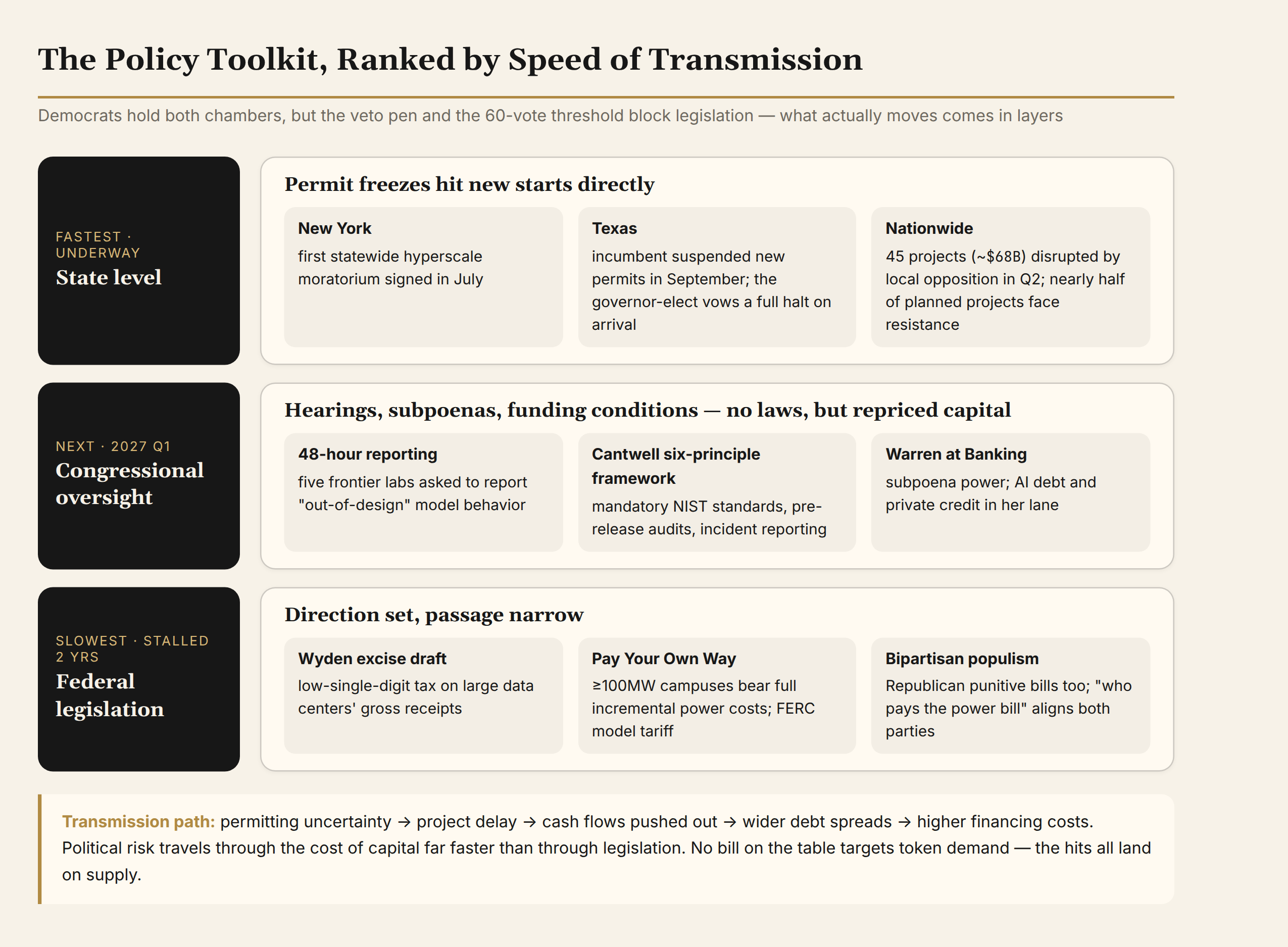
A three-layer toolkit, ranked by speed of transmission. The first layer is state-level, and it already hurts: New York's Governor Hochul signed the nation's first statewide hyperscale data center moratorium back in July (the political friction started well before the election); in Texas, incumbent Governor Abbott suspended new data center permits at the environmental agency in September pending an audit, and Governor-elect Hinojosa campaigned on going further — halting all data center approvals until the legislature passes protective legislation, with the first test arriving when the legislature convenes in January. Earlier, in Q2 2026, 45 projects worth about $68 billion had already been disrupted by local opposition; Bloomberg's assessment is that nearly half of planned U.S. AI data center projects face moratoriums, local restrictions or community pushback. The second layer is congressional oversight, opening in Q1 2027: House Democrats in October already demanded that OpenAI, Anthropic, Meta, Google and SpaceX disclose safety measures and report "out-of-design" behavior within 48 hours; Senator Cantwell, expected to chair Commerce, has a six-principle framework including mandatory NIST safety standards, pre-release independent audits and mandatory incident reporting; and Senator Warren, expected to chair Banking, gains subpoena power — with AI debt, private credit exposure and CoreWeave-style credits' spreads all in her lane. Hearings do not legislate, but they make bond buyers charge more. The third layer is federal legislation — slow, narrow, but the direction is set: Senator Wyden has drafted a low-single-digit excise tax on large data centers' gross receipts; 28 House members have co-sponsored a bill ending bonus depreciation for data centers; the industry-aligned Chamber of Progress proposed a "Pay Your Own Way Act" requiring campuses above 100 MW to bear the full incremental cost of serving them, with FERC to set a model tariff and federal grid funding conditioned on states adopting it. Two notes: Republican senators have introduced punitive tax bills of their own — anti-data-center politics is a bipartisan populist junction, not a partisan one. And "who pays the power bill" is the one direction both parties already agree on: Trump's own pre-election executive order required data centers to cover the new energy costs of their projects. That line has the highest certainty of all.
What the market priced was not legislation but the cost of capital. That explains November 5. The rout was three triggers stacked: the Democratic sweep, weak Qualcomm and Arm earnings, and persistent investor doubt about AI payback periods (Goldman's broad AI basket had already fallen 15% in October and 24% from its peak before the vote — the election was catalyst, not cause). The transmission channel from political risk into compute asset pricing is short: permitting uncertainty → project delay → cash flows pushed out → wider debt spreads → higher financing costs. Anthropic's IPO pricing window is now clouded; Meta turned to the bond market (up to $25 billion). Rates markets have even begun trading the chain: futures cut about 15 basis points off expected hikes through mid-2027 — AI slowing means the Fed hikes less.
The bills on the table aim not at demand but at the shape of supply. Six directions to watch follow. First, token demand is not in the line of fire of any bill on the table — the hits all land on supply: permits, power, capital, each gaining a layer of friction. The likely reading is higher rents, not lower. Second, capacity under construction in 2026–27 is largely safe (more than 80% pre-leased, protected by contracts); what freezes is new starts — projects stopped in 2027 will disappear from delivery numbers only in 2028–29, coinciding exactly with the collapse in Morgan Stanley's 2028 capex growth to +14.6%. Two independent signals point at the same window. Third (this article's projection, conditional on "pay your own way" actually becoming the compliance floor), once bearing full power costs becomes a legal requirement rather than a threat, behind-the-meter self-generation accelerates — if you must pay for all the power anyway, build your own plant. This cuts against the Democrats' own emissions agenda and will be the most consequential intra-party policy fight of 2027. Fourth (also this article's projection, assuming compliance costs do amortize with scale), regulatory cost is fixed cost — nominally anti-Big-Tech policy in practice may accelerate the culling of leveraged players and consolidate the cash-rich hyperscalers. Fifth, infrastructure migrates offshore faster: Google just announced $15 billion in Malaysia for 2027–28 (officially framed as capacity expansion, not a regulatory escape), Brookfield plans a $27 billion project at a UK power station, and the UAE holds an export-control fast lane — industry consultancy ABI's read: "a meaningful share of the chips on order will be installed outside the United States." Sixth, policy toward China most likely hardens: Trump may lean on external toughness to deflect midterm losses, the Democratic Congress is more hawkish than the White House, and export controls are a bipartisan consensus area. The U.S.–China trade truce expires January 10 — one week into the new Congress — the first stress test. For China's domestic substitution drive, this is another ring of policy fencing: Washington tightening and Beijing substituting are the two halves of the same loop.
5. Trend Watchpoints
Watchpoint 1: the demand side shows no inflection signal yet. The evidence is the agreement of consumption magnitude and price signals; the condition for the trend to continue is sustained growth in inference consumption, especially agent traffic. Counter-signal: two consecutive months of negative sequential OpenRouter token growth, or a sustained downturn in H100-class rental indices — that would mean agent economics peaked before power did, and the demand story needs reassessing.
Watchpoint 2: multiple signals point to a tighter 2027 supply. 'Tighter' here is relative to the mainstream forecast range — SemiAnalysis's 51.2 GW at the top, cautious estimates (Altimeter's Gerstner) around 25 GW at the bottom. Power delays (30–50% of projects slipping) and rising capital costs (CDS spreads, 9%-class coupons) both subtract from supply, while the big-delivery-year assumption requires power to arrive on schedule. Counter-signal: if mid-2027 H200-class rents start falling and AWS-style capacity bookings loosen, supply caught up, and the squeeze logic dissolves.
Watchpoint 3: political risk is already being priced through the cost of capital, faster than legislation. Federal AI bills are unlikely to become law within two years (veto plus 60 votes), but bond spreads, IPO pricing and neocloud financing terms may reflect Warren's first subpoenas as early as Q1 2027. Indicator to track: whether Anthropic's listing (originally a mid-November pricing window) happens, slips or shrinks — the litmus test of political pricing across the AI capital chain. Counter-signal: if AI bond spreads and IPO pricing show no directional response after congressional subpoenas land in Q1 2027, this transmission needs reassessing.
The timeline to watch: January 3, 2027, the new Congress convenes (whether the first hearings target electricity bills or AI safety; whether Warren moves first on AI debt); January 10, the U.S.–China trade truce expires; the same month, the Texas legislature convenes (whether the moratorium is pushed for real or softened — per CBS, Texas accounts for 25% to 30% of U.S. data center capacity expected online through 2030); end of Q1, hyperscaler earnings (whether any company writes "regulatory and permitting risk" into a capex cut for the first time — Meta, Alphabet and Amazon are all, for now, guiding up).
One symmetry is worth recording: the American market is undersupplied, rents soaring, politics now slamming the brakes; the Chinese market is expanding fastest on earth, three-fifths idle, official policy pushing "efficiency over scale." The two markets have opposite diseases and opposite prescriptions, but the diagnosis is the same — compute's bottleneck was never only chips. It is the product of power, capital and public tolerance, and whether all three tighten at once in 2027 is the main line this observation will keep tracking.
Sources
- OpenRouter platform data page (October 2026): token volume, agent share, price declines
- Google I/O 2026 (May 2026): platform-wide monthly token volume
- AT&T (company disclosure, as reported): internal multi-agent token volume; Goldman Sachs Research: 24x token consumption projection for 2026–2030
- a16z Charts of the Week (October 23, 2026, X, based on Ornn data): GPU rental increases and executed-trade price levels
- Silicon Data index (October 7, 2026): absolute levels and increases
- Amazon Jassy interviews (October 2026, multiple outlets): AWS capacity bookings
- TSMC and ASML Q3 2026 earnings (as reported): capacity and demand
- Google, Microsoft, Amazon Q3 2026 earnings and calls (late October 2026): cloud revenue growth; Microsoft capex guidance (October 28)
- IEA, Powering AI (2026 edition): electricity forecasts, connection queues, the PJM event
- CBRE North American Data Center Trends H1 2026, JLL: vacancy and pre-leasing
- Sightline Climate (February 2026): project delay estimates; ERCOT queue (Delphi Digital)
- Morgan Stanley research (mid-October 2026, as reported): lease-inclusive investment forecasts; the ~32 GW power gap before 2028 is the report's own power model
- J.P. Morgan (September 2026): data center financing structure; Forbes (October 22, 2026): AI debt stock
- Epoch AI (April 2026): estimate of OpenAI's actually operating contracted compute
- S&P GMI data (late October 2026, multiple outlets): CDS spreads; Financial Times (November 2026): Applied Digital bond; Bloomberg (as reported): Vantage loan syndication
- Anthropic S-1 (filed October 26, 2026) and November 2 amendment: compute commitments, revenue, unit economics
- China's National Data Administration, Digital China Development Report: installed intelligent computing capacity; China MIIT (September 2026): intelligent computing capacity; IDC (H1 2026): China accelerator shipments
- China Business Journal (October 27, 2026): computing center utilization; Economic Daily (October 16, 2026): domestic chip price increases
- NBC, AP, CNN, BBC (November 3–4, 2026): midterm results and exit polls
- NPR, CNBC, Le Monde (November 5–6, 2026): post-election markets
- Foley & Lardner, BDO, Tax Foundation, Brookings, MultiState (November 2026): Democratic policy agenda and state legislation
- The New York Times (July 2026): New York State moratorium; Bloomberg (2026): Q2 blocked projects and nationwide project assessment
- CBS News (November 2026): Texas share of U.S. data center capacity
- TokenPost, NDTV Profit, The Washington Sun (November 2026): AI legislative plans
- SemiAnalysis, Datacenters 2027 (October 19, 2026, via Data Center Frontier): the 51.2 GW forecast; Altimeter (Brad Gerstner, as reported): cautious ~25 GW estimate for 2027
- ABI Research (November 2026): post-election data center buildout guidance
- Asia Times, South China Morning Post, Baker McKenzie (November 2026): China policy direction
- Rhodium Group (as reported): China AI infrastructure investment; Google/Reuters: Malaysia investment
Related Reading
- The AI Compute Chain's Ledger: From Neoclouds to the Lab IPO — the balance-sheet view of the chain's players, the other half of this article's supply-and-demand picture