
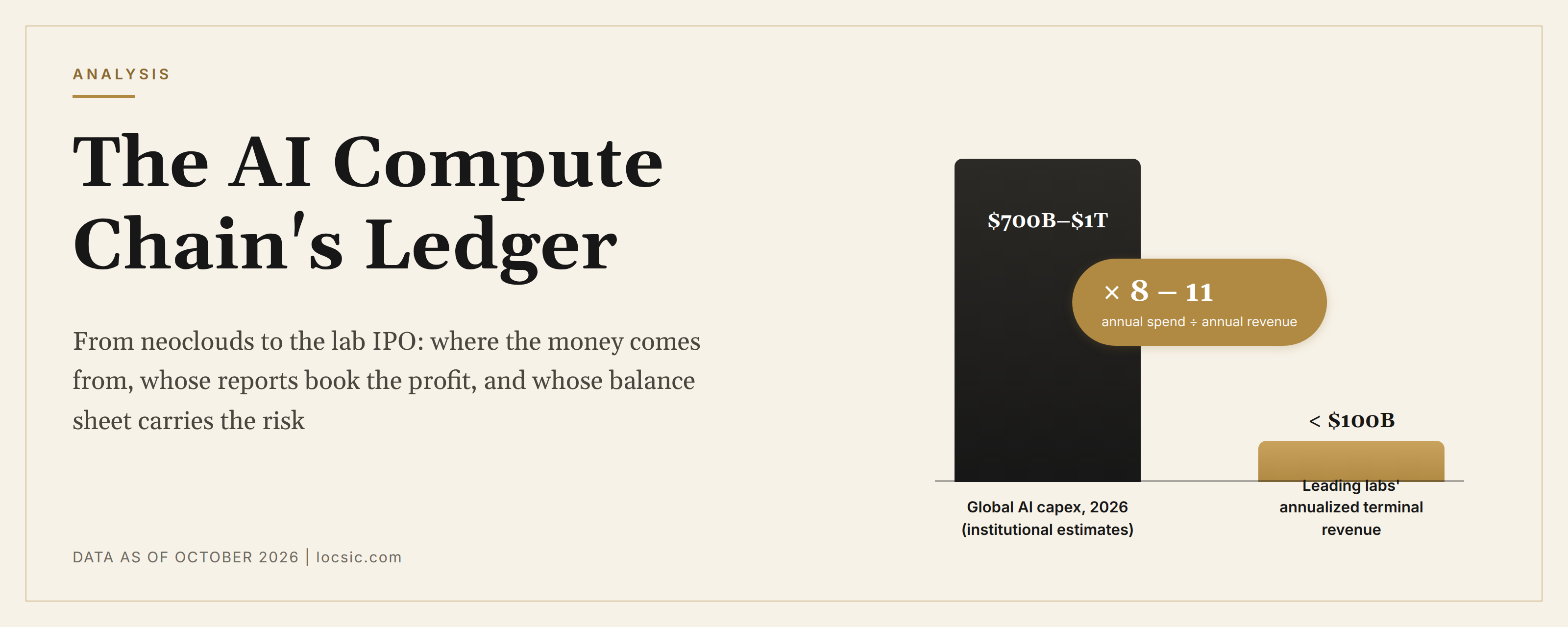
Compiled from public reports, company disclosures, and sell-side research | Data as of October 28, 2026
From early to late October, four events landed in quick succession. According to media reports, GPU cloud provider Firmus pulled its IPO about three days after the bookbuild opened. Singapore data center operator DayOne, two weeks after filing, was reported by Bloomberg, citing informed sources, to be considering cutting its planned IPO raise from as much as $5B to $2.5–3B. Bridge Data Centres, the data center company Bain Capital put up for sale, has now been on the market for seven months without a buyer. And CoreWeave, the largest neocloud, saw its bonds fall below 80 cents on the dollar, with yields above 15%. The four events sit across three markets: IPOs (two cases), a private equity exit, and the public bond market. What connects them is one supply chain: the financing of the AI compute industry is being repriced across several layers at the same time.
This article walks the chain's whole ledger. Where the money comes from, whose hands it passes through, whose income statement the profit comes to rest on, and whose balance sheet the risk finally lands on.
1. First, the Two Sides of the Ledger
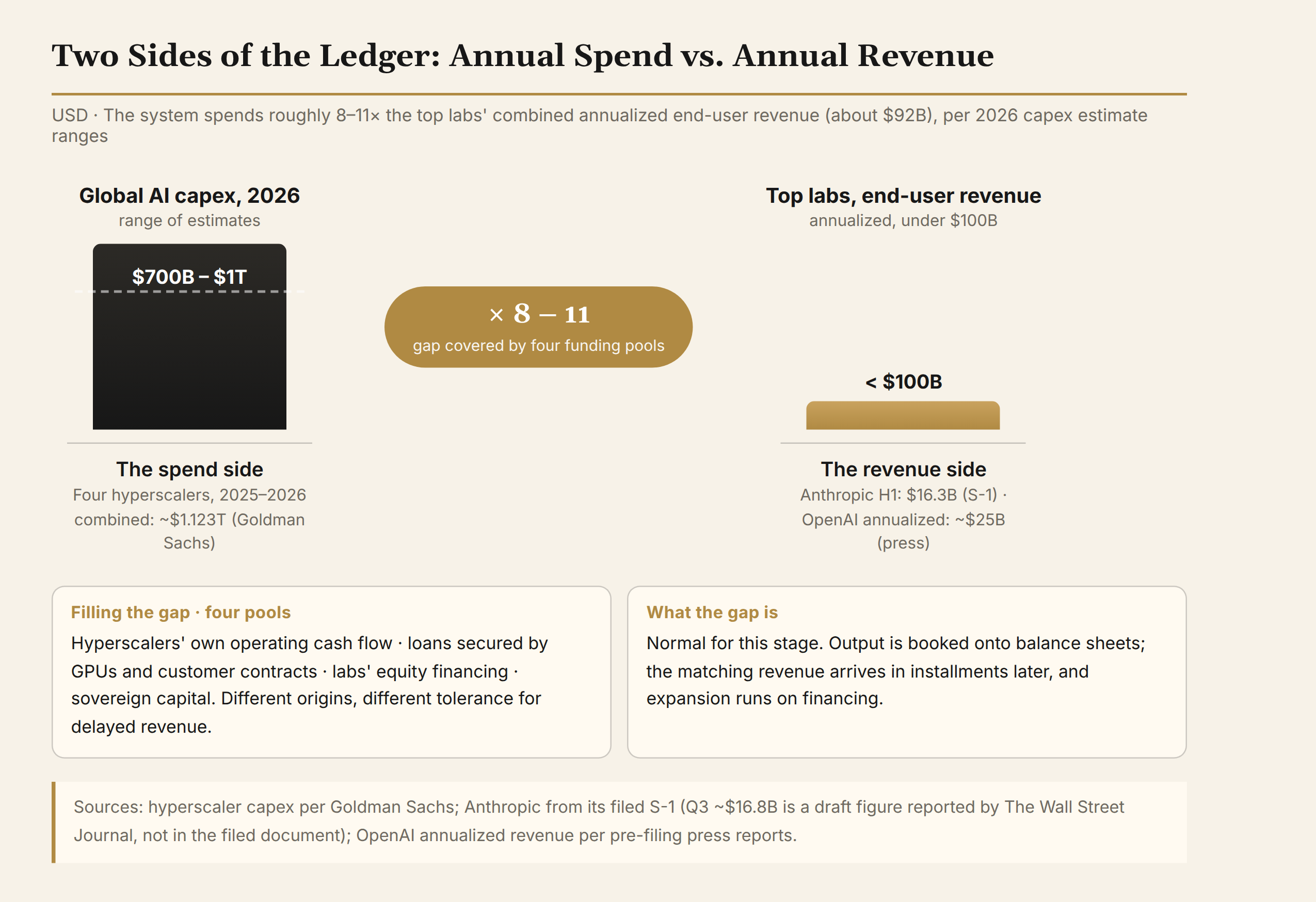
On the spending side. By Goldman Sachs' tally, Microsoft, Amazon, Alphabet, and Meta will have spent a combined $1.123 trillion of capital expenditure across 2025–2026. Estimates for global AI-related capex in 2026 range between $700B and $1 trillion.
On the revenue side. Anthropic's publicly filed S-1 shows $16.3B of revenue for the first half of 2026, of which $11.56B came in the second quarter. An earlier draft, reported by The Wall Street Journal on October 20, put third-quarter revenue at roughly $16.8B, up 45% quarter over quarter, a figure not included in the filed document. On committed compute-infrastructure spending, media tallies from the now-public S-1 land between $518B and $567B depending on scope, reaching roughly $750B at most when optional and conditional items are included (for the detailed account, see our earlier S-1 analysis). OpenAI, per pre-filing media reports, has annualized revenue of about $25B at a gross margin of roughly 33%, with compute commitments also in the $600B range.
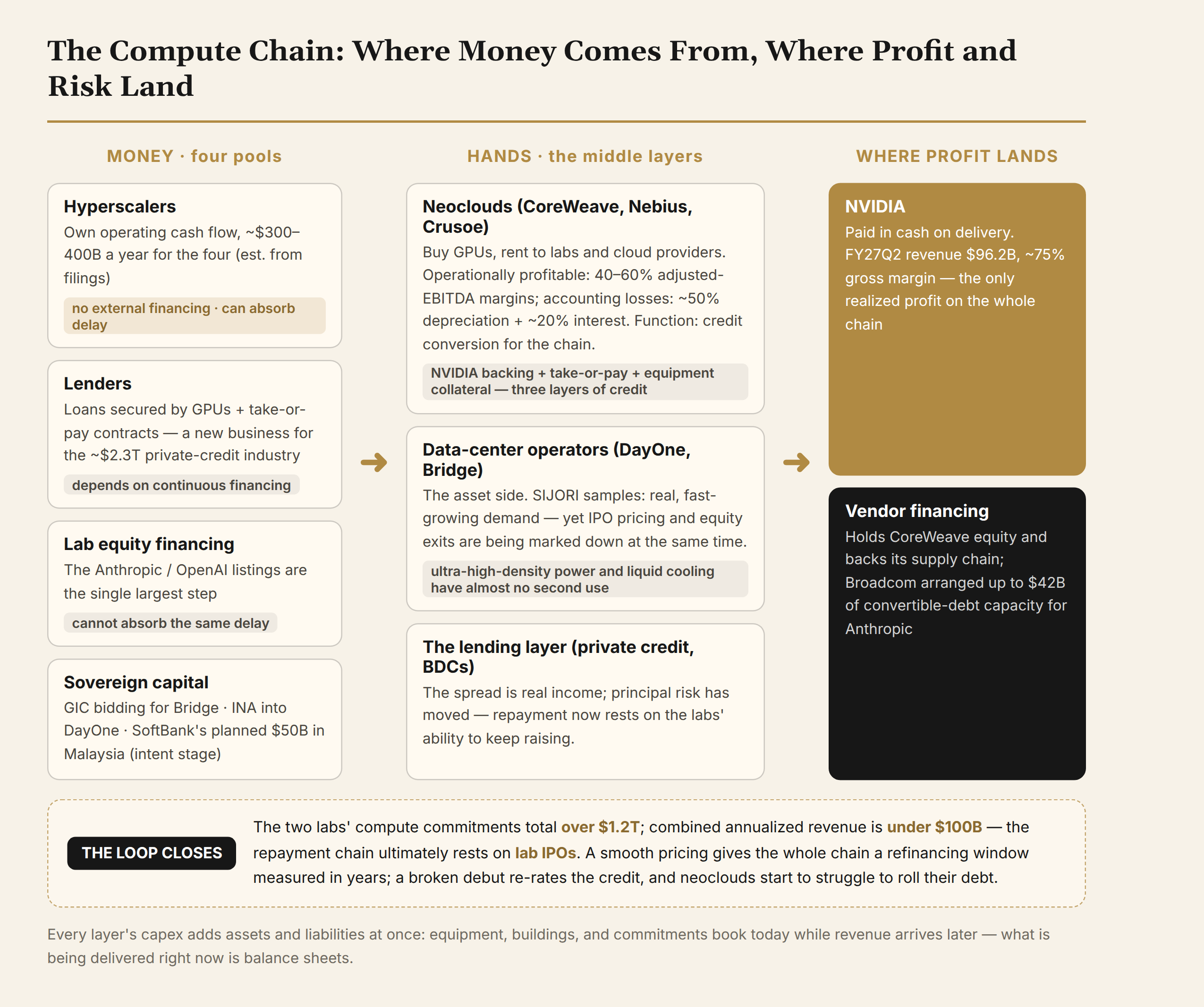
Subtract one side from the other: on estimates of $700B to $1 trillion of 2026 capex against the two leading labs' combined annualized terminal revenue of roughly $92B (Anthropic annualized from the reported third-quarter figure), the system invests roughly eight to eleven times what those labs earn in a year. The multiple divides industry-wide capex by lab terminal revenue directly; the numerator includes hyperscalers' non-AI spending, so treat it as an order-of-magnitude reference only. This gap is the norm of the current phase, and it is filled by four kinds of money: the free cash flow of the hyperscalers (Microsoft, Google, Amazon, Meta, the platform companies that build their own gigantic data centers), loans collateralized by GPUs and customer contracts, lab equity funding, and sovereign capital. The four sources differ, and so does how much revenue delay each can tolerate. That difference decides the fate of every link in the chain.
One claim needs spelling out here, because the whole article rests on it: what this industry currently delivers is balance sheets. A normal industry delivers a product or a service, the customer pays, and revenue covers cost. This system does not run that way. Its quarterly output is mostly new assets and new liabilities. A neocloud buys GPUs: one more piece of equipment on the asset side, one more loan on the liability side. A data center company builds a hall: one more building, one more syndicated loan. A lab signs a compute commitment: one more obligation on the liability side, while equity funding replenishes cash on the asset side. These activities consume real resources and labor, but what they produce is booked on the balance sheet, and the corresponding revenue is realized in installments in the future. Model capability is what this system ultimately sells; today it enters the books mainly in two forms: signed long-term contracts, and valuations discounted from future revenue. The leading labs' combined terminal revenue against the system's annual investment is the multiple laid out above. Expansion is financed, not self-funded. That is the premise for every layer that follows.
Now walk the chain layer by layer.
2. Neoclouds: Operating Profit, Accounting Loss
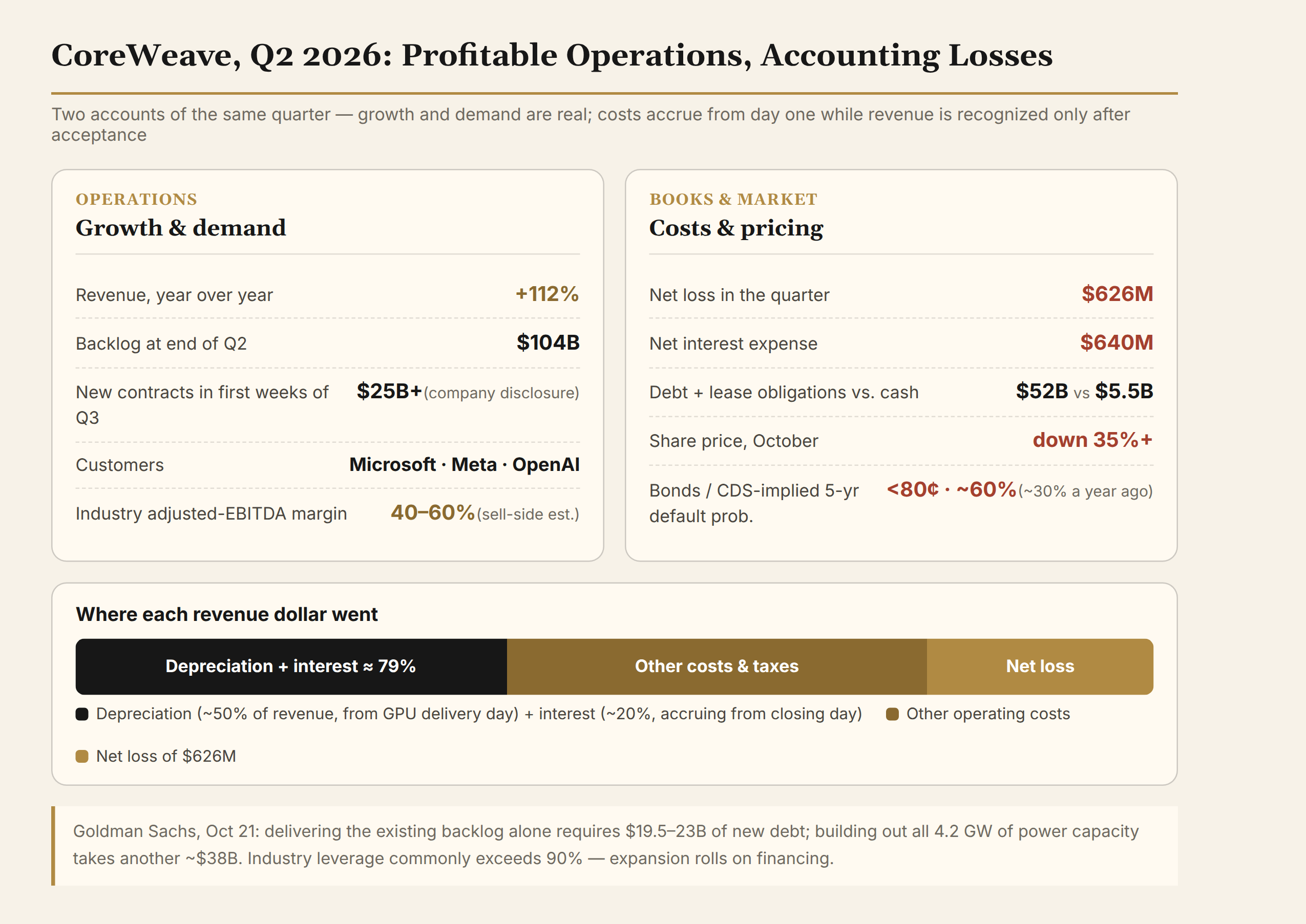
Neocloud refers to GPU cloud providers like CoreWeave, Nebius, and Crusoe, which buy NVIDIA equipment and rent it out to customers such as OpenAI and Microsoft. This layer is profitable at the operating level. Sell-side research puts industry adjusted EBITDA margins broadly at 40–60%, which says the rental business itself works. The losses come from two costs that start accruing on day one: depreciation at roughly 50% of revenue, from the day the GPUs arrive, and interest at roughly 20%, from the day the loans close. Revenue, meanwhile, is recognized only gradually, after deployment and customer acceptance. The whole industry lives inside this timing gap. The demand is real, with backlogs typically running at ten times annual revenue. The timing gap is real too, and it presses the income statement into a loss.
Take CoreWeave, the largest. In the second quarter of 2026 revenue grew 112% year over year, with a quarter-end backlog of $104B; the company disclosed a further $25B-plus of contracts signed in the first weeks of the third quarter. Customers include Microsoft, Meta, and OpenAI. The same quarter posted a net loss of $626M, while net interest expense reached $640M; depreciation plus interest consumed roughly 79% of quarterly revenue. Debt and lease obligations together come to about $52B, against $5.5B of cash. Goldman Sachs' October 19 note upgraded the stock to Buy with the target cut to $106; it estimated that honoring existing orders alone requires $19.5–23B of new debt, and roughly $38B to fully build out 4.2 gigawatts of power capacity. The note's core bull argument is that the 15% yield reflects the secondary market only, and that CoreWeave's new borrowing, mostly collateralized by GPUs and contracts, costs far less. That judgment sits opposite this article's, and Section 4 tests it against the spread data. The market is already pricing these numbers: the stock fell more than 35% in October, the bonds dropped below 80 cents, and credit default swaps (CDS, contracts that insure the bonds against default; their spread is the price of that insurance) imply a five-year default probability of about 60%, versus roughly 30% a year ago.
Why no one stops is structural. Industry leverage generally exceeds 90%; expansion rolls on financing; backlogs stand at ten times revenue, and stopping means ceding capacity to competitors. Sell-side estimates put industry return on invested capital (ROIC) below 8% for 2026–2030, under the cost of capital. The sensitivity math is starker: one quarter of delivery delay, or GPU useful life below five years, and project IRR falls below the weighted average cost of capital (WACC). By ORTEX's count, five neoclouds together carry about $17B of short interest, with roughly $6B of profit booked in October alone; the shorts are betting on the same thesis. Jensen Huang takes the opposite view, saying the systems can run for more than eight years (Yahoo Finance interview). In a CNBC interview at GTC Berlin, he said demand for neoclouds is "off the charts," and that the binding constraint right now sits on the money side: the demand for capital far exceeds its supply, though he expects that problem "is going to get solved." The money-side constraint is the same thing Goldman's estimate says.
The accurate description of this layer: at this stage it functions as a credit-conversion vehicle for the industry chain, not yet a business that rolls forward on its own operating cash flow. NVIDIA's supply commitment and equity stake back one layer of credit, take-or-pay contracts with large customers add a second, GPU collateral adds a third: three layers of credit stacked to raise financing (NVIDIA's explicit backstop is covered in Section 3). One more line in the ledger is even more direct: about $10.6B of principal comes due across the rest of 2026 and 2027.
3. Upstream, NVIDIA: The Largest Realized Profit in the Chain
NVIDIA's fiscal 2027 second quarter (ended July 2026) produced $96.2B of revenue, annualizing to roughly $400B, at a gross margin of about 75%, settled mostly in cash (for the financial detail, see 2026Q2 NVIDIA Earnings: From Selling Chips to Selling AI Factories). Its role is more than selling: it holds equity in CoreWeave and backstops its supply chain. Per Anthropic's S-1, Broadcom has provided Anthropic up to $42B of convertible note capacity (unused as of the filing date), the same kind of move: chipmakers directly financing their customers' purchases, what the equipment industry has historically called vendor financing. In a separate $63B SPV financing set up for Anthropic's purchase of Broadcom XPUs, Broadcom provides residual-value support in an amount comparable to the senior tranche (per the October 26 joint press release from BofA, Blackstone, Citi, and Morgan Stanley), moving the risk of insufficient residual value from lenders onto the chipmaker (see Section 4). Per The Information's analysis of its filings, NVIDIA has taken on up to $171.5B of guarantees and commitments to support new data centers: the single largest item is a credit guarantee of up to about $105B for an Ohio campus rented by OpenAI, plus roughly $36B of buyback commitments for capacity that cannot be sold, among other items, including up to $6.3B covering CoreWeave. The bulk of the exposure sits on the lab side, not the neoclouds. On October 15 in Stockholm, Jensen Huang said CoreWeave "gets stronger every day," that NVIDIA has "no need" to backstop it, and that its "cost of capital is actually coming down." On the company's own numbers, its weighted average cost of debt did fall by nearly 300 basis points over the past year; what moves the other way is the price of new borrowing and secondary-market yields, with the 2031 bond's yield reaching 15.78% that same day. Per S&P Global Market Intelligence data (Benzinga), NVIDIA's own five-year CDS has reached 127 basis points, more than three times its end-2025 level of 39, passing Meta (119) on October 21, with a 0.80 correlation to CoreWeave. Across the chain, realized profit is concentrated on the equipment side: chips are the largest piece, with TSMC, the memory makers, and power-equipment suppliers also banking real profit.
4. The Lenders: Real Spread Income, Principal Risk That Moved
The private credit industry, roughly $2–2.3 trillion in size depending on the tally, about six times its level a decade ago, took up a new business in 2023: lending against GPUs plus take-or-pay contracts. The template was the $2.3B CoreWeave loan led by Magnetar and Blackstone in August 2023: H100 chips as collateral, customer contracts as the repayment cash flow. The structure was copied widely, and its price states plainly whose contract sits underneath. July 2025's $2.6B DDTL 3.0, backed by OpenAI's long-term agreement, priced at SOFR+400. March 2026's $8.5B DDTL 4.0 (delayed-draw term loan), backed by a single investment-grade customer's take-or-pay contract (the announcement does not name the customer; multiple reports point to Meta), with about $7.5B initially available and $8.5B once assets stabilized, earned the first investment-grade rating ever given to GPU-collateralized financing (Moody's A3), floating tranche at SOFR+225 and fixed tranche near 5.9%, in effect lending that customer's credit to CoreWeave. May's $3.1B DDTL 5.0 sits against two unnamed large non-investment-grade customers, rated Ba2, at 450 basis points. In the same window, Nebius's $775M loan, secured on an investment-grade customer's contract, priced at just SOFR+250. Investment-grade counterparties price at 225 to 250, non-investment-grade at 400 to 450, roughly 200 basis points apart. August's $2.6B DDTL 5.5 went to 550, but it is not directly comparable to 5.0: the underlying contracts average about three years against a roughly five-year loan, and the extra hundred basis points mainly price renewal risk. Where structures are similar, the price tracks the counterparty's credit.
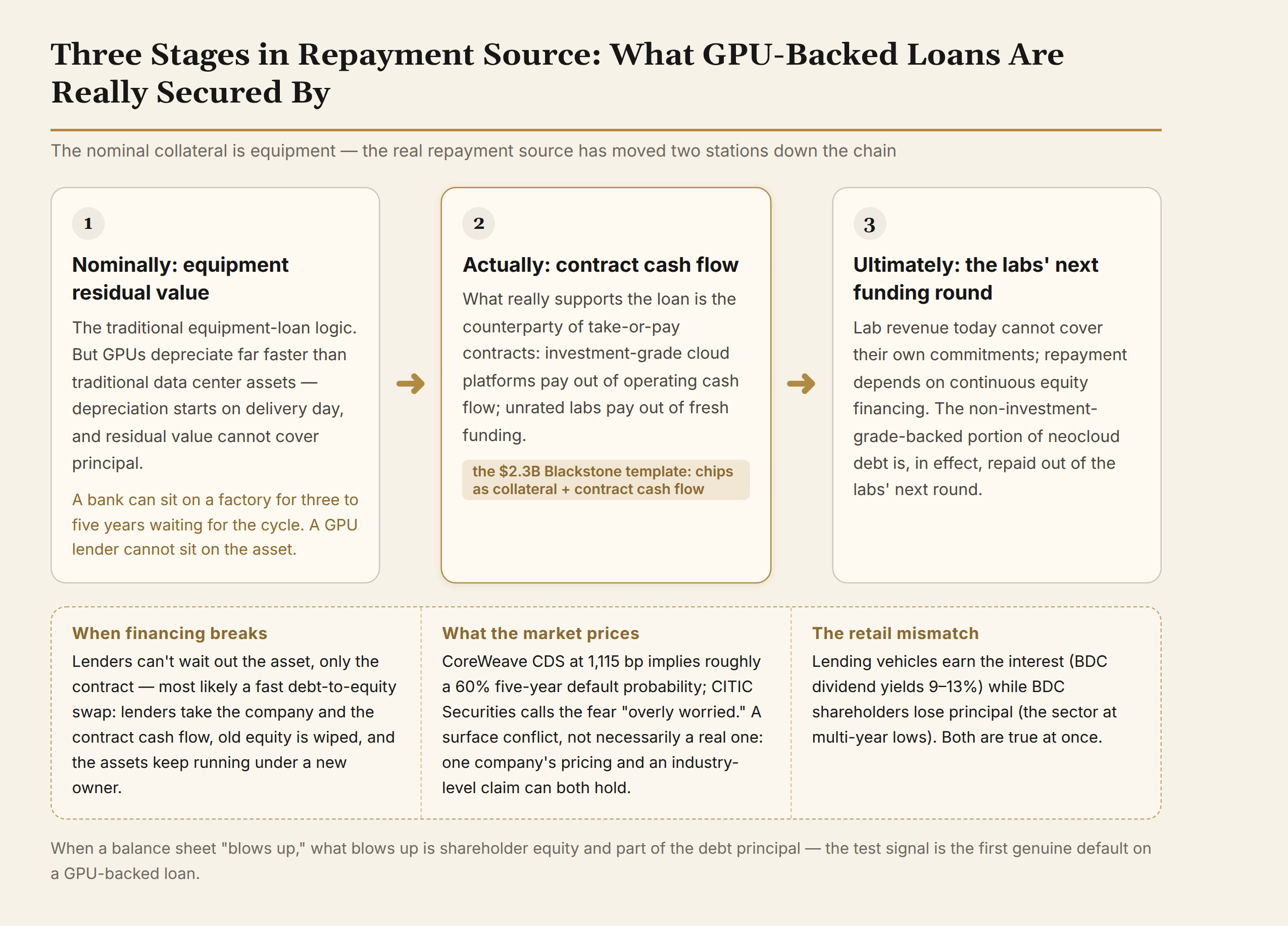
These prices say plainly that GPU loans are secured not on equipment but on the counterparty's credit: GPUs depreciate far faster than traditional data center assets, residuals cannot cover principal, and what supports the loans is contract cash flow. The counterparties come in two tiers: the investment-grade tier is mostly cloud platforms and companies like Meta; what the non-investment-grade tier confirms is the labs: DDTL 3.0 is backed directly by an OpenAI contract; 5.0's two customers are unnamed, and whether they are labs cannot be confirmed. The roughly 200-basis-point gap above is the price difference between the two credits. The first tier is repaid out of operating cash flow; the labs in the second tier earn less than they have committed, and repayment depends on continuous equity funding. The real repayment source of the neocloud debt secured on non-investment-grade customer contracts therefore includes the labs' next funding round. This also answers Goldman's bull case from Section 2: the project-level loans are not fully recourse to the parent, they are priced off the contract counterparty, and the secondary market's 15% yield genuinely does not reach this layer, on which point Goldman is right. But the insulation itself is two-tiered: the non-investment-grade tier pays 400 to 450 basis points, about 200 more than the investment-grade tier; how much of Goldman's "much cheaper" case covers new borrowing depends on how many new orders land with investment-grade counterparties. The parent-level bonds still price off CoreWeave's own credit.
On residual value, Jensen Huang sits on the other side: in his October 22 CNBC interview at GTC Berlin, he said NVIDIA is pushing to establish compute as a "financeable asset," with residual value "becoming an asset class." (He also said the systems can run for more than eight years; see Section 2.) Broadcom's $63B SPV is a counterexample: per TheStreet, banks considered walking away until Broadcom provided residual-value support on the senior tranche and the rate was raised. The SPV buys Broadcom's custom XPUs rather than general-purpose GPUs, but at least in this deal, lenders would not lend on chip residual value alone; it took the chipmaker itself stepping in with a guarantee.
The collateral's character also dictates how distress gets handled. A traditional bank can hold a factory through a five-year downturn and wait for the cycle; a GPU lender cannot wait out the asset, only the contracts. When financing breaks, the likely path is a fast debt-to-equity swap: lenders take over the company and its contract cash flow, and the original shareholders are out. What blows up on the balance sheet is equity and part of the principal; the assets and the contracts keep running under a new owner. The same CoreWeave now quotes 1,148 basis points on CDS on October 26 (S&P Global Market Intelligence data), having touched 1,167 on October 22, implying a roughly 60% five-year default probability.
The retail expression of this is BDCs (business development companies, listed lending vehicles created by U.S. legislation in 1980 that must distribute 90% of taxable income, with dividend yields commonly 9–13%). Per BTIG's October 26 report, the sector sits at multi-year lows with feeble rebounds. The lenders are earning interest while BDC shareholders lose principal; both are true at once.
On this pricing dispute, CITIC Securities argues the market is "overly worried" and that neoclouds' funding gaps "remain absorbable." The CDS-implied 60% default probability conflicts with that view on the surface, but not necessarily underneath: a CDS spread carries risk and liquidity premia, so it implies a risk-neutral probability, usually above the real-world one; it prices CoreWeave the single company, while CITIC judges the industry's absorbable gap, and both can be true at once. A first genuine default would give a single-firm signal; at the industry level, what to watch is whether defaults spread. This article uses CITIC's structural math but does not adopt its "absorbable" conclusion directly: that conclusion depends on refinancing windows staying open, which is exactly the variable Section 6 takes up.
5. The Asset Layer: Two Southeast Asian Samples
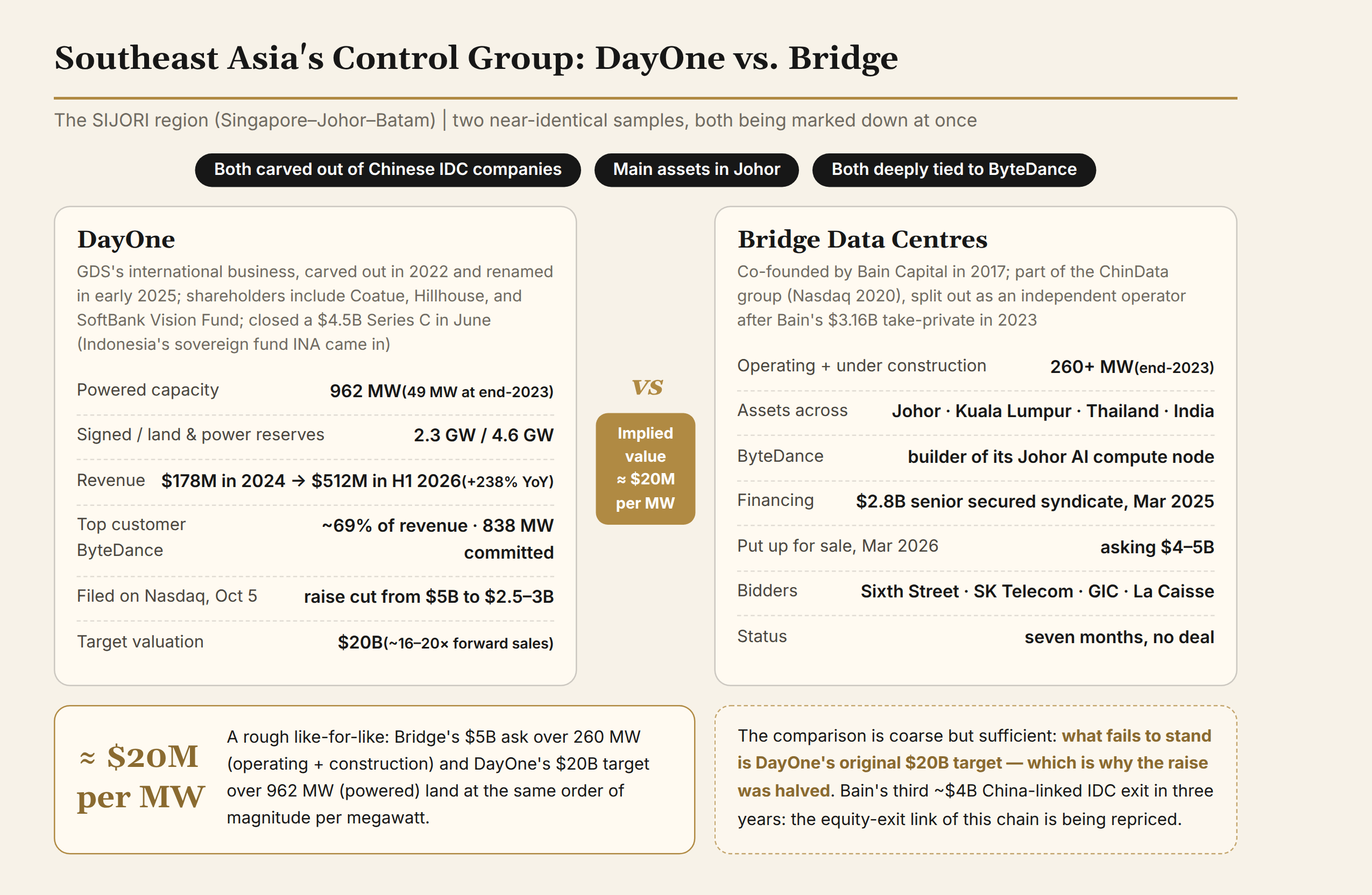
DayOne is the international business GDS spun off in 2022, renamed and set up on its own in early 2025, focused on the SIJORI data center corridor spanning Singapore, Johor (Malaysia), and Batam (Indonesia). Shareholders include Coatue, Hillhouse, and the SoftBank Vision Fund; in June it closed a $4.5B Series C, with Indonesia's sovereign wealth fund INA coming in. Growth is fast: revenue rose from $178M in 2024 to $484M in 2025, and to $512M in the first half of 2026, up 238% year over year and more than all of the prior year. Powered capacity expanded from 49 MW at the end of 2023 to 962 MW in service (as of September 20; at the end of June it was 675 MW, of which 666 MW billed). With 2.3 GW contracted as of September 20 and 4.6 GW of land and power in reserve. Per its prospectus and media reports, its largest customer ByteDance accounts for about 69% of revenue, and the second-largest customer about 15% (Oracle, per SemiAnalysis research), roughly 84% combined; ByteDance has committed to 838 MW across DayOne's sites in Malaysia, Thailand, and Finland. It filed on Nasdaq on October 5; two weeks later, Bloomberg reported it was weighing halving the raise. Its earlier target valuation was $20B, roughly 20 times annualized first-half revenue; the multiple compresses if revenue keeps growing in the second half.
Bridge Data Centres shares its origin and its market. Bain Capital co-founded the company in 2017; in 2019 it was merged with China's ChinData (Nasdaq-listed in 2020); in 2023 Bain took ChinData private at $3.16B and split the overseas business out on its own. Its assets sit in Johor, Kuala Lumpur, Thailand, and India, totaling more than 260 MW operating and under construction at the end of 2023, and it built ByteDance's AI compute node in Johor. In March 2025 it secured a $2.8B senior secured syndicated loan. Bain launched the sale this March, asking $4–5B, with Citi and JPMorgan as advisers. Bidders that surfaced include Sixth Street, SK Telecom, Singapore's GIC, and Canada's La Caisse; by end-October, no deal. This is Bain's third $4B-class exit of China-linked IDC assets in three years.
The two make a near-experimental comparison: both are overseas spinoffs of Chinese IDC companies, both concentrated in Johor, both deeply tied to ByteDance. The valuation comparison can only be rough, and the statistical ranges and dates must be stated: Bridge's 260 MW is operating plus under construction at the end of 2023; DayOne's 962 MW is in-service capacity as of September 20. The two figures are nearly three years apart, so the comparison holds only at order-of-magnitude level. On those respective bases, Bridge asks $5B and DayOne targets $20B, an implied value around $20M per megawatt on both sides, the same order of magnitude. The comparison supports a limited but sufficient conclusion: both priced at the same order, and Bridge found no buyer at that level for seven months, suggesting the whole asking range was rich; DayOne's reported weighing of a smaller raise or a postponement shows the same price struggles to clear in the public market.
This layer also carries an export-control episode. Last October, U.S. Senator Cotton wrote to the Commerce Department alleging that Singapore compute provider Megaspeed had deployed NVIDIA chips in Malaysia and Indonesia to sell compute remotely to customers in China; Singapore police opened an investigation. Bridge removed Megaspeed from its facilities, and this February disclosed the customer change to its lending syndicate without stating a reason (Bloomberg, April). To be clear, ByteDance's 838 MW was signed by overseas entities for overseas business, a different path from the repatriation chain Megaspeed was investigated over. But the episode shows the gray path carries real exposure: halls in Johor, NVIDIA chips, China-linked customers, and enforcement that can travel from the customer end to the hosting end.
For Southeast Asia, three accounts: two of demand, one of capital. First, the U.S. cloud companies' Malaysia commitments: Microsoft $2.2B, Google $2B, AWS $6.2B (to 2038), just over $10B combined, mostly self-built campuses, with third-party halls getting only wholesale spillover. Second, local Southeast Asian demand: AI demand from Grab, Shopee, GoTo, and Sea is real but on the order of tens of megawatts; sovereign AI projects run from tens to one or two hundred megawatts; Singapore's financial-sector demand is the most solid, but Singapore restricts new builds, and that demand has already spilled into Johor. The first two plus Singapore's hard-to-quantify but most solid financial-sector demand together come to roughly half of ByteDance's commitments (author's estimate). Third, sovereign capital is entering: GIC is bidding for Bridge, INA has invested in DayOne, and per Malaysia's Prime Minister on October 26, SoftBank proposes to invest $50B in Malaysian AI data centers (intent stage, no formal agreement), nearly five times the three U.S. clouds' combined Malaysia commitments. SoftBank, for its part, is one of OpenAI's major shareholders.
If demand stalls, a data center is no store of value. From the day it is built, three payments accrue monthly: depreciation, syndicated loan interest, and power capacity fees. The ultra-high-density power and liquid cooling designed for AI training have almost no second use; what holds value is the land and the power interconnection. The fiber glut of 2001 and after provides a complete precedent: Global Crossing and WorldCom went bankrupt in 2002 (WorldCom's case also involved accounting fraud), the fiber changed hands at a discount, and video traffic filled it within five to eight years. The loss landed on the original shareholders; the assets survived to the next demand cycle under new owners.
6. Closing the Loop: Repayment Finally Rests on the Lab IPO
Assemble the chain and the money paying NVIDIA today comes from four sources. The hyperscalers use their own operating cash flow, roughly $300–400B a year across the four per their filings (estimated), needing no external financing and able to withstand a delay in AI revenue. The investment-grade-backed portion of GPU-collateralized debt is ultimately repaid out of the cloud platforms' operating cash flow and belongs with the first category; in the remaining three, the non-investment-grade-backed portion of GPU-collateralized debt, lab equity funding, and sovereign capital all depend on continuous financing and cannot withstand the same delay. The two labs' combined compute commitments run between $1.1 trillion and $1.35 trillion (depending on whether optional and conditional items count), more than ten times their combined annualized revenue.
That is why Anthropic's IPO, and the OpenAI listing still expected to follow, matter well beyond exits. Reported expectations for Anthropic's valuation diverge widely: late-October reports mostly land between $1.5 trillion and $2 trillion, and one market analysis (Miaotou) puts the lower bound as low as $1.1 trillion; the filed S-1 sets no price range. The labs' credit as contract counterparties, and the repayment source of the non-investment-grade-backed portion of neocloud debt, ultimately rest on the labs' ability to raise money, and an IPO is the largest single step of equity funding. If pricing goes well, the chain gains a refinancing window measured in years (author's estimate: 12 to 18 months). If it breaks, the labs' credit as contract counterparties gets re-rated, private credit reprices in step, and neoclouds start to struggle to roll their debt. The test already has its first reader. Per The Information, SoftBank's SB Energy is weighing delaying its roughly $60B IPO to December or next year. It is the developer of the Ohio campus from Section 3, the one OpenAI rents and NVIDIA backs with up to about $105B of credit guarantees. Its data centers are not yet operational; its $139M of first-half revenue comes from its legacy energy business, and the $60B valuation rests almost entirely on roughly $430B of forward contracts (the facilities come online in stages from 2028). IPO investors see the valuation as resting wholly on future revenue and balk; management is watching Anthropic's November listing before deciding whether to issue in December. DayOne can still be measured by price-to-sales (about 20); at SB Energy's level, the ratio has lost meaning: a valuation ladder that runs from assets with revenue to assets whose revenue has not yet begun and whose value is almost entirely in contracts.
The tightening has already happened. Per financial-media tallies, monthly AI-related bond issuance fell from about $113B in June to about $23B in September, with reports of partial recovery from late October. Elon Musk's October 25 posts on X were more direct: in the past few weeks, the debt market has all but cut off financing to any company without substantial revenue independent of AI data centers, and the two-hundred-plus neoclouds will see "guppy-level death and consolidation." In the same posts he mentioned that SpaceX had just secured $40B of debt to buy GPUs, backed, in his words, by an investment-grade credit rating and cash-generating businesses like Starlink and launch. The speaker's position matters here: SpaceX builds its own data centers and rents out compute, in direct competition with the neoclouds. It is also a supplier to the labs: per the S-1, Anthropic has signed agreements with SpaceX for up to $120.5B of compute through 2029, running on SpaceX-owned GPUs. Whether the GPUs bought with the $40B debt serve that contract, no public information shows; but SpaceX's compute business itself likewise leans on the labs as counterparties. The independent cash flow Musk points to is, in the compute business, not independent of the labs. The lending standard of the moment, as Musk describes it, draws the line at whether a company has meaningful revenue outside its AI data centers. Three days before his post, on October 22, Nebius had secured a $3.5B senior secured bridge loan from Citi: SOFR+275, raisable to 350, with a term of just 364 days (per media reports). The window has not fully closed; it has grown shorter and more expensive.
The S-1 also shows the operating layer improving: first-half operating loss narrowed to $693M, second-quarter operating profit turned positive ($974M), with $131.65B of cash and short-term investments on hand. That does not change this section's verdict: commitments far exceed revenue, and repayment still rests on funding. One detail in the filing illustrates the chain's accounting: a first-half net loss of $80.7B, of which about $72.4B was non-cash fair-value marks on convertible notes and similar financing instruments: the higher the company's valuation, the larger the accounting loss. Across the chain, balance sheets carry discounted future revenue on the asset side and valuation-linked remeasurement on the liability side (that $72.4B charge is the remeasurement), both resting on a single assumption: that AI revenue keeps compounding.
One step further up is NVIDIA. Its revenue comes from downstream capex, and a large share of downstream capex comes from lab equity funding and borrowing. A meaningful part of NVIDIA's realized profit is an advance monetization of the labs' future fundraising capacity: what pays NVIDIA today is downstream money raised on that future capacity as the credit basis. This also explains why the most primitive demand datum, the token-consumption growth curve, is one NVIDIA returns to again and again: the whole chain's revenue assumption rides on that curve.
7. Three Judgments, Four Checkpoints
Judgment one: what this industry currently delivers is balance sheets, not intelligence. Section 1's ledger is that claim unpacked: every layer's capex adds assets and liabilities simultaneously; equipment bought, halls built, commitments signed, all booked today, with revenue realized in installments later. The gap between Section 1's two sides is financed. Intelligence's role here is that of a revenue assumption: if it holds, today's assets are worth their book value. If it fails, depreciation and repayment run on schedule anyway, and the difference is borne by shareholders and creditors. The verification metric is ready-made: terminal revenue's coverage of annual capex, currently around one-tenth.
Judgment two: the chain will not break all at once; stress resolves layer by layer, starting from the weakest credit. It has already visited the weakest link, Firmus's pulled IPO. The valuation layer is being worked through now, with neocloud stocks and bonds, BDCs, and Southeast Asian IDCs all falling. The return-on-capital problem is already here: industry ROIC runs below the cost of capital, eroding equity value without immediately threatening cash flow. The cash-flow operating layer only faces the test if AI revenue is falsified.
Judgment three: the endgame looks like discounted transfer into steady-state infrastructure, not an industry-wide wipeout. The 2001 precedent: demand arriving two or three years late is enough to break leveraged shareholders, but not the assets. Third-party forecasts point the same way: Gartner expects more than 80% of neoclouds to be unable to remain independent by 2030, most ending in merger or exit; what survives is the assets and the contracts, not the companies. The same release estimates that more than $3.5 trillion of AI infrastructure spending could face impairment by the end of 2030.
Four checkpoints, in order of consequence. First, Anthropic's IPO pricing, the single most consequential event of the year, in effect a refinancing test for the whole chain. Second, the first genuine neocloud default (a parent-level bond or a project-level GPU loan), which will test the gap between CDS pricing and the sell-side judgment. Third, Bridge's closing price, the real bid that a sovereign-and-private buyer group puts on Southeast Asian IDC. Fourth, the token-consumption growth curve, the raw data behind the entire chain's revenue assumption.
Data and Sources
This article's figures come from company disclosures and public reports. Anthropic's numbers are from its publicly filed S-1 and from an earlier draft reported by The Wall Street Journal on October 20 (the third-quarter figure is a relayed number). Commitment totals are media tallies from the public S-1, and they differ in scope: $518B per Reuters; $542B to $567B, and up to roughly $750B including optional and conditional items, per Fortune. CoreWeave figures are from its Q2 2026 earnings, Goldman Sachs' October 19 research note (the upgrade and the estimates); the backlog is the earnings figure, the third-quarter additions per company disclosure; short-interest data per ORTEX. Industry structure (leverage, EBITDA margins, ROIC, sensitivities) per sell-side research including CITIC Securities. Private credit industry size per industry tallies (roughly $2–2.3 trillion depending on scope). The Blackstone loan structure and the DDTL series per CoreWeave announcements and LSEG/Octus data as relayed by media; the composition of NVIDIA's guarantees and commitments per The Information's analysis of its filings; Broadcom's $42B convertible note facility per the S-1; the $63B SPV structure and Broadcom's residual-value support per the October 26 joint press release from BofA, Blackstone, Citi, and Morgan Stanley, with the banks' wavering per TheStreet (October 27); NVIDIA financials per its earnings; CoreWeave and NVIDIA CDS per S&P Global Market Intelligence (Benzinga, October 26 and 27); Nebius's Citi bridge loan per media reports. OpenAI figures per pre-filing media reports; the three U.S. clouds' Malaysia commitments per company announcements and media reports. BDC sector status per BTIG's October 26 report. DayOne data from its prospectus and reporting including The Information. The Bridge and Megaspeed episodes per Bloomberg and Reuters. Jensen Huang's remarks on demand and capital are from his CNBC interview at GTC Berlin (October 22); his claim that the systems can run for more than eight years is from a Yahoo Finance interview during GTC Berlin (October 21); his Stockholm remarks (October 15, on CoreWeave needing no backstop) per media reports; SB Energy's weighing of an IPO delay, its revenue composition, and its forward-contract total per The Information's October 22 report; the Anthropic-SpaceX compute agreements per Anthropic's S-1 (Fortune). Musk's statements are from his October 25 X posts and replies as reported by media. Anthropic's valuation expectation (the lower-bound $1.1 trillion reading from Miaotou) and the SoftBank Malaysia investment per multiple late-October reports (the SoftBank figure disclosed by Malaysia's Prime Minister; intent stage). Monthly AI bond issuance per financial-media tallies; the Gartner forecast per its October 14 press release. The four-cloud capex total is Goldman Sachs'. The Southeast Asian local demand magnitude is the author's estimate from public information.