
Splitting “how far does reuse go” into four evidence-backed layers
Abstract: A testable way to ask whether a cross-platform ecosystem is mature: when the same team migrates a second model, upgrades a framework, or replaces a hardware generation, how much prior work can be reused? This piece splits reuse into four layers:
- Interface shapes: API alignment is publicly documented, but the capability list has gaps;
- Implementation code: fully public, with results queryable under their respective conditions;
- Tests and verification methods: systematic tests are inheritable, but they verify components, not the user’s combination;
- Runtime environment: the HDK behind the published results is not yet publicly released.
What must be maintained is a set of combinations; turning each party’s validation results into exchangeable checklists is the route from releasing to accumulating.
The first six parts assessed “this migration”: how to count resources, compare performance, verify correctness, and compute cost. The final part changes the question: of what this wave of open source builds, how much can the next migration or the next upgrade inherit? And how much of that can be stated clearly today?
If “ecosystem maturity” only describes repository counts, release hype, or one successful demo, it cannot be tested. The testable form: when the same team migrates a second model, upgrades a framework, or replaces a hardware generation, how much existing work can be reused?
Answering requires layers. Reuse is not an on/off switch; interface shapes, implementation code, tests and verification methods, and the runtime environment are four different things, each with its own public evidence and boundaries. What the four layers can currently show publicly is not the same. Blending them into “mature” or “not mature” yields only slogans.
1. How Version Changes Propagate: One Real Sample
First, the pressure an ecosystem must withstand: version change.
The first sample comes from FlashMLA’s change log. The version released on September 30, 2026 removed support for the Hopper architecture and some older models (DeepSeek V3, V3.2, V4.0) and modified the FP8/FP4 KV cache format. Users still needing the old support switch to a designated historical commit (FlashMLA README).
Narrowing support is in itself a normal engineering choice, concentrating effort on the model and hardware combinations that matter most now. For deployers, the key is analyzing such changes dependency by dependency, not the blanket verdicts “everything broke” or “nothing happened.” The table below takes this change as the example (this piece’s analysis, not an official impact statement):
| Change | Which dependency it touches | What must be re-verified | What is unaffected |
|---|---|---|---|
| FP8/FP4 KV cache format modified | Writers and readers of the cache: the quantization path, index interpretation, attention kernels’ format assumptions | Whether writer and reader sides updated in sync; whether old cached data must migrate or be invalidated | Paths that never touch this cache format |
| Hopper and V3/V3.2/V4.0 support removed | Combinations using these models or architectures | Switch to the designated historical commit, or freeze the old version and keep running | Deployments already frozen on old versions for old models are not automatically affected by the mainline narrowing |
So the engineering burden is not just “does it install and run,” but maintaining many valid combinations of models, hardware, frameworks, and quantization configurations together over the long term. At every change, ask the table’s four questions: what changed? Which dependency is affected? What must be re-verified? What can stay as is?
2. The Four Layers of Reuse, and Each Layer’s Public Evidence
Layer one: interface shapes.
DeepEP’s public buffer API matches the NVIDIA version, and DeepGEMM keeps the same package name and API, so upper-layer calling code may need fewer changes. This layer’s evidence is the most solid: alignment is stated in the repositories, and the interface constraints (for example, do_expand must be True, routing indices must be int64) are publicly documented.
But Part 1 already listed it: identical interface shapes do not mean identical capabilities. Load-balancing communication exposes an API with no kernel yet; graph capture is unsupported. These gaps sit beneath the interface layer.
Layer two: implementation code.
The five repositories (DeepGEMM-Ascend, DeepEP-Ascend, FlashMLA, TileKernels, DeepJIT, the five of Part 1) publish all implementation code, with results as follows:
- DeepGEMM’s GEMM reports a peak utilization of 99.8%; FlashMLA’s sparse attention reports 95%/83%;
- DeepEP and MegaMoE provide bandwidths and whole-path benchmarks under their respective conditions;
- DeepJIT is a compile runtime, not among the peak-reporting components.
These results hold only under their declared conditions; they do not extend from components to the whole service.
For optimizers, the code is a reference to take apart; for second developers, an adaptable starting point. TileKernels’ TileLang dual-backend auto-selection, running one Python API on two kinds of hardware, is a ready example. Adaptation, though, must redo layouts and pipeline semantics for Ascend (Parts 2 and 4); it is not zero-cost porting.
Layer three: tests and verification methods.
The most easily underestimated layer. Alongside the code, the repositories ship systematic tests:
- DeepEP’s tests cover expert alignments 1 and 128 and check expert intervals and padding regions;
- DeepGEMM cross-validates against aclnn reference implementations and carries a determinism switch;
- layout conversion has a standalone stride check.
These tests and cases are themselves inheritable assets. Every link of Part 5’s acceptance path is built on them; newcomers need not invent acceptance from zero.
This layer’s boundary must also be stated: the tests verify each component’s behavior under its declared conditions, not the user’s combination. “Component tests pass” and “my combination is verified” are two different things, and the latter is accumulated by each team itself.
Layer four: the runtime environment.
DeepEP’s published results were measured on a manually configured PoC HDK, not a public release. Per the README, the commercial version is expected from the vendor around mid-October, subject to actual release (DeepEP README).
Until the commercial version ships, between “the code can be read” and “the results can be reproduced” stands one configuration environment. Users’ own numbers may come in below the README tables; whether the gap comes from configuration or implementation must be checked item by item against the known configuration requirements, not assumed to be anything.
Separately, V3.2-Exp’s release materials provide an SGLang NPU image entry. That path is the existing framework route for the previous generation; it neither means this batch of 950 kernels is fully integrated nor that the path is unusable. The two facts stand separately and vouch for each other in no direction.
The four layers together are the complete answer to “what this release provides”:
- interface layer: reusable;
- code layer: studyable and adaptable;
- verification layer: methods inheritable;
- environment layer: still missing a public release.
All four layers’ evidence appeared in the first six parts. Layering turns “ecosystem maturity” from an adjective into a checkable list.
3. What Is Maintained Is Combinations; What Accumulates Is Checklists
Once components multiply, what is maintained is no longer components but their combinations.
Suppose a deployment team maintains 3 model versions, 2 kinds of hardware, 4 framework versions, and 3 quantization configurations: 3 × 2 × 4 × 3 = 72 combinations in all. This is this piece’s constructed analytical frame, not an exhaustive count; most teams touch only a fraction. Any component upgrade may affect every combination containing it and require re-verification. Section 1’s version change is one real example.
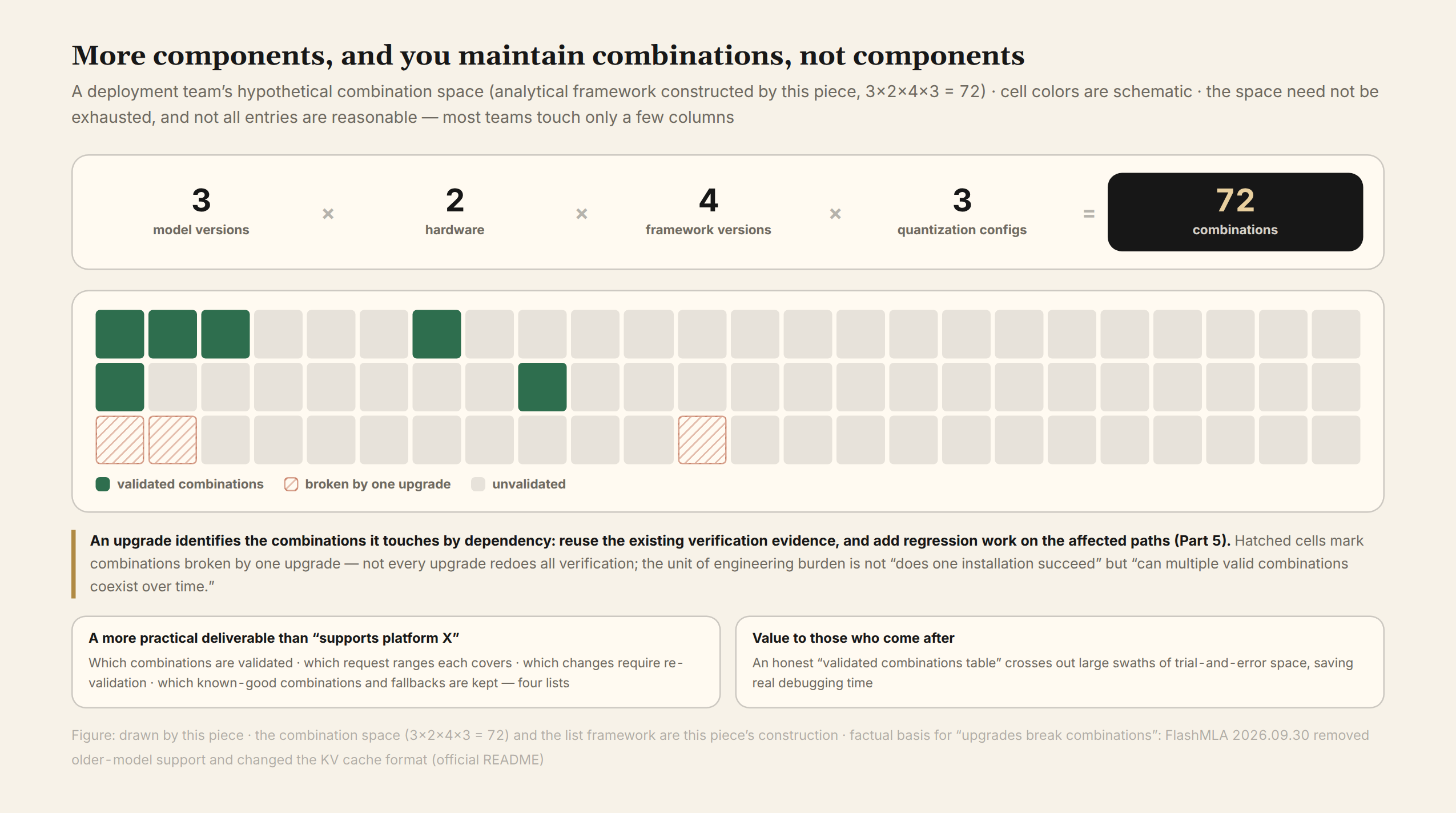
So a more useful deliverable than “supports platform X” is a checklist stating:
- which combinations have been verified;
- what request range each combination covers;
- which changes require re-verification;
- which known-good combinations and fallbacks are retained.
What is publicly checkable today as “verified combinations” is the configuration covered by vendor component tests and whole-path benchmarks like MegaMoE. Two things must be distinguished: “runnable tests exist” and “a public report of passing execution in a specified environment exists.” The former ships with the repositories; the latter is absent from this round of public materials, at least as a complete production-framework acceptance report. How much public validation exists on the user side, this piece has not exhaustively surveyed. Turning each party’s validation results into exchangeable checklists is exactly the route from “releasing” to “accumulating.”
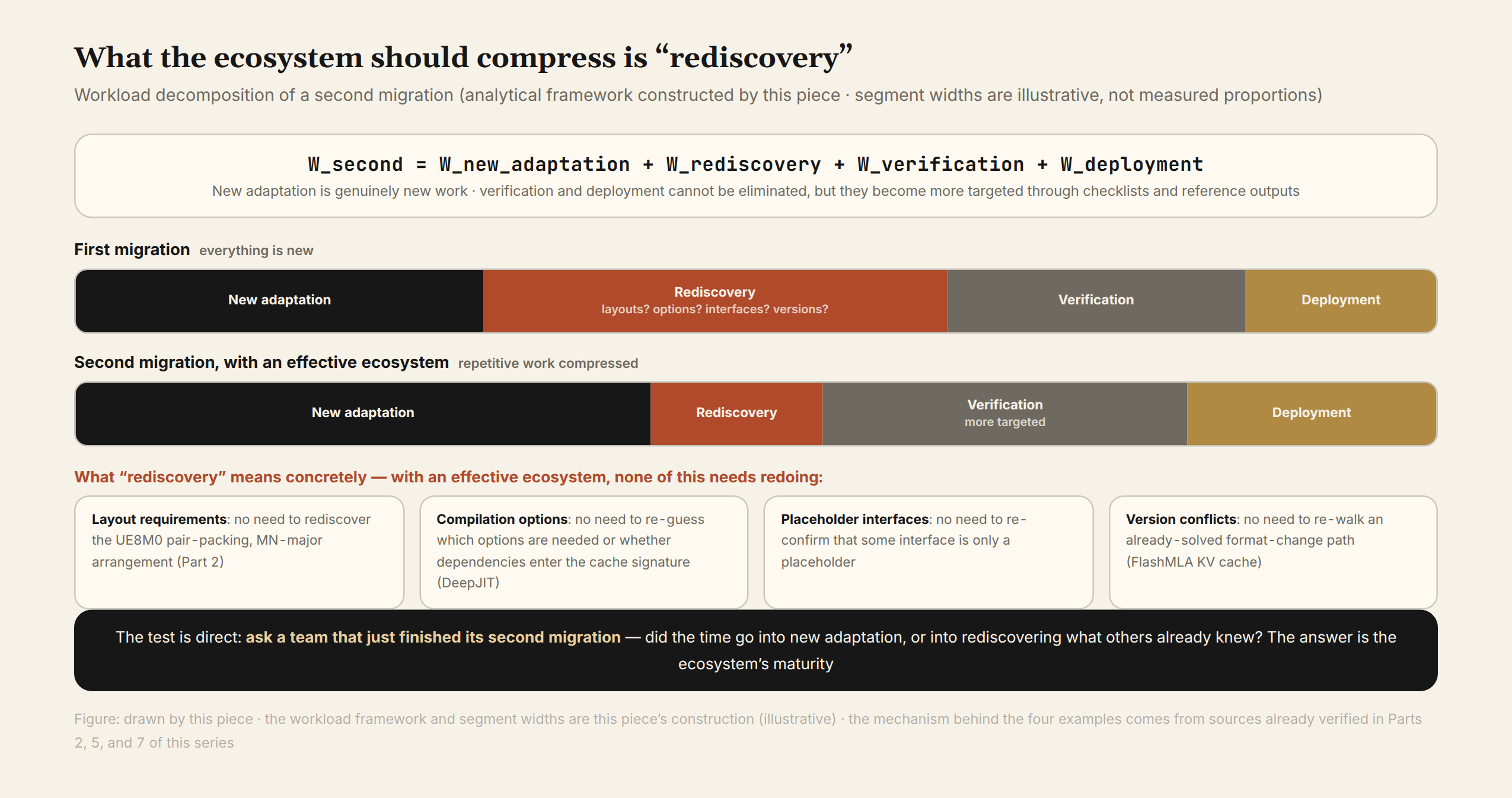
The second migration’s workload splits into four parts:
W_second = W_new-adaptation + W_rediscovery + W_verification + W_deployment
What ecosystem building compresses is the “rediscovery” term. If the ecosystem works, newcomers need not:
- rediscover the UE8M0 arrangement (Part 2);
- re-guess compilation parameters and cache signatures (Part 5);
- re-confirm which interfaces are placeholders;
- re-walk already-solved version-conflict paths (Section 1).
4. For Deployers: Judge in Two Stages
Stage one: function and environment decide whether piloting is possible.
Combinations meeting both conditions can enter technical evaluation and piloting:
- Required functions within current support: no graph capture, no load-balancing communication kernels, no Bucket reduce-scatter or all-reduce;
- Obtainable environment: 950-series hardware and the matching CANN, HDK configured per official guidance.
Piloting can include: running the components, studying the implementation, setting up acceptance per Part 5’s path, and measuring both the MegaMoE and composable routes.
Stage two: verification results decide production.
Before production, three things must be completed for the combination: correctness verification, service performance measurement, and upgrade regression. Specifically:
- measurement under your own load shapes (Parts 2, 3, 4);
- combination verification and service-level measurement (Parts 5, 6);
- re-checking the affected scope of version changes (Section 1).
No one can do this for you. Public component tests and MegaMoE’s whole-path benchmarks are starting points within their own scopes and do not prove a whole framework combination verified; the pre-production verification step cannot be skipped.
On gaps, judge precisely whether they block: only when the solution depends on a capability on the gap list with no validated alternative path is it a blocker for that solution. Deployments not depending on those capabilities need not wait.
One expectation to calibrate: after the commercial HDK ships publicly, downloaded numbers still need not match the README tables. Tracing environment differences remains the deployer’s work. What this series does is: every listed item either has public evidence to check or states its gap and conditions.
5. For Ecosystem Builders: The Checklist Is the Roadmap
This batch of components made the reference for “what a cross-platform inference stack looks like” public, with gains per role:
- Framework vendors: integratable operators and interfaces;
- Toolchain vendors: working cases of two compile routes (DeepJIT and TileLang);
- Platform vendors: an explicit gap list. What this round of public materials lacks is precisely framework integration, graph capture, load-balancing communication kernels, and an equivalent runtime environment.
What to fill in, and in what order, the checklist itself provides the basis. How quickly tests and verification methods (layer three) accumulate publicly largely determines how much repetitive work newcomers must redo.
Conclusion
The judgment on this set of projects can be stated precisely: this batch of components has made reusable interfaces, implementation code, and testing methods public, an accumulation later migrators can take directly; the runtime environment still awaits a public release. Whether the next migration can do less repeated work depends on three things: whether interfaces stay stable across version upgrades (Section 1), whether the runtime environment can be obtained equivalently (layer four), and whether tests and verification methods stay public.
The test is simple: ask a team that just finished its second migration whether the time went into new adaptation or into rediscovering what others already knew. The answer reflects the ecosystem’s maturity.
For deployment teams, these components give every link a checkable reference and inheritable verification methods; what remains in-house is measurement under real load shapes, combination verification, and upgrade regression. Concretely:
- At a version change, walk the dependencies through Section 1’s impact table;
- When evaluating a solution, follow Section 4’s two stages: combinations whose functions and environment are satisfied pilot first, and before production, complete that combination’s correctness verification, service performance measurement, and upgrade regression;
- When wording like “compatible,” “near peak,” or “mature ecosystem” appears, check three things item by item: what support range does it declare; under which model, hardware, software version, and load were the results measured; and has it been validated in an actual service combination?
Series recap
- Part 1: drew the system overview and the entities migration involves;
- Part 2: from API compatibility into data layouts and shapes;
- Part 3: walked one expert-parallel round trip end to end;
- Part 4: took apart the chain of trade-offs behind 95% utilization;
- Part 5: gave a reproducible acceptance path;
- Part 6: converted technical choices into cost per unit of effective output;
- Part 7 (this part): split reuse into four layers and gave the basis for judging combination maintenance.
Sources and computation notes: This piece is based on the projects’ public repositories and documents, fact-checked as of October 7, 2026.
- From the official READMEs: FlashMLA’s September 30, 2026 version change; DeepEP’s capability tiers, the manually configured PoC HDK, and the commercial-version plan (expected mid-October 2026, subject to the vendor’s actual release; if the HDK has shipped by publication, the corresponding statements follow the actual state); DeepGEMM’s API compatibility and aclnn cross-validation; TileKernels’ dual-backend auto-selection.
- The SGLang NPU image entry comes from V3.2-Exp release materials. Its integration with this batch of 950 kernels is not stated in public materials, and this piece makes no claim.
- Constructed by this piece: the four-layer reuse frame, Section 1’s change-impact table (not an official impact statement), the 72 combinations (3 × 2 × 4 × 3), the second-migration workload decomposition, the deployer’s two-stage judgment, and the judgments for both audiences.
- Vendor component tests and the MegaMoE benchmark provide public starting points for verification only within their own scopes. This piece has not exhaustively surveyed public acceptance reports for framework-level combinations and has seen no complete list.
No hardware measurements were made, and no market or commercial predictions are offered. This is Part 7, and the final part, of the DeepSeek Ascend open-source series.