
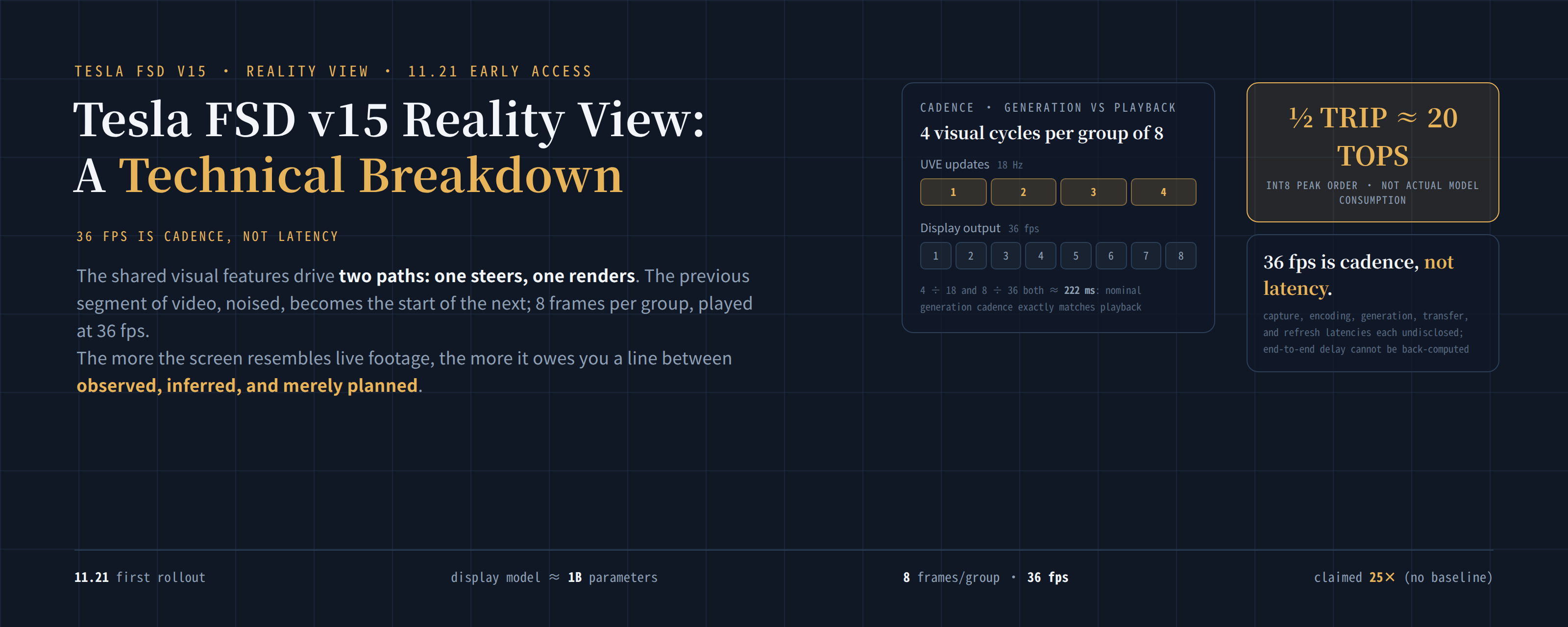
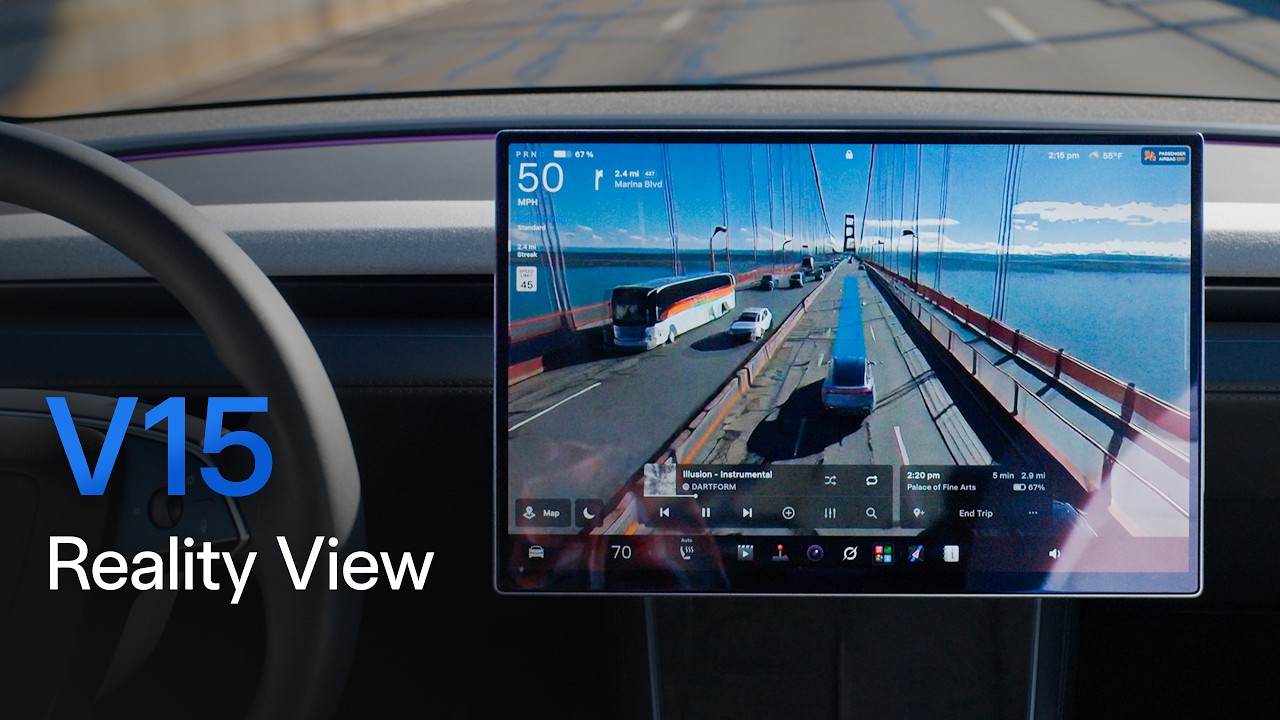
How the car display generates 36 fps of video, follows a road that keeps changing, and makes the car's intent legible.
Abstract: Tesla's FSD v15 Reality View reuses recent visual features from the driving stack: a separate model of roughly 1 billion parameters turns a noised version of the previous segment into the next segment of video. Per Musk's disclosure, half an AI4 TRIP spreads each group's generation across four visual-update cycles and produces 8 frames, played back at 36 fps. This piece diagrams why that chain runs on the car, and in the night-rain, occlusion, and tap-to-park scenarios, separates which conclusions the footage supports from which still need measuring.
A car sits in a parking lot. The driver taps an empty spot on the screen, watches the system mark the target, and the car starts parking. The scene invites a game comparison: the viewpoint hangs above the car, and space looks directly manipulable. But an in-car display differs from a game in one fundamental way. A game engine holds a designed map; Reality View has to generate its picture from a real road that is changing and that gets occluded. The more the screen resembles live footage, the more the system owes the user a clear line between what was observed, what was inferred, and what is merely planned.
Tesla announced the FSD v15 rollout to the first users on November 21. The next day, Musk explained three key links in Reality View: where it takes its information from, how it joins one segment of video to the next, and how it keeps producing frames inside the budget of half an in-car accelerator. Following those three links is more reliable than inferring the underlying 3D technique from the picture alone. [1–3]
1 Display and Driving Share Visual Features
The old visualization can be described as taking objects, lanes, or other explicit signals out of a model, then letting a graphics program arrange them into a picture. Each signal carries a clear meaning, but the picture is bounded by predefined classes and assets. The v15 release notes say Reality View replaces those explicit visualization signals with a single end-to-end display output; that does not mean the driving stack internally stops using any explicit state. Tesla also says the new visualization uses less total compute, but has published no retestable baseline, quality conditions, or measurement scope, so the saving relative to v14 cannot be quantified from it. [1–3]
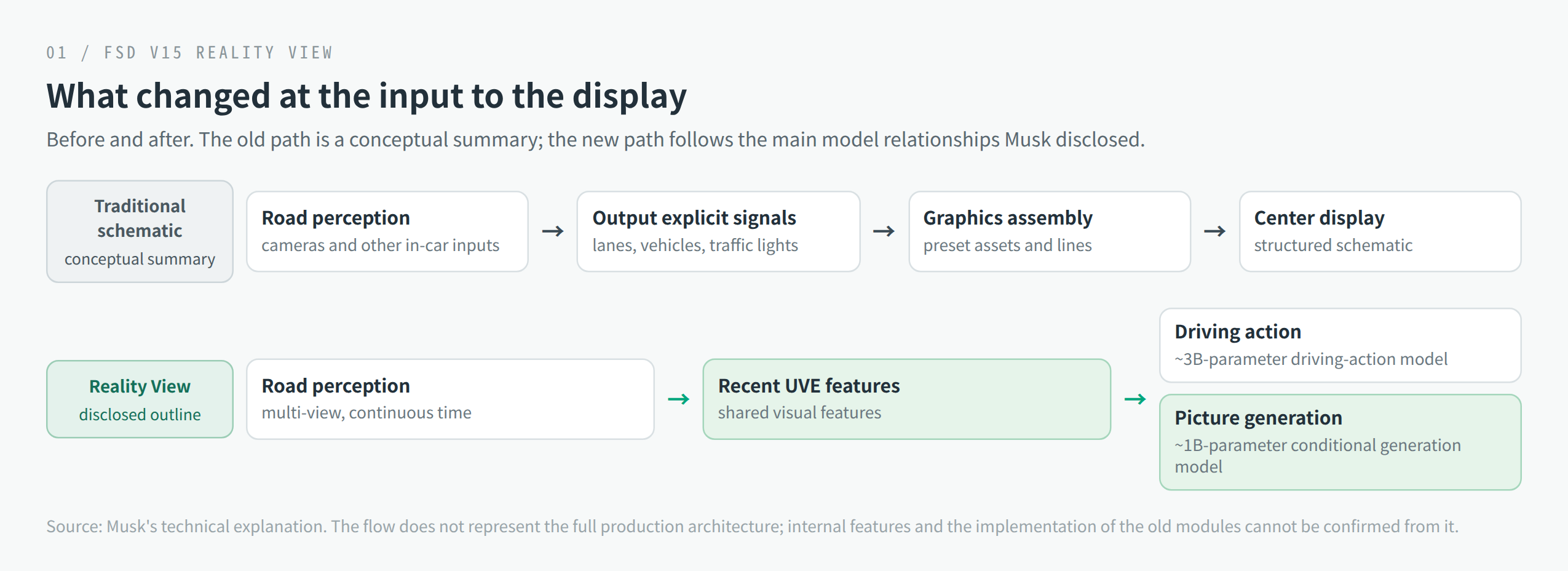
Per Musk's account, the recent feature sequence of the Universal Vision Encoder (UVE) feeds two paths: one into a roughly 3-billion-parameter driving-action model, the other into a roughly 1-billion-parameter display-generation model. Elluswamy described the link as "the same end-to-end driving model"; Musk later spelled out the split. Read together, what is shared is the visual input and its representation. There is no evidence that driving decisions are made by watching the screen's pixels, and the screen should not be treated as an auditable, item-by-item perception output. [2–3]
2 How the Next Segment of Video Is Generated
Musk first mentioned that Tesla already runs a larger world model for making synthetic data; what ships in the car is a much smaller conditional Mean Flow model. The two serve different purposes: the former produces training data, the latter renders the on-screen picture while driving. Musk did not disclose whether the in-car version was distilled from the large one. [3]
The in-car model receives two things at once. The first is the previous segment of Reality View output: noise is added to it so it becomes the starting point for the next segment, rather than being replayed verbatim. The second is the recent UVE feature sequence: the changes the car's cameras saw over that window, encoded as the generation condition. A separate diffusion model of roughly 1 billion parameters denoises the noised input under those conditions and produces a new group of frames. That new group then becomes the input of the next round. [3]
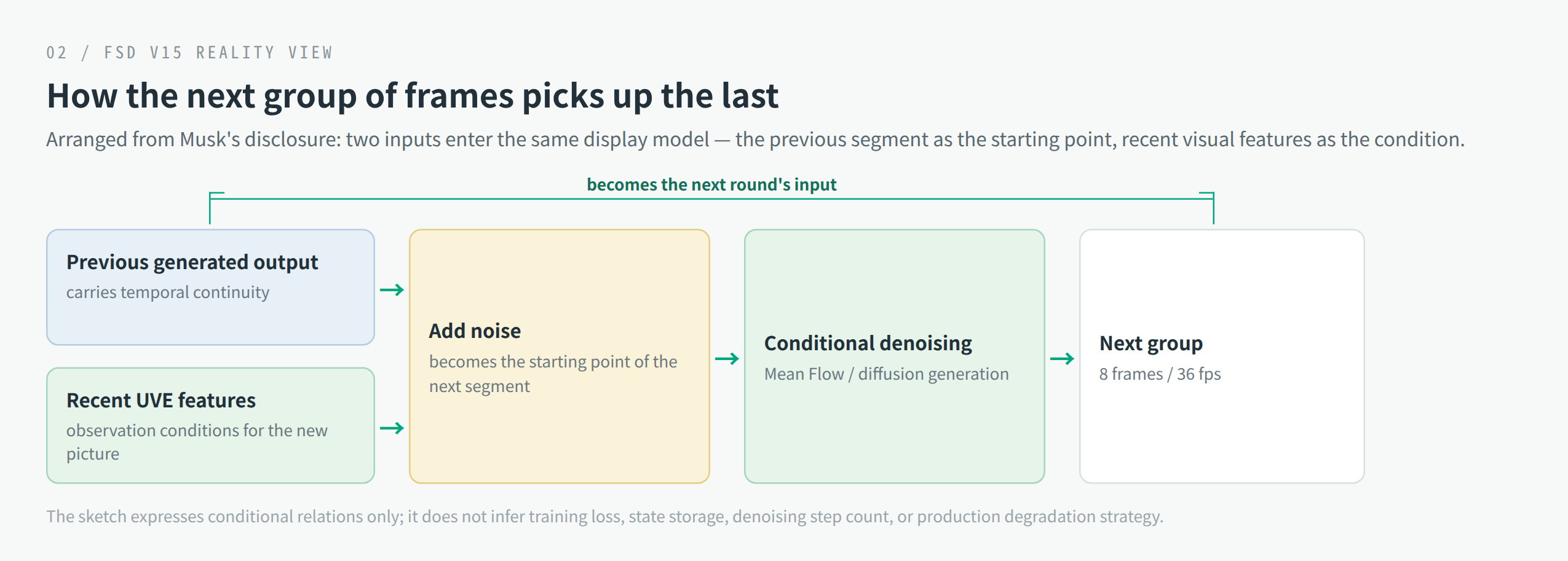
Consider a lead car braking suddenly. The previous segment leaves the model a continuous appearance of road and buildings; the recent features supply evidence of the lead car's changing position. Both are useful, and they can conflict: if new observations arrive late, the buildings still render coherently while the lead car's position lags. This is an example for understanding and testing the chain, not a failure measured on the production release.
Mean Flow is about how the denoising is done. Conventional multi-step sampling makes repeated small corrections along the generation path; the MeanFlow paper trains the model to learn the average change over an interval, aiming to cover it in fewer inference steps. The "flow" here is the change in denoising state, not the car moving. The paper demonstrated one-step generation, but Musk has not disclosed how many steps run in the car, or whether denoising happens in pixel or latent space. [3,5]
On lineage: AI Day 2021 and 2022 showed multi-camera unified representations and 3D occupancy, and Tesla has also shown Gaussian-splatting work for geometric reconstruction and simulation. That establishes the lineage; it does not license assigning an occupancy tensor or a 3DGS renderer to Reality View. What this round of disclosure actually makes clear is the conditional generation chain. [4,4a,4b]
3 36 Frames per Second Is Not 28-Millisecond Freshness
Musk gave three numbers: UVE features update at 18 Hz; about half an AI4 TRIP spreads each group's generation over 4 UVE cycles; each group yields 8 frames, generated at the display's interface resolution and output at 36 fps. 4 ÷ 18 and 8 ÷ 36 both come to about 222 ms, meaning the nominal cadence of generating one group exactly matches the cadence of playing one. Adjacent display frames sit about 27.8 ms apart; that is not end-to-end latency, and the 4 compute cycles are not 4 denoising steps. [3]
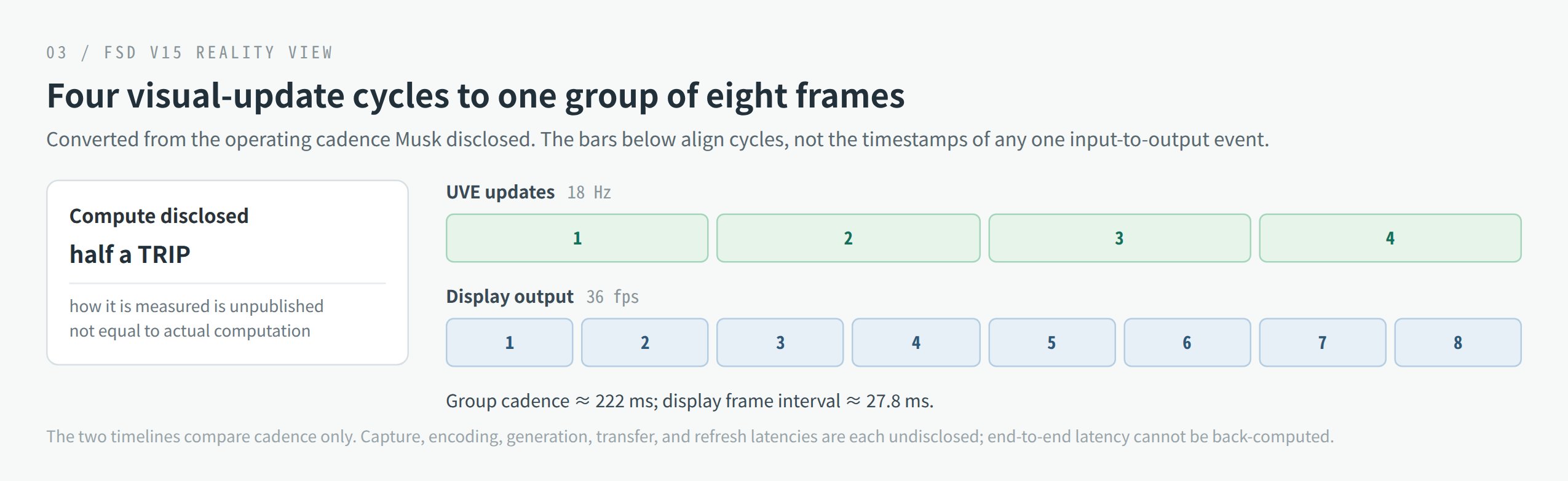
Frames can refresh often while the information inside them stays stale. Musk said compute limits already keep latency high, and proposed inserting updated UVE features at different layers of the diffusion transformer, so that later layers of a still-generating group can draw on observations more recent than when computation started. The ~35% figure is his estimate for that optimization, not a shipped result; the post gave no retestable absolute latency either. [3]
What scale is half a TRIP? Per SemiAnalysis's chip analysis, a TRIP has a 96×96 array of multiply-accumulate units at about 2.2 GHz. Counting multiply and add separately and halving: 96×96×2×2.2 GHz÷2, on the order of 20 TOPS INT8 peak. That sets a ruler for the hardware's scale, not the model's actual consumption. Quantization, utilization, and memory traffic are unpublished, so it cannot be divided by frame rate to get per-frame compute, nor used to rule out a class of generation methods. [3,14]
On the previous-generation HW3, compute is not the only threshold. SemiAnalysis estimates AI4's per-SoC memory bandwidth at about 224 GB/s, roughly 3.3× the previous generation. Beyond holding model weights, the car's computer must move recent visual features, keep video buffers, and leave headroom for driving; without a per-version resource profile, there is no telling which item hits its limit first. [14]
4 Where the Field Actually Stands
Separating what each line of work produces keeps datacenter reconstruction, driving simulation, and the center screen from being lumped into one product. The technical problem closest to Reality View is pixel generation from a novel view under real observation constraints; the product problem closest to it is presenting the vehicle's state and intent to a driver or passenger.
| Line and representative work | The problem it solves | What it cannot prove |
|---|---|---|
| NeRF / 3D Gaussian Splatting [6,6a] | NeRF learns a radiance field and samples along rays; 3DGS projects optimizable ellipsoids and blends them, rendering quickly after fitting. | Render frame rate on a fitted scene is not the cost of reconstructing, updating, and displaying while driving. |
| DrivingGaussian / Street Gaussians [7,7a] | Decompose static background from dynamic participants, then synthesize a novel ego view. | Research benchmarks are not evidence for the AI4 car; fast feed-forward research is not supervised production. |
| NVIDIA NuRec / Wayve GAIA-2 [8–9] | The former reconstructs simulation-ready scenes from sensor data; the latter generates driving scenarios conditioned on inputs, for counterfactuals and training evaluation. | The use is data and simulation; cloud throughput cannot be benchmarked against an in-car display. |
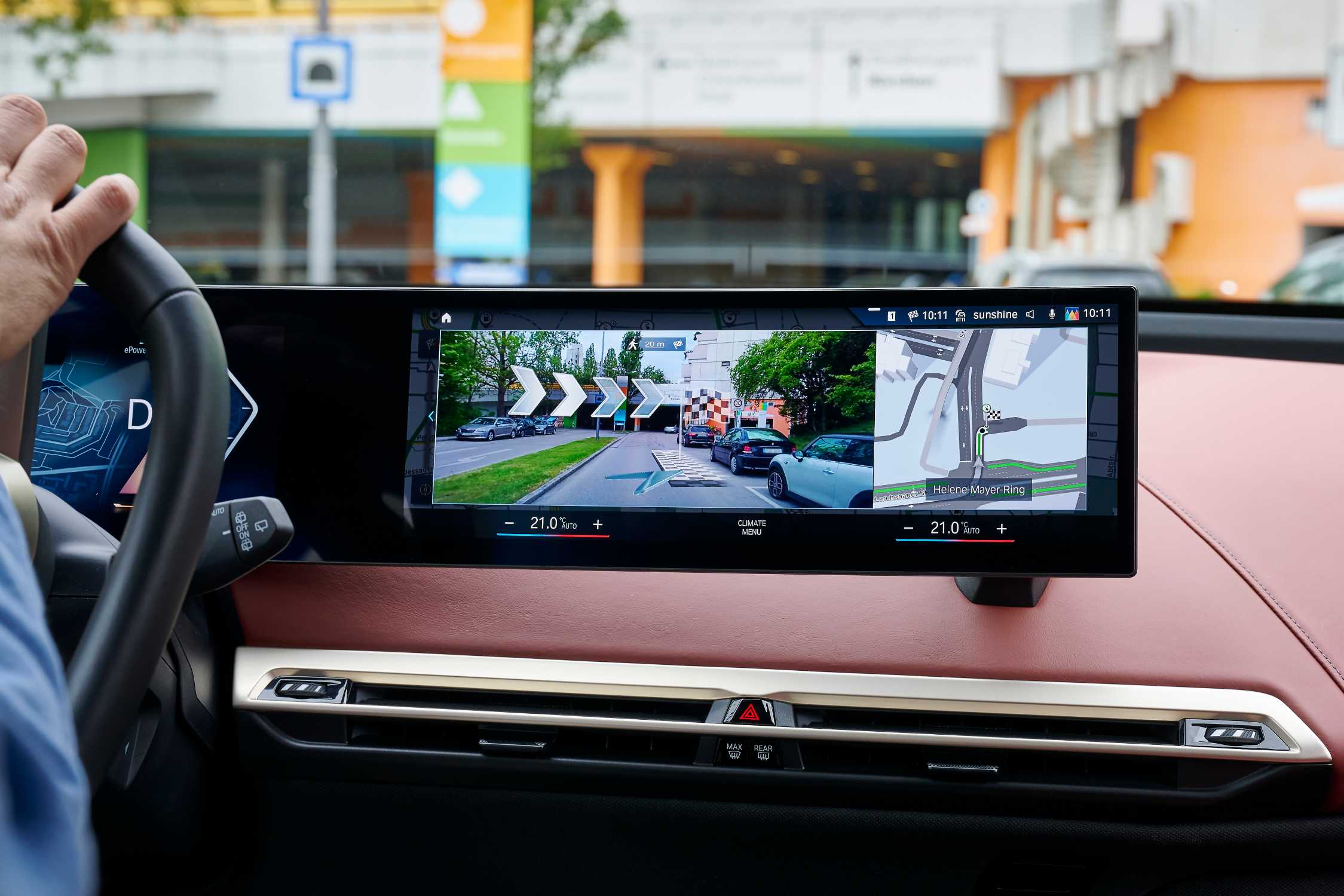
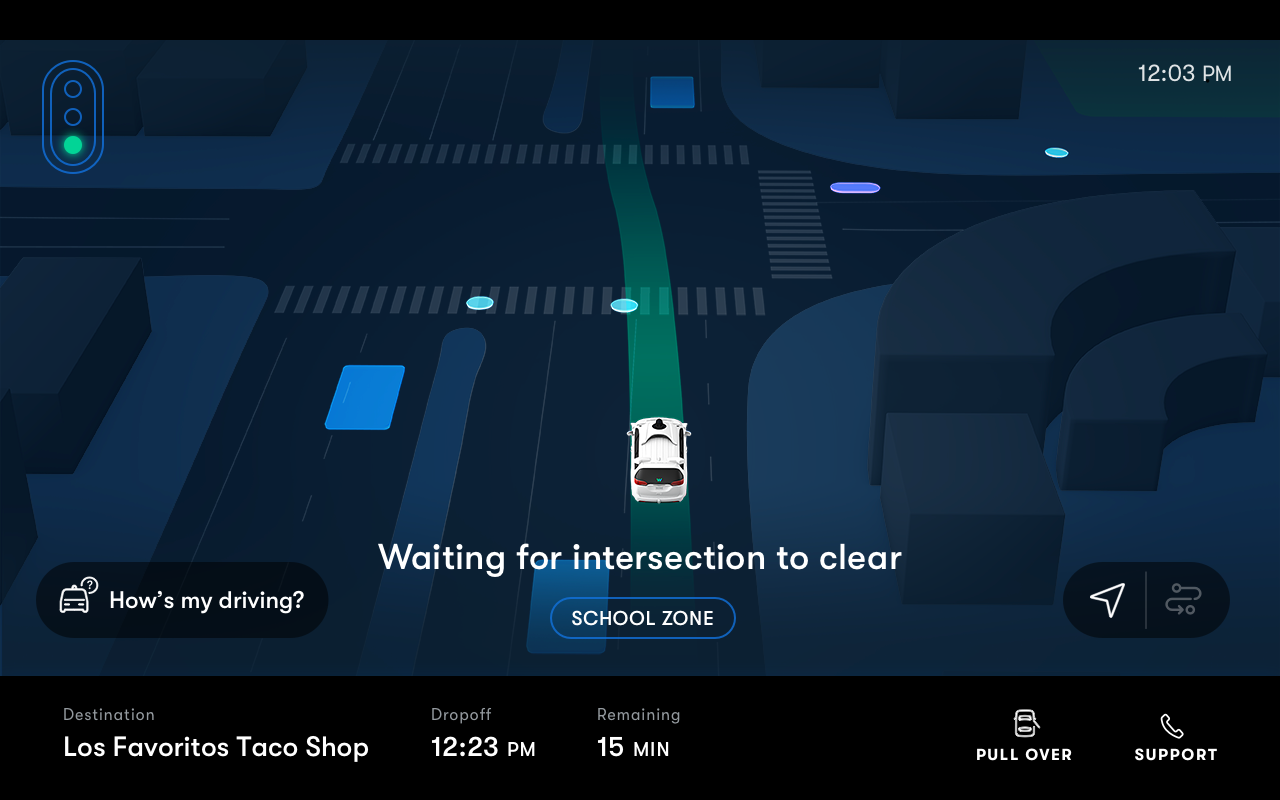
| Waymo rider UI / BMW Augmented View [10–11] | The former explains intent with abstract scenes; the latter overlays navigation prompts on the live camera feed. | Shows that legibility and trust can come from information design, not a rival pixel-reconstruction route. |
| Tesla Reality View [1–3] | An early production rollout that reuses driving visual features, generates live-style footage in the car, and carries part of the interaction. | Not a disclosed 3DGS deployment, and no benchmarked latency, geometric error, or failure rate to compare against. |
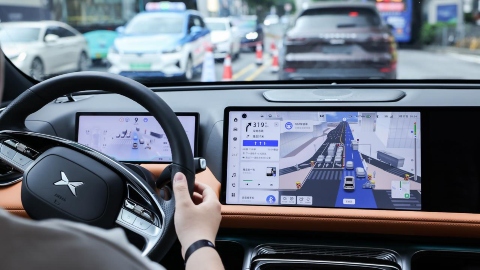
The comparison also surfaces a trade-off: the SR environment-simulation display in XPeng's production cars is likewise an interface organized from recognition results. [10a] When abstract graphics mark the object the car is yielding to, it is easier to read what the system cares about; realistic footage makes it easier to recognize where you are going. The two can be layered. The former layer most needs to express intent and uncertainty clearly; the latter most needs to stay spatiotemporally consistent with the real scene. Blending image quality and explanatory power into one metric makes it harder to tell where engineering effort should go.
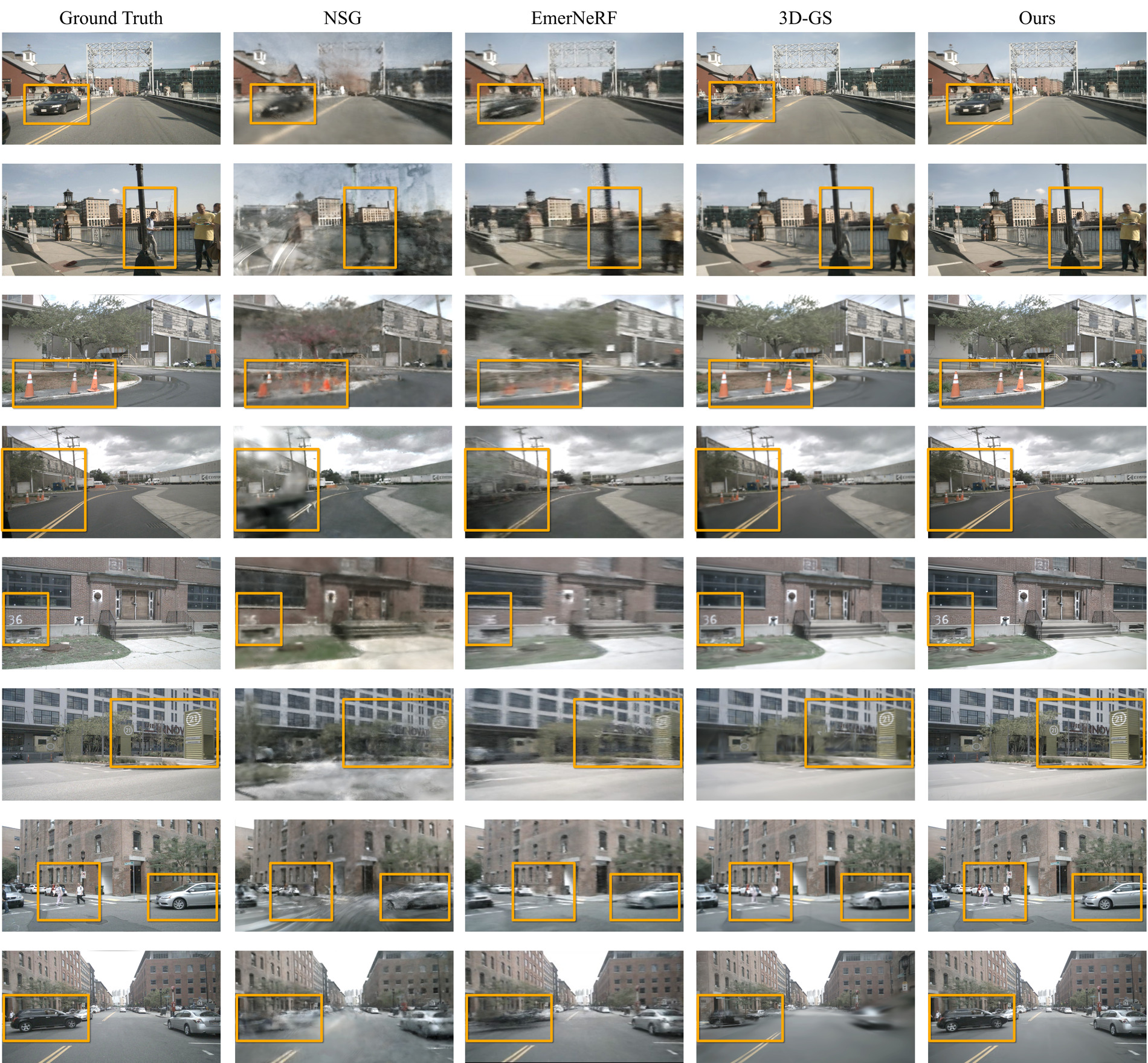
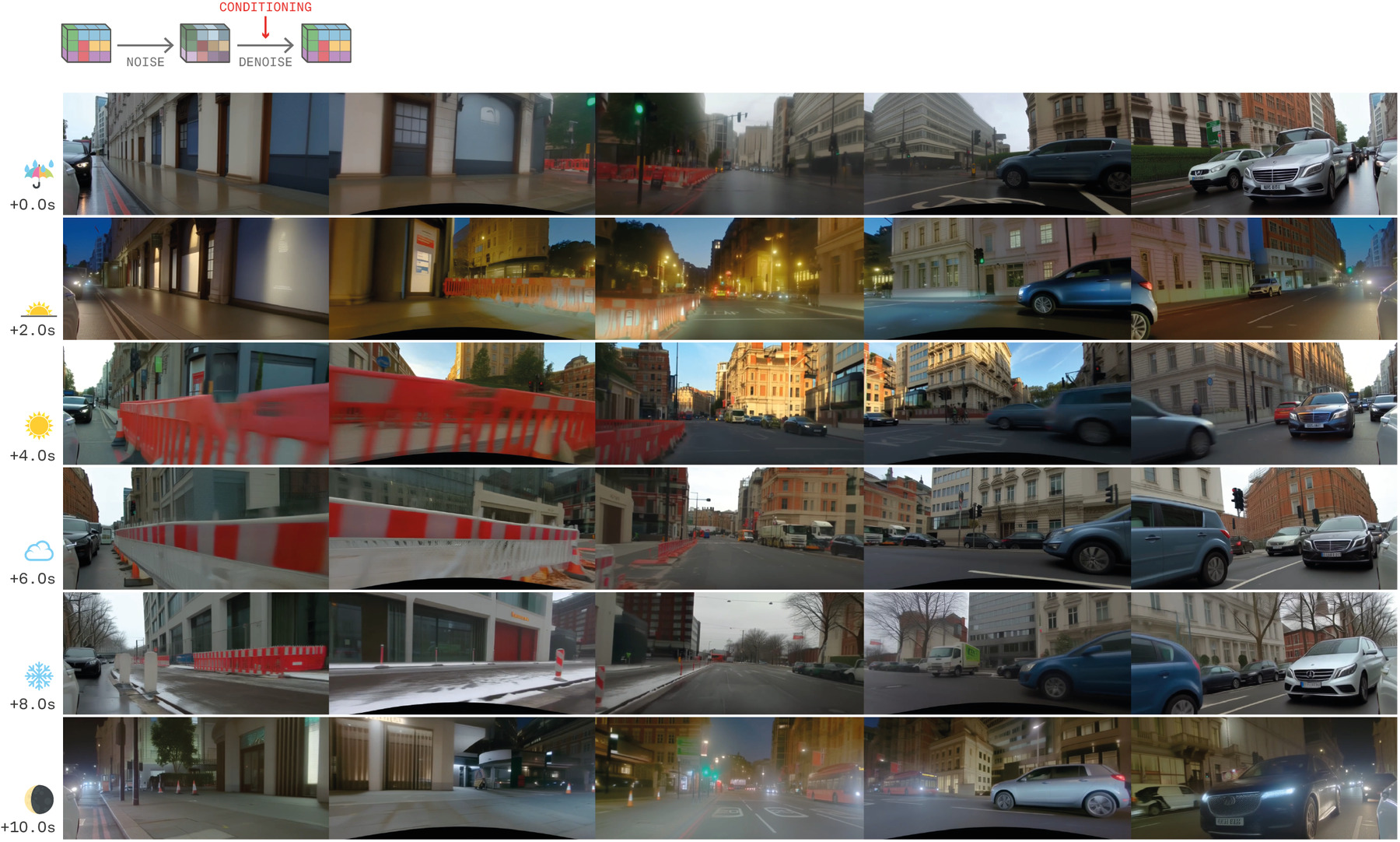
Side by Side Four In-Car Displays
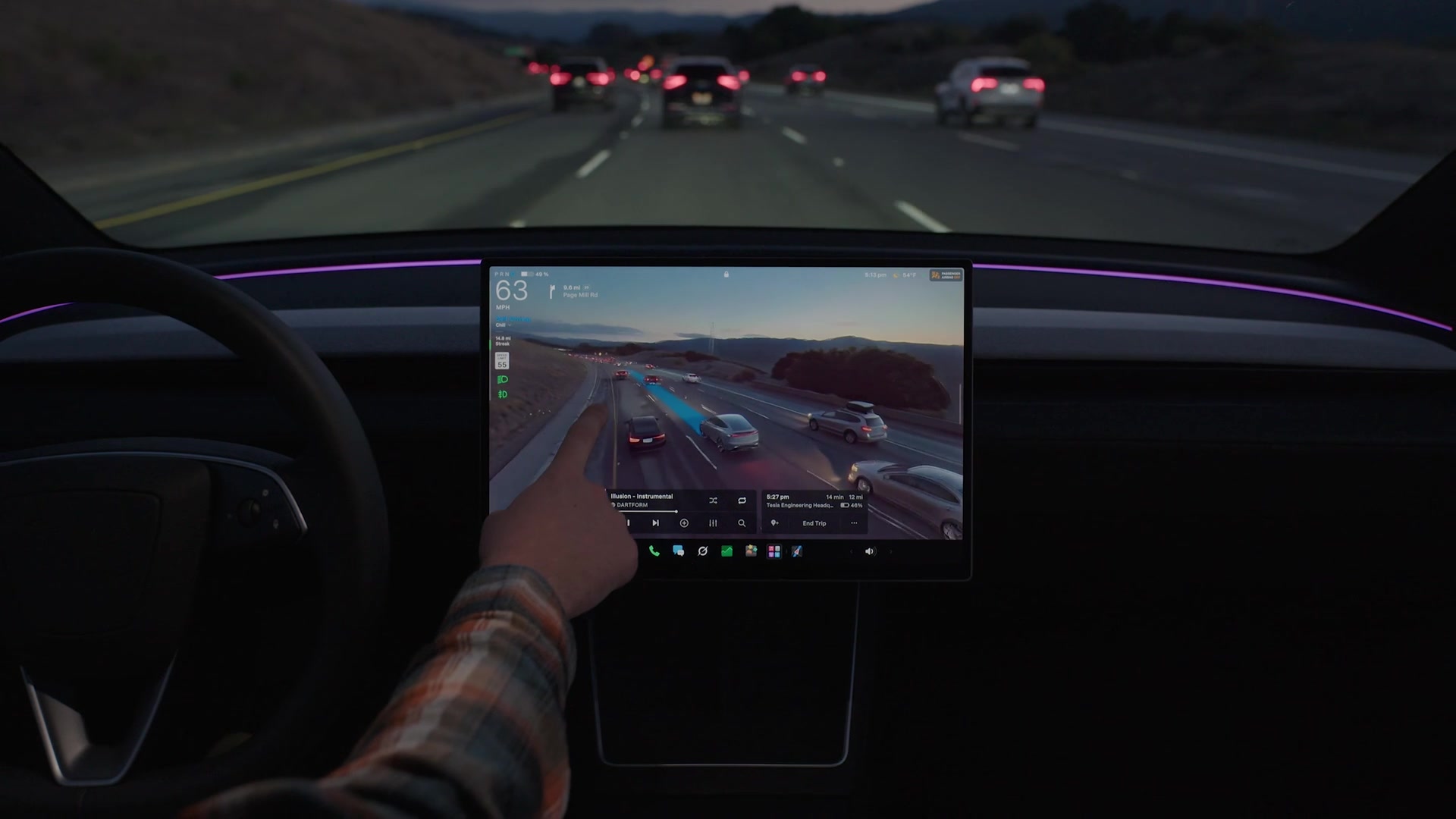
Start with what each picture is made of. BMW keeps the camera feed as the base; Waymo and XPeng select the road elements that need explaining; Tesla generates a live-style exterior view. These are different display approaches, and driver-assistance capability cannot be ranked by how realistic the picture looks.
These come from different products and road conditions — not a same-road rendering comparison. Lines or arrows on screen indicate guidance or intent, not that the vehicle has executed anything.
5 The Hardest Boundaries to Hold In-Car
Unlike offline simulation, the car display must keep up with a road that is changing. First, temporal consistency: continuing from the previous segment reduces flicker, but can also carry its errors forward. Tests can log sudden events — a lead car cutting in, a pedestrian emerging from behind a truck, the ego car swerving — and compare when the outside scene changed against when the screen corrected.
Next, spatial consistency. Drawing the scene from a virtual rooftop viewpoint is not the same as adding another camera. The same object sits at different positions in different lenses (parallax), and surfaces no lens can see have no current pixel ground truth. What the screen shows may draw on earlier observations, or may be texture the model filled in from priors.
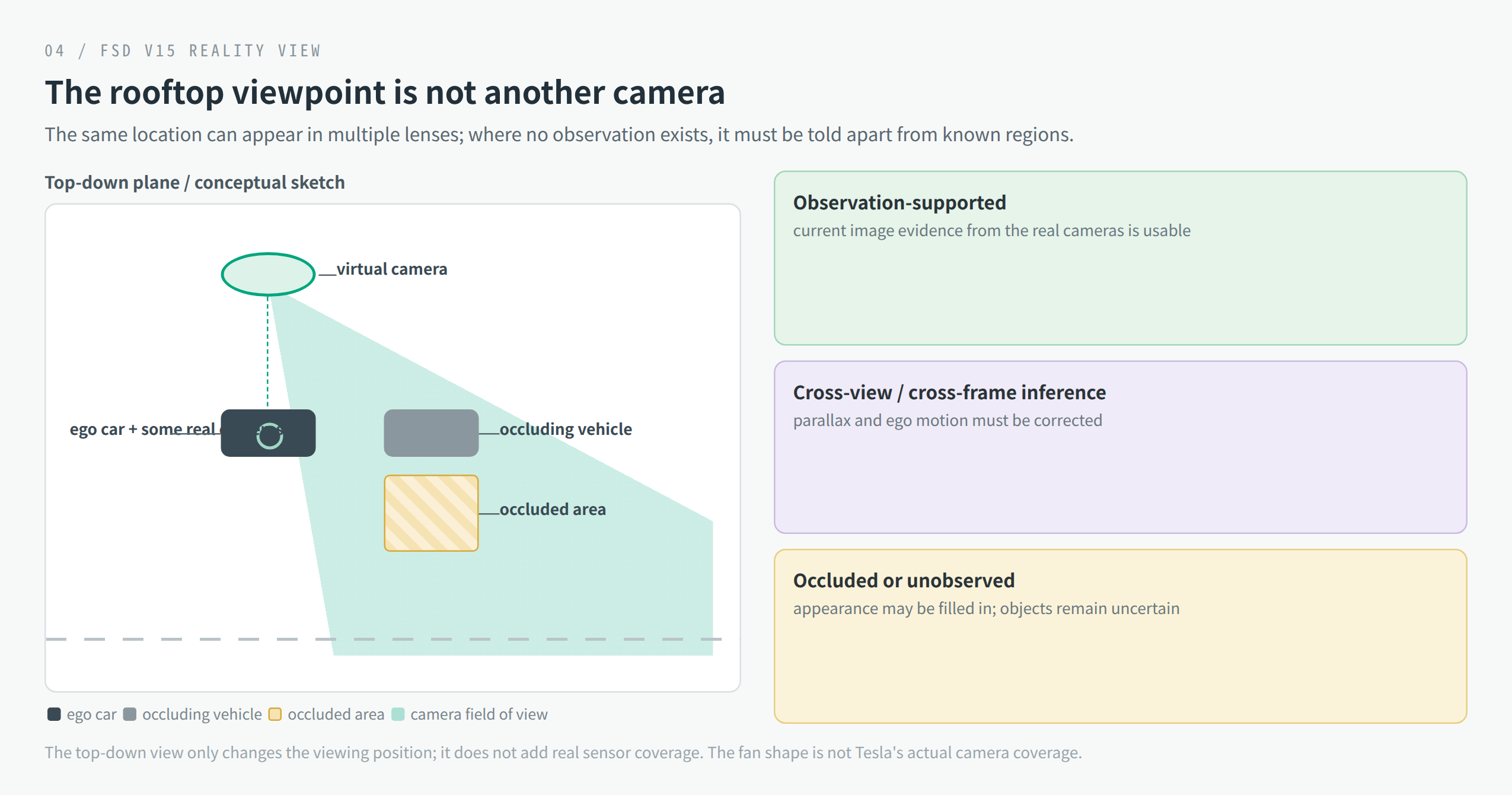
Calibration drift, body vibration, shutter skew, rain, and backlighting all amplify cross-view inconsistency. Lane lines and parking spots can be measured against reference geometry; small text, signal colors, and vehicles appearing from occlusion call for character-accuracy tests, state false-positive rates, and appearance-delay measurement. When the picture lacks evidence, the options include flagging staleness, reducing detail, or falling back to a schematic. Tesla has not published a production degradation strategy.
Finally, resource contention. A generative model with high average throughput does not guarantee controllable tail latency under shared load with driving. Validation should cover sustained heat, abnormal camera input, view switching, and generation backlogs, while watching the driving task's worst-case cycles. Architecturally, driving should win; display can drop frames, fall back to a schematic, or pause. These are acceptance recommendations, not claims about FSD's scheduling policy.
Fog-Night Footage Outside View and Generated Frame in One Shot
This owner video captures the road beyond the windshield and the center screen in the same frame. It shows directly why a generated picture can read better, and why the screen cannot substitute for watching the road.
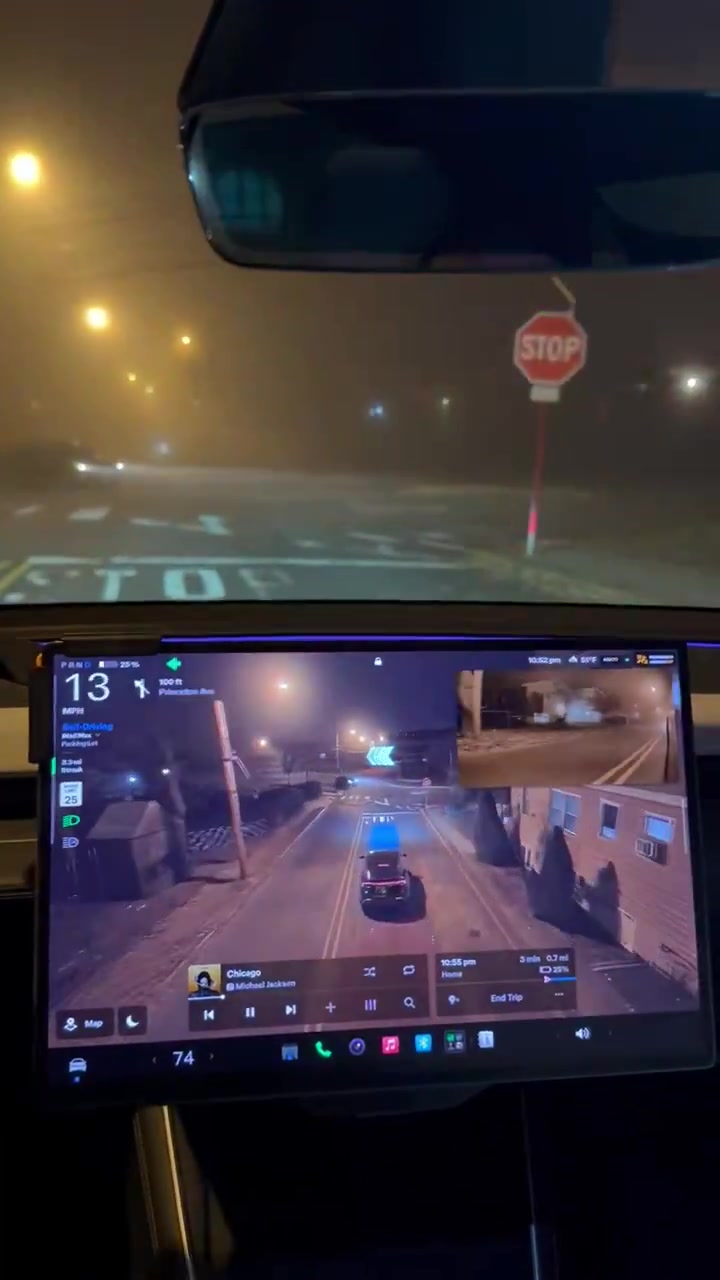
What this frame establishes: a generated picture can present the environment and route more legibly, but it need not reproduce true positions or detail. This one frame cannot support "seeing through fog," latency claims, or judgments that a target on screen was missed. To verify latency and geometry, use timestamped reference footage from a near-identical viewpoint and log, per target, when it first becomes visible outside, appears on screen, and stabilizes.
6 The Screen Is Tappable; the Spot Still Needs Planning-Side Confirmation
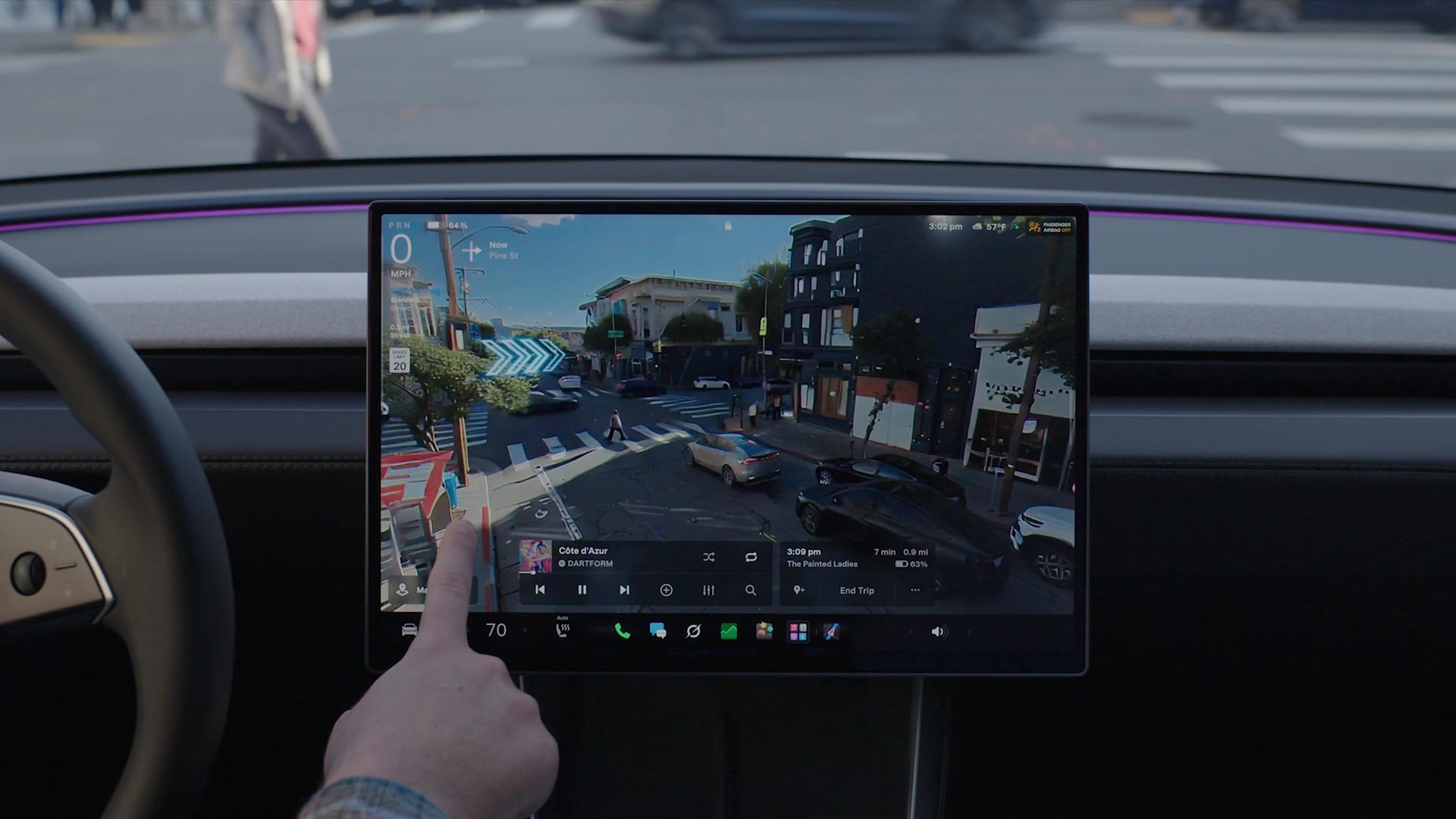
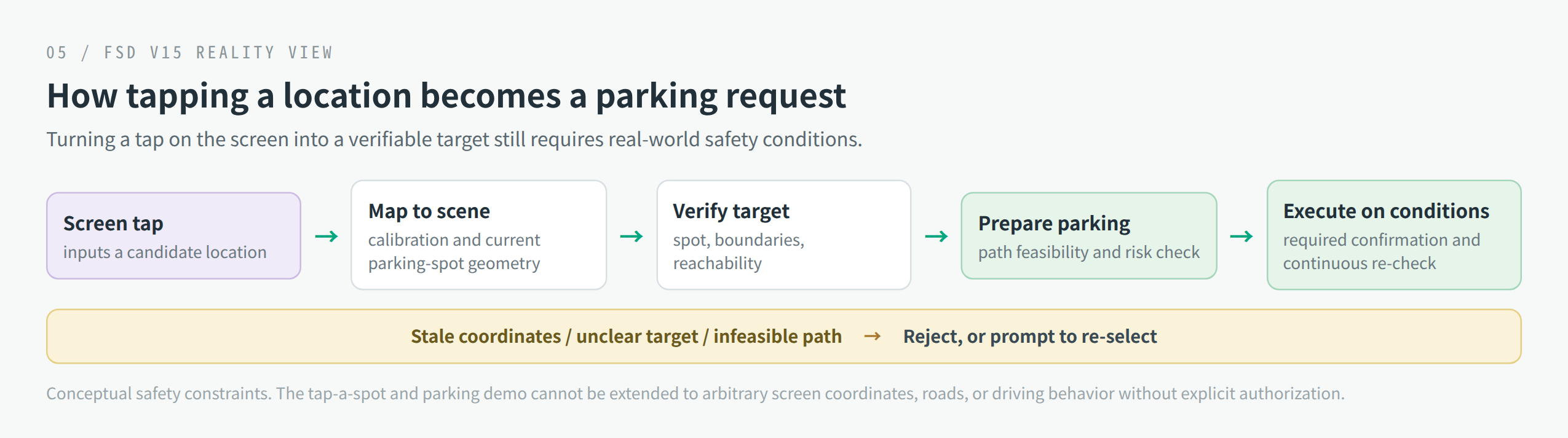
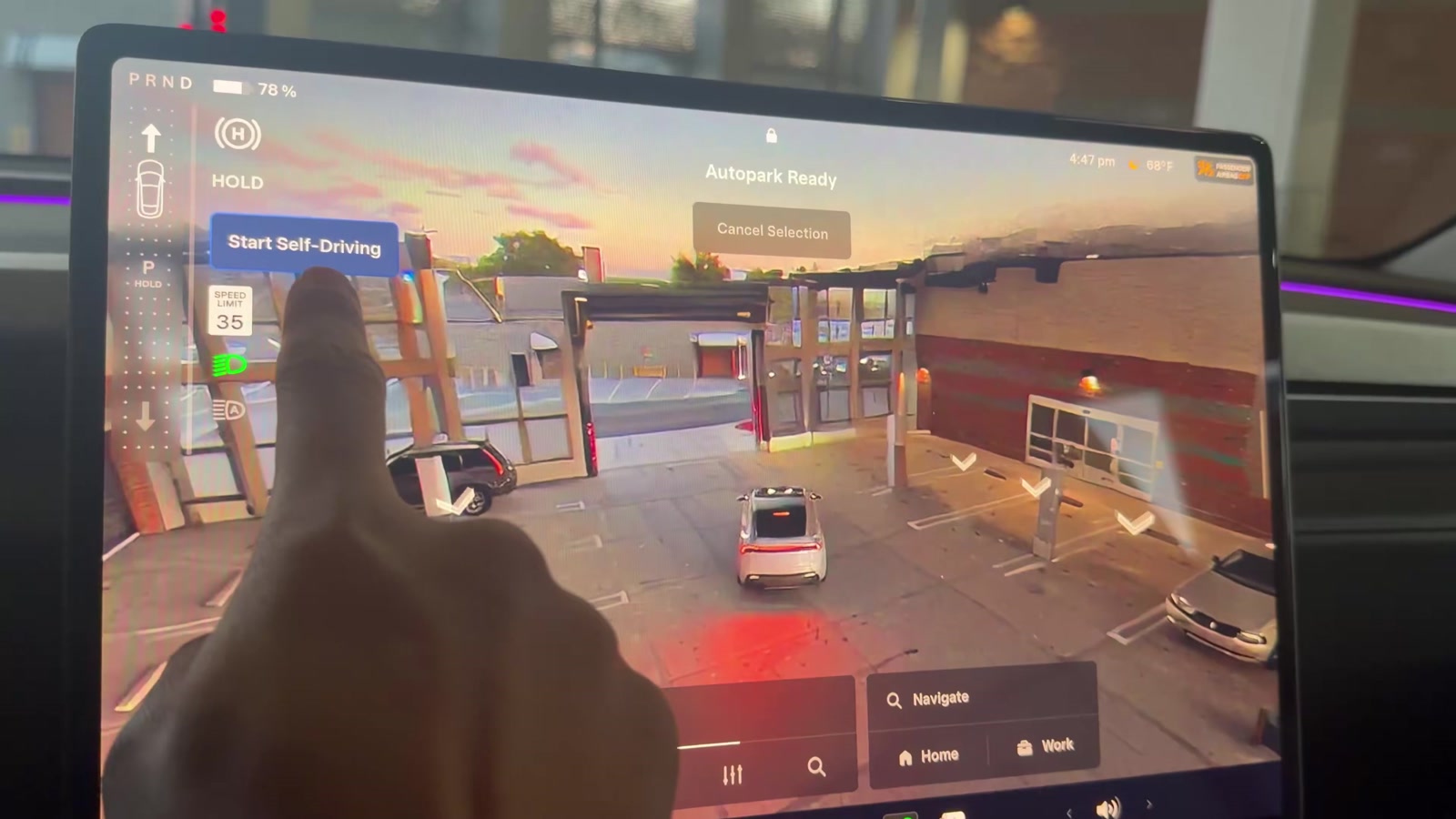
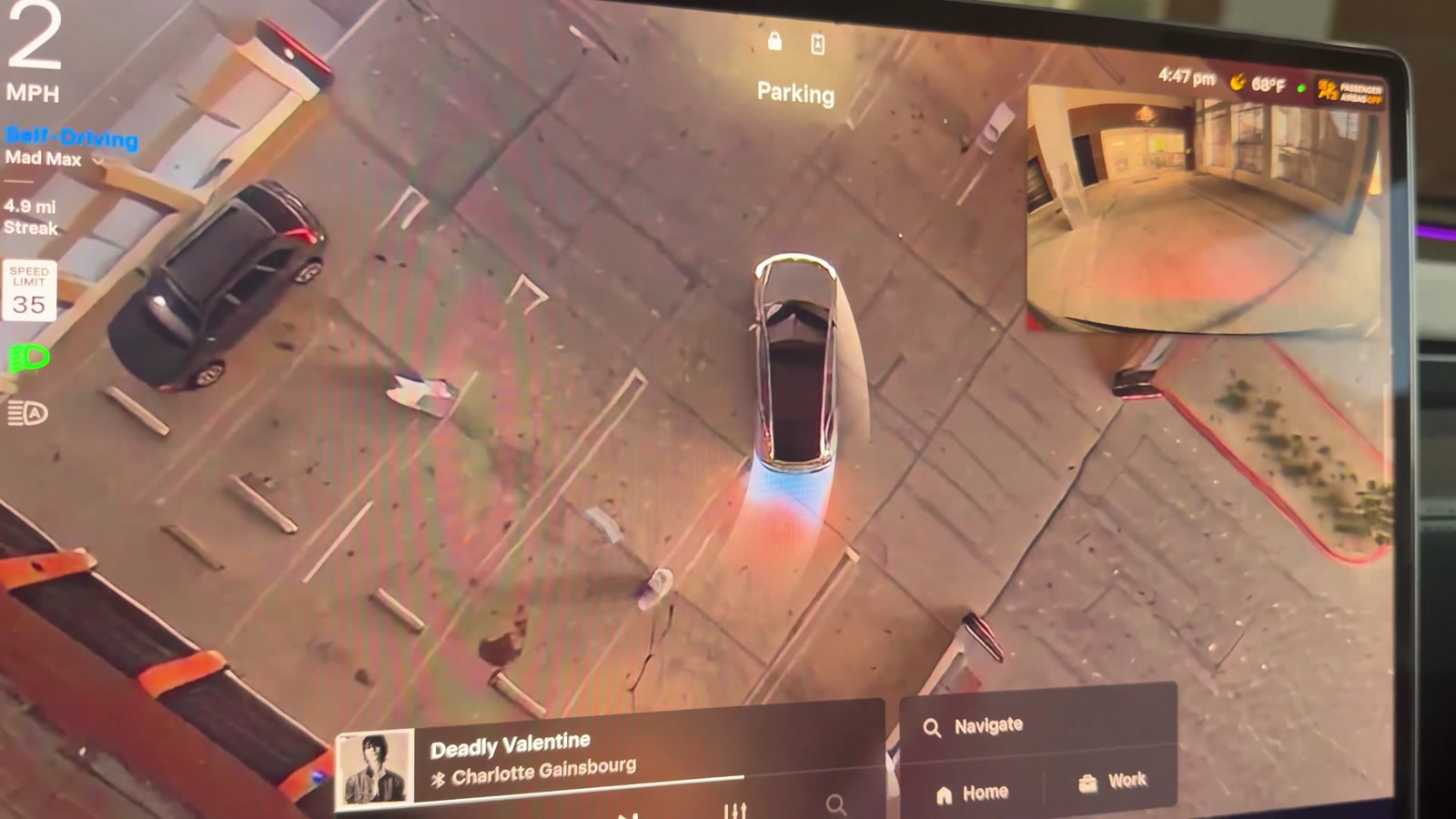
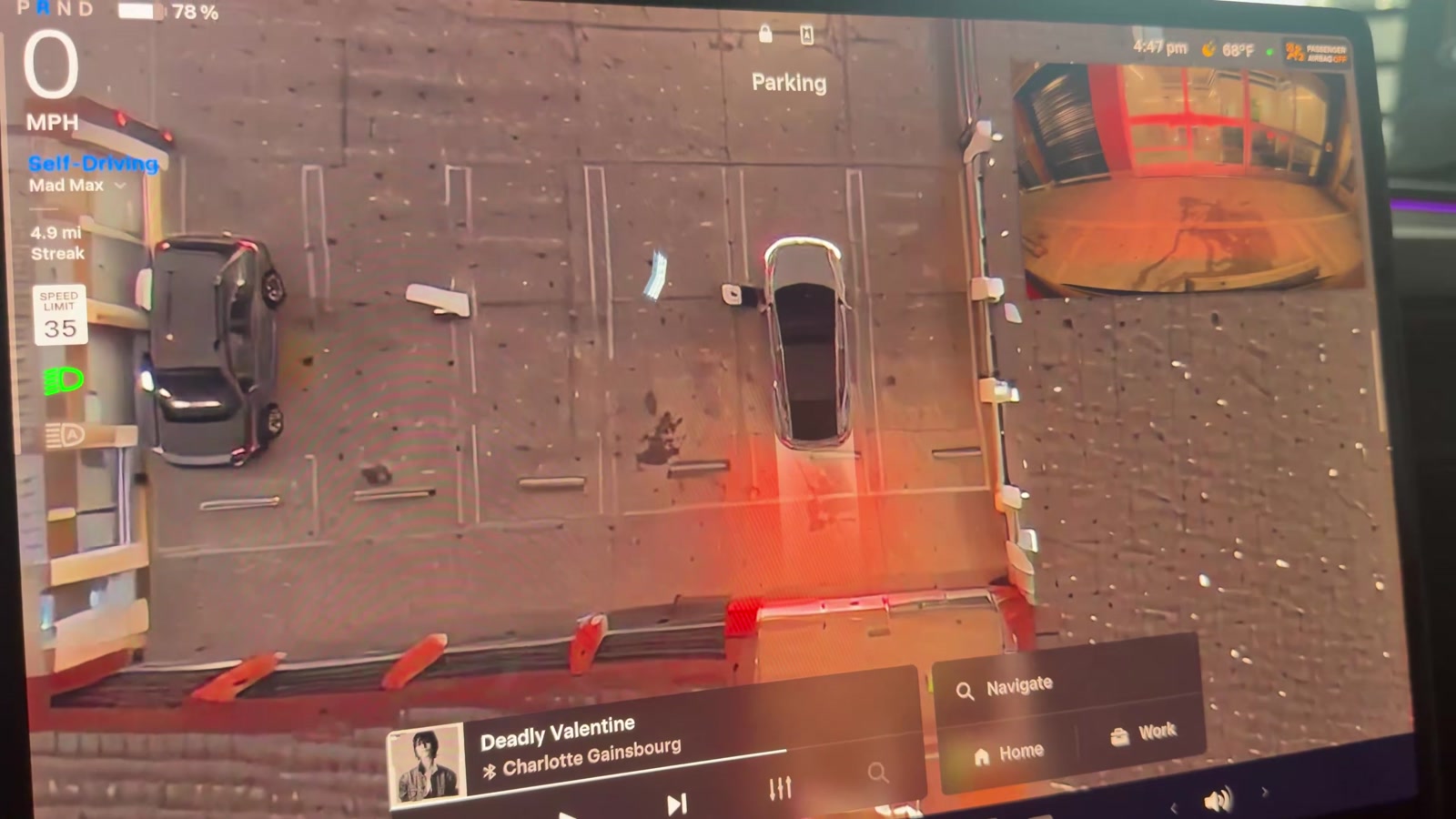
Once the screen accepts commands, geometric error is no longer just about drawing accurately. Tapping an image location is only the first step of the interaction. A 2D screen pixel is a ray through the virtual camera: it may correspond to road surface, a parking-spot line, a neighboring car, or even a region the picture filled in. A verifiable design maps the tap to candidate targets in the current scene, checks their semantics, coordinates, and validity, then hands them to planning and safety checks, and draws the target and the intended path. Path arrows and the parking box express the next intended step; they are not proof of arrival, and the demo should not be read as "tap anywhere on any road and the car will drive there." [1–2]
Of the first eight owner videos, four segments show best why picture quality and evidence are different things. In night rain, wet-road reflections look natural — but there is no synchronized outside view, so whether it matches the actual road cannot be verified. The busy-downtown segment shows dense traffic, but frame sampling cannot judge jitter or missed vehicles. A coherent dusk sky only says the appearance is natural. These three are early sampled observations, not independent retests.
The owner's parking video can be checked in three stages: selecting the spot, separately confirming start, and the car entering the parking maneuver. The fog-night video shows the outside view and the generated picture at once. The surrounding sections give stills from both clips; neither is a quantified test of latency or safety. [12b–12c]
What is worth finding next is not more beautiful footage, but screen and road on the same timeline. Small text that is hard to read: check character shapes and content. Vehicles appearing from occlusion: measure how late and how far off. Tap-to-park: log the moments of target confirmation, rejection, or execution. Those are what distinguish a screen that drew it wrong, one that lagged behind, and a recording that never resolved it.
Tesla's official figure for v15's handling of safety-critical scenes is 25×. The public material lacks a defined statistical basis, control samples, and independent verification to convert that into an accident rate, critical-intervention mileage, or "25× safer"; and Reality View's picture cannot vouch for the number. This piece covers the first FSD (Supervised) features, where the driver must keep supervising per product requirements. What follows is grounded in verifiable releases and comparable data on the same basis, and planned rollout dates are not treated as promises. [1,13]
Parking Footage Tap and Execution Are Two Steps
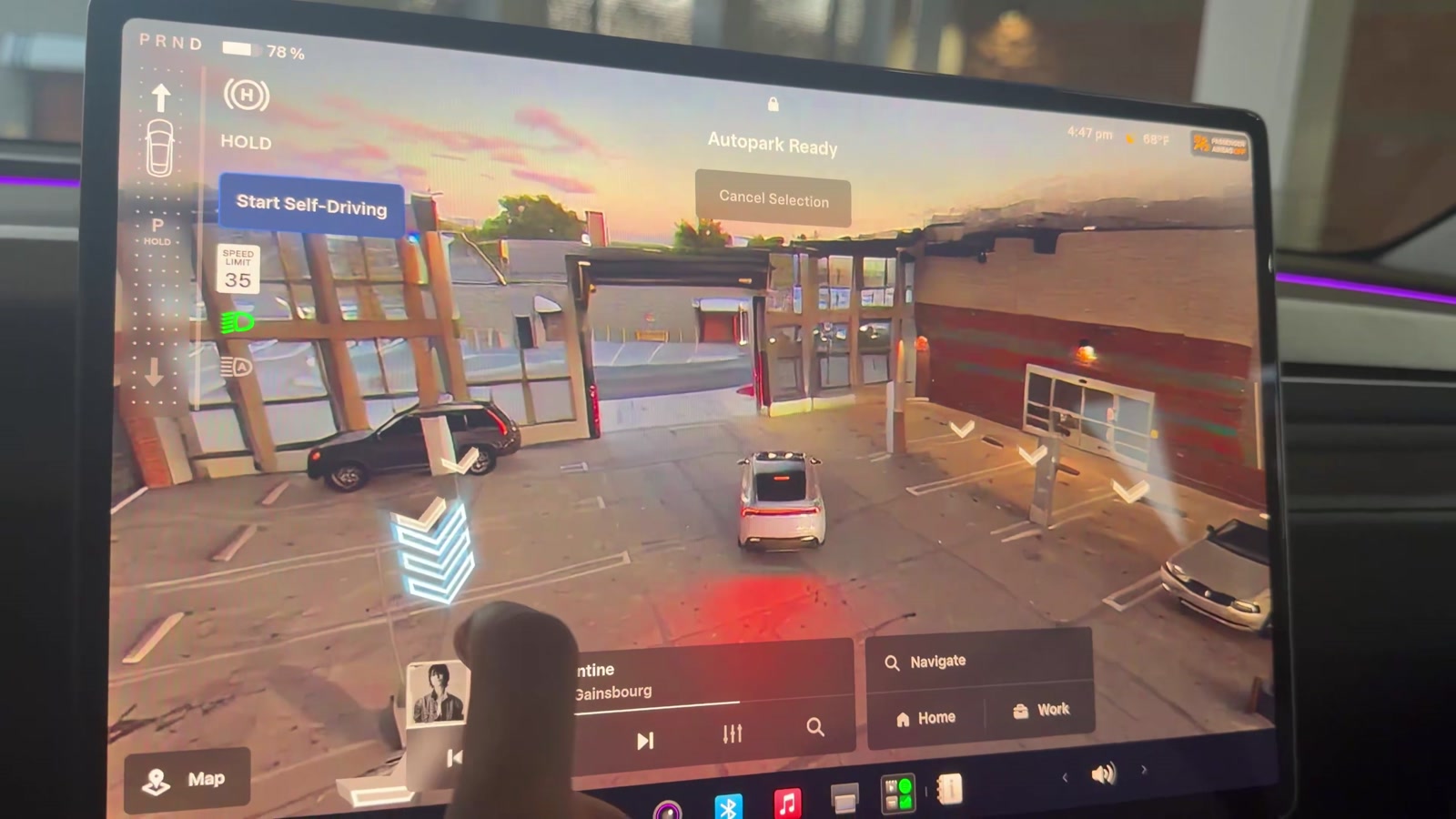
The owner first taps a candidate spot already marked on screen, then separately taps start. The screen then switches to the top-down parking view, with the live camera window at upper right. What can be checked here is the order of the interaction, not the internal coordinate mapping or safety validation.
Closing Making the Car Legible
Reality View's value is not only that it looks more like the real road than the old interface, but that routes and parking targets land in a scene the user can recognize. That use matters more in a robotaxi: a passenger cannot ask the driver "why are you stopping here," so the interface must say whether the car is yielding or preparing to turn. The next thing worth watching is not how much further resolution can climb, but whether the screen lets passengers tell observation from plan, and whether it can say so clearly when information is stale or missing.
Sources and Demonstrations
1 Tesla / Tesla Super Intelligence v15 launch and full release notes
2 Ashok Elluswamy statements on Reality View's display and intent
3 Elon Musk statements on the UVE split, conditional Mean Flow, and generation cadence
3a readable archive of post 3
4 Tesla AI Day 2022 3D occupancy network demo
4a Tesla AI Day 2021 multi-camera visual representation
4b Tesla geometric reconstruction and video simulation in the Scaled ML 2026 talk
5 Geng et al. Mean Flows for One-step Generative Modeling
6 original NeRF and 3D Gaussian Splatting research
6a Kerbl et al. 3D Gaussian splatting
7 DrivingGaussian dynamic road-scene reconstruction
7a Street Gaussians static-dynamic decomposition
8 NVIDIA Omniverse NuRec sensor reconstruction and simulation
9 Wayve GAIA-2 controllable driving-scene generation
10 Waymo rider-facing in-car visualization
10a XPeng production-car SR driver-assistance environment-simulation display
11 BMW official Augmented View description
12 Tesla first rollout and product demonstrations
12a Tesla official Reality View video and cover
12b owner komocode tap-a-spot original post
12c owner hashemcreatedus dense-fog footage original post
13 Tesla FSD Supervised usage documentation
14 SemiAnalysis HW 4.0 chip architecture and memory bandwidth
15 XPeng official release SR 2.0 production interface images
16 DrivingGaussian project originals nuScenes real-vs-reconstruction comparison
17 Wayve GAIA-2 technical report Figure 6 conditional-generation comparison
18 BMW Group PressClub BMW iDrive Augmented View official photo P90424007
19 Waymo official rider-screen intersection example