
This article examines a historical Rubin VR200 NVL72 rack estimate attributed to Morgan Stanley's Howard Kao team on May 21, 2026. Its purpose is to examine the relationship between GPU, memory and system costs, not to supply a current procurement quote.
Evidence boundary, reviewed October 19, 2026: The original research report and complete quotation terms were not available for independent verification in this review. Amounts below remain the secondary estimates used in the original article, not NVIDIA list prices, completed contracts or current supplier offers. Taxes, delivery scope, order size and ownership of memory may differ. BOM cost, ODM selling price and supplier margin are distinct measures.
What can be reproduced? With the rounded inputs below, $7.8M versus $4M is a 95% increase; $3.96M of GPU value is 50.8% of the total, and $2M of memory is 25.6%. That checks arithmetic, not the input prices. Jump to the component table, or connect acquisition cost to operating returns in the 10,000-GPU Token Factory financial model.
$7.8 Million Per Rack: Where Does the Money Go?
VR200 NVL72 is a rack-scale system with 72 Rubin GPUs and 36 Vera CPUs. The $7.8 million figure is the article's historical estimate, compared with roughly $4M for GB300, not a currently executable ODM offer. Consult the NVIDIA DGX Vera Rubin hardware guide for configuration; that guide does not validate these price assumptions.
But the real story isn't the total price — it's where the incremental value flows.
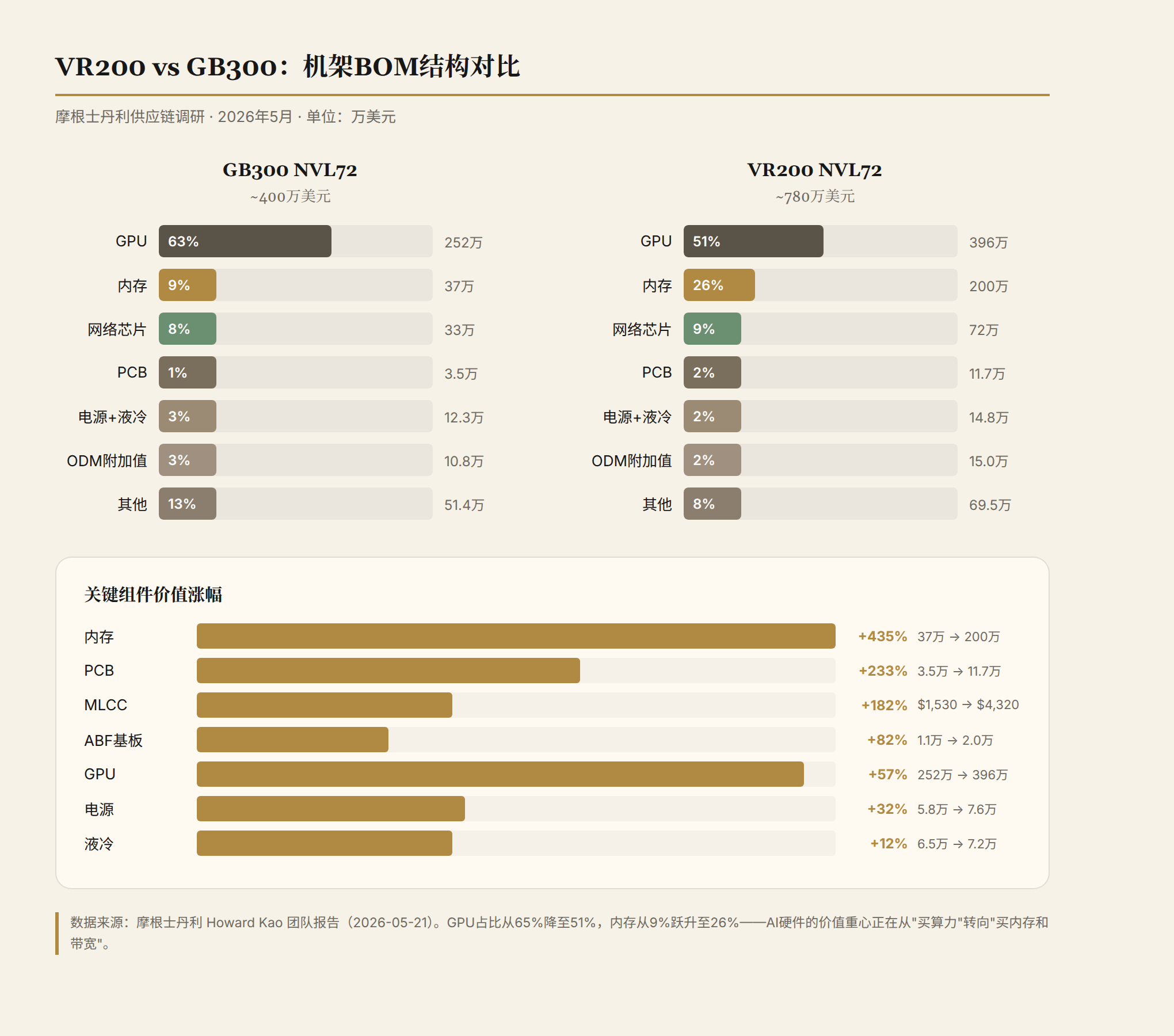
Historical illustration: amounts and percentages preserve the original estimates, not current quotations. The text below supplies the arithmetic corrections and scope.
In this estimate, GPUs remain the largest item at about $3.96M, up roughly 57% from $2.52M. Recalculating the rounded table inputs puts their share at 63% for GB300 and about 51% for VR200; memory rises from about 9% to 26%. PCB, MLCC and substrate increases remain conditional on the same historical inputs.
Nothing went down. Everything went up.
Memory: From Supporting Actor to "The New GPU"
Memory rises from $370K to $2M in the estimate, a 440.5% increase using those rounded values. The original 435% cannot be reproduced from them; unavailable unrounded figures cannot be assumed to resolve the discrepancy. Three assumptions contribute:
HBM4: 72 GPUs × 288GB = 20.7TB. SK Hynix dominates supply. Estimated $400-500K.
LPDDR5X: The original model assumes 54TB and $8-10/GB, or $432-540K using decimal capacity units. These are historical inputs, not current procurement prices.
3D NAND: The biggest structural addition. Rubin integrates NAND flash at scale for model loading and checkpointing. Over $1M per rack, versus near-zero in GB200.
Combined, memory-related costs approach $2M — already over half the GPU cost. With NVIDIA's ~70% markup on SOCAMM memory modules, the actual economic value of memory in the system is even higher.
A variable to verify: The original direct-SOCAMM-procurement scenario reduces the estimate from $7.8M to about $6.7M. The $1.1M difference cannot be identified as NVIDIA's net profit, or guaranteed buyer savings, without reconciling procurement scope and itemized pricing.
PCB: The Largest Percentage Gainer
PCB value rises from $35K to $117K in the estimate, about 234.3% on rounded inputs. Three assumptions explain the increase:
New high-value modules: ConnectX module PCBs (72 per rack × $270) and Midplane PCBs (18 × $1,500) — these didn't exist in GB300, contributing ~$46K in pure incremental value.
Existing boards upgraded across the board: Compute PCBs upgraded from 22-layer HDI to 26-layer, CCL grade from M7 to M8, unit price from $650 to $1,400. Switch PCBs from 24-layer to 32-layer. The switch upgrade is actually more aggressive than compute — interconnect complexity is growing faster than compute itself.
Physical spec improvements: Larger compute board dimensions, new 44-layer midplane PCB.
Layer count increase + material upgrade + new modules = PCB is the most elastic component in this cycle. For PCB suppliers, this is structural growth, not cyclical — AI servers don't need more boards, they need more complex and expensive ones.
MLCC and ABF: The Underappreciated Increments
MLCC surged from $1,530 to $4,320 (+182%). Murata reports a single AI server carries ~30,000 MLCCs — 30x a smartphone, 3x a car. A full NVL72 cabinet consumes 440,000 units.
ABF substrate grew from $11K to $20K (+82%). Rubin GPU ABF unit price doubled from ~$100 to $200, while NVSwitch ASICs doubled (18→36) and ConnectX chips doubled (36→72).
Power and Cooling: Forced by Power Density
Power rises from $58K to $76K in the historical estimate, about 31.0% using rounded values. The NVIDIA hardware guide specifies four power shelves, each rated at 110kW, feeding a 54V DC bus. The shelf rating is not rack consumption, and adding ratings does not establish operating draw. Do not mix another generation's HVDC architecture into this BOM; electricity costs require load, utilization, measured power and PUE.
Liquid cooling rises from $65K to $72K in the estimate, about 10.8% on rounded values. Adding a separately assumed $50K side-car CDU gives $122K. Liquid-cooled compute trays do not imply that every rack component is fanless; compute cooling, power-supply cooling and facility infrastructure need separate boundaries.
ODM: Absolute Profits Rising, But Pricing Power Declining
The historical estimate raises ODM value-add from $108K to $150K, about 38.9% using rounded inputs. More value-add is not itself confirmed profit growth.
But gross margin declined from ~2.7% to ~1.9% as the denominator (rack price) doubled. More importantly, the consignment model is spreading — Foxconn and Quanta have both confirmed customer-direct procurement of core components, reducing ODMs to advanced assemblers.
Two Deep Signals
Signal 1: AI Hardware Costs Are Shifting from "Buying Compute" to "Buying Memory and Bandwidth"
The rounded inputs move GPU share from 63% to about 51%, and memory from about 9% to 26%. SOCAMM ownership and markup have not been reconciled with the DRAM line; adding them again cannot establish that memory exceeds GPU cost. The useful question is how capacity and bandwidth constraints affect inference economics, not which unreconciled subtotal looks largest.
Signal 2: NVIDIA's Gross Margin Peak Risk Is Real
Not from competition (there isn't any), but from three structural pressures: rising memory share (priced by others), hyperscaler direct SOCAMM procurement (bypassing NVIDIA markup), and consignment model diffusion (shifting procurement power to cloud providers).
Data Summary
| Component | GB300 | VR200 | Change | Key Driver |
|---|---|---|---|---|
| GPU | ~$2.52M | ~$3.96M | +57% | Architecture upgrade, share diluted |
| Memory (all) | ~$370K | ~$2M | ~+440.5% | Rounded-input calculation; avoid double counting |
| PCB | ~$35K | ~$117K | ~+234.3% | Layer upgrade + material + new modules |
| MLCC | ~$1,530 | ~$4,320 | +182% | Per-board usage doubled + new modules |
| ABF Substrate | ~$11K | ~$20K | +82% | GPU substrate doubled + chip count doubled |
| Power | ~$58K | ~$76K | ~+31.0% | Power shelves and distribution; rating is not draw |
| Liquid Cooling | ~$65K | ~$72K | ~+10.8% | Liquid-cooled trays + QD/manifold increase |
| ODM Value-Add | ~$108K | ~$150K | ~+38.9% | Value-add is not confirmed profit |
| Rack Total | ~$4M | ~$7.8M | +95% | — |
USD. Historical secondary estimates attributed to research dated May 21, 2026; the original report and supplier quotations remain unverified. This is not an exhaustive, additive BOM. Rounded inputs may not reproduce reported percentages or establish contract values and supplier profits.
Outlook
High confidence: Storage (HBM/LPDDR/NAND) is the highest-conviction sector for the next two years. Liquid cooling has moved from optional to mandatory. Power architecture shift to 800V HVDC is a confirmed trend.
Medium confidence: PCB/CCL structural upgrade (layers + materials) drives margin expansion, not just volume. ODM short-term absolute profits rise, but long-term pricing power faces pressure from consignment.
Key variables to watch: CPO inflection timing (NVL576 may push optical engine/GPU ratio from 2-4 to 17+). HBM capacity release pace. Hyperscaler direct SOCAMM procurement progress.
The original article relied on secondary accounts attributed to "Analysis of Rubin rack BOM, component content, and ODM value-added" (May 21, 2026). This review withdraws the earlier assurance of cross-validation. The outlook preserves historical analysis, not confirmed outcomes or investment advice.
Beyond procurement prices, network and optical interfaces change the system boundary. Continue with Corning GlassBridge's coupling and manufacturing constraints and SIGCOMM 2026's AI infrastructure research agenda.