
I. The Signal: Four Things Happened at Once in July 2026
In July 2026, four developments entered view simultaneously. They seem unrelated on the surface, but all point to the same conclusion. Three clustered in the first week of July; the fourth is a two-month stock price correction.
First: a GPU spot market was born. On July 6, Axios reported that a startup called Ornn launched a GPU spot trading exchange. a16z led a $33 million seed round. H100s are priced by the hour, and prices keep falling. This is not a cloud provider's on-demand instance — it is a genuine spot exchange, matching buyers and sellers with transparent, public pricing. For the first time, GPUs have a market-driven hourly price.
Second: Nvidia lost one trillion dollars in market cap. From its May 14 peak to July 8, Nvidia's stock fell roughly 16% over about two months. Bloomberg's July 8 data put the equivalent market value loss at approximately $1 trillion. The strange part: analysts raised earnings estimates over the same period. Fundamentals did not deteriorate. What investors were selling was not Nvidia's performance — it was the assumption of Nvidia's pricing power.
Third: the valuation signal. Nvidia's forward P/E dropped to 18x. Over the same period, the S&P 500 stood at 20x. Hershey's chocolate had a higher P/E than Nvidia. In other words, the market priced Nvidia's growth prospects below the broad market average. This is an extreme contrast with the "sole pick-and-shovel player of AI" narrative from a year ago.
Fourth: memory makers surged. Over the same window, Micron's market cap nearly tripled. SK Hynix completed a $26.5 billion U.S. listing on July 10 — the second-largest IPO after SpaceX. Capital is voting with its feet: if compute is the new oil, memory is the new pipeline, and pipeline supply is even scarcer.
TechCrunch's July 9 headline nailed it: "Nvidia is a victim of the compute marketplace it created." Nvidia built the infrastructure for compute trading, ultimately catalyzing compute's commoditization. And commoditization is the natural enemy of pricing power.
Key judgment: this is not an Nvidia problem. It is a repricing of the entire "compute scarcity" narrative. When an asset transitions from scarce to tradable, its price must converge toward marginal cost. Investors are pricing in this process ahead of time.
II. The Three Conditions for Commodity Formation Are Being Met Simultaneously
Commodities are not self-declared. Oil, natural gas, and electricity became commodities because three preconditions were met at the same time. GPU compute is checking off each one.
Condition One: Standardization
An H100 is an H100. Whether you rent it on AWS, Azure, GCP, or CoreWeave, the silicon is the same, the architecture is the same, the FLOPS are the same, the HBM bandwidth is the same. Compute output is homogeneous and measurable. FLOPS, memory bandwidth, and interconnect latency form the standardized units of measure.
CUDA's ecosystem does lock in developer mindshare, giving Nvidia strong software-layer stickiness. But note: software lock-in does not equal hardware differentiation. When a customer's inference workload can run on any H100, CUDA's moat exists only in switching costs — and switching costs decline as toolchains mature.
This mirrors the standardization of oil. WTI and Brent crude have quality differences, but same-grade crude is homogeneous. GPUs have already crossed this threshold.
Condition Two: Tradeability
What Ornn is building is a spot market for GPU compute. On July 7, Saturn Cloud launched self-service GPU deployment on the Nebius marketplace: pick a card, pick a duration, swipe a credit card, and have compute in minutes. This is no longer closed cloud-provider pricing — it is open matching.
GPU compute has a physical property more extreme than oil: it cannot be stored. Oil can go into storage tanks to wait for higher prices. A GPU-hour, once past, is gone forever. Idle compute's marginal cost approaches zero, and so does its marginal revenue — unless a market exists to monetize it.
This characteristic makes GPUs more in need of real-time trading than oil. Spot markets like Ornn's are essentially price discovery mechanisms for a non-storable commodity. Axios's report quoted Ornn's founder: GPU compute price volatility is far higher than in electricity markets, because supply is rigid (fixed capacity) while demand is pulsed (training jobs launch in clusters).
Condition Three: Supply Diversification
A commodity requires multiple suppliers — no single seller can control price. GPUs are rapidly moving toward this state:
- Meta MTIA "Iris": Co-designed with Broadcom, manufactured by TSMC, entering production in September. Meta's internal target: 7GW of self-owned compute in 2026, doubling to 14GW in 2027. This is not a lab project — it is a volume production plan.
- AMD Instinct: Meta has already placed multi-billion-dollar orders. AMD achieved a key CUDA compatibility breakthrough on the MI400 series.
- Amazon Trainium/Inferentia: Self-designed inference chips deployed at scale, with costs reportedly 40% lower than H100.
- Google TPU v6: The Trillium version is generally available; the entire Gemini model family runs on TPUs.
- Anthropic × Samsung: The Information reported in July that Anthropic is negotiating with Samsung for custom AI chips. The chip type is undetermined, but the strategic intent is clear: do not let a single supplier hold the leash. Cramer's analysis noted that this path requires billions in semiconductor equipment investment.
- DeepSeek custom silicon: CNBC reported on July 7 that DeepSeek is pushing forward on self-designed chips. A survival move under export controls.
- OpenAI Jalapeño: The most aggressive vertical integration case — full-stack self-design from models to silicon.
Six of the seven top AI companies are already building custom chips. The sole exception is xAI — and given Musk's personality, that is only a matter of time.
When all three conditions are met simultaneously, the consequence is clear: GPU compute is transitioning from a single-vendor scarce product to a multi-supplier tradable standard good. That is the definition of commoditization.
III. The Bottleneck Moves Up: From Compute to Memory
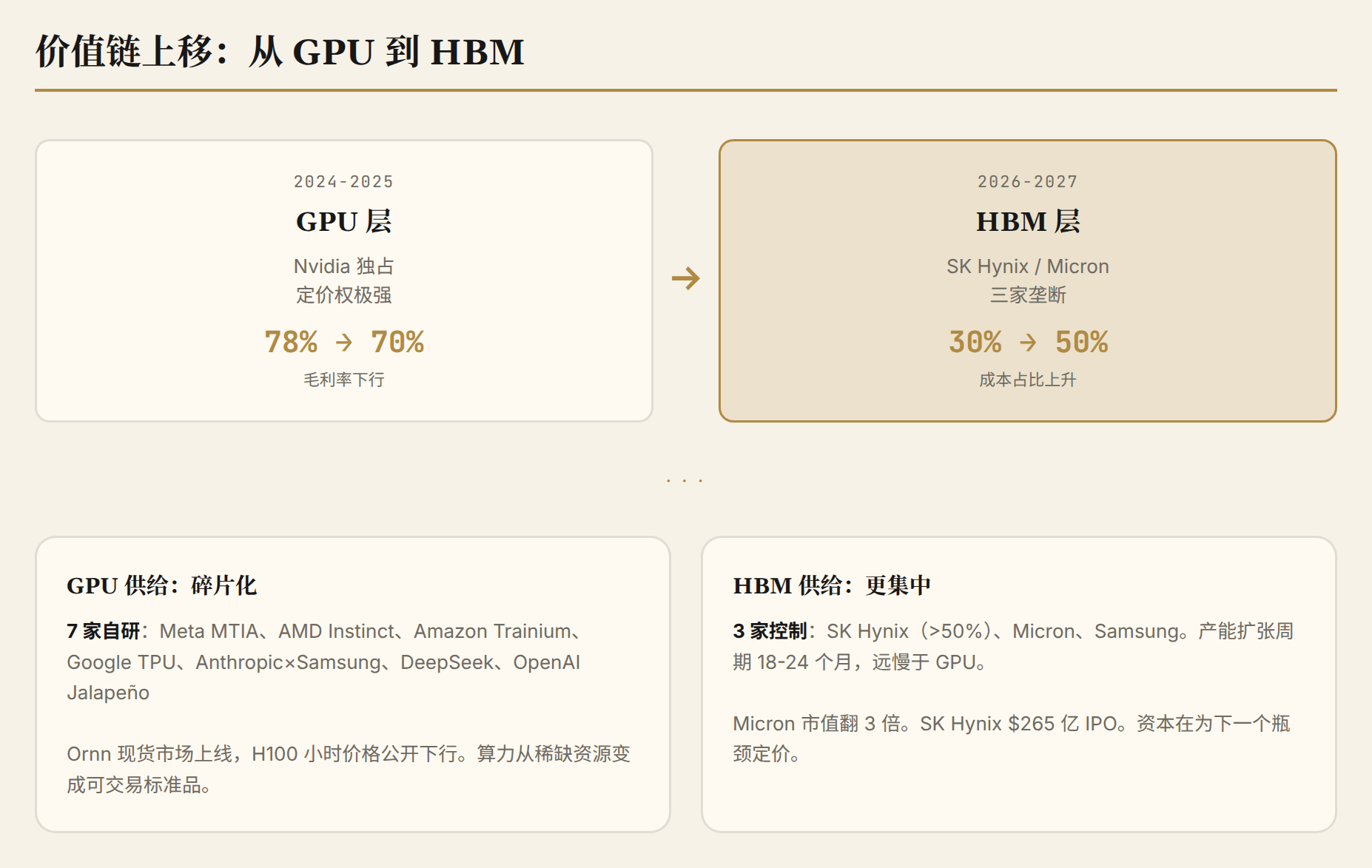
If GPUs are the new oil, then HBM is the new refinery — and refinery capacity expands far more slowly than oil wells.
For the past two years, everyone focused on Nvidia's GPU capacity. But the real physical bottleneck is not GPU silicon — it is HBM (High Bandwidth Memory). Each H100 carries 80GB of HBM3; each B200 carries 192GB of HBM3E. GPU capacity is constrained by TSMC's CoWoS packaging capacity, which in turn is constrained by HBM die capacity. The bottleneck of the bottleneck is the real bottleneck.
Micron's 3x market cap surge is not speculation. Memory capacity expansion cycles (building a new fab to volume production typically takes 18–24 months) are far longer than GPU capacity expansion (adding wafer runs at an existing fab takes roughly 3–6 months). Once GPU capacity catches up, memory becomes the decisive constraint on inference throughput.
The SK Hynix $26.5 billion IPO signal is even stronger than Micron's. SK Hynix is the world's largest HBM supplier, holding over 50% of the HBM3E market share. The valuation the capital markets are assigning to SK Hynix effectively says: whoever controls HBM supply controls the next AI bottleneck.
The value chain restructuring logic is straightforward.
At the GPU layer, Nvidia's gross margin has started declining from its 2024 peak of 78%. Rising competition + custom chips eroding the inference market = pricing power loosening. Nvidia remains the largest player, but is no longer the only player.
At the memory layer, HBM3E capacity remains tight in 2026. Samsung's HBM3E yield issues delayed mass production, leaving SK Hynix and Micron as the effective suppliers. Three memory companies control global HBM supply — a concentration higher than the GPU market.
This means: even if GPU commoditization drives compute prices down, memory makers' profits may actually rise. Compute demand is growing faster than HBM capacity expansion, and HBM's share of inference system cost is moving from 30% toward 50% (industry estimates, not official data).
The capacity ramp cadence of HBM3E and the next-generation HBM4 will directly determine the actual supply of inference compute in 2026–2027. The question is not how many GPUs exist — it is how much HBM exists. The latter is the hard constraint.
IV. The Custom Chip Wave: Not About Replacing Nvidia, but Breaking Pricing Power
Every major company is pursuing custom silicon, but motivations and strategies differ sharply. Understanding these differences reveals where Nvidia will be eroded and where it remains safe.
Meta MTIA "Iris": Cost-Driven + Scenario-Specific
Co-designed with Broadcom, manufactured on TSMC's 5nm process, entering formal production in September. MTIA's core use case is recommendation systems and ad ranking. Meta's largest compute consumption is not training large models — it is trillions of recommendation inferences per day.
An internal Meta memo obtained by Reuters and CNBC acknowledged: "Adopting the latest GPUs is costly and has taken us time." In commercial terms: Nvidia's pricing power has grown strong enough that Meta finds custom silicon more economical.
Meta's 7GW/14GW targets show this is not a small-scale experiment. 1GW roughly corresponds to 600,000–700,000 GPU-equivalent units (estimated at ~1.5kW per H100 including overhead). 14GW means Meta plans to own 8–9 million GPU-equivalents of custom compute by end of 2027 — more than most cloud providers' total GPU holdings.
Anthropic × Samsung: Supply Chain Hedging
The Information's report provided limited detail on the negotiation stage, and the chip type (inference vs. training vs. general-purpose) is undetermined. But the signal itself matters more than the details.
Anthropic's current compute comes primarily from AWS (Amazon's Trainium + Nvidia GPUs) and Google Cloud (TPUs). Adding Samsung as a third supplier is essentially supply chain hedging — decoupling from TSMC's CoWoS capacity bottleneck. Samsung's 4nm HBM baseline foundry capability trails TSMC, but its 3nm GAA process has matured.
Cramer's analysis noted that this path requires "billions in semiconductor equipment investment." This signals Anthropic is betting it will be a long-term compute buyer, justifying heavy capital expenditure at the infrastructure layer.
DeepSeek Custom Silicon: Survival-Driven
CNBC's July 7 report framed DeepSeek's custom chip push in the context of "circumventing export controls." This motivation is fundamentally different from U.S. companies. Meta builds custom chips to save money. DeepSeek builds them to survive.
But from a market competition perspective, the effect is similar: every additional non-Nvidia compute supplier accelerates GPU commoditization. DeepSeek's custom chips are unlikely to enter Western markets, but they further reduce China's AI ecosystem dependence on Nvidia.
OpenAI Jalapeño: Vertical Integration
OpenAI's custom chip project, codenamed Jalapeño, is the most aggressive vertical integration case among top companies. From model architecture to inference framework to custom silicon, OpenAI wants to control the entire inference stack.
The logic: as model capabilities converge (GPT, Claude, and Gemini are closing the gap), cost efficiency becomes the competitive moat. Custom silicon can deliver 20–30% efficiency gains through model-hardware co-optimization. In a competition where inference costs need to drop 10x annually, this is decisive.
Judgment: Training Safe, Inference Lost
Custom chips will not topple Nvidia. The training market remains CUDA-dominated. From cuDNN to NCCL to Triton, the entire training toolchain is deeply bound to Nvidia's architecture. The cost and risk of migrating a training stack far exceed those of inference.
But inference is a different story. Inference workloads are more standardized (forward passes, KV cache management, batch scheduling) and less dependent on CUDA. Competitors to TensorRT-LLM (vLLM, SGLang, Triton Inference Server) already run efficiently on non-Nvidia hardware.
Inference accounts for the majority of AI compute consumption and is the fastest-growing segment. At Meta, inference represents over 80% of compute usage. As the inference market is eroded by custom chips and AMD/Google/Amazon offerings, Nvidia's revenue growth engine will decelerate noticeably.
V. Nvidia's Dilemma: Prisoner of Price
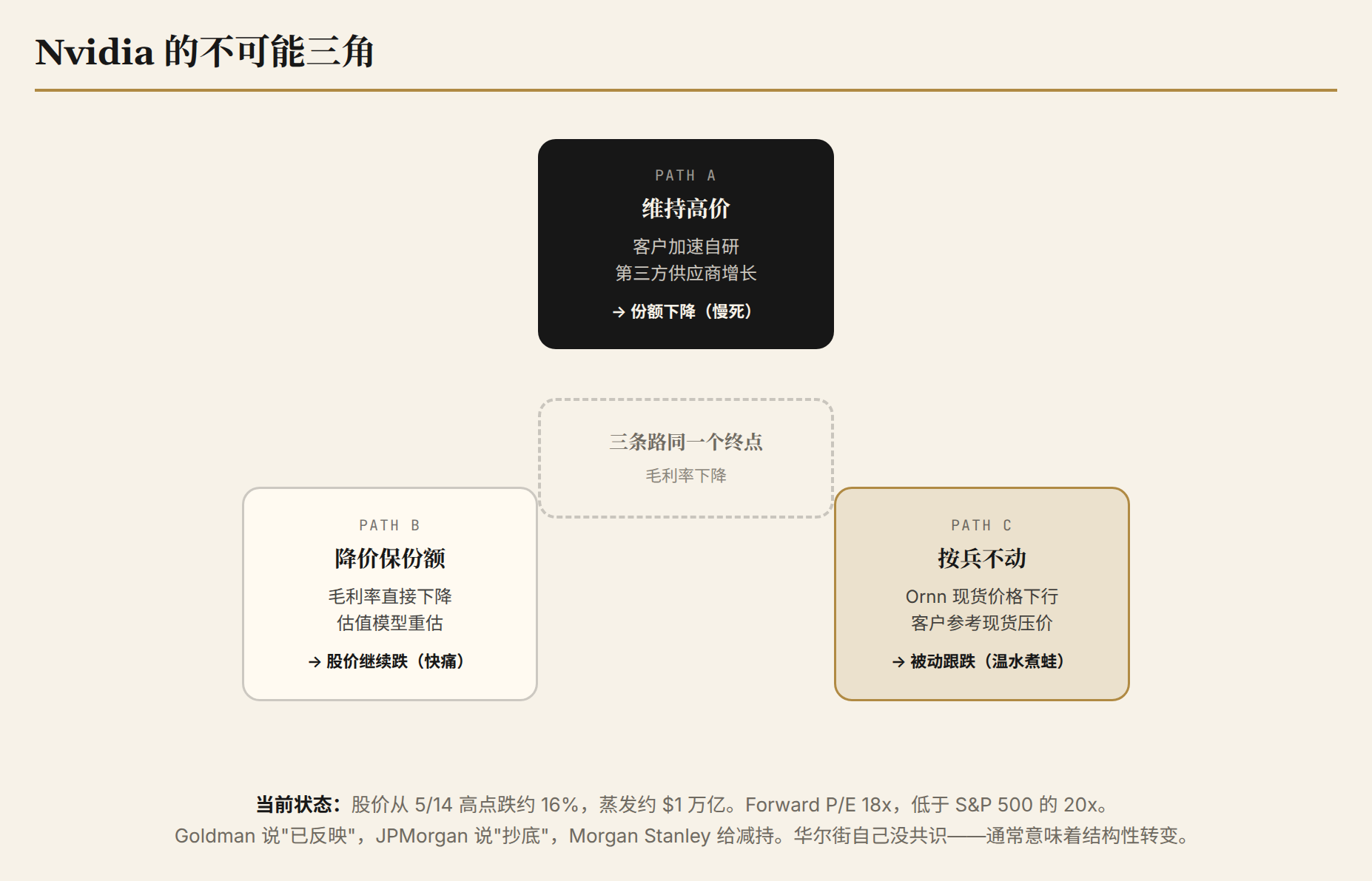
Nvidia faces a classic impossible trilemma. Three paths, all leading to the same destination — declining gross margins.
Path one: maintain high prices. If Nvidia holds current pricing, customers accelerate custom silicon adoption and third-party suppliers grow. Meta's MTIA, Amazon's Trainium, and Google's TPU all gained internal justification because of Nvidia's high prices. The higher the price, the better the ROI of alternatives, the faster customer migration. Market share declines.
Path two: cut prices to defend share. If Nvidia proactively lowers prices, it can slow custom-silicon substitution — but gross margins drop directly. Nvidia's current gross margin is approximately 70–75%. For every 10 percentage point decline, operating profit falls roughly 30–40%. Valuation models need full recalculation; stock price remains under pressure.
Path three: do nothing. If Nvidia makes no adjustment, Ornn's spot market price decline will continuously drag down the market's expected price. Customers will reference spot prices to negotiate contract discounts. Nvidia follows the market down passively. Margins erode slowly, but market cap falls first.
The common endpoint of all three paths: Nvidia transitions from a high-margin, high-growth, high-pricing-power "sole AI pick-and-shovel player" to a medium-margin, medium-growth, limited-pricing-power "largest GPU supplier." The 18x forward P/E is the market pricing this end state in advance.
The two-front war. On June 4, we reported that Rubin required a respin. Next-generation architecture delays mean the 2027 product roadmap carries uncertainty. GPU spot price decline + next-gen chip delay — one pressures current profits, the other pressures future expectations. Nvidia is fighting on two fronts, with no strong defensive options on either.
No Wall Street consensus. According to Bloomberg's July 8 report, Goldman Sachs's view is that "market share loss is already priced in," with an implicit recommendation to hold or add. JPMorgan is more aggressive: "Time to buy the dip." But Morgan Stanley issued a reduce rating, and Citi cut its price target by 22%. When sell-side research cannot reach consensus, it signals that an inflection point in fundamentals and valuation is genuinely forming.
When a market cannot even reach consensus among sell-side analysts, it usually means a structural transformation is underway — not a cyclical fluctuation.
VI. Implications for China
GPU commoditization has complex, multi-layered impacts on China's AI industry.
Export Control Leverage Weakens
If GPUs become commodities, alternative supply sources multiply. When Meta MTIA, AMD Instinct, Google TPU, and Amazon Trainium all compete in the market, when Ornn enables cross-border compute matching, the marginal effectiveness of U.S. export controls declines.
Ban the export of one H100, and the buyer can rent equivalent compute, use alternative chips, or build their own. The 2023 ban was effective because alternative supply was insufficient. The 2026 ban is less effective because commoditization has created supply redundancy.
The combination of DeepSeek's custom chips and open-source models has already proven that competitive AI can be built without the most advanced Nvidia hardware. The performance of Qwen, DeepSeek, and Zhipu models on international leaderboards further undermines the logic that "restricting GPU access stalls China's AI."
Policy May Cut Off the Dividend
Forbes reported on July 7 that Beijing is considering restricting overseas access to Chinese AI models. If implemented, the dividend of "cheap Chinese models + commoditized compute lowering inference costs" could be severed by policy. Model output is a service trade; restricting cross-border access amounts to shooting oneself in the foot.
Tech Competition Becomes Information Warfare
The Washington Post reported on July 6 that Anthropic accused Alibaba's Qwen of distilling Claude's outputs through 25,000 fake accounts. Unverified, but the signal warrants attention. As model capability gaps narrow and compute costs converge, competition is shifting from "whose model is stronger" to "whose narrative prevails."
This is not a positive development. Tech competition should be settled by products and data. Information warfare is settled by narratives and accusations. The latter only increases regulatory intervention risk, to the detriment of all participants.
HBM Is the Real Chokepoint
GPUs can be self-designed, bought from AMD, or replaced with TPUs. But HBM supply is highly concentrated. SK Hynix (South Korea), Micron (United States), and Samsung (South Korea) control global HBM production. China has virtually no domestic supply at this layer.
Manufacturing HBM3E requires EUV lithography, advanced CoWoS packaging, and ultra-pure chemicals — all structural weaknesses for China. GPU commoditization makes GPUs less critical, but HBM becomes an even purer bottleneck. As the value chain shifts up to the memory layer, China faces not "can we get GPUs" but "do we have HBM to run on those GPUs."
GPUs are becoming replaceable commodities. HBM is not. China can design its own GPUs (Huawei Ascend, Cambricon), build its own models (DeepSeek, Qwen), and compete in open-source ecosystems. But at the HBM manufacturing layer, China faces a structural gap across the entire semiconductor supply chain: EUV lithography, advanced packaging, materials science.
If GPU commoditization is the most significant AI infrastructure shift of 2026, then the pace at which the realization spreads — "GPUs are no longer the bottleneck; HBM is" — will determine the next focal point of national AI policy. The U.S. may be realizing that restricting HBM equipment exports is more effective than restricting GPU exports. If policy pivots, China's AI compute supply faces a deeper constraint.
This is not a prediction. It is a variable to monitor continuously.
VII. Judgment
Compute Commoditization Is a Structural Inflection, Not a Cyclical Fluctuation
The three conditions (standardization, tradeability, supply diversification) are being met simultaneously in 2026. This process is irreversible. Even if Nvidia launches a revolutionary next-generation architecture, it would only delay — not reverse — the commoditization trend. The oil market experienced the same transition in the 1860s: from Rockefeller's monopoly, to the Texas oil boom, to the formation of OPEC. The core pattern is always the same — from single supplier to diversified market.
GPUs may complete this journey in 5 years, not the 50 years it took oil. Technology commoditization moves far faster than natural resource commoditization.
The Biggest Winner Is Not GPU Buyers — It Is Memory Makers
Bottleneck migration means value migration. When GPUs are no longer scarce, HBM becomes the new scarcity. Micron's 3x market cap surge, SK Hynix's $26.5 billion IPO. These numbers are not coincidences — capital is pricing the next bottleneck.
If one were to make a three-year investment in AI infrastructure, HBM supply chains offer higher certainty than GPU supply chains. This judgment carries risk (HBM4 could be displaced by a new architecture), but within the visible time horizon, memory capacity expansion is deterministically slower than compute demand growth.
Ornn's Long-Term Value Lies in Price Discovery
The significance of a GPU spot market extends beyond "making GPUs cheaper." The deeper value is price discovery: letting the market know what an H100-hour is actually worth.
This parallels China's interest rate liberalization. When deposit rates are set by the central bank (GPU prices set by Nvidia), banks (cloud providers) profit from the spread (resale markup). When rates are liberalized (GPU spot prices go public), banks (cloud providers) must compete on service and efficiency, not on information asymmetry.
All cloud providers' GPU resale margins will be eroded. This benefits Nvidia's direct customers (large enterprises, research institutions) who can budget compute costs more precisely. It hurts intermediaries (cloud providers' GPU instance businesses).
Nvidia Will Not Collapse, but the Narrative Has Changed
CUDA's ecosystem moat remains deep. The training market remains dominant. The Rubin roadmap (even if delayed) remains competitive. Nvidia will continue to be a high-revenue, strong-technology company.
But the "sole pick-and-shovel player of AI" narrative is over. An 18x forward P/E below the S&P 500's 20x is the market saying: we no longer believe Nvidia is the one irreplaceable player of the AI era. The valuation returning to early-2023 levels is not an oversold correction — it is a repricing to a new reality.
What will Nvidia become? The most likely outcome: "the Intel of the AI era." The analogy is Intel in the PC cycle of the 2000s–2010s — technologically leading, commanding large market share, but no longer the market's growth focus. Not Intel's current predicament.
What to Watch Next: Compute Futures
When spot markets mature, the natural evolution of hedging demand is derivatives. GPU compute's non-storability makes futures more necessary, not less. Oil futures exist because producers and consumers need to lock in future prices. The demand for GPU futures is stronger, because the non-storability of GPU-hours makes spot price volatility more extreme.
By 2027, we may see compute futures contracts, compute ETFs, even compute derivatives hedge funds. It sounds absurd, but consider electricity futures. Electricity is equally non-storable, and electricity futures markets have been running for 20 years.
But compute futures face a barrier that electricity futures do not: standardization. Electricity has unified delivery standards and a transmission grid. GPU differentiation (H100 vs. B200 — different generations, different configurations) makes standardized contracts extremely difficult. In a market where hardware performance doubles every 18 months, the underlying asset for a 3-month-forward contract may have already depreciated. Ornn currently handles only spot trading — futures are the logical next step, but far more complex than spot.
Sources & Disclaimer: This article is based on publicly available information, including Ornn's official platform data, NVIDIA FY2027 Q1 earnings and earnings call, Micron/SK Hynix/Samsung latest quarterly reports, SemiAnalysis GPU market analysis, Artificial Analysis and PricePerToken inference pricing trackers, Bernstein and Goldman Sachs research reports, and public disclosures from relevant companies. Not investment advice. Data as of July 11, 2026.