
The real watershed for AI4S is not whether scientific agents exist, but whether agents can consistently obtain low-cost, traceable, and reproducible real-world feedback.
This article is written based on publicly available information as of June 25, 2026 (Beijing Time), including the ISC 2026 agenda, talk abstracts, the June TOP500 list, and contemporaneous papers and institutional disclosures. ISC 2026 runs from June 22 to 26, so this article does not include any workshop outcomes that may be released afterward.
1. What ISC 2026 Is Rewriting Is Not the Leaderboard, but the Unit of Value in HPC
ISC 2026's official stance on HPC is already quite clear: the era of competing solely around the largest machines and peak FLOPS is passing. Today's mainstream workloads simultaneously mix large-scale simulation, AI, and data processing, constrained by energy, bandwidth, and cost; the unit of value is no longer an isolated benchmark, but whether an end-to-end scientific workflow can be completed.
Jack Dongarra further distilled this shift in his keynote abstract: the center of gravity in HPC is moving from FP64, single nodes, and single-machine systems toward accelerators, rack-scale systems, and workflows; the more meaningful evaluation dimensions going forward are "time–energy–trustworthiness," and the so-called "effective ZettaScale" will increasingly come from validated mixed-precision algorithms, communication-avoiding methods, AI-reduced-order models, and AI–simulation hybrid workflows with error control and uncertainty quantification (ISC 2026 program page).
This means the core theme of ISC 2026 is not "will GPUs replace CPUs," but: the smallest unit of scientific computing is shifting from a single floating-point operation to an evidence pipeline that generates hypotheses, performs numerical computation, screens candidates, conducts experimental validation, and updates the model.
Three Easily Misread Data Points
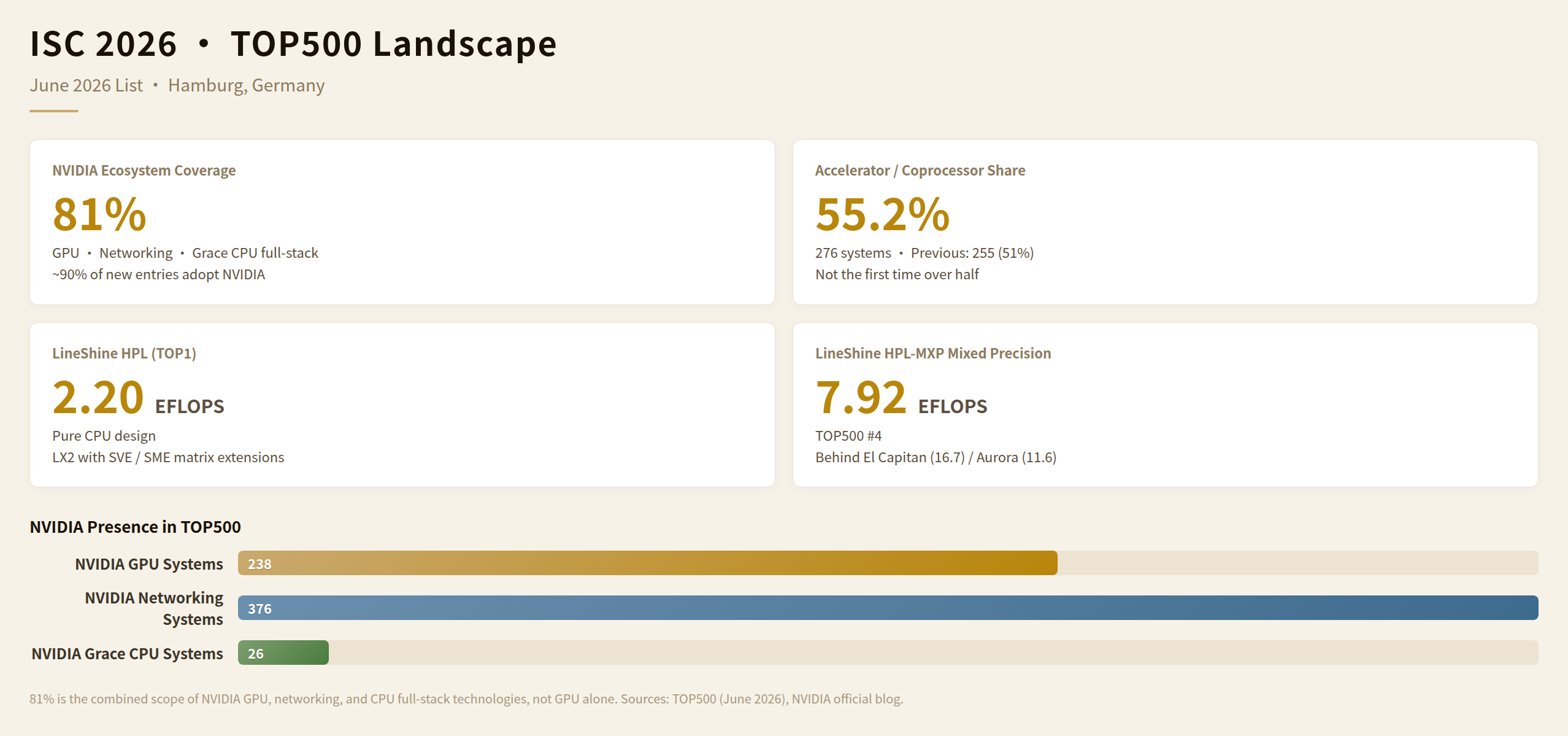
First, in the June 2026 TOP500, 276 systems use accelerators or co-processors, accounting for 55.2%, not 55.4%. And this is not the "first time over half": the previous edition already had 255 systems, accounting for 51% (TOP500 June 2026 list).
Second, "81% of the TOP500 use NVIDIA technology, and roughly 90% of new entries use NVIDIA technology" cannot be directly interpreted as "81% all use NVIDIA GPUs." NVIDIA's own disclosed breakdown is: 238 systems use its GPUs, 376 use its networking, and 26 use Grace CPUs; the 81% figure is an aggregated metric covering GPU, networking, and CPU technologies (NVIDIA official blog).
Third, LingSheng LineShine reached the top spot with an HPL score of 2.198 EFLOPS, indeed making it the first TOP500 system to achieve sustained double-precision performance above 2 EFLOPS using CPUs. But the term "pure CPU" means it has no discrete GPU or external co-processor — it does not mean these are still conventional general-purpose CPUs. The LX2 supports SVE and SME matrix extensions, with matrix computation capabilities integrated into the chip and even within CPU cores, paired with HBM and a software environment optimized for both HPC and AI (TOP500 reporting).
In mixed-precision HPL-MxP, LineShine reached 7.92 EFLOPS, ranking fourth, behind El Capitan's 16.7 EFLOPS, Aurora's 11.6 EFLOPS, and Frontier's 11.4 EFLOPS. This also shows that discrete accelerators still hold a clear advantage in low-precision and mixed-precision workloads.
So LineShine is neither evidence that "the GPU route has failed," nor evidence that AI and HPC can go their separate ways again. It serves more as a strong corroboration: you can do without discrete GPUs, but it has become very difficult to design a top-tier supercomputer that does not account for matrix computation, AI workloads, mixed precision, and data movement at all.
In this sense, HPC may not "depend on AI" in any single technology, but AI has become an inescapable system variable in chip design, software ecosystems, investment direction, talent structure, and scientific demand. The domestic CCF HPC China 2026 adopting "Deep Fusion of HPC and AI" as its theme resonates with this global trend.
2. AI4S Is Not One Paradigm — It Is Three Paradigms of Entirely Different Depth
The fourth paradigm proposed by Jim Gray is data-intensive science built upon theory, experiment, and numerical simulation. Its core is extracting knowledge from massive scientific data with the help of databases, workflows, and computing infrastructure.
People today call AI4S the "fifth paradigm," but it lacks a rigorous, unified definition. More precisely, AI adds three new capabilities to the first four paradigms:
- Learning: learning approximate laws from data and high-precision computation;
- Generation: shifting from predicting known objects to generating unknown candidates;
- Action: invoking tools, orchestrating computation or experiments, and adjusting the next step based on feedback.
These three capabilities correspond to vastly different levels of maturity. Lumping DeePMD, MatterGen, Co-Scientist, and self-driving labs together under the umbrella of "AI4S" obscures the fundamentally different validation challenges each faces.
The developmental thread of AI4S can be roughly summarized as: AlphaFold won first place at CASP13 in 2018; AlphaFold2 in 2020 was considered to have solved the long-standing protein structure prediction problem, with methods and code made public in 2021; the Deep Potential team won the Gordon Bell Prize in 2020 for 100-million-atom molecular dynamics with first-principles accuracy; Pangu-Weather demonstrated the speed and accuracy potential of data-driven weather forecasting in 2023; the 2024 Nobel Prize in Chemistry brought computational protein design and protein structure prediction into the scientific mainstream; MatterGen was formally published in Nature in 2025; and by 2026, Co-Scientist, Robin, and AI Scientist began attempting to extend AI from a single model to multi-agent workflows in scientific research.
One timeline correction: MatterGen's preprint appeared in 2023, but its formal Nature paper was published in 2025. This distinction matters, because the experimental validation after formal publication and the subsequent peer skepticism together form a complete case study for understanding AI4S maturity.
3. From Exploration to Application: Five Intervention Points for AI4S
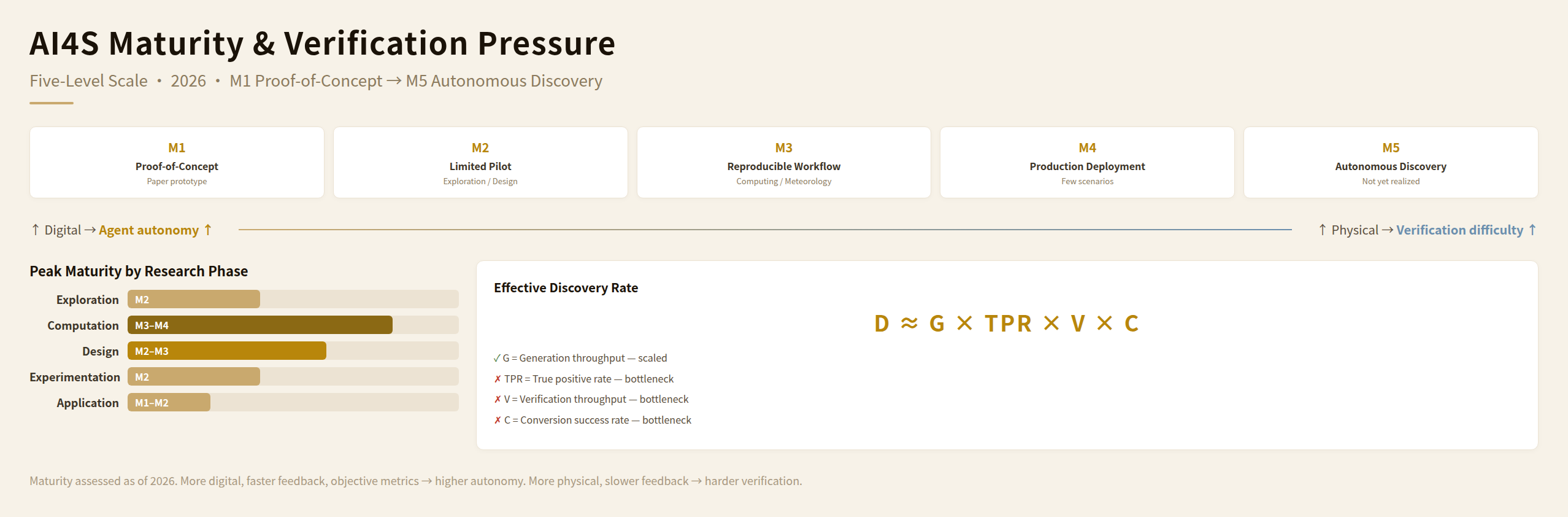
Maturity can be roughly described on a five-level scale:
- M1: Proof of concept;
- M2: Pilot in constrained scenarios;
- M3: Repeatable, specialized workflow;
- M4: Production deployment with monitoring and boundary conditions;
- M5: Autonomous scientific discovery transferable across problems and environments.
| Research Stage | Current Primary Role of AI | Maturity in 2026 | Biggest Bottleneck |
|---|---|---|---|
| Exploration | Literature search, knowledge organization, hypothesis generation, experimental protocol drafting | M2 | Genuine novelty, specialized reasoning, citation and causal errors |
| Computation | Potential functions, surrogate models, reduced-order models, solver acceleration, weather forecasting | M3–M4 | Out-of-distribution generalization, physical consistency, uncertainty quantification |
| Design | Inverse generation of molecules, materials, proteins, and process parameters | M2–M3 | Synthesizability, stability, multi-objective constraints, spurious novelty |
| Experiment | Bayesian optimization, robotic experiments, in-line characterization, closed-loop control | M2 | Instrument error, latent variables, fault recovery, cross-lab reproducibility |
| Application | Clinical trial support, manufacturing optimization, regulatory documentation, and operational decisions | Tool-type M3, end-to-end M1–M2 | Safety, scalability, regulation, real-world transfer |
The most important pattern here is: the more digital the environment, the faster the feedback, and the more objective the evaluation metric, the higher the agent's autonomy; the more physical the environment, the slower the feedback, the greater the noise, and the more open-ended the evaluation criteria, the lower the autonomy.
4. Layer One: AI Replacing Expensive Computation — the Most Mature, but Not "the Disappearance of Computation"
This layer is represented by machine-learned potential functions, surrogate models, neural operators, and AI weather forecasting. AI's role here approximates a new numerical method: train a model on large volumes of high-precision computation or observational data, then perform inference at a cost far below that of the original solver.
DeePMD is a representative case. The 2020 Gordon Bell Prize–winning work used machine-learned potential functions to scale molecular dynamics with first-principles accuracy to over 100 million atoms, simulating more than 1 nanosecond of trajectory within a single day. The breakthrough was not abandoning HPC but first using high-precision computation to generate trustworthy data, then using AI to compress high-precision laws into approximate models callable at scale, and finally running large-scale parallel execution on Summit.
Pangu-Weather follows a similar logic. The paper trained on 39 years of global data and, for the variables and reanalysis data tested, achieved results superior to the contemporaneous ECMWF IFS deterministic forecast while dramatically reducing inference time.
But the subsequent trajectory in meteorology was not "pure AI eventually replacing numerical weather prediction." A 2026 hybrid-framework work explicitly noted that purely data-driven models can sacrifice physical consistency, so it combined a low-resolution dynamical core with a neural operator to improve physical consistency and long-term stability at lower cost.
This reveals the true endgame for Layer One AI4S: not a binary choice between AI and traditional models, but a division of labor:
- Traditional equations and high-precision computation provide physical constraints, training data, and calibration benchmarks;
- AI provides speed, scale, and parameter-space coverage;
- HPC handles training, ensemble computation, high-precision back-calculation, and uncertainty quantification.
This layer faces the least validation controversy, because benchmarks generally exist in the form of DFT, PDE solvers, observational data, or experimental results. The real bottleneck is: when AI outputs millions of results, can high-precision back-calculation and experimental validation keep pace?
5. Layer Two: AI Directly Designing — Candidate Generation Is Mature, but "Discovery" Is Not
When AI shifts from predicting properties to "given a target, directly generate structures," the nature of the problem changes.
Traditional high-throughput screening searches within known databases or enumerated spaces; generative models attempt to establish an inverse mapping from target properties to candidate structures. This greatly expands the search space but also amplifies the risks around novelty, synthesizability, and validation.
MatterGen: A Complete Validation Funnel
For each target bulk modulus, MatterGen generated 8,192 candidates, which after multiple rounds of filtering — novelty, stability, phonon, and elemental criteria — were reduced to 75; experts then selected 4 for experimentation, and ultimately 1 candidate was successfully synthesized. The paper reports that its experimentally estimated property value deviated from the target by no more than roughly 20%.
This result deserves recognition but must be interpreted precisely:
- It proves that generative models can enter real materials experiments;
- But it does not mean that generated structures directly translate into materials discovery;
- The entire funnel remains heavily dependent on DFT, other machine-learning models, expert review, and physical experimentation;
- The attrition from mass-generated candidates to successful synthesis is conspicuous.
A 2026 peer-reviewed article published in Materials Horizons further raised the concern that the TaCr₂O₆ used for experimental validation in MatterGen may correspond to a disordered phase already reported as early as 1971 and present in the training data, and therefore should not be regarded as a genuinely new compound.
This challenge is not a definitive negation of MatterGen's overall capability, but it exposes an extremely valuable question: "the model generated a previously unseen ordered structure," "the experiment synthesized a phase," and "a genuinely new material was discovered" are three distinct scientific propositions.
Validation must not only answer "are the properties close to the target," but must separately answer: is the structure genuinely novel, is the disordered phase already known, does the experimental product match the predicted structure, and can the conclusion be independently reproduced.
CuspAI: 300 Trillion Is Not a Result, and Neither Are 20
The project announced by CuspAI and Kemira in 2026 generated over 5,000 designs from approximately 300 trillion potential structures, then narrowed them to about 20 priority candidates, over roughly six months. But the official language is that these candidates "enter further development and testing" — not that 20 materials have completed experimental validation or reached industrial application.
Therefore, when evaluating generative AI4S projects, one should not just look at how large the search space is or how many structures were generated, but at the candidate funnel: effective discovery rate ≈ generation throughput × true positive rate × validation throughput × translation success rate. AI has already dramatically boosted the first factor, but the second, third, and fourth factors remain governed by experimental capacity, physical models, and engineering conditions.
6. Layer Three: AI Running Its Own Scientific Closed Loop — "Semi-Autonomous" Has Arrived, but Not Yet a Universal Discovery Engine
The goal of this layer is no longer to deliver a predictive model or a set of candidates, but for the agent to execute by itself: search literature → propose hypotheses → schedule computation or experiments → analyze results → revise hypotheses.
In Well-Defined Experiments, Closed Loops Already Work
The University of Chicago's autonomous physical vapor deposition system reached its target in an average of roughly 2.3 attempts for silver thin-film experiments, with the entire prototype system costing under $100,000. The research team also explicitly describes it as a prototype, with the next step being extension to more complex materials.
The relatively high degree of autonomy achieved here stems from several favorable conditions: control parameters are relatively limited, characterization speed is reasonably fast, the objective function is computable, and the cost of experimental failure is fairly manageable.
In the Life Sciences, the Current Mainstream Remains "Agent + Human Wet-Lab"
Google Co-Scientist uses multiple agents to generate, critique, and refine hypotheses, validated across three biomedical domains — drug repurposing, target discovery, and mechanisms of antibiotic resistance — with some leukemia drug combinations undergoing in vitro experiments.
FutureHouse's Robin can combine literature retrieval and data-analysis agents to generate hypotheses, propose experiments, interpret results, and update hypotheses; but the paper accurately describes it as a "semi-autonomous" system. Its candidate drug for age-related macular degeneration was still confirmed through human-executed in vitro experiments.
The genuine novelty of such systems is not that large models replace lab technicians, but that AI begins to bridge several previously siloed steps. The agent organizes the workflow, but physical experimentation remains an irreplaceable interface with reality.
Purely Digital Research Can Be More Autonomous, but "Able to Write Papers" ≠ "Able to Do Science"
Sakana AI Scientist's 2026 Nature paper shows that among three automatically generated papers, one reached the acceptance threshold for an ICLR workshop. However, the research team manually selected the most promising outputs at each stage; none reached the ICLR main conference standard, and the paper also reported failure modes including shallow ideas, implementation errors, experimental errors, and hallucinated citations.
Another 2026 work, ERA, performed strongly on automatically scoreable scientific and engineering tasks, with the key prerequisite precisely being that the tasks had well-defined quality metrics, allowing code-execution results to be directly fed back to tree search.
Together, both illustrate: the current ceiling for agents is often determined not by "language capability" but by whether a reliable feedback referee exists. Whether code runs can be automatically judged; whether a Kaggle score improves can be automatically judged; whether DFT energy decreases can be automatically computed; but whether a biological hypothesis is genuinely novel, whether a material has industrial value, whether a clinical outcome carries causal significance — these cannot easily be scored by a single function.
In its in-house benchmark, the Shanghai Artificial Intelligence Laboratory had 100 scientists across 10 disciplines pose questions: frontier models scored roughly 50 on general scientific reasoning, but around 15–30 on specialized tasks such as targeted literature retrieval and concrete experimental design. These numbers should not be taken as a unified industry benchmark, but they can serve as a signal that "general expressive capability currently far exceeds stable, specialized reasoning capability."
Thus, a relatively accurate assessment for 2026 is: scientific agents are already amplifiers of research efficiency and coordinators of workflows, but they are not yet universal discovery engines that can independently bear the burden of scientific truth.
7. The Real Bottleneck Is Shifting from a Compute Gap to a "Validation Gap"
The fundamental contradiction of AI4S is: the cost of generation is falling much faster than the cost of validation.
In the past, a scientist might propose a few dozen candidates, and validation capacity could roughly match. Generative models can produce hundreds of thousands, millions, or even more candidates in very little time — but high-precision simulation, synthesis experiments, animal trials, clinical trials, and cross-institutional replication do not expand at the same rate.
This creates a kind of "validation debt": the system generates more and more claims awaiting verification, while the resources capable of converting those claims into reliable knowledge grow slowly.
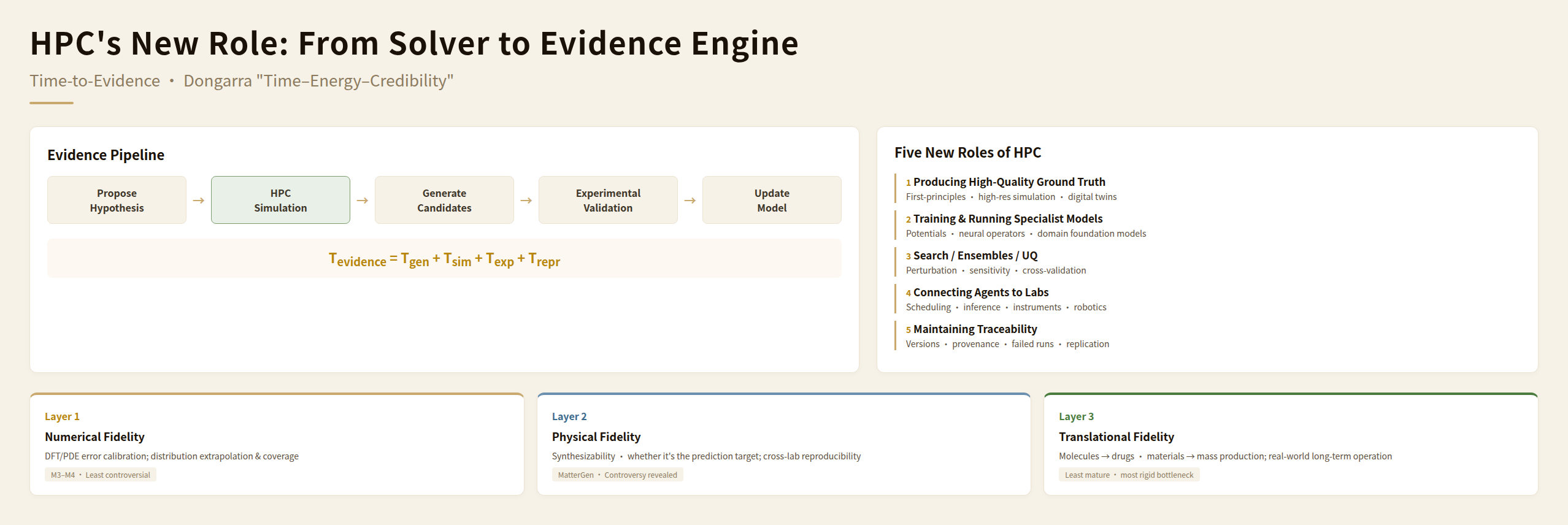
Layer One: Numerical Truth
For potential functions, weather models, and surrogate solvers, comparison can be made against DFT, traditional numerical solvers, or historical observations. The main issues are the expense of high-precision benchmarks, the difficulty of covering out-of-distribution cases, and whether errors are properly calibrated.
Layer Two: Physical Truth
For materials, molecules, and process design, the questions are: "can it be made," "is what was made the predicted object," "are the properties stable," and "can different equipment and laboratories reproduce it." The subsequent controversy around MatterGen demonstrates that property validation, structure identification, and novelty auditing must each be completed separately.
Layer Three: Translational Truth
A molecule that binds a target does not mean it can become a drug; a material with ideal simulated properties does not mean it can be manufactured at low cost; a single successful experiment does not mean it can operate reliably in real-world environments over the long term.
The pharmaceutical domain illustrates this especially well. The FDA has stated that between 2016 and 2023 it handled over 500 submissions containing AI components; its Good AI Practice principles, released in 2026, emphasize risk tiering, explicit context of use, data governance, performance evaluation, and lifecycle management.
The rentosertib study published in 2025 completed the first multicenter, double-blind, randomized, placebo-controlled Phase II clinical trial of a target and small molecule discovered by generative AI — this is important progress, but it still does not equal a completed full drug approval.
The FDA qualified AIM-NASH as its first AI Drug Development Tool in December 2025, applied to liver histology scoring in clinical trials; but it is a development tool, not a new drug discovered by AI, and final interpretation still rests with pathologists.
Thus, "AI has entered the FDA regulatory pipeline," "an AI tool has received qualification," "an AI-discovered drug has entered Phase II clinical trials," and "a new drug discovered end-to-end by AI has received full approval" are four distinct milestones.
8. HPC's New Role: Not an Answer Generator, but an Evidence Engine
In the traditional paradigm, HPC is primarily responsible for solving a given problem; in the AI4S paradigm, HPC will take on at least five roles.
First, producing high-quality ground truth. First-principles calculations, high-resolution simulations, and large-scale digital twins provide training labels for AI while also auditing AI outputs in unknown regions.
Second, training and running specialized models. AI4S requires not only large language models but also potential functions, neural operators, graph models, multimodal scientific models, and domain foundation models.
Third, executing search, ensembles, and uncertainty quantification. A single optimal candidate proposed by AI is usually insufficient. Scientific research demands extensive perturbation, sensitivity analysis, multi-model cross-validation, and confidence intervals.
Fourth, connecting agents with experimental facilities. Future HPC centers will not merely be job queues — they will simultaneously orchestrate simulation, databases, AI inference, experimental instruments, edge devices, and robotic labs.
Fifth, maintaining traceability. Recording model versions, data provenance, parameters, random seeds, computing environments, failed experiments, and human modifications is the foundation for validating AI-generated scientific results.
Thus, the more reasonable division of labor in the AI4S technology stack is: Agents are the control plane, HPC is the evidence plane, laboratories are the reality plane, and humans with independent replication are the accountability plane.
HPC will still need hardware metrics like TOP500, HPL, and HPCG in the future, but research institutions should also add new workflow metrics. The time required to obtain one piece of trustworthy evidence, the energy consumed per piece of trustworthy evidence, the cost per independently validated successful result, whether AI confidence matches the true error rate, and the cross-lab reproducibility rate — these are the standards by which HPC's value in the AI4S era should be measured.
9. Domestic and International Are Not Two Mutually Exclusive Paths, but Four Different Starting Points
United States and United Kingdom: Starting from Major Problems and Frontier Models
AlphaFold, Co-Scientist, Robin, AI Scientist, and CuspAI are closer to a "problem-driven" path: concentrating specific resources around a high-value problem. The advantage is that it is easier to produce highly visible landmark results; the weakness is that success on one problem does not necessarily transfer directly to another.
That said, the U.S. is clearly moving toward platformization as well. The U.S. Department of Energy's Genesis Mission aims to connect supercomputers, experimental facilities, AI systems, and unique datasets into a unified science and security platform.
China: Starting from Platforms, Full-Stack Tools, and Engineering Scale
China's AI4S path emphasized platformization from an early stage. Weinan E describes it as scientific research moving from "small workshops" to an "Android model": building physics models and algorithms, efficient experimental characterization, databases and knowledge bases, and accessible heterogeneous computing on a common platform, with vertical teams then developing specific applications.
China's advantage lies in engineering organization, platform replication, domestic computing adaptation, and cross-team sharing; the potential ceiling is whether the platform can consistently produce single-point breakthroughs like AlphaFold — breakthroughs that are independently validated by global peers and trigger cascading scientific chain reactions.
But reducing China and the U.S. to a simple "China is platform-driven, America is problem-driven" framing is no longer accurate. China already has problem-level achievements like DeePMD and Pangu-Weather, while the U.S. is building national platforms like Genesis. Both sides are converging toward the same endgame: shared platforms + major scientific missions + automated facilities + traceable validation systems.
Europe: Public Computing, Collaboration, and Trustworthy Governance
EuroHPC's AI for Science access program emphasizes integrating foundation models, generative AI, and machine learning into scientific workflows, while highlighting ethics, public infrastructure, and transnational collaboration. Its advantage may not be the fastest delivery of a closed frontier system, but rather the establishment of a shareable, auditable computing and model environment that conforms to public research rules.
Japan: Hardware–Software–Application Co-Design
FugakuNEXT is explicitly positioned as a platform for seamless AI–simulation fusion, incorporating AI, traditional simulation, automated experimentation, and real-time data into a unified design. Its construction is carried out in collaboration among RIKEN, Fujitsu, and NVIDIA, with application co-design and an open-source software ecosystem as system-level goals. The Japanese path embodies traditional HPC's strengths: not buying an AI machine first and then looking for tasks, but reverse-engineering the system design from scientific applications, architecture, software, and energy constraints simultaneously.
10. Four Business Models, and Entirely Different Validation Pressures
1. Platform Type: Selling a "Scientific Operating System"
Representative forms include scientific computing platforms, workflow systems, model libraries, and tool marketplaces. Its moat should not be merely the number of papers, models, or registered users, but whether scientific workflows are genuinely embedded within the platform, whether data models and experiments carry complete provenance records, whether high-precision computation and real instruments can be connected, and whether each experimental feedback loop can feed back into the model.
2. Major-Problem Type: Proving a Paradigm with One Breakthrough
AlphaFold is the top-tier exemplar of this model. Its advantage lies in extremely high scientific and brand value. But from the perspective of business and organizational economics, success in protein structure prediction does not automatically replicate to catalysis, drug toxicity, or new materials. Migration to new problems often requires re-acquiring data, scientific priors, evaluation functions, and experimental collaboration systems. The moat of this model is not the general large model itself, but an extremely high-density concentration of interdisciplinary talent, along with long-term, focused organizational capability around a specific scientific problem.
3. Vertical Closed-Loop Type: Materials, Pharmaceuticals, Chemistry, and Bioengineering
This model connects computational design, automated experimentation, and industrial development. Its real moat often resides in the parts that seem "not AI enough": proprietary wet-lab data, failed experiments and negative results, automated experimental facilities, process experience, patient or real-world data, and clinical and regulatory execution capability. It faces the highest capital and time pressure, but is also the most likely to form a "data–experiment–model" closed loop that is difficult to replicate.
4. Validation Infrastructure Type: A Potentially Underestimated New Market
As candidate generation capacity becomes excessive, independent validation itself will become a scarce resource. In the future, infrastructure specializing in high-precision simulation, robotic experimentation, cross-lab replication, model auditing, and regulatory-grade evidence management may emerge. In AI4S, the most valuable platform may not be the one that generates the most candidates, but the one that can most quickly and cheaply determine which candidates are wrong.
11. Four Signals Most Worth Tracking Over the Next Two Years
Signal One: The First New Drug with Clearly Attributable AI Contribution Completes Full Approval
2027–2028 can serve as an observation window. The criteria must go beyond "AI was used in the R&D process" and should at least include: AI made a traceable, critical contribution to a new target or new molecule, pivotal clinical trials were completed, and full marketing approval was obtained.
Signal Two: China Achieves an AlphaFold-Level Problem Breakthrough
The criteria are not how many models, tools, or users a platform has, but solving a clearly defined and important scientific problem, published with rigorous peer review, independently validated domestically and internationally, widely adopted by other research teams, and triggering new chains of experiments, papers, and industrial research.
Signal Three: Self-Driving Labs Move from Prototypes to Replicable Facilities
"Under $100,000" is an important signal, but not yet industrial maturity. A stricter standard would be: the same system and protocol running in at least three independent laboratories, with publicly reported uptime, failure rate, number of human interventions, per-validation cost, and cross-lab result deviation.
Signal Four: Scientific Agents Cross the Threshold of Specialized Reasoning and Verifiable Execution
The genuine criteria should include: correctly invoking tools even for out-of-distribution problems; citations, data, and computation processes being fully traceable; knowing when to refuse to answer or request higher-precision computation; being able to calibrate their own uncertainty; experimental protocols being stably executable after independent expert review; multiple runs producing consistent or interpretably divergent results; and final results being independently reproducible by other teams.
Conclusion: The Endgame of AI4S Is Not "AI Replaces Scientists," but a Redivision of Scientific Labor
As of 2026, the most effective and most trustworthy AI4S practice is neither simply "traditional computation + a chat agent," nor handing everything — discovery, design, and experimentation — over to a general-purpose agent. It is a layered hybrid system:
- Specialized models are responsible for learning specific laws;
- Agents are responsible for planning, retrieval, scheduling, and workflow orchestration;
- HPC is responsible for high-precision computation, training, search, and uncertainty quantification;
- Automated experiments are responsible for providing real-world feedback;
- Scientists are responsible for problem definition, anomaly judgment, and accountability;
- Independent replication is responsible for turning a single result into scientific knowledge.
In digital, automatically scoreable research environments, agents can gradually become the primary executors; in materials, life sciences, clinical contexts, and complex engineering, the mainstream for a considerable time to come will remain a collaborative closed loop of humans, HPC, domain AI, agents, and experimental facilities.
Thus, looking back at AI4S from ISC 2026, the most important change is not that computing power has been "swallowed" by AI, but that HPC's task has been upgraded: AI proposes more possibilities, HPC compresses possibilities into computable evidence, experiments compress evidence into physical reality, and independent replication compresses reality into scientific knowledge.
Declaration: This article is written based on publicly available information as of June 25, 2026 (Beijing Time), including the ISC 2026 agenda, talk abstracts, the June TOP500 list, the NVIDIA official blog, Nature and peer-reviewed journal papers, FDA public documents, and other sources. It does not constitute investment advice. All data in this article is current as of June 25, 2026.
Sources: ISC 2026 Conference Highlights (isc-hpc.com); TOP500 June 2026 list and reporting (top500.org); NVIDIA Blog (blogs.nvidia.com); Nature series journals (Pangu-Weather 2023/2025; MatterGen 2025; Co-Scientist/Robin/AI Scientist 2026); Materials Horizons (RSC Publishing 2026); Kemira/CuspAI collaboration announcement; University of Chicago PME autonomous physical vapor deposition system; FDA AI for Drug Development guidance and qualification announcements; Shanghai Artificial Intelligence Laboratory, Bowen Zhou AAAI 2026 talk; EuroHPC AI for Science access program; RIKEN FugakuNEXT public materials; CCF HPC China 2026 public information.