
On September 1, 2026, Rani Borkar, President, Azure Hardware Systems and Infrastructure, published a piece on Microsoft's official blog that reads nothing like a product announcement. It announces no new products; instead, it proposes a new yardstick for the entire AI infrastructure industry: yield.
Her opening move is an analogy: "Every industry has a word that shapes how it thinks. For pilots, it's safety. For insurers, it's risk. For the semiconductor industry, it's yield." Yield does not ask how elegant the solution is, how many years it took or what the roadmap promised; "it asks one simple question: What useful output did we produce?" For more than sixty years, the discipline of relentlessly maximizing the usable chips from every wafer "turned the transistor from a laboratory curiosity into the foundation of modern life." Her claim is that AI must now answer the same question: after capital on a scale once reserved for nations, gigawatts of power, and record-breaking fabs and datacenters, what exactly has come out the other end.
What makes the claim worth taking seriously is the specific chip standing behind it. Just over seven months earlier, Microsoft had released Maia 200, purpose-built for inference; just over seven months later, the yield-imperative manifesto is essentially that chip's design methodology distilled into an industry proposition. The manifesto is the narrative, the chip is the evidence, and only together do they form the complete story: as inference economics takes over AI infrastructure, the objective function of architecture design is shifting from "peak performance" to "how many useful tokens each dollar and each watt produces."
1. Inference economics swapped the design objective function
1.1 The structural change in demand: 3,400×
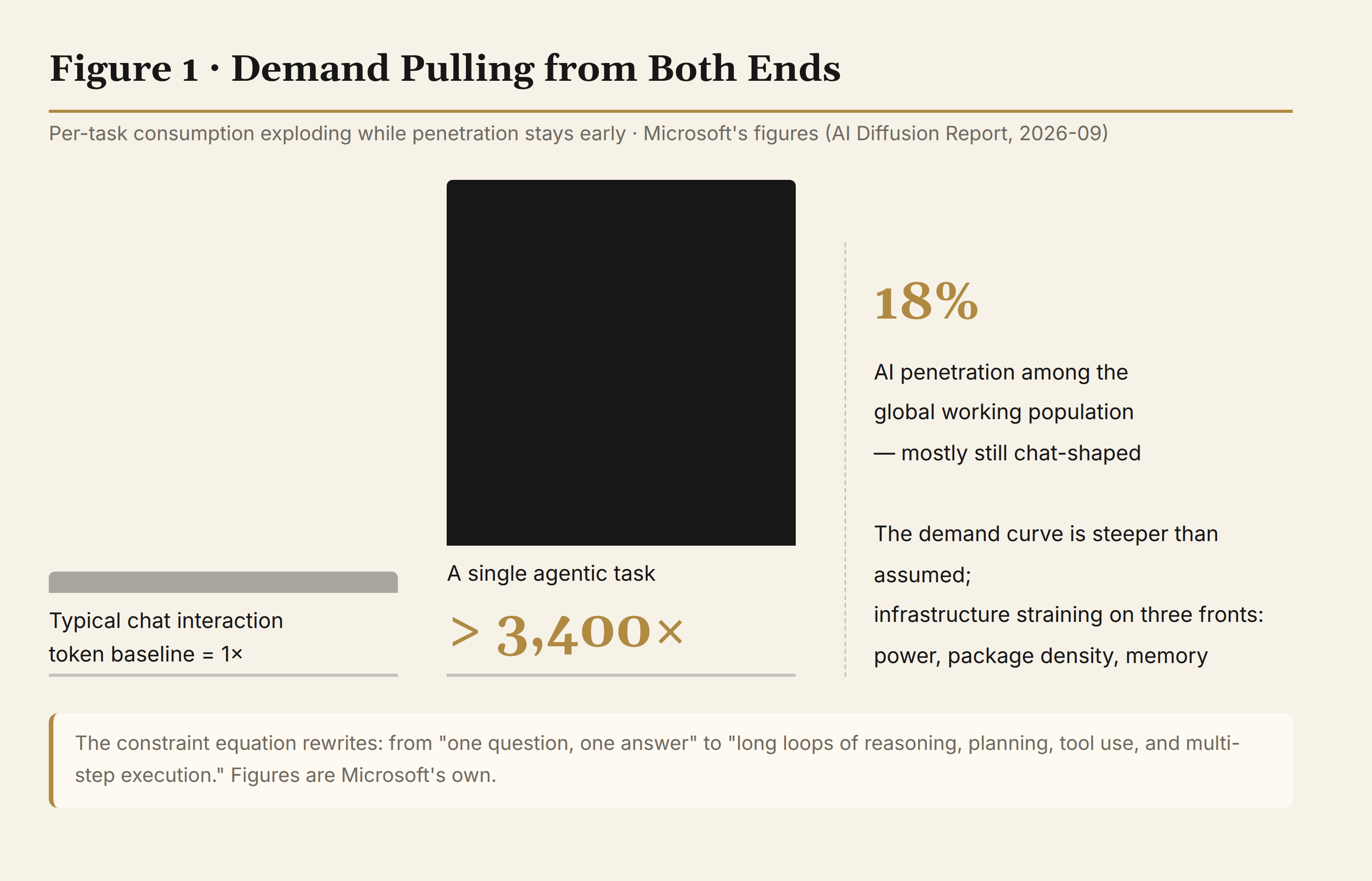
Microsoft's key number: a single agentic task consumes more than 3,400× the tokens of an ordinary chat interaction (Microsoft's figure, from its AI Diffusion Report). What the number captures is structural change: the workload shifts from single question-and-answer exchanges into long loops of reasoning, planning, tool calls, and multi-step execution, and the constraint equations of the underlying infrastructure are rewritten wholesale.
The other number is penetration: AI reaches only 18% of the global working population, and most of that usage is still chat-shaped. Adoption is still early, per-task consumption has already exploded past three orders of magnitude, and the infrastructure is already straining. The manifesto's own words: "We are only in the early innings of agentic adoption, and the infrastructure is already strained. Power is setting the limits on what we can build and when. Packages and racks are growing larger and denser. Memory is becoming an even tighter constraint."
1.2 The supply-side treadmill has stopped
Borkar's summary of the industry's answers of the past few years is unsparing, and worth quoting at length: "For years, the industry's rational answer to each new requirement resulted in more: more silicon in the package, more memory beside it, more power to feed it and more fiber to connect it. Each generation delivered meaningful progress. But when each new gain requires more input than the one before it, we are on a treadmill. It moves only as long as we keep adding to it." The treadmill metaphor is precise because it describes success — success that cannot continue.
Her way forward runs on two paths, in her words: "The first is evolutionary: we continue improving the architectures we have today, driving incremental efficiency, utilization and economics within each generation. The second is transformational: changing the curve itself with innovation in new architectures, new materials and new approaches to system and model design." The manifesto names the two precedent curve changes: CPU clock speeds hit the power wall and the industry turned to multicore; planar NAND ran out and storage went vertical. Her judgment is that the third one is now arriving.
1.3 Methodology: constraints are rarely solved at the layer where they appear
The manifesto's most valuable content is the pair of lessons she draws from Microsoft's own practice, and they deserve to be quoted verbatim: "First, the biggest constraints are rarely solved in the layer where they appear. Second, when we attack a constraint across the whole stack, tradeoffs that seemed inherent to the problem often turn out to be artifacts of the architecture." Not every constraint in today's systems is a law of physics; some are inherited from decisions made elsewhere in the system and can change only when we work across traditional boundaries.
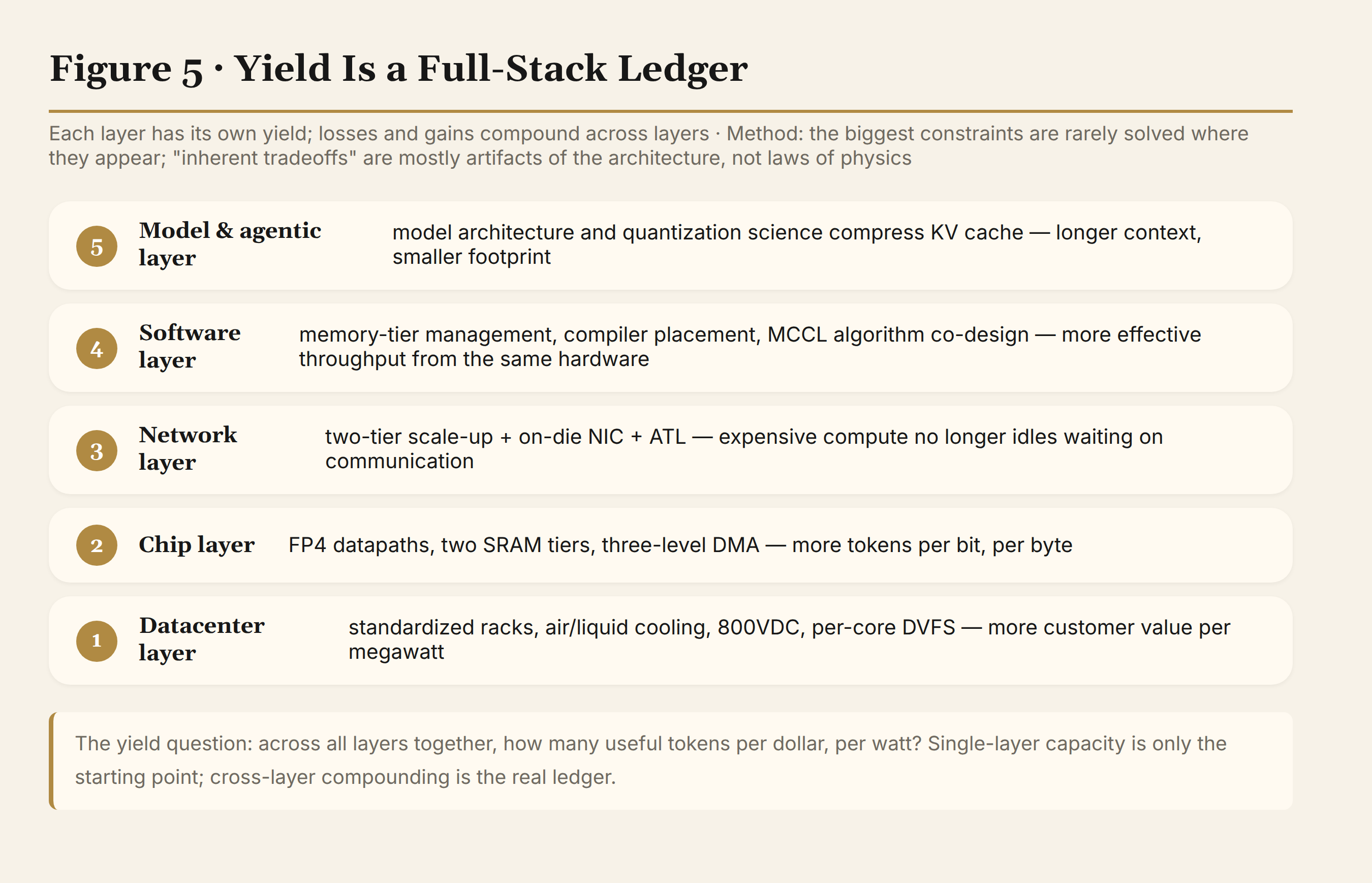
That is the spine of the manifesto and the design spec for Maia 200. Under conventional per-layer optimization, memory running short gets more memory, bandwidth running short gets more bandwidth; each layer optimizes within its own boundary, and the system as a whole leaks through the seams between layers. The yield perspective demands changing the question: from "how much capacity can each layer provide" to "how much useful intelligence do these layers produce together." The manifesto's fuller formulation: "From development through execution, each layer has a yield of its own, and losses and gains compound across them. Capacity at any one layer is only a starting point. The real measure is how effectively those layers work together to produce useful output from the system as a whole."
2. The manifesto's three cases: memory, networking, power
After the methodology, the manifesto does not stay at the level of principle; it offers three cases already happening inside Microsoft. The three map to the hard constraints of inference infrastructure, and they preview the design directions of Maia 200.
Memory is the first case. The manifesto's judgment is blunt: "Today, memory is viewed as a supply problem or a component problem. In reality, it is a system problem." Agentic workloads push the pressure to a new scale: "Generation, retrieval, tool use and persistent memory run together in loops that can last minutes or hours," stretching the memory horizon and keeping far more information close to the compute, available across an expanding sequence of turns. The proposed fix is a joint effort across five fronts: "Model architecture, data science and compression can reduce the amount of KV cache"; "software can manage memory hierarchies more effectively, silicon can be optimized for data movement efficiency and compilers can place data closer to compute. No one change removes the constraint. Together, they increase the useful intelligence the system can deliver from the same memory resources." The closing line of the case is the definition itself: "That is useful yield: not simply adding bytes but getting more useful intelligence from every byte we already have."
Networking is the second case, and the lens zooms from the chip to the cluster: "intelligence does not come from one chip. It comes from thousands of chips operating as one system." Faster links are only part of it; the manifesto names congestion management, failure recovery, workload placement, programming complexity, and the boundaries between silicon, system and software: "Together, they determine whether expensive compute is producing intelligence or sitting idle." The objective is stated just as plainly: "Our objective is not merely to move data faster. It is to keep more compute productive and deliver more tokens from every watt and every dollar."
Power is the third case. "Racks have gone from tens of kilowatts to hundreds of kilowatts, and datacenter campuses can operate on the scale of gigawatts. Power used to be something the system simply plugged into. Now, it is something we design around, from the grid to the chip." Two concrete levers: solid-state transformers and 800-volt direct current power delivery to cut distribution losses; and power and cooling "are no longer downstream of the design, they are part of the product definition from the start." The case lands on Cobalt 200, Microsoft's Arm-based server CPU: "every core has its own voltage and frequency controls, paired with software-based, per-virtual-machine power capping," allowing Microsoft "to run more servers within the same power envelope."
The common pattern across the three, in the manifesto's own summary: "start with the useful output, then optimize the whole rather than any one layer." The first two cases, in fully engineered silicon form, are Maia 200.
3. Maia 200: deriving the architecture backward from token output
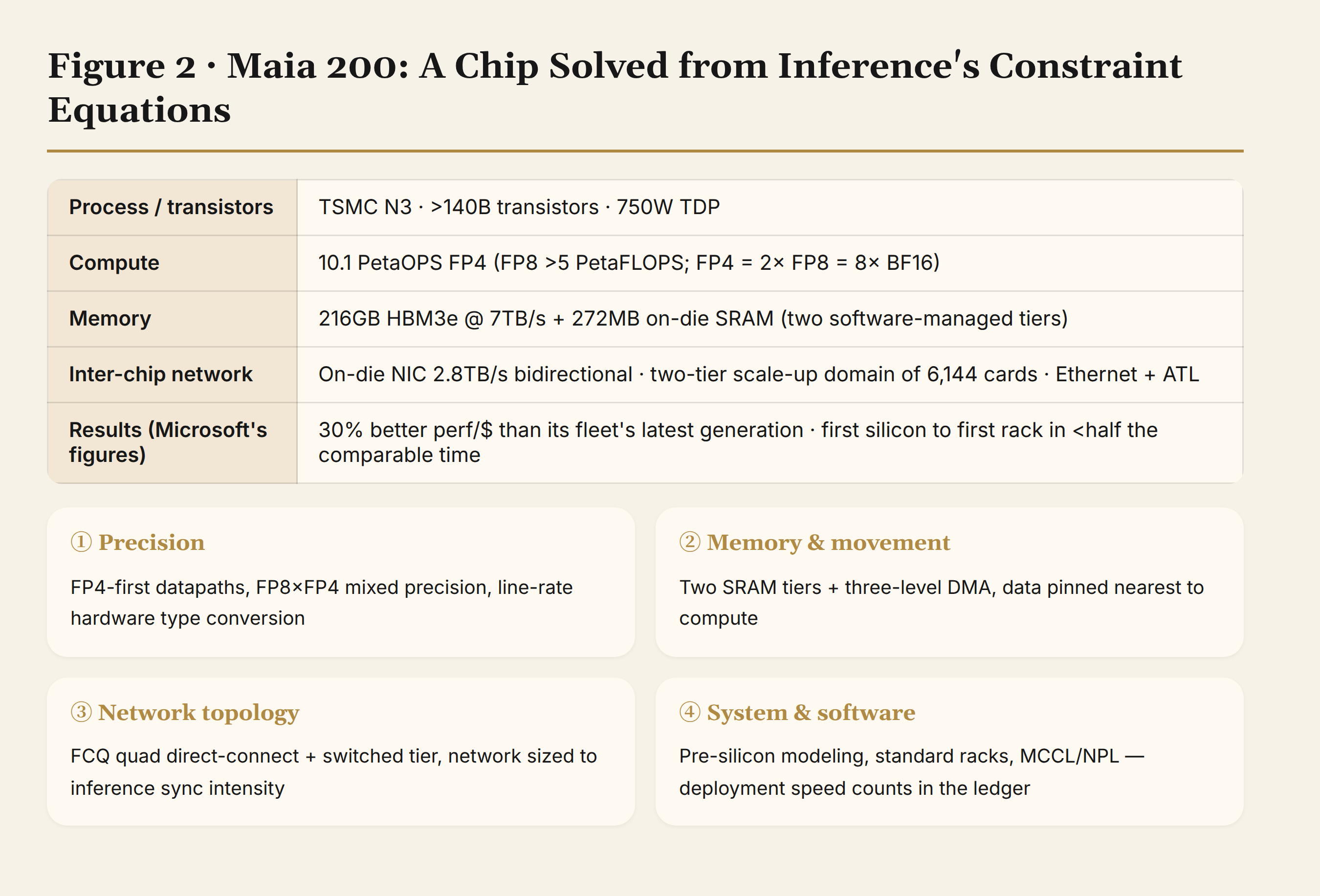
Maia 200 was announced on January 26, 2026 (Scott Guthrie's official announcement plus a deep-dive post on the Azure infrastructure blog), and it is Microsoft's first platform purpose-built for inference from silicon to system. The deep dive's positioning, verbatim: "a breakthrough inference architecture engineered to dramatically shift the economics of large-scale token generation," claiming "the most efficient performance per dollar of any inference system deployed in Azure" (vendor self-assessment, for positioning only). The specs establish the identity: TSMC N3 process, more than 140 billion transistors, 10.1 PetaOPS FP4 delivered within a 750W TDP (FP8 above 5 PetaFLOPS; FP4 throughput is 2× FP8 and 8× BF16), 216GB of HBM3e providing 7TB/s of bandwidth, plus 272MB of on-die SRAM; the Hot Chips 26 spec table has since filled in the physical parameters: a die of roughly 820mm², CoWoS-S packaging, 75×75mm. By Microsoft's own assessment, FP4 performance is 3× Amazon Trainium 3 and FP8 exceeds Google TPU v7.
Specs are not the point; the panorama is the entrance.
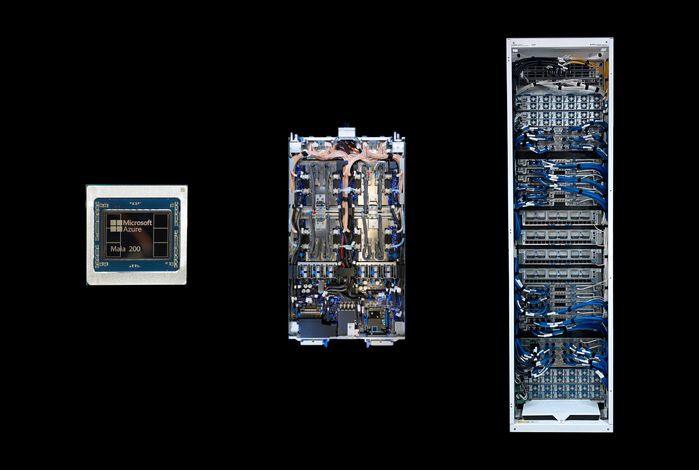
3.0 The full picture first: from one chip to the 6,144-accelerator inference domain
Before zooming into any component, lay out the cluster's physical hierarchy in one pass. Microsoft has disclosed four tiers.
Tier one is the chip. Each Maia 200 package integrates compute, 216GB of HBM3e, 272MB of two-tier SRAM, and an on-die NIC co-designed with the compute, exposing a 1.4TB/s unidirectional Ethernet path to the outside.
Tier two is the tray (the node). The deep dive's words are "groups of four accelerators connected via switchless, direct links"; that is the FCQ. Guthrie's announcement blog adds the physical form: four accelerators fully connected inside each tray, no switch in between. Tensor parallelism, the heaviest communication, stays locked inside the quad, skipping all switching latency.
Tier three is the rack. Standardized racks share the mechanical and power architecture with Azure's third-party GPU systems and deploy on both air- and liquid-cooled sides (second-generation liquid-cooling sidecar HXU); the same communication protocol runs intra-rack and inter-rack, so the protocol stack never changes and cross-rack is simply more Ethernet.
Tier four is the scale-up domain. 6,144 accelerators, that is 1,536 FCQ trays, are linked into one domain through the switched Ethernet tier; cross-domain traffic is mostly medium-intensity collectives handed to commodity multi-vendor switches. The NIC-side configuration later landed in the Hot Chips 26 spec table: 28 lanes of 400G per accelerator, 1.4TB/s unidirectional in total. Switch-side specifications remain undisclosed. Two independent third-party inferences exist: Glenn Lockwood, reasoning from 1,536 nodes, works out an 8-plane fat-tree of 128-port switches relying on packet spraying across multipaths; NAND Research, reasoning from SerDes lane allocation, independently arrives at a multi-plane structure of eight separate inter-rack rails, with its 28 transmit lanes exactly closing against the official 28×400G configuration. The switch-side numbers are external inferences, not Microsoft's figures.
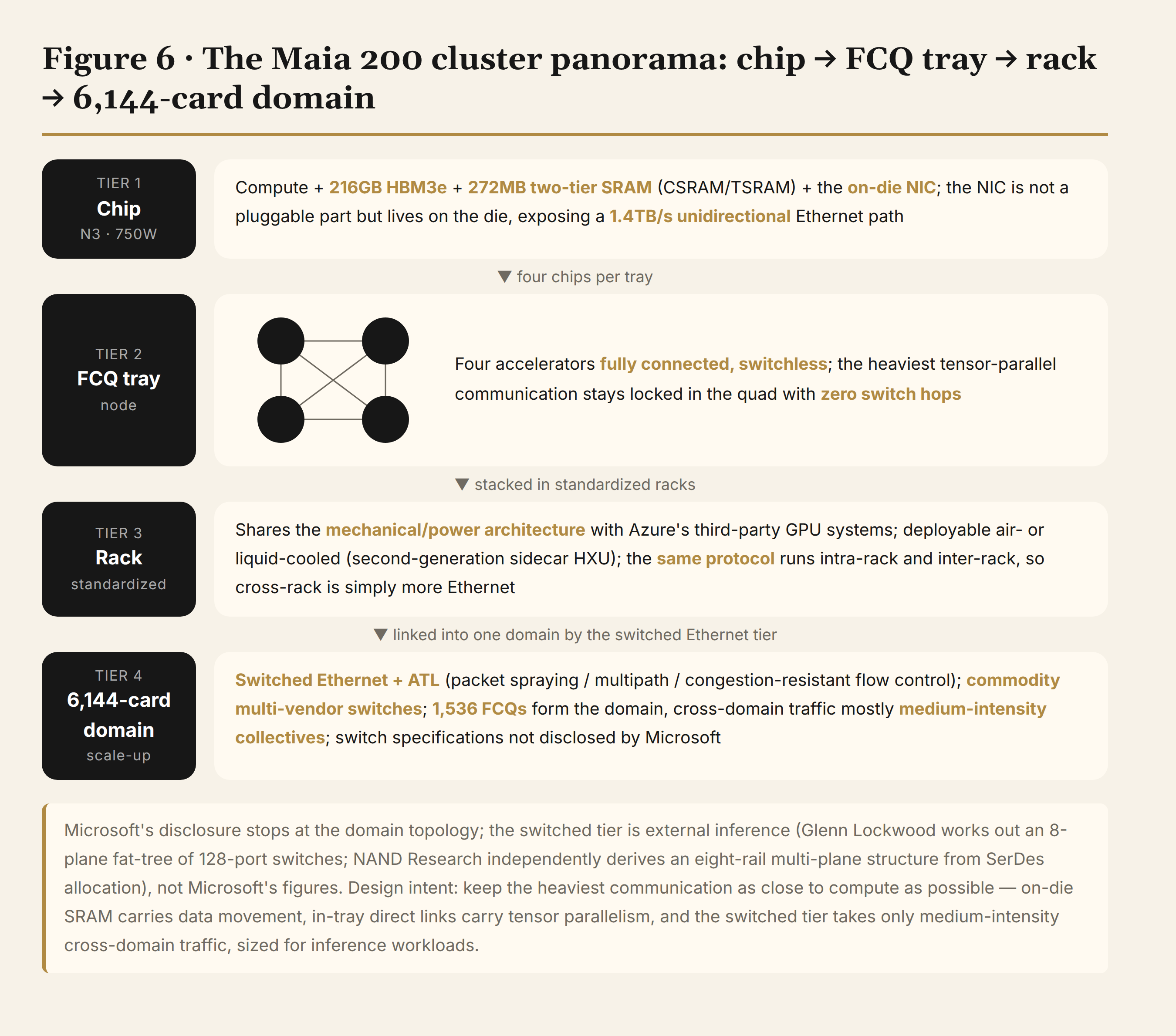
Each section that follows zooms into one block of this picture: 3.1 the datapath inside the chip, 3.2 the on-chip SRAM/DMA/NoC, 3.3 the on-die NIC and the two-tier network of tray and domain, 3.4 the rack and the software stack.
3.1 Precision: an FP4-first datapath
The first lever in inference economics is precision. The industry has repeatedly validated that FP4 suffices to hold inference accuracy, and Maia 200's tensor units (TTUs) were optimized bottom-up for FP8/FP6/FP4, supporting "mixed-precision modes such as FP8 activations multiplied by FP4 weights," with companion hardware converting low precision to compute precision at line speed in the datapath. The vector units (TVPs) retain BF16/FP16/FP32 capability, leaving an exit for operators that genuinely need high precision.
This is a textbook case of a constraint solved across layers: precision was never only the chip layer's own problem; model architecture, quantization science, and datapath design jointly determine how many bits each token actually costs. The fewer the bits, the more tokens the same memory and bandwidth can serve.
3.2 Memory and data movement: two tiers of SRAM and three tiers of DMA
Inference performance is increasingly bound by data movement; peak compute is the secondary constraint. Maia 200's answer is a system with a formal name: SDLA (Software Defined Local Access dataflow). The Hot Chips 26 presentation named it for the first time and stated the motivation plainly: for inference, data-access patterns are largely known at compile time, so the hardware cache's job of guessing the next access is wasted work. Per Microsoft's paper, tag arrays and remapping logic cost 30-35% of area and energy plus 10-15% extra access latency; SDLA deletes that budget entirely and replaces it with software orchestration. The dataflow is fixed at compile time and known in advance, data access stays entirely local to the compute elements, and control, I/O, and compute run independently, synchronized explicitly through semaphores. The system has three tiers:
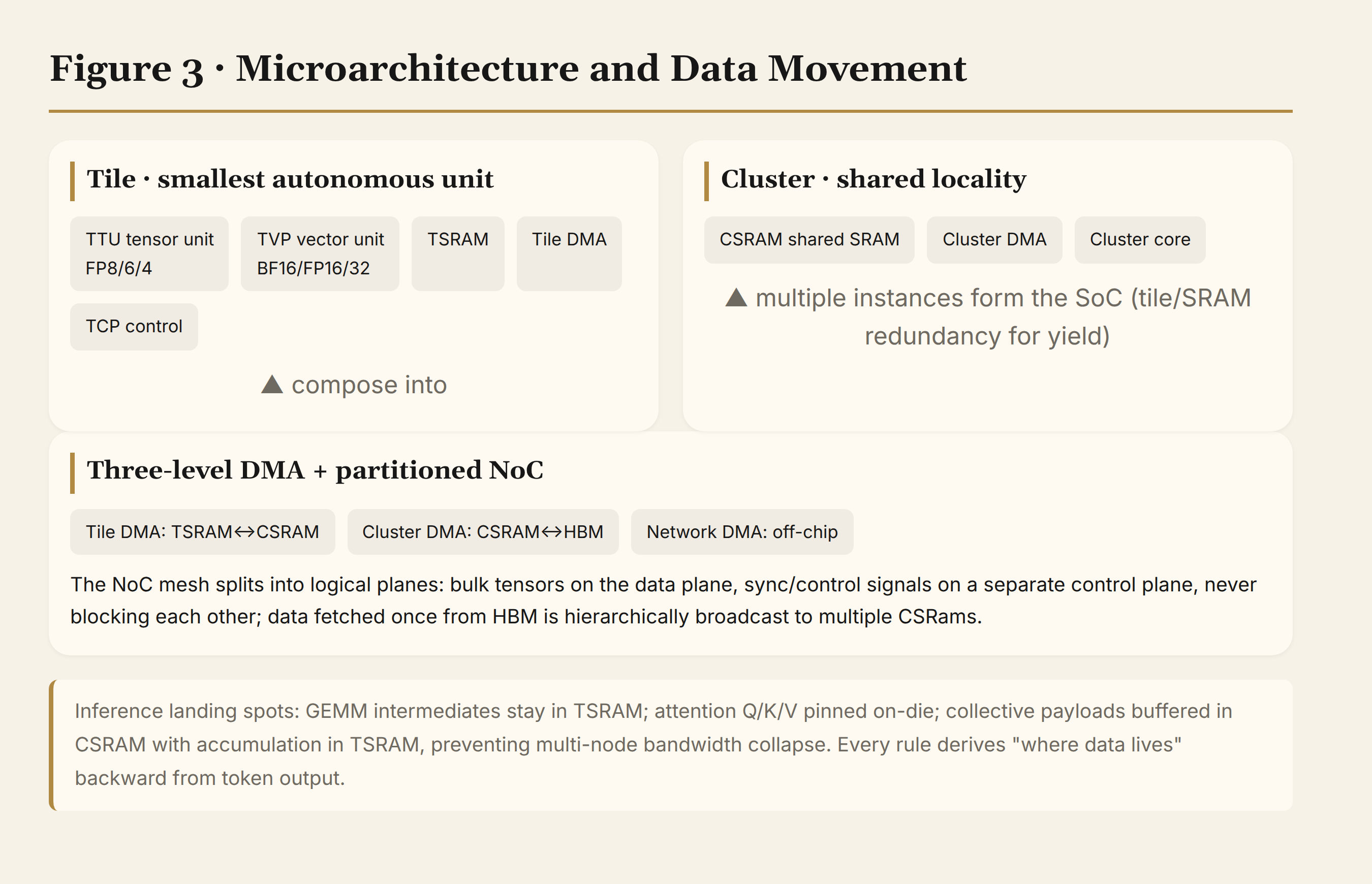
- Microarchitecture tier: tiles (tensor unit + vector unit + tile SRAM + tile-level DMA + control processor) form clusters (shared cluster SRAM + cluster-level DMA), and the SoC is built from multiple clusters. The deep dive's words: "Both CSRAM and TSRAM are fully software-managed, allowing developers—or the compiler/runtime—to deterministically place and pin data for precise control of locality and movement." The Hot Chips 26 spec table adds a previously undisclosed number for that 272MB of SRAM: 80TB/s of on-die bandwidth, more than eleven times HBM, making the speed advantage of on-die movement structural.
- Data-movement tier: three levels of DMA engine (tile-level moves data TSRAM↔CSRAM, cluster-level CSRAM↔HBM, network-level handles off-chip transfers) support 1D/2D/3D strided transfers, with movement overlapped against compute.
- On-chip-network tier: the NoC mesh is partitioned into logical planes; bulk tensor traffic rides the data plane, synchronization and control signals ride a separate control plane, so latency-sensitive traffic is never blocked by bulk transfers.
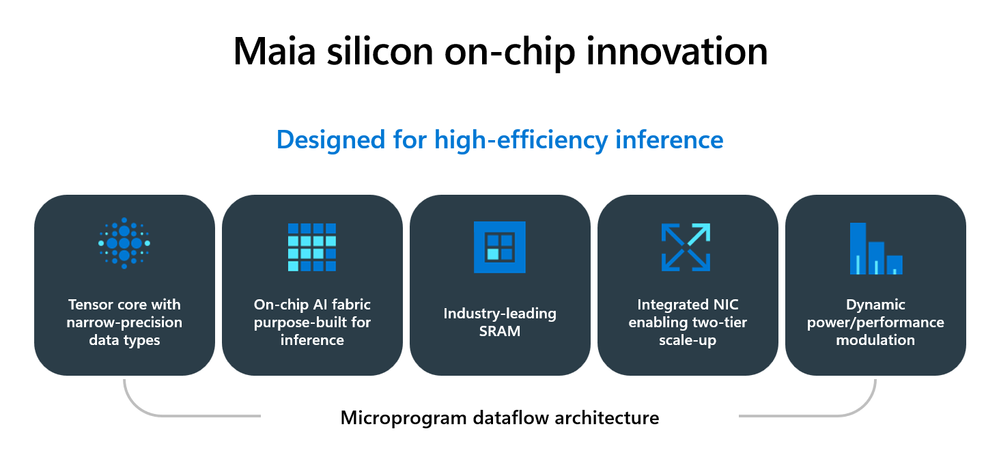
Concretely for inference workloads: intermediate GEMM blocks stay resident in TSRAM to eliminate HBM round trips; attention Q/K/V and partial products are pinned on-die as much as possible; the payloads of collectives (collective communication operations) are buffered in CSRAM while accumulation proceeds in TSRAM, avoiding bandwidth collapse during multi-node operations; a single HBM read is broadcast down the hierarchy to multiple CSRAMs, eliminating redundant reads. Every one of these answers the same question: where should the data live for token output to be maximal.
3.3 Network: FCQ + ATL, a head-on rebuttal of the all-switched fabric
The network is the layer where Maia 200 takes its clearest stance, corresponding to tiers one (the on-die NIC), two (the FCQ direct links), and four (the switched Ethernet domain) in the panorama. The manifesto's account of the design origin, verbatim: "When architecting the platform for Maia, we did not begin with an existing networking design. We began with the outcome we wanted to deliver: efficient inference at fleet scale, designing across silicon, networking and system software. Instead of separate scale-up and scale-out fabrics, we built a two-tier scale-up network, integrated the NIC functionality directly into the chip and developed a custom transport layer." The three decisions all follow from that origin.
The first decision is the on-die NIC. 1.4TB/s unidirectional and 2.8TB/s bidirectional bandwidth are built directly into the chip, tightly coupled with the transport-protocol engines and network DMA, removing the cost and power of external NICs.
The second decision is a two-tier scale-up topology replacing the separate scale-up/scale-out dual network. Tier one is the FCQ (Fully Connected Quad): every four accelerators are directly connected with no switch in between, locking tensor-parallelism and other high-intensity communication inside the four-card domain. Tier two is a switched Ethernet layer that extends the domain to 6,144 accelerators. Cross-domain traffic is handed to the switches, and it is mainly medium-intensity collectives.
The third decision is the ATL transport layer. Microsoft's in-house AI Transport Layer runs end to end over standard Ethernet; packet spraying, multipath routing, and congestion-resistant flow control are built into the transport itself, while preserving the commercial multi-vendor switch ecosystem and refusing to bet on any proprietary fabric. Hot Chips 26 material fills in ATL's hard numbers: under 8pJ per bit, under 1µs one-way P2P latency, end-to-end encryption, and an out-of-order receiver. The I/O slide also carries a sentence with real weight: ATL "had key influence" on the Ultra Ethernet Transport (UET) specification and the multipath reliable-connection specification. Microsoft's transport-layer engineering findings are feeding back into industry standards, raising the credibility of the open "Ethernet substrate plus endpoint intelligence" route another notch.
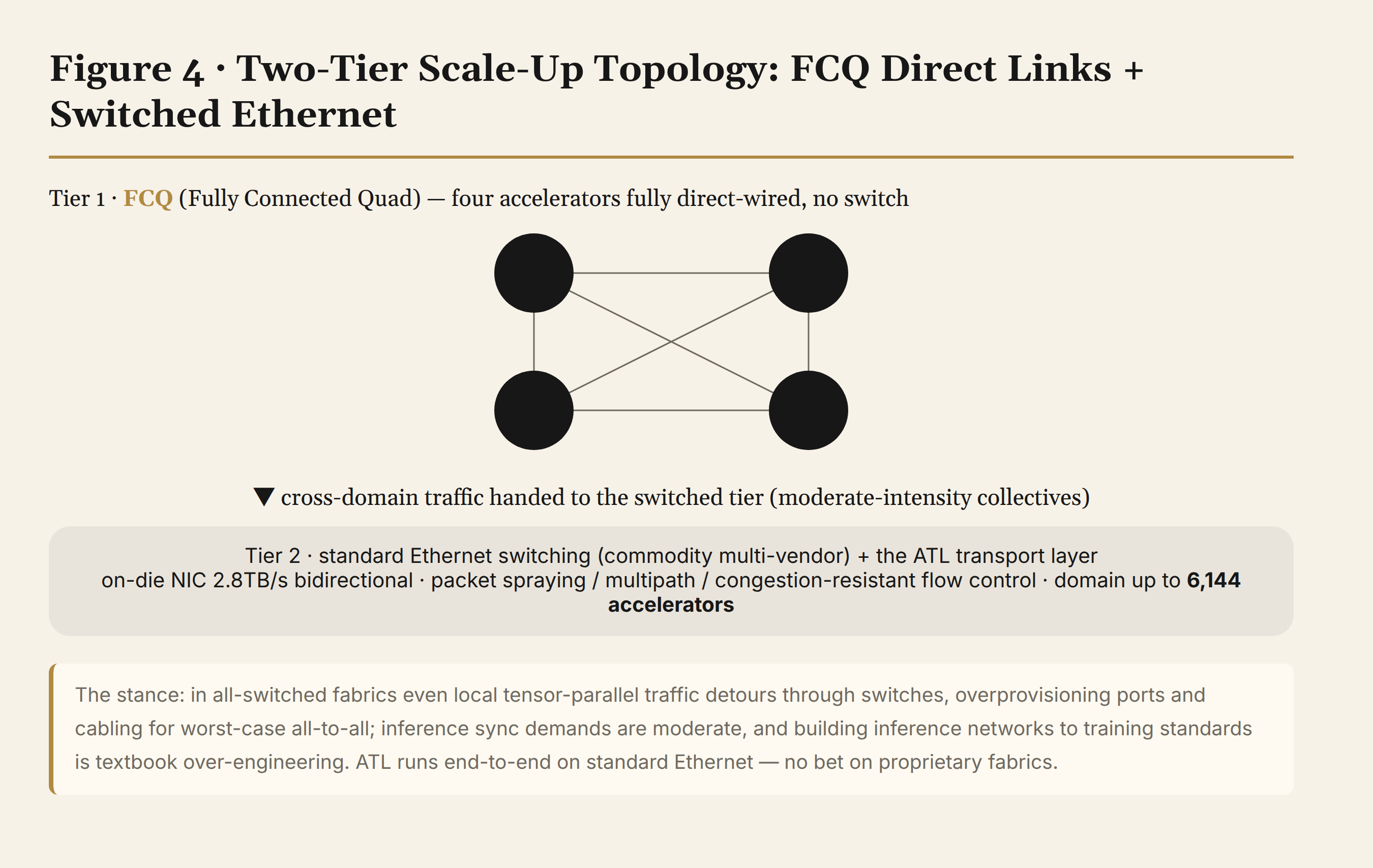
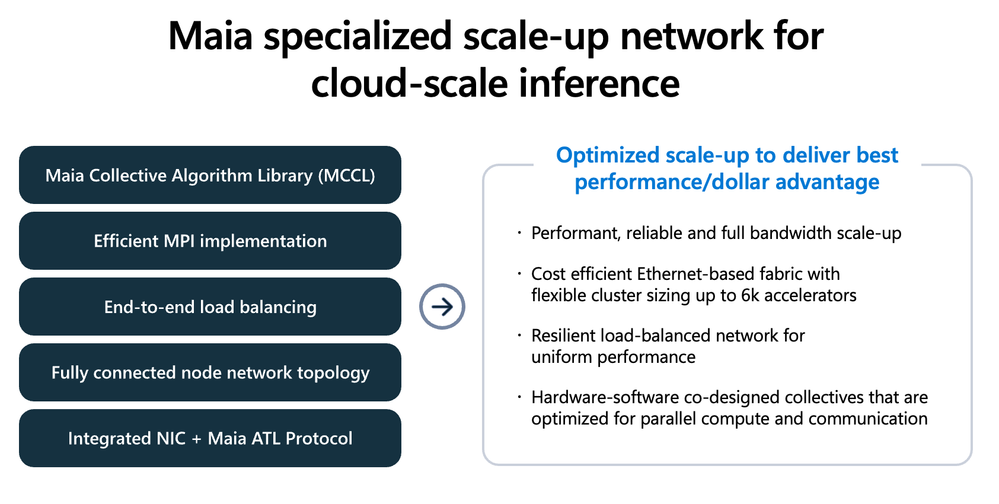
Microsoft's argument for this design is a head-on rebuttal: in an all-switched scale-up architecture, even local tensor-parallel traffic must detour through external switches, forcing most collectives onto shared paths, adding hop latency and power, and requiring ports and cables to be overprovisioned for worst-case all-to-all patterns. Inference workloads have "medium-intensity" synchronization needs, far short of training's extreme all-to-all pressure. Building the inference network to training-network standards is textbook overengineering. The previous layer's tradeoff (an inference network must cost as much as a training network) is thereby exposed at this layer as an artifact of the architecture. The companion MCCL (Microsoft Collective Communication Library) selects collective algorithms dynamically by tensor size and communication pattern, overlaps compute with I/O, and uses hierarchical collectives to suppress incast (many-to-one convergence). The logical topology is adaptive as well: small collectives can complete in a single hop with zero overhead, and bulk transfers switch to a ring topology automatically. Hardware-software co-design comes together at this layer.
3.4 System and software: deployment speed is yield too
The last layer is easy to overlook, and it is yield logic all the same: the objective extends beyond tokens to deployment speed and utilization. The deep dive positions the chip as "not just a highly efficient inference accelerator, but a cloud-native compute building block": models and workloads are "scheduled, partitioned, and monitored using the same tooling that supports Azure's GPU fleets," so operators can optimize for perf/$, latency, or capacity without rewriting orchestration logic.
- Pre-silicon environment: before tape-out, the compute and communication patterns of LLMs are modeled at high fidelity, with silicon, network, and system software optimized as one whole. Result: models were running within days of the first packaged chips arriving, and first silicon reached first rack in less than half the time of comparable projects.
- Standardized racks: Maia 200 shares its rack/power/mechanical architecture with Azure's third-party GPU systems ("co-designed with Azure's third-party GPU systems"), is deployable on both the air-cooled and liquid-cooled sides (second-generation liquid-cooling sidecar), integrates natively with the Azure control plane, and runs firmware updates and fault detection through "impactless, fleet-wide management workflows."
- A three-tier software stack: port directly from PyTorch → generate kernels quickly with the Triton compiler → use the low-level NPL language for explicit control over data movement and SRAM placement, approaching peak utilization. A full-fidelity simulator, profilers, and quantization-validation suites let model teams optimize before tape-out.
4. The scoreboard and three judgments
4.1 The scoreboard Microsoft has produced
All of the following are Microsoft's own figures, with no independent third-party data yet:
- 30% perf/$ over the latest-generation hardware in its own fleet
- A two-tier scale-up domain of 6,144 accelerators, 2.8TB/s bidirectional bandwidth per accelerator
- Hot Chips 26 measurements: 6,143 GEMM shapes run close to the roofline; attention reaches an effective peak of 1.65 PFLOPS; BF16 AllReduce approaches 1.3TB/s; All2All peaks at 655GB/s
- 40% higher token generation under the same rack power budget (MAI-Thinking-1 versus other leading accelerators in the Azure fleet, per the August deep-dive post)
- First silicon to first rack in under half the time of comparable projects
- Deployed in US Central (Des Moines), with US West 3 (Phoenix) second; serving GPT-5.2, Foundry, and M365 Copilot; the Superintelligence team uses it for synthetic data and RL
4.2 Judgment 1: inference-specialized architecture becomes the dividing line for cloud vendors
Purpose-built inference silicon is nothing new; AWS Inferentia proved the category before this AI wave. Maia 200's difference is depth. The training/inference split is a line we have tracked in our earlier cloud-vendor custom-silicon coverage, and Maia 200 pushes it into full-stack form: the precision system, memory hierarchy, network topology, and software stack are all re-solved under the constraint equations of inference workloads, while the "training chips that also run inference" path cannot deliver equivalent gains at any layer. The yield-imperative manifesto follows, elevating this methodology into an industry proposition. The dividing line is quantifiable: by Microsoft's figures, full-stack redesign buys 30% perf/$ (1.3×, versus the latest-generation hardware in its own fleet); whichever vendor's next-generation inference silicon remains a modified training architecture will fall systematically behind on this metric.
4.3 Judgment 2: Ethernet scale-up's substitution of proprietary fabrics enters the substantive phase
ATL's choice of route is explicit: run on standard Ethernet, embrace the commercial switch ecosystem, and push intelligence down to the endpoints (on-die NIC plus transport layer). This is the same tide as Meta's loss-tolerant RoCE design and the Ultra Ethernet Consortium (UEC) push: three facets of one current, in which scale-up domains drift from the proprietary fabrics (NVLink, ICI, and the like) toward the open route of "Ethernet transport plus endpoint intelligence." The FCQ-plus-switched-tier topology gives this route its most complete inference-scale reference frame today (a 6,144-accelerator domain). The outcome is undecided, but Microsoft has pinned "building inference networks to training-network standards" squarely into the overengineering column.
4.4 Judgment 3: the yield narrative still lacks third-party data; three nodes can test it
First, the sourcing: the 30% perf/$, the 3,400×, and the 3× Trainium 3 are all Microsoft's figures, with no independent third-party data yet. The "yield imperative" is at this point a narrative, not yet a validated measurement system. But narratives that precede complete validation are not rare in the industry's history. Three nodes can test it going forward: (1) public price-performance data for GPT-5.2-class models running on Maia 200 (MLPerf Inference or equivalent); (2) fleet-level utilization disclosures after the US West 3 deployment; (3) whether other cloud vendors follow the "yield" disclosure convention: adoption is acknowledgment, silence is disagreement.
4.5 Postscript: Maia 300 is already on its way
The Information reported on August 10 (carried by Reuters and other outlets; the sourcing is anonymous) that Microsoft plans to unveil the next-generation Maia 300 this fall, as early as September, and is negotiating with TSMC for capacity of more than 300,000 units delivered in 2027, with an eventual goal beyond one million. Nadella reiterated Maia 200's 30% perf/$ on the Q4 FY26 earnings call and said it is scaling to support OpenAI and MAI models. On the supply side, J.P. Morgan analysts expect tightness in N3 and CoWoS packaging capacity to persist through 2027, directly constraining Maia 300's ramp; the 300's process node and packaging have not been publicly confirmed. The same reporting also carries the caution: Maia 200 was delayed after early tests fell short of internal goals, and is currently deployed in only a small number of datacenters. This puts a timetable on Judgment 3's observation points: if Maia 300 appears in September, whether its framing continues the yield narrative or swaps the objective function will show within two quarters.
Summary and judgment
Microsoft's two 2026 artifacts mirror each other: January's Maia 200 is the evidence, September's yield imperative is the methodology distilled. The core change is the replacement of the design objective function, from peak performance to useful tokens per dollar and per watt, running through five layers: precision, memory, network, system, and software.
The manifesto's endpoint also lies beyond tokens: "tokens and intelligence are not the finish line. What we produce becomes the input for someone else's work." In Borkar's narrative, efficiency ultimately connects to accessibility: "at scale, accessibility depends on efficiency," and "when every person and every company can access intelligence, build on it and create value of their own, that is full yield." Her closing paragraph deserves to be quoted in full: "We will continue to build capacity because the world will need it. But our defining measure of progress must be what comes out: not only chips or tokens, but useful intelligence translated into empowerment, opportunity and human achievement. That is the yield imperative. And it is work our entire industry must take on together."
Taken together, this chip and this manifesto turn "re-solving the full stack under the constraint equations of inference workloads" into a testable engineering proposition. How far it holds depends on the data the three verifiable nodes deliver over the next two quarters.
What to watch next: third-party MLPerf (or equivalent) results for Maia 200, the deployment progress of US West 3, and whether large customers such as OpenAI and Anthropic publicly endorse the yield framing.
Disclaimer: This article is based on Rani Borkar's "The Yield Imperative" on the Microsoft Azure official blog (September 1, 2026), Microsoft's Maia 200 announcement and architecture materials on the Azure infrastructure blog (January 26 and August 26, 2026), and Microsoft's Hot Chips 26 presentation materials. All performance and economics figures are Microsoft's own and have not been independently verified. Nothing in this article constitutes investment advice. Data as of September 9, 2026.