
The Infrastructure Generation Gap: AI Data Centers at ODCC 2026
In eight years, power density has increased 15-25x. Six technology directions—power, cooling, UEC, scale-up, in-network computing, token economics, NPO—coupled and evolving simultaneously. China is becoming a standards setter in power and cooling, but gaps remain in core networking standards.
Source note: ODCC Summer Conference is an internal event (ODCC explicitly states "non-members are denied entry"). This article is based on publicly available sources: (1) Huawei official release (June 27) — plenary + New Technology & Testing WG + Networking WG; (2) ZT official release (June 29) — Data Center Facilities WG; (3) xFusion official release (June 25) — Cooling Focus Group; (4) Grundfos official release (July 1) — Facilities WG; (5) UALink chair Kurtis live transcript (July 2); (6) XSKY release (June 29) — Storage Focus Group KV Cache evaluation.
June 24-26, 2026. Jingdezhen, China. The Open Data Center Committee (ODCC) held its summer conference here. Six working groups, hundreds of industry experts, three days of intensive discussion. The core theme was singular: AI is rewriting the fundamental rules of data center infrastructure.
I. A Simple Arithmetic Problem
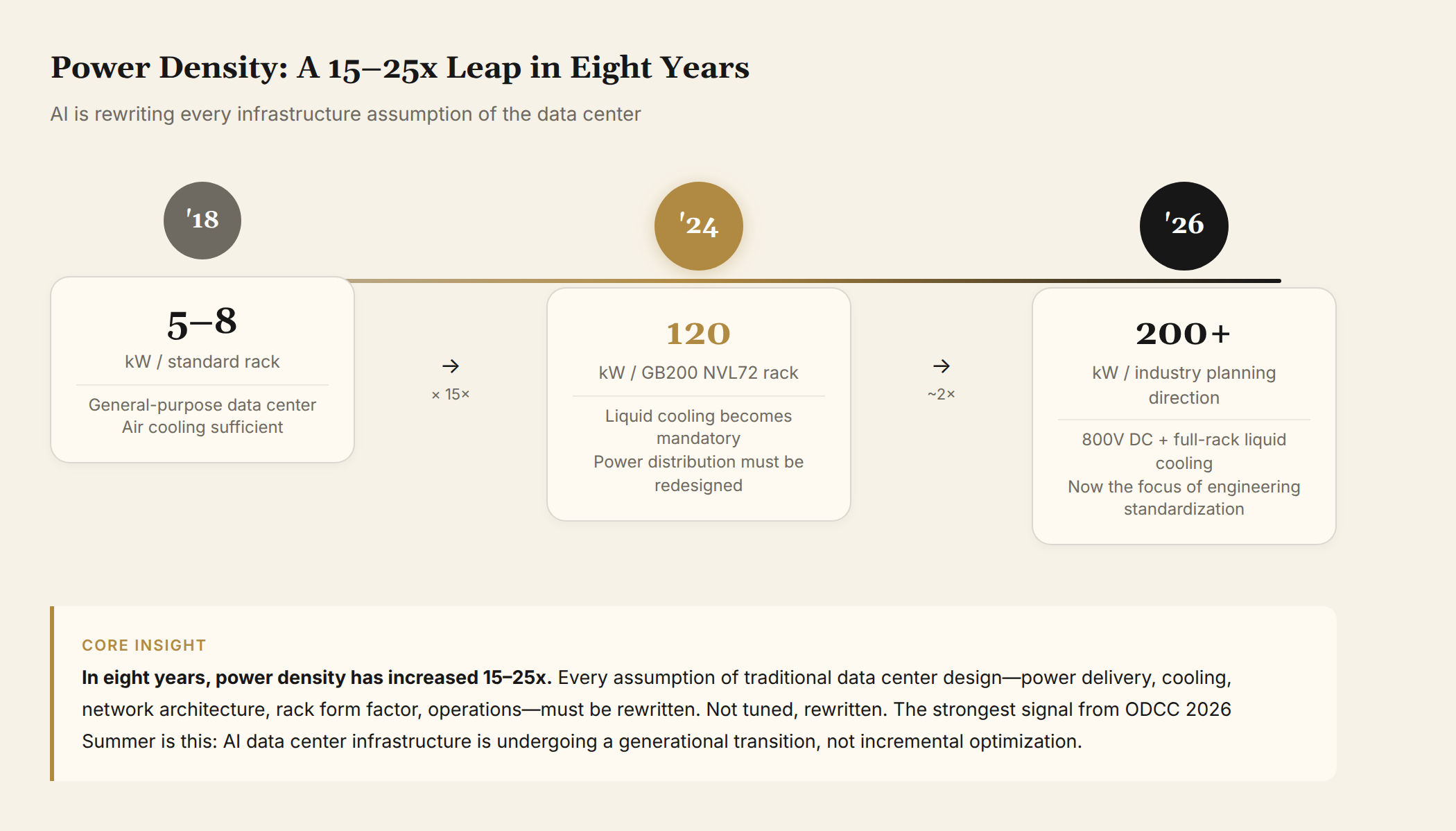
In 2018, a standard data center rack delivered 5-8 kW of power density. By 2024, the NVIDIA GB200 NVL72 rack reached 120 kW. In 2026, the industry is already discussing 200 kW per rack and beyond.
In eight years, power density has increased 15-25x.
What does this mean? Every assumption of traditional data center design—power delivery, cooling, network architecture, rack form factor, operations—must be rewritten. Not tuned. Rewritten.
The strongest signal from ODCC 2026 Summer is this: AI data center infrastructure is undergoing a generational transition, not incremental optimization. This transition spans six technology directions that are coupled, mutually constraining, and evolving simultaneously.
II. Six Directions, One Problem
Physical Infrastructure: From AC to DC, From Air to Liquid
The first direction is power and cooling—the "water and electricity" of the data center.
On the power side, traditional 400V AC distribution has reached its ceiling. When single-rack power exceeds 100 kW, AC cable cross-sections, circuit breaker interrupting capacity, and harmonic interference become engineering nightmares. The ODCC Facilities Working Group has explicitly designated 800V DC as the future mainstream direction—not a technical preference, but a constraint imposed by physics.
ZT demonstrated a three-tier DC circuit breaker matrix at the conference: from traditional DCCBs, to hybrid solid-state SSHCBs (100μs-10ms response), to full solid-state SSCBs (1μs-50μs response). DC arc extinction—a problem that has troubled the industry for years—finally has engineering solutions from component to system level.
On the cooling side, when single-chip power dissipation exceeds 1000W, air cooling's heat transfer efficiency is no longer sufficient. xFusion, as lead of the Liquid Cooling Industry Promotion Group, proposed the concept of "full-rack liquid cooling standardization"—elevating cooling standardization from component-level (cold plates, piping, coolant) to rack-level and facility-level. This is a leap in the standard system itself.
The OCP and ODCC ±400V HVDC sidecar standard has been finalized. Meta, Microsoft, Google, ByteDance, and Tencent have all incorporated HVDC busbars into their next-generation liquid-cooled rack specifications. Power and cooling are being upgraded simultaneously.
Network Architecture: From "Fast Enough" to "Fit for Purpose"
The remaining five directions all relate to networking, but their core tension is not "insufficient bandwidth"—it's that the evaluation criteria for networks have fundamentally changed.
Second direction: UEC (Ultra Ethernet Consortium) standard adoption. Huawei's CloudEngine XH9000 passed the ODCC's computing benchmarking evaluation at this conference, receiving the first domestically issued test certificate aligned with UEC standards from CTTL. However, this is not an official UEC compliance certification (the UEC certification process is still under construction)—it is ODCC's validation based on its own LLR & CBCF functional test specifications. InfiniBand's monopoly in AI high-performance networking is facing its first systematic challenge from an open Ethernet ecosystem. The speed at which Chinese vendors adapt will determine the cost and supply chain security of domestic AI computing networks.
Third direction: Scale-Up (supernode). AI model parameter sizes have exceeded single-GPU memory capacity, requiring multiple GPUs to pool memory into a single address space. At this conference, the UALink Consortium had its own dedicated track (UALink Track) with board chair Kurtis personally attending in Jingdezhen. He revealed that UALink released four new specifications in April 2026 (Common 2.0 / 200G DL/PL 2.0 / Chiplet 1.0 / Manageability 1.0), expanding from a single link specification to a complete deployment framework. More importantly, UALink and ODCC are collaborating to provide local interoperability testing services in China—marking the transition of open Scale-Up standards from "paper specification" to "engineering validation." Meanwhile, Huawei's Lingqu 2.0 has achieved large-scale commercial deployment (300+ sets on Atlas 900), Tencent's ETH-X is advancing all-optical interconnect, and six Scale-Up protocol routes are now in an accelerating industrialization race.
Fourth direction: In-network computing. Traditional network devices only move data; computation happens at endpoints (CPU/GPU). In-network computing lets switches participate in collective operations (e.g., the reduction step of AllReduce), reducing data movement. Huawei proposed a three-dimensional testing framework covering functionality, performance, and reliability—an area that previously lacked standardized testing. As multi-agent workloads explode, collective communication patterns become more complex, and the value of in-network computing will be reassessed.
Fifth direction: Token economics reshaping network design. This is a novel perspective: if the token becomes the fundamental unit of compute measurement (China's National Data Administration has formally defined tokens as "measurable, pricable, and tradeable"), then the evaluation criteria for network architecture must shift from "bandwidth/latency" to "token throughput efficiency / token transport cost." Huawei presented this perspective at the New Technology & Testing Working Group, analyzing data center network evolution through the lens of token economics. This is not a marketing concept—China's daily token invocation volume has exceeded 140 trillion, a 1000x increase in two years. When token traffic becomes the dominant type of data center traffic, networks must be redesigned around token efficiency.
Sixth direction: NPO (Near-Package Optics) engineering deployment. The AI cluster's Scale-Up domain is expanding from hundreds to thousands of cards, and copper interconnect's physical distance limitation (within 7 meters) becomes a hard constraint. NPO places the optical engine near the switch chip package, balancing performance, cost, and engineering risk, and is seen as the critical transition from copper to CPO (Co-Packaged Optics). Huawei detailed the engineering challenges of 1024-lane NPO switches at this conference—connector selection, physical dimensioning, and rack layout—demonstrating that NPO has entered real engineering validation.
III. Coupling: Why These Six Directions Must Be Analyzed Together
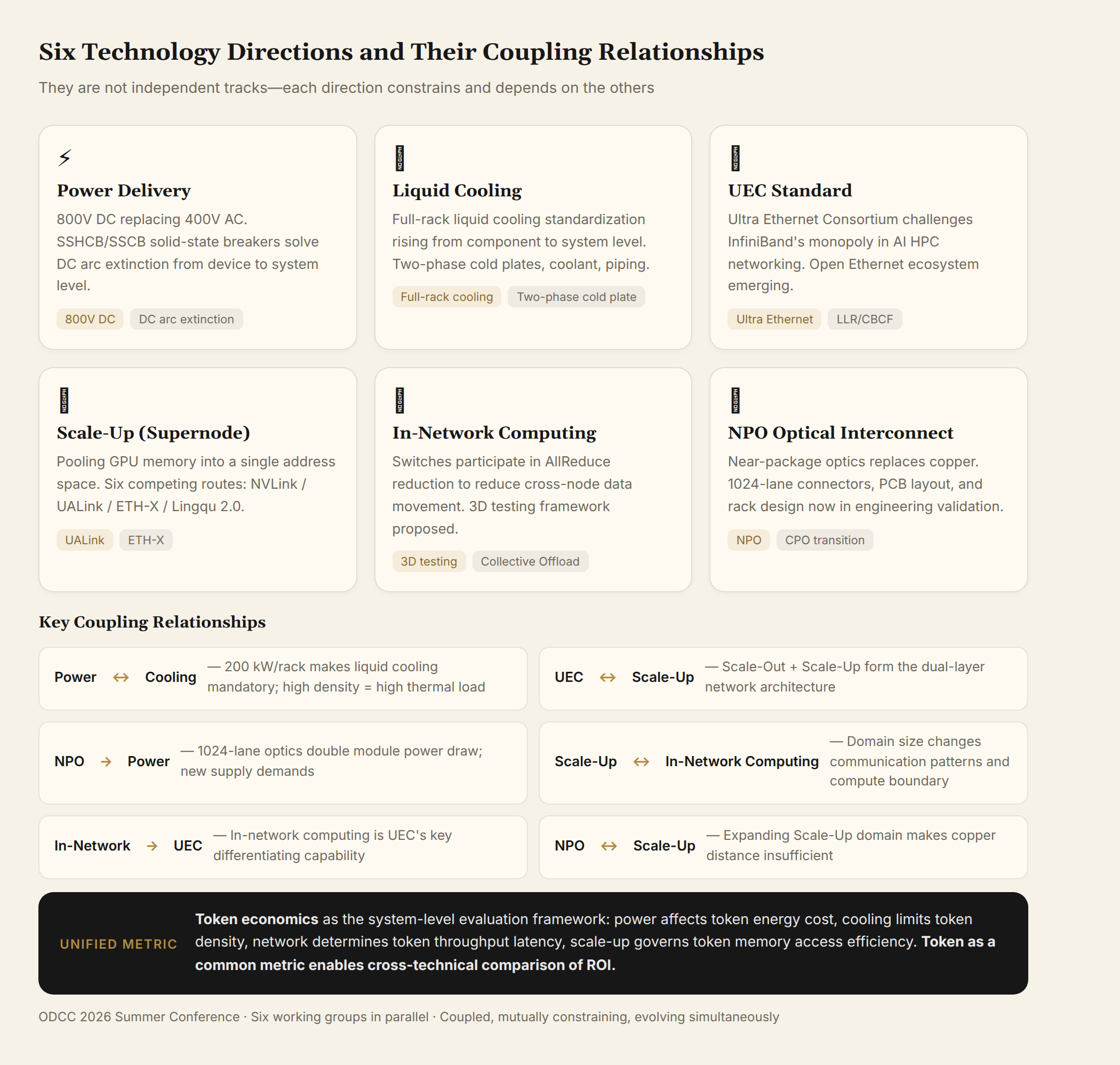
These six directions are not independent technology tracks. They exhibit strong coupling constraints:
Power ↔ Cooling: 800V DC directly drives liquid cooling demand—high-density power generates high-density heat, and air cooling's COP completely fails at 200 kW/rack. Conversely, the pumps and coolant circulation of liquid cooling systems themselves require more precise power management.
Network ↔ Power: NPO and CPO optical module power consumption far exceeds copper. A 1024-lane NPO switch may double its power requirements. All-optical interconnect solutions under scale-up architecture impose new demands on power density.
Scale-Up ↔ In-Network Computing: The expansion of the Scale-Up domain changes communication patterns—intra-domain communication runs on memory-semantic protocols (NVLink/ETH-X/UALink), while inter-domain communication runs on Ethernet. The value boundary of in-network computing shifts with the size of the Scale-Up domain.
Token Economics ↔ All Directions: Token efficiency is a system-level metric. Power affects token energy cost, cooling limits token density, network determines token throughput latency, and scale-up governs token memory access efficiency. Using the token as a common metric enables horizontal comparison of ROI across different technological approaches.
UEC ↔ Scale-Up: UEC defines the open standard for Scale-Out (cross-rack, cross-cluster) networking, while Scale-Up defines the technical route for intra-rack networking. Together they form the dual-layer network architecture of AI clusters, requiring coordinated standard design.
IV. China's Position
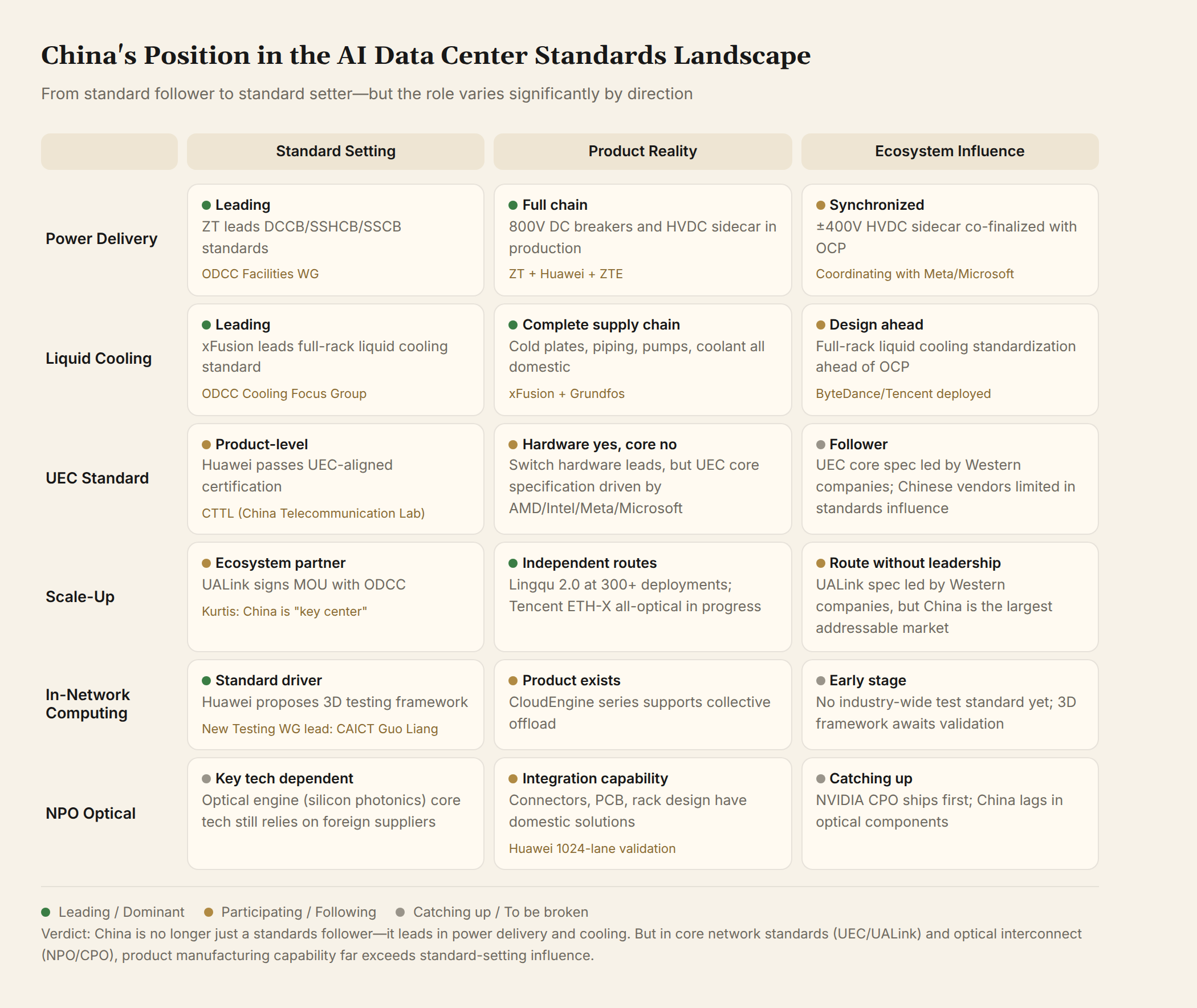
This conference revealed a structural shift: China is no longer just a standards follower—in several directions, it is becoming a standards setter.
ODCC's decision-making layer—Tencent, Alibaba, Baidu, China Mobile, China Telecom, CAICT, Meituan, JD.com—represents the world's largest AI compute consumer base. When these users jointly set standards, the supply chain must follow. Several concrete signals:
- ODCC and UALink signed an MOU, creating cross-organizational coordination for scale-up interconnect protocols
- Huawei received the first domestically issued UEC-aligned Ethernet switch certification
- ZT and xFusion are leading standard development in power delivery and liquid cooling respectively
- CAICT's Guo Liang (ODCC New Testing WG chair) has produced a systematic report covering the entire supernode chain
But the gaps remain visible. UEC core specifications are driven by AMD, Intel, Meta, and Microsoft—Chinese vendors have far more influence in product manufacturing than in standards setting. UALink is similarly led by Western companies—though UALink chair Kurtis explicitly positioned China as "one of the big centers of revenue" at this conference, and confirmed the local interoperability testing partnership with ODCC. This is a substantial ecosystem cooperation signal.
V. What This Series Will Address
The following six deep-dive articles each focus on one direction, independent but mutually reinforcing:
- AI Data Center Physical Infrastructure Transition: How 800V DC + full-rack liquid cooling is restructuring the entire power and cooling chain
- UEC Standard Adoption—Chinese Vendors' Ultra Ethernet Race: The critical path from specification to product
- Scale-Up Technology Tracking: Engineering progress across ETH-X / UALink / NVLink
- In-Network Computing Standardized Testing Framework: Technical principles, standardization gaps, and agent-era demands
- How Token Economics Reshapes Network Design: The paradigm shift from bandwidth/latency to token efficiency
- NPO from Concept to 1024-Lane Engineering: Techno-economic analysis of optical interconnect in the Scale-Up domain
Each article follows the same framework: technical principle → engineering constraints → industry progress → risks and boundaries.
VI. A Judgement
Placed in a longer technology cycle, the ODCC Summer Conference marks a turning point: the center of gravity for AI data center infrastructure innovation is shifting from the chip layer (GPU/accelerator) to the facility layer (power/cooling/network), and from point optimization to system-level standardization.
The past two years were about "whose GPU is fastest." The next two may be about "whose data center is more efficient." Chip performance gains are approaching physical limits, but data center system efficiency—end-to-end energy conversion from grid to chip—still has enormous room for improvement.
Whoever can first close the engineering loop of standardization in 800V DC power, full-rack liquid cooling, scale-up interconnects, and optical interconnects will hold the next-generation definition power for AI infrastructure.
This is not about "which technology is better." It is about "who can turn good technology into replicable standards first."
Disclaimer: This article is based on publicly available information from the ODCC 2026 Summer Conference (June 24-26, Jingdezhen), synthesized from ODCC official news, participant company announcements (Huawei, ZT, xFusion, Grundfos, etc.), and CAICT research reports. Not investment advice. Data as of July 2, 2026.