
Scale-Up Is the New Datacenter Network: SIGCOMM 2026 Re-runs 2015–2020
1. The Claim
For a decade, "datacenter networking" meant the scale-out network across servers — Clos topologies, BGP/ECMP, RDMA, congestion control: SIGCOMM's home turf. In 2026, a new network domain is taking shape in the same researchers' hands: the scale-up domain — GPU-to-GPU intra-rack fabrics, and below them, chiplet networks and wafer-scale networks.
The evidence is structural. SIGCOMM 2026 gives Scale-Up Fabrics its own session (RS8, four papers), and related work is scattered across RS1 (TurboBus), RS15 (Scale-up PIFO), RS17 (Harvest, Credit-Guided), RS9 (photonic fabrics — Opus belongs to the Piece 4 thread) — nine papers in all, with eight as this piece's subject, spanning measurement, topology, dataplanes, scheduling, and transport.
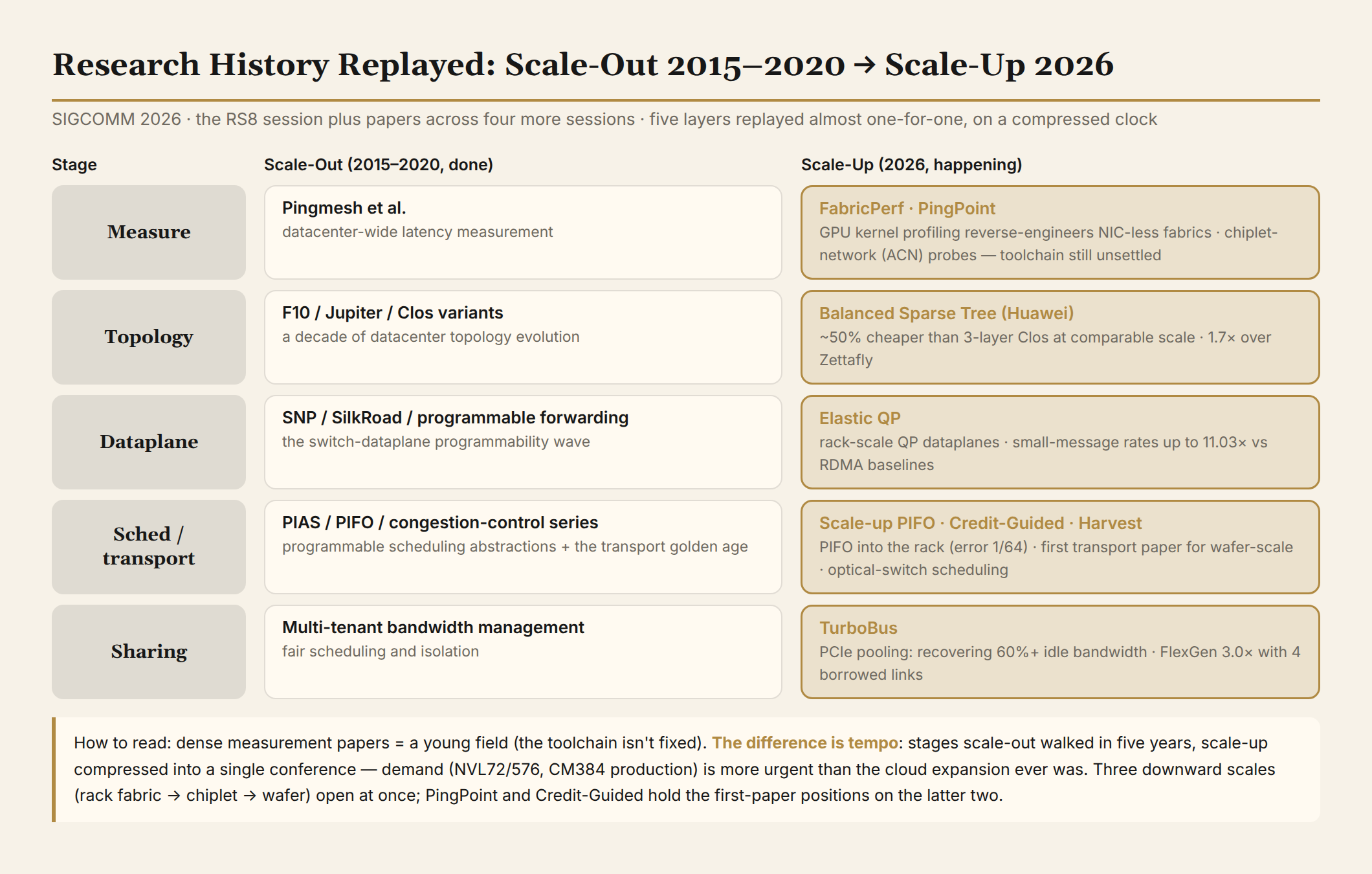
Align this session distribution with scale-out's research history and an almost layer-by-layer replay emerges:
| Stage | Scale-out (2015–2020) | Scale-up (SIGCOMM 2026) |
|---|---|---|
| Measurement | Pingmesh et al. | FabricPerf (NVLink fabrics), PingPoint (chiplet networks) |
| Topology | F10/Jupiter/Clos variants | Balanced Sparse Tree (Huawei), Opus (photonic) |
| Dataplane | SNP/SilkRoad programmable forwarding | Elastic QP (rack-scale fine-grained dataplanes) |
| Scheduling/transport | PIAS/PIFO/congestion-control series | Scale-up PIFO, Credit-Guided (wafer-scale), Harvest (optical scheduling) |
| Resource sharing | multi-tenant bandwidth management | TurboBus (PCIe pooling) |
Measurement first, toolchain unfixed — this is scale-out's "2016." The difference is tempo: this round is compressed, because demand (NVL72/576, CloudMatrix384 production volumes) is more urgent than the cloud expansion ever was.
Why does scale-up suddenly deserve a research agenda? Three forces. First, PD disaggregation and MoE training push intra-rack traffic to new orders of magnitude — the intra-rack interconnect is no longer a system bus but a real network, with topology choices, congestion, and scheduling problems. Second, superpod physical latency is non-uniform (UBEP's synchronization tax and topology-blind scheduling): the unified logical address space hides physical heterogeneity that must be managed explicitly. Third, PCIe/NVLink/UB resources sit under-shared across jobs (TurboBus shows 60%+ of PCIe bandwidth idle) — resource pooling is being reinvented inside the rack.
2. What the Papers Actually Do
2.1 FabricPerf: how do you measure a network with no NICs?
The NVLink fabric poses a paradox for measurement: it is a real multi-hop network with topology, congestion, and subtle path behavior — and it contains not a single NIC. The entire methodology of network measurement — insert probes, capture packets, read NIC counters — fails here. You want to know why an AllGather is slow, and you do not even have ping.
FabricPerf's (HKU) methodological move is the paper's real contribution: turn network telemetry into a GPU kernel-profiling problem. The execution footprints of communication kernels (SEND/RECV) on the GPU — launch latencies, throughput wobble, inter-channel imbalance — themselves carry the fabric's behavior; extend GPU instrumentation tooling and network state can be inferred from the software side. The diagnostic object changes layers; the question does not.
The engineering output along this line is concrete: work-stealing rebalances channels by 46% (AllGather throughput +17.5GB/s); LLC read hit-rate tuning adds ~16GB/s of bandwidth. For operators, this is a tuning playbook usable today — no switch interfaces required.
The effectiveness boundary comes from the methodology itself: kernel footprints are indirect evidence; the fabric's internal queuing detail (which hop, which port) cannot be recovered. A stopgap with immediate value and limited resolution — the typical state of a "measurement first" phase.
2.2 PingPoint: one level down, the network between chiplets
PingPoint (UW-Madison) pushes the same question one level down: the Accelerator Chiplet Network (ACN) — the network linking compute chiplets, IO chiplets, and memory stacks. Chiplets are now the dominant accelerator form factor; ACN behavior increasingly governs application performance; and it is even harder to observe than an NVLink fabric — there is not even a host side, so kernel profiling cannot reach it either.
PingPoint makes the first move with probe injection plus low-overhead co-resident analysis (abstract-level; details in the paper). The value is positional: the first paper to pose "chiplet-network observability" as a problem; every later standardization discussion starts from it.
2.3 Balanced Sparse Tree: the economics of topology at ten-thousand-GPU scale
The scale-up domain's first topology-design paper comes from nine Huawei authors plus SJTU (the analogue of the Clos-variant era). The problem is direct: ByteDance has built 12,288-GPU clusters to train 175B-parameter models (BST's citation of public deployment information; original provenance not independently verified). At that scale, topology cost itself becomes the first-order variable. Full interconnect in a three-layer Clos pays a double toll in power and cost on high-radix silicon, and NVL72-class racks scaling upward deserve a fresh look at where the money goes.
BST's answer is a sparse tree: keep Clos's tiering, cut the redundant links, and pair it with Ranktable orchestration that confines traffic within groups and kills inter-group congestion. The ledger: half the cost of a three-layer Clos at comparable scale, and 1.7x the reach of Zettafly.
Effective, but it is a Huawei-ecosystem design: BST's orchestration assumptions bind to the UB/supernode form and do not transplant across ecosystems. Its significance is in re-opening "topology cost" as a research question — scale-out had the same moment around 2015.
2.4 Elastic QP: the software route to rack-scale dataplanes
The dataplane-layer problem: queue pairs on scale-up fabrics are statically allocated at coarse grain; small-message rates stall and bandwidth utilization suffers. Elastic QP (UW + UW-Madison) makes QPs elastic at rack scale; small-message rates reach up to 11.03x over RDMA baselines (abstract wording), on a BlueField-3 DPA + ConnectX-8 (2x400G) testbed.
The paper continues this group's long line in efficient RDMA. The positional relationship worth noting: it and Huawei's BST are two routes to the same problem — the software-stack route (change the dataplane, run on commercial hardware) versus the hardware-topology route (change the structure, need new build-out). Which scales first depends on how fast NVLink-class fabrics open dataplane interfaces.
2.5 Scale-up PIFO: the programmable-scheduling abstraction moves into the rack
The P4 era left the switch world the PIFO abstraction (the theoretical model of programmable scheduling); Fudan's Scale-up PIFO moves it into the scale-up interconnect. The problem: intra-rack scheduling is fixed hardware logic today — changing the scheduling algorithm means changing the chip; the problem PIFO solved in switches, scheduling as programmable policy, exists equally in the rack.
The approach: interleaved parallel PIFO queues, paying in peak scheduling error. The result: error down to 1/64 (against simple parallel PIFOs, Errmax = K/R = 1,562), hardware complexity down 51%. The P4-era abstraction replayed inside the rack — itself evidence of "research problems exporting across domains" (§3, Observation 3).
2.6 Credit-Guided: the first transport-layer paper for wafer-scale networks
ICT CAS occupies a farther position still: the first transport-layer paper for wafer-scale on-chip networks. Wafer-scale architectures (Cerebras-class) put an entire accelerator on one die-sized wafer, and the on-chip network is finally large enough to need transport semantics — congestion control, tail-latency management, host-networking concepts entering silicon.
Its motivating quantification deserves record: molecular-dynamics workloads are acutely tail-latency-sensitive; inflate per-hop tail latency by 10% and throughput falls to 22-40% of baseline. That number turns "on-chip needs a transport layer" from intuition into measured fact. The mechanism is an on-chip credit scheme — classic datacenter congestion control, transplanted once more across domains.
Farthest from production of all eight, but as a first-paper claim, its five-year option value is already visible.
2.7 TurboBus: PCIe pooling, the first high-value application of scale-up fabrics
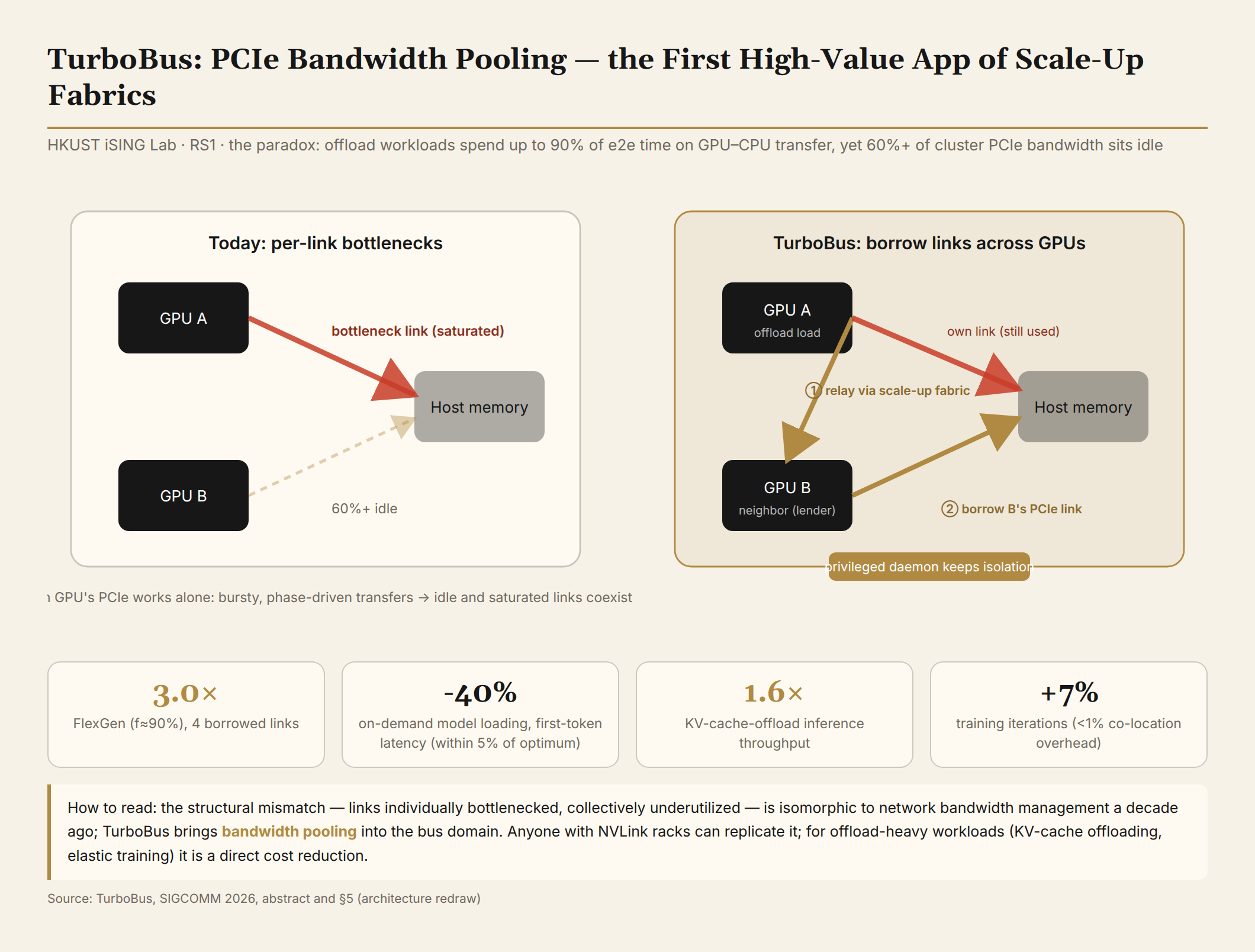
HKUST tells a counterintuitive story. GPU memory offloading (KV-cache spilling, elastic training) pushes the bottleneck onto GPU-CPU transfer: up to 90% of end-to-end time. The reflex conclusion is "not enough PCIe bandwidth". But TurboBus's measurement shows: over 60% of cluster PCIe bandwidth sits idle at the same time. Per-link bottlenecks with collective underutilization — each GPU's PCIe works alone; bursty loads saturate each own link while neighbors' links idle.
The structural fix for the mismatch is pooling: TurboBus lets a GPU relay data through neighboring GPUs' PCIe links over the scale-up fabric. FlexGen-class workloads (offload fraction f~=90%) gain up to 3.0x with four borrowed links; on-demand model loading cuts first-token latency by up to 40% (within 5% of the analytical optimum); KV-cache-offloaded inference throughput up to 1.6x, training iterations +7%, with <1% overhead on co-located jobs.
The first high-value application of scale-up fabrics is not collective communication but PCIe pooling — a new abstraction for intra-rack resource sharing. Deployability is the most direct of the eight: anyone with NVLink racks can replicate it; a privileged daemon keeps isolation.
2.8 Harvest: the photonic crossing
Purdue + MSR on optical-switch scheduling (detailed in Piece 4), noted here as the physical-layer evolution of the scale-up domain: once optical circuit switching enters the rack, topology itself becomes a reconfigurable resource, and scheduling follows.
3. Route Analysis
The eight papers are not parallel topics but a standard formation path of a research domain from zero:
Observation 1: measurement is the field's biggest gap. Scale-out matured ping/traceroute/tcpdump/perfSONA; the scale-up domain today has two papers. FabricPerf's kernel-profiling workaround is a stopgap — what's needed is fabric-native telemetry (link-level counters exposed on NVLink/UB, probe standards for chiplet NoCs). When the toolchain settles, the field graduates from "measurement first" to "systems optimization."
Observation 2: Huawei has placed three positions in scale-up. BST (topology) + UBEP (communication library, Piece 2) + the UB ecosystem itself — full depth from physical interconnect to topology to library. Contrast NVIDIA: NVLink/NVSwitch is the de facto standard but publishes no papers (Meta's 100K+ GPU paper serves as its deployment-side validation). Huawei's route is "make every ecosystem layer publishable academic output" — a discourse strategy that also reflects the reality that domestic stacks must build every layer themselves.
Observation 3: scale-up and scale-out are exporting problems to each other. The PIFO abstraction moves from switches into scale-up (Scale-up PIFO); credit-based congestion control moves from datacenters onto wafers (Credit-Guided); PCIe pooling replicates network bandwidth management into the bus domain (TurboBus). The reverse flow has begun too — OptCCL's topology modeling already treats intra-host interconnects as first-class constraints. When two domains share abstractions, fusion — not just coexistence — begins.
Observation 4: three downward scales open at once. Rack (NVL72-class fabrics) → chiplet (ACN) → wafer-scale. PingPoint and Credit-Guided occupy the first-paper positions on the latter two — and "first paper" value is agenda-setting: successors must cite them.
4. Evidence Check
| Claim | Number | Source |
|---|---|---|
| Offloading transfers up to 90% of e2e; PCIe idle 60%+ | offload workload measurement | TurboBus abstract/§2 |
| TurboBus FlexGen 3.0× with 4 links; FT -40% (within 5% of optimum); inference 1.6×; training +7%; <1% overhead | f≈90% offload; abstract trio | TurboBus abstract/§5 |
| BST cost −50% vs 3-layer Clos; 1.7× vs Zettafly | topology cost model | BST abstract/§5 |
| FabricPerf channel rebalance +46% (+17.5GB/s AllGather) | measured | FabricPerf abstract |
| Elastic QP small-message rate up to 11.03× vs RDMA baselines | abstract wording | Elastic QP abstract |
| Scale-up PIFO peak error to 1/64 (Errmax≈1,562), complexity −51% | vs simple parallel PIFOs | Scale-up PIFO abstract |
| Harvest vs BvN: RD 7.3× / Swing 10× / pA2A 5.3× | optical reconfiguration schedules | Harvest §6 |
| Wafer-scale: +10% per-hop tail inflation → throughput 22–40% of baseline | MD perturbation experiments | Credit-Guided §2 |
| ByteDance 12,288 GPUs training 175B | cited in BST §1 (secondary source noted) | BST §1 citation |
Provenance notes: PingPoint's "8×" overhead-improvement figure could not be anchored to full context in the sections read and is excluded from this piece; "PingPoint cites 160 references" was cut for lack of anchoring. Harvest's own figures carry over from its fact card; its session home is RS17.
5. Assessment and Predictions
1. Scale-up will grow its own star abstraction within 2–3 years. Scale-out gave the world SDN/P4/eBPF; candidates here: fabric-native telemetry interfaces, a unified programming layer across PCIe/NVLink/UB, isolation primitives for intra-rack pooling (TurboBus's privileged daemon is the primitive form). Which one wins is too early to call, but the schedule is legible: 2027 measurement and telemetry, 2028 programming abstractions.
2. PCIe pooling is the near-term commercial landing. TurboBus's value is engineering translatability: PCIe bandwidth management software inside an NVL72 rack could be a product line for switch-silicon vendors, server vendors, or clouds alike. Recovering 60% idle bandwidth is a direct cost reduction for offload-heavy workloads (KV cache offloading, elastic training).
3. The chiplet-network standards contest is next. With PingPoint opening ACN measurement, telemetry and QoS interfaces above UCIe will be on the agenda — whoever defines them locks the next-generation chiplet supply chain's network layer. ICT CAS appearing simultaneously on the wafer-scale line (Credit-Guided) is not accidental.
4. Deployability: Huawei-ecosystem pieces are immediately usable as a set (BST+UBEP); the Ethernet ecosystem waits for EPIC/Centec silicon; PCIe pooling (the TurboBus approach) is replicable by anyone with NVLink racks. Wafer-scale is furthest from production, but as companion research for Cerebras-class architectures its five-year option value is already visible.
5. Ledger against earlier locsic analysis. The supernode-series judgment — "the interconnect protocol is only the foundation; libraries and topology are the user-perceivable surface" — is directly validated by the BST+UBEP combination; "scale-up is replaying scale-out's research history," proposed in June's supernode-evolution analysis, now has its academic-side confirmation — and the replay of research history is tidier than the replay of industry history.
Disclosure: Based on eight papers (full text or abstracts as marked per claim) plus UBEP cross-referenced from Piece 2. BST's 12,288-GPU figure is a deployment fact cited by the paper (primary source not independently verified); PingPoint's 8x figure could not be anchored and is excluded. Data as of August 22, 2026.
Piece 3 of the SIGCOMM 2026 close-reading series. Previous: overview, KV cache, collectives as a runtime. Next: "The Photonic P4 Moment Hasn't Arrived, but the Language Has" (Piece 4).