
On the evening of August 19, Stripe announced its acquisition of OpenRouter. Three numbers are worth putting on the table first.
The first is $7.5 billion. It is Stripe's largest acquisition since its founding in 2010, and what it bought is a company often described as an "API intermediary": it trains no models and buys no GPUs. Its business is scheduling hundreds of models behind a single unified interface on behalf of developers.
The second is 82 days. On May 26, OpenRouter closed a Series B led by CapitalG at a $1.3 billion valuation; on August 16, Bloomberg confirmed the deal at $7.5 billion. In under a quarter, the valuation multiplied 5.8 times.
The third is $1.5 billion. In the split reported by the New York Times, the founding team takes $1.5 billion and investors $6 billion. Just the founders' portion exceeds the entire company's valuation from three months earlier.
A note on the numbers: Stripe's same-day investor letter says "more than $8 billion," which coexists with the NYT's $7.5 billion across coverage. Neither side has explained the gap; this article uses the NYT figure as primary, lists the other alongside, and declines to reconcile for either party.
One detail easy to miss: when the Wall Street Journal first reported the talks on July 23, the price discussed was around $10 billion, and The Information's August 10 report was in the same range. The final price settled lower, at $7.5 billion. A price easing after rival bidders step back is ordinary M&A dynamics, but it also means Databricks, for one, weighed the asset seriously and chose to walk.
A payments company, buying a model-routing company, with the biggest check it has ever written. Why?

1. What OpenRouter Earned: From Group-Buy Discounts to a Clearing House for Intelligence
OpenRouter was founded in New York in early 2023, and it started as a small business: aggregate developer volume and negotiate API discounts with model vendors. Co-founder Alex Atallah's previous role was co-founder and CTO of OpenSea; he left in July 2022 and started OpenRouter the next year.
Group-buy discounts look unglamorous, but Martin Casado of a16z, in an essay published the same day as the announcement, gave it a serious historical rating: precisely because long-tail developers could get tokens at close to big-tech prices, the AI application ecosystem grew into its current shape. The judgment comes with an interest disclosed up front (a16z is an OpenRouter shareholder, and the essay landed the same day as the announcement), but the factual core holds.
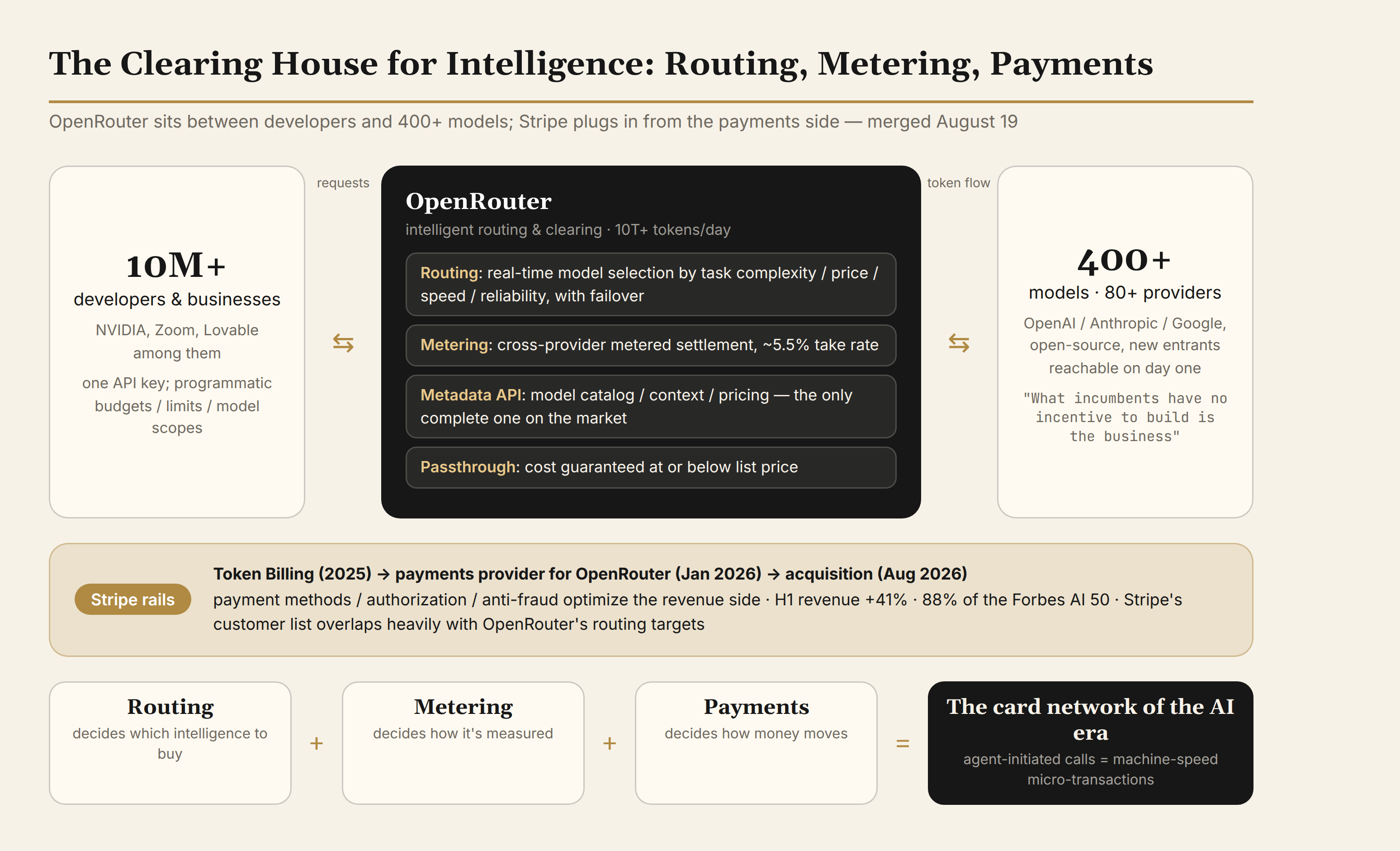
Small businesses don't get priced at $7.5 billion for no reason; the change happened in scale. The official blog's latest numbers: more than 10 trillion tokens processed daily, more than 400 models integrated, more than 10 million developers served. Growth has three published framings: the official one is "10x per year" in inference volume, a historical average that compounds to roughly 4.5% per week; in May the company said weekly token volume had grown 5x in six months, roughly 6.4% per week; and Stripe's investor letter gives the current rate as 9% per week. The three come from different measurement windows and cannot be chained into one series, but they agree on direction: growth is accelerating. And compounding May's 25 trillion per week at 9% for thirteen weeks lands around 11 trillion per day, which squares with the official "10 trillion+ daily." The numbers are internally consistent.
The argument in Casado's essay that Chinese retellings tend to drop: an aggregator's nature changes past a certain scale. OpenRouter began as a discount channel; once it ran into a market explosion, it became a clearing machine that has to hold many nines of uptime, execute exquisite failover, and reconcile across dozens of providers. In his words, it is engineering of "blood, sweat and tears"; do it poorly and the whole AI economy shakes. The moat, in other words, is not forwarding requests but keeping this running, steadily, for years.
What the moat looks like in practice came through more clearly in the Hacker News thread than in any official narrative. One user who manages his company's model spend listed the DevEx: you can programmatically create API keys in bulk, each with time limits, model restrictions, and budgets, with costs guaranteed at or below list price from the providers. His own comparison group: OpenAI's platform can't set per-key limits, and the spend view sits pages away from key management; Gemini's key management he described as a labyrinth. An agent developer added the more decisive point: OpenRouter is the only provider on the market with a complete model metadata API (context lengths, supported modalities, pricing across vendors), that returns actual routing details and exact costs in each response, and that offers a balance endpoint. His words: "You would think these things would be standard fare, but they really are not."
The thread had an aside worth noting: an OpenAI employee working on API developer experience showed up in the comments asking for improvement suggestions, and got swatted back with "a trillion-dollar company making the public do its market research for free." The incumbent's constraint and the middle layer's opportunity both surfaced in that single exchange.
Putting the evidence together, my read: OpenRouter's value is not in "requests forwarded" but in translating a fragmented model market into one interface. The incumbents have no incentive to build this. OpenAI wants you on GPT only, Anthropic wants you on Claude only; keeping switching costs high serves every vendor's interest, and the middle layer sits precisely in that gap. The business model is startlingly light: a take rate of roughly 5.5%, annualized revenue around $140 million as of July (per The Information; roughly $50 million in March per Chinese press accounts), a team of about 48, per-head annualized revenue around $2.9 million, inference costs passed through to customers (leaving gross margins near pure-software levels). An infrastructure company light enough to not look like one.
2. What Stripe Is Buying: Three Layers Deep
The official framing is the easiest to understand and the least complete. Stripe's press release says: Stripe has long optimized the revenue side for businesses, working the variables of payment methods, authorization rates, and fraud prevention; OpenRouter optimizes the cost side, trading off the "which model, what speed, what price" matrix in real time. Together they "manage both sides of profitability in the AI era." The customer lists do overlap: OpenRouter's customers include NVIDIA, Zoom, and Lovable; on Stripe's side, 88% of the Forbes AI 50 use its products, including OpenAI and Anthropic.
One piece of groundwork deserves attention. Stripe launched its Token Billing product line last year for metering and billing token usage; since January it has also been OpenRouter's payments provider, with an announced integration covering metering, pricing, and cross-provider settlement (the last per Chinese media retellings of the talks; primary sourcing pending). In other words, the pipes were connected and running for over half a year before the announcement. This is not strategy from zero; it is buying up an established partnership and making it exclusive.
The second layer is the thesis a16z published, titled "tokens are the new dollars." Casado's argument: it is rare in economic history for a new universal medium of value exchange to appear, and tokens have become the unit of account for intelligence; OpenRouter routes and clears this medium, a position equivalent to the payments network of the previous internet era. Stripe president Will Gaybrick is quoted in the piece: making the exchange between tokens and dollars as seamless and safe as dollars for euros, and a big part of Stripe's future. The two companies are genuinely isomorphic: Stripe turned "getting paid" from an ordeal into a few lines of code, OpenRouter turned "using hundreds of models" into one API; both abstract messy plumbing and run it at scale. a16z goes so far as to call OpenRouter, on this logic, already "one of the most important companies in the world."
The third layer is my own judgment. It answers not "why do they fit" but "why now, and why it had to be a purchase": the land-grab for agentic commerce is underway. When the caller shifts from humans to agents, API calls become high-frequency micro-transactions at machine speed: routing decides which intelligence to buy, metering decides how it's measured, payments decide how money moves. Together, the three are the card network of the AI era. Stripe holds two of the three; the data and interfaces for "deciding whose intelligence to buy" sit with OpenRouter. The Collison brothers wrote in the investor letter that "optimizing for developers is in many ways the same thing as optimizing for coding harnesses and for agents." What that line betrays is urgency about timing: agent defaults, once formed, are expensive to rewrite. Wait for someone else to finish laying the intelligence pipes, and the price is no longer $7.5 billion.
A word on the singularity. In the same investor letter, Stripe declared that "we decided that January 1st marked the beginning of the singularity," explaining it as a large inflection in long-run trends such as the rate of new firm creation, and used it as a reason to keep deferring its IPO. Patrick Collison had used the word publicly back in April and admitted it was tongue-in-cheek ("a bit, but only a bit"). The hard numbers in the letter are real: first-half revenue up 41% year over year, free cash flow up 43%; its internal share price up 31% annualized since Series D, ahead of the S&P and Nasdaq over the same period (a private company's self-reported basis). A company known for rigor putting "singularity" in an investor letter is rhetoric more than epistemology; more on that in the next section.
3. The Other Side: Alternative Ways to Do This Math
The most-quoted line in the HN skeptics' threads: "A credit card processor buys the company making ODBC drivers. Would you call that strategic?" The insinuation: model interfaces are converging, most already speak OpenAI-compatible formats, and the middle layer may not survive the incumbents collapsing it. The second objection follows: since OpenRouter takes 5.5%, any high-volume customer's rational move is to connect directly and save the fee, leaving hobby projects behind, so $7.5 billion bought a hobby economy? The rebuttals were equally specific: what's locked in is not price but the flexibility of switching to the newest, cheapest model with a one-line change, plus zero-cost access the moment a new provider comes online; and the "15% take" figure circulating was itself wrong, with the real number at 5.5%, lower for enterprise. A third came from a self-described former Stripe employee: the company's v2 API ran from 2022 to May 2025 before shipping. "Can they work another miracle? I'm not sure." Another commenter ran the math differently: the consideration is mostly equity rather than cash, so risk-adjusted it isn't really $7.5 billion.
TechCrunch's headline offered another reading outright: Stripe didn't buy OpenRouter because of the singularity. The Decoder went further: singularity declarations are becoming fashionable; Hassabis says we're at the foothills, Altman wrote about a "gentle singularity" last year. For Stripe specifically, staying private means no disclosed financials, lighter regulation, and founder control, while its ability to raise money is not in doubt (31% annualized). The singularity is a rhetoric of not going public.
Taken together, the skeptics don't overturn the structural logic of the deal, but they mark its risk boundary: middle-layer value rests on incumbents staying on the sidelines. As long as OpenAI and Anthropic treat multi-model routing as someone else's problem, OpenRouter's position is safe; the day an incumbent decides to build cross-model management into its own platform, the moat needs re-surveying.
And there is one risk I think deserves the closest watch, which HN did not fully develop: neutrality. OpenRouter's announcement promises "routing decisions will remain driven by one thing: what's best for you, the user," adding that "AI is too important for its future to be decided by whichever single model gets embedded first." Strong words. But its new parent company is simultaneously the collection agent for nearly every AI company. Stripe's customer list and OpenRouter's routing targets overlap heavily; once payment data and routing data pool inside one company, "routing answers only to the user" stops being a technical promise and becomes a question of corporate governance: the firm allocating traffic among models and the firm collecting money for the companies behind those models are the same firm. That is not a conspiracy theory; it is a structural risk that requires continuous auditing.
4. The Toll-Booth Trilogy
Place this deal back into two essays we wrote in June, and its position comes into focus.
"The Toll Booth on the Throat" was about the compiler layer: AI compilation creates enormous value yet captures almost none, value leaking down the stack. That was the problem chapter, on the middle layer's value funnel. "When AI Starts Spending" was about agent payments: everyone fighting for the protocol position of "how AI pays," because whoever sets the standard collects the rent in the future. That was the war chapter.
This essay closes the arc. With a 5.5% take rate and roughly 54x price-to-sales ($7.5 billion against roughly $140 million annualized revenue), OpenRouter proved that middle-layer value can be captured. And then it was promptly absorbed by the payments layer. The answer is not that the toll booth grew into a castle; the castle bought the toll booth.
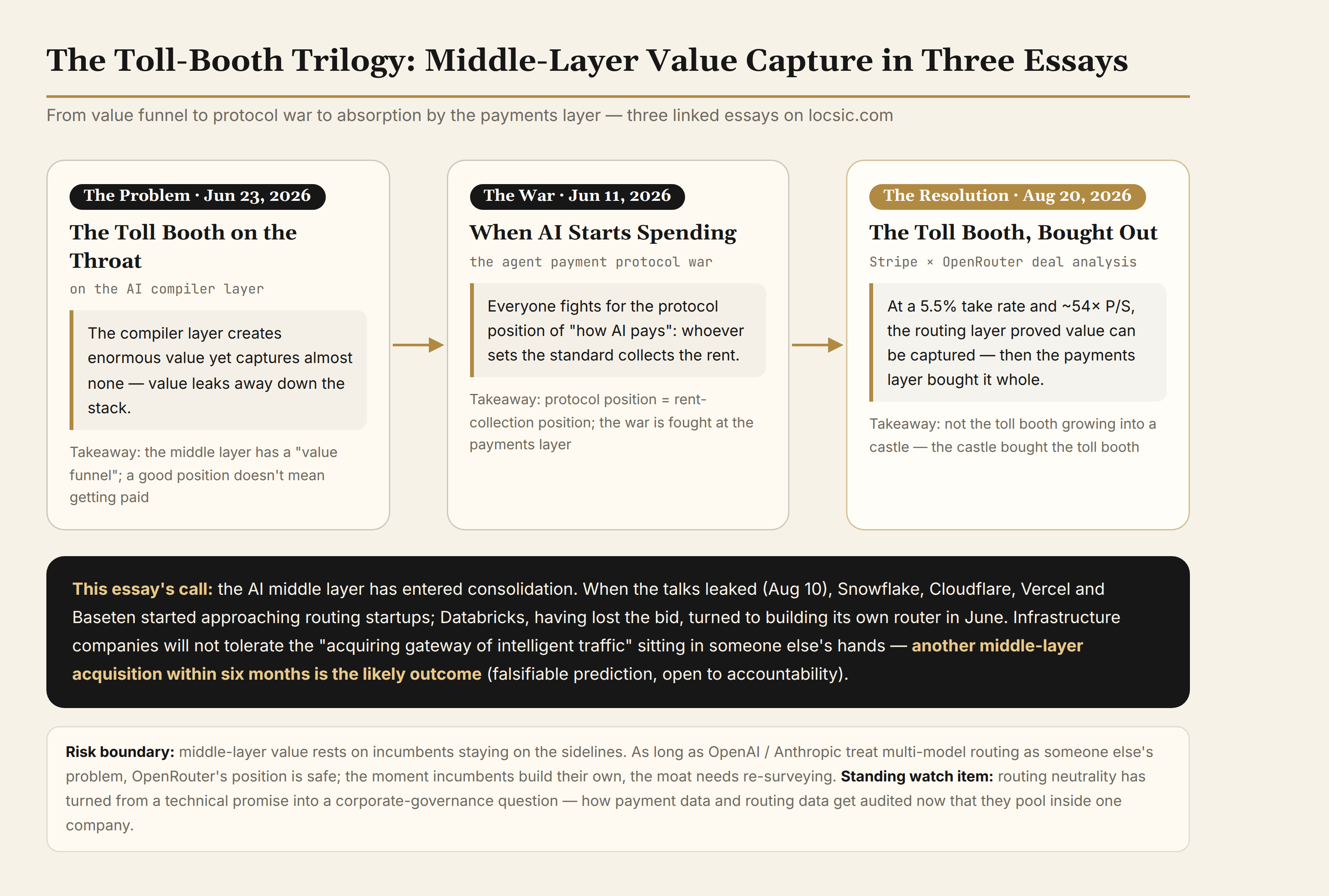
My call: the AI middle layer has entered consolidation. The Information reported that once the talks leaked on August 10, Snowflake, Cloudflare, Vercel, and Baseten began approaching routing startups; Databricks, having lost the bid, had already turned to building its own internal router in June. Infrastructure companies will not tolerate the acquiring gateway of intelligent traffic sitting in someone else's hands; within the next six months another middle-layer acquisition is likely to land. That prediction is open to falsification; I'll come back and settle the account either way.
The coda returns to the title. Intelligence doesn't know about pipes; it only knows price and latency. Pipes don't produce intelligence, but pipes decide intelligence's market price, which route it takes, and how fast it arrives. What Stripe bought for $7.5 billion is the intersection of those three. The toll booth has been bought out. The tolling has not.
Disclosure: This essay is based on Stripe's official press release, OpenRouter's official blog, and a16z's essay (Martin Casado, August 19, 2026); the Stripe investor letter as obtained by the New York Times, TechCrunch, The Decoder, and Axios; the Hacker News discussion of August 19, 2026; and deal reporting from the Wall Street Journal, Bloomberg, and The Information, cross-checked against each other. OpenRouter's financials (ARR, headcount) are secondhand retellings from The Information and PitchBook, with the take rate cross-checked against Tencent Cloud's developer-community analysis and HN comments; the Databricks bid is per LinkedIn News and TechCrunch, and the middle-layer outreach dynamics are from The Information (via Chinese-language retellings). Not investment advice. Data as of August 20, 2026.