
NVIDIA's earnings have never been just earnings. Three months ago at Hot Chips, it drew a blueprint for AI factory networking: five dedicated networks, each serving one traffic class, with its own hardware and failure domain. At the time, the framework read like a technical talk. This quarter, it started showing up in revenue.
The numbers first. In Q2 FY2027 (ended late July):
- Revenue and profit: total revenue of $96.2B, up 106% year over year and 18% sequentially, with data center revenue at $89.0B, up 117%. Net income was $59.7B, up 126%; GAAP gross margin was 75.0%, up 2.6 points; GAAP EPS was $2.46 and non-GAAP EPS $2.22, up 120%.
- Guidance: $108B (plus or minus 2%), putting a single quarter above $100B for the first time, excluding China data center compute.
- Cash flow and shareholder returns: operating cash flow of $24.1B and free cash flow of $21.3B; buybacks plus dividends of roughly $26B, with about $99B of repurchase authorization left.
- Balance sheet: inventory rose to $31.6B, up 47% sequentially; days sales outstanding climbed to 60, officially because large customers negotiated extended payment terms for multi-quarter shipments. Demand-side confidence and supply-side buildout, both leaving traces on the balance sheet.
Profitability, cash flow, and shareholder returns are all at historic highs.
Beyond the numbers, three things are worth unpacking: the buyer base is changing, networking has become a business of its own, and financing has become part of the product. Put these together with the Hot Chips five-network framework, and the strategy is clear: NVIDIA is converting "selling chips" into "defining and supplying everything in an AI factory," and this report is the first complete evidence of that conversion.
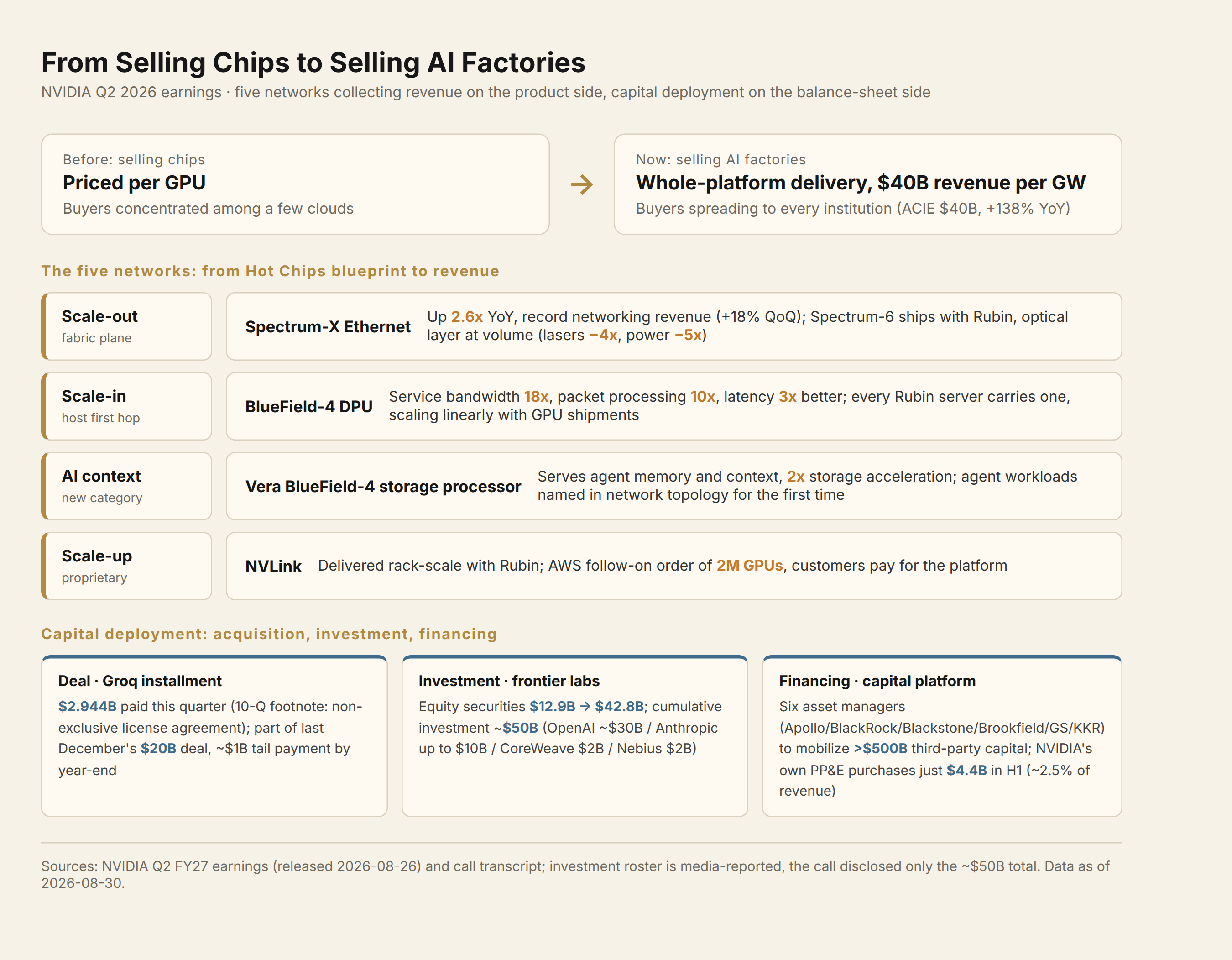
I. The buyers changed: compute went from a hyperscaler procurement line to a necessity for every institution
The structural change in the $89.0B data center number is the most important signal of the quarter.
Hyperscalers contributed $49B, up 13% sequentially, still the largest block. The other block, AI cloud, enterprise, and sovereign customers (officially ACIE), contributed $40B, up 25% sequentially and 138% year over year, growing four times as fast as hyperscalers. Supporting numbers from the call: NVIDIA's AI cloud partners (builders using the DSX reference designs) expect roughly 8 GW of installed capacity by year-end, versus 3 GW at the end of 2025. Industry-wide backlog for NVIDIA compute exceeds $2 trillion, and the top five cloud providers are expected to spend close to $800B on capex in 2026 and $1.3T in 2027.
The call broke the $40B into three layers: AI cloud, enterprise, and sovereign.
AI cloud is the main engine: CoreWeave, Nebius, and Nscale built their infrastructure businesses with NVIDIA's direct help. Regional clouds are scaling worldwide, Firebird in Armenia, Cassava Technologies across Africa, GMI Cloud in Taiwan, Yotta and Neysa in India, Firmus in Australia, YTL AI Cloud in Malaysia, pairing local land, power, and operating expertise with the NVIDIA platform.
On the enterprise side, on-prem revenue in the automotive vertical reached $8B over the trailing twelve months, with financial services, manufacturing, and health care combined contributing $7B. Customers include Samsung running cuLitho for computational lithography and Bristol Myers Squibb building a Vera Rubin AI factory, following the Roche and Lilly buildouts.
Sovereign AI lands mostly through regional clouds, up 35% sequentially and more than tripled year over year. AI start-ups are scaling too: nearly 20 companies, including Cursor, Figma, and Together AI, now exceed $1B in annualized run-rate revenue, up from 13 at the end of last year, with global AI venture funding above $400B in the first half of 2026, roughly 70% of it spent on compute.
The mechanism is a shift in AI's business model: training is concentrated, so buyers were concentrated; inference is distributed, so buyers now spread across every institution that needs compute. One quarter of $40B second-tier revenue and a 3-to-8 GW buildout say this diffusion is past its early stage; it is a structural change in the process of paying out.
There is also a geopolitical reading: Hopper shipments to China-based customers were under 1% of data center revenue this quarter. Export controls are largely priced in, and China's influence on NVIDIA's data center revenue has gone from a major variable to marginal noise. The flip side: future growth now rests entirely on Vera Rubin and what follows, and whether the China market reopens is a long-horizon variable.
For NVIDIA, buyer diffusion brings a subtler benefit: the demand curve shifts from a few large order swings to an accumulation of many small orders, sharply improving revenue predictability. That explains both the $108B guidance and the aggressive inventory policy: inventory rose from $21.4B to $31.6B, up 47% in one quarter, officially pre-positioned for Vera Rubin volume production. The more dispersed and predictable the demand, the safer it is to lock supply early.
II. Five networks: from the Hot Chips blueprint to products in the financials
NVIDIA's AI factory network design is five dedicated networks, each serving one traffic class with its own hardware and failure domain. Why five? The latency sensitivity of the five traffic classes differs by orders of magnitude: chip-to-chip tensor parallelism needs sub-microsecond response, cross-rack training sync is microsecond-level, and campus-spanning flows tolerate milliseconds. Node I/O plus agent context access have entirely different profiles. A single general-purpose fabric serving all five would depend on a scheduler arbitrating priorities, and arbitration cost diverges with scale; at 512K GPUs, the isolation benefits of physical separation begin to outweigh the overhead of running five fabrics.
The quantified payoff of the multi-plane design sits in the scale-out plane: versus a multi-tier single fabric, 1.7x fewer scale-out switches; when one plane fails, the remaining planes hold 90% bandwidth, with 2.68ms fault detection and 100ms recovery; whole-rack goodput up 1.6x. A 512K Rubin GPU cluster is organized as 8 planes across 4 rails, each GPU with 1.6T scale-out; 100T switches built from 512x200G ports form a plane, pushing addressable scale from 8K to 512K. Physical separation buys more than isolation; it buys convergent failure domains.
In the financials, the blueprint corresponds to five products that are now collecting revenue:
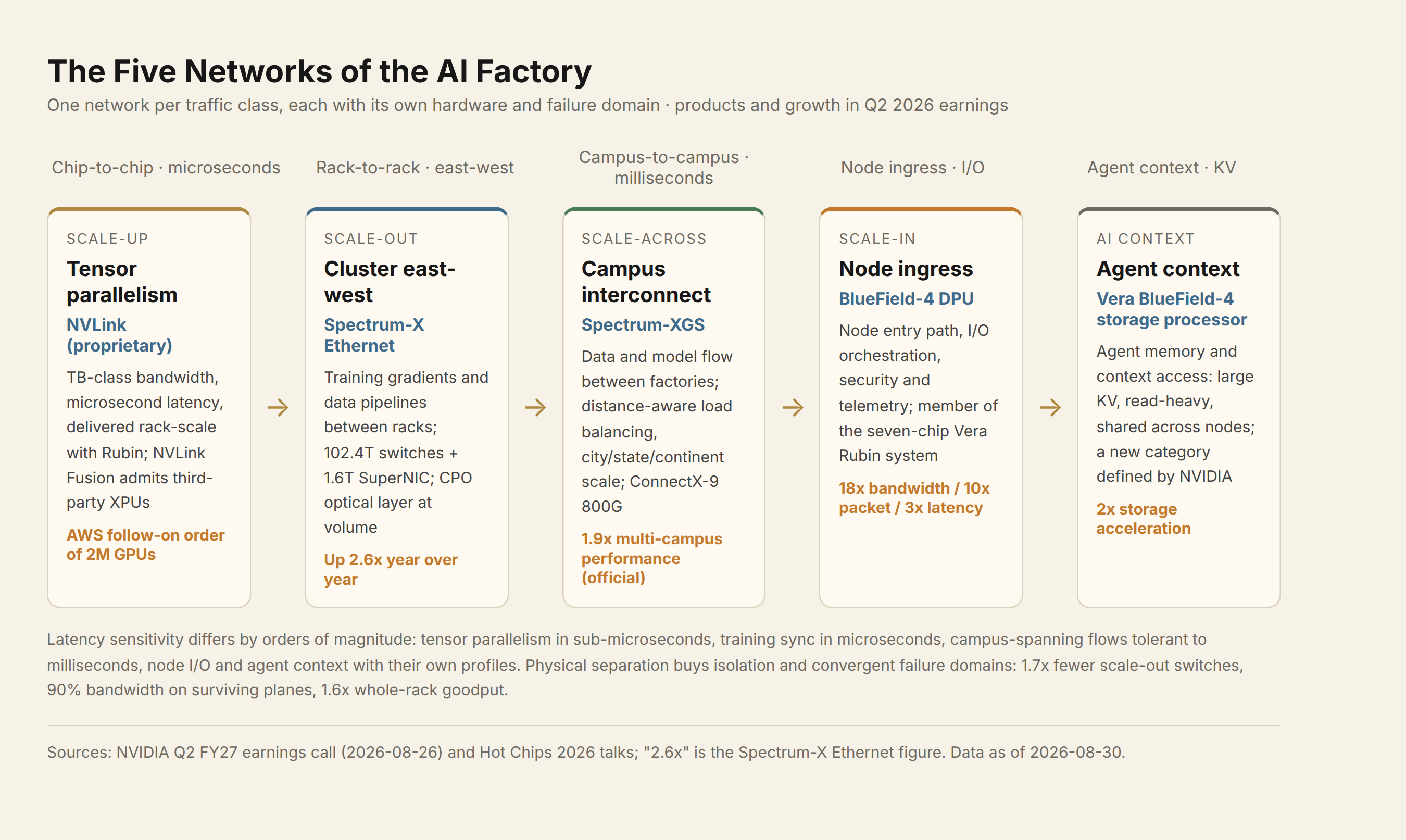
Scale-out plane: Spectrum-X Ethernet, up 2.6x year over year. This is the first of the five to take off. The Spectrum-6 switches shipping with Vera Rubin come in both pluggable optics and co-packaged optics (CPO) flavors; the optical layer moved from demo to volume, with microring modulators in production, 4x fewer lasers, 5x lower power, and 10x better mean time between failures. Ethernet is pushing beyond InfiniBand's territory, and total networking revenue set a quarterly record, up 18% sequentially, in step with total revenue.
Scale-across plane: Spectrum-XGS, campus interconnect. Data and model movement between factories and campuses demands distance awareness: load balancing and congestion control tuned by link length, expanding across cities, states, and continents, with the goal of cutting cross-datacenter latency. The product is Spectrum-XGS with ConnectX-9 at 800G, and NVIDIA claims 1.9x multi-campus performance. This is the easiest of the five to overlook, because it does not live inside a single AI factory; it is the backbone between factories, and its scale becomes visible as multi-campus deployments become standard among hyperscale customers.
Scale-in plane: BlueField-4 DPU (data processing unit), the first hop of the host. The closest of the five to compute: node ingress, I/O orchestration, security, and telemetry all run through it. NVIDIA's quantified position: 18x AI-factory service bandwidth, 10x packet processing, 3x lower latency. It is part of the seven-chip Vera Rubin system, with 7Tb/s Astra aggregation carrying its throughput. Every server needs one; this is a business that scales linearly with GPU shipments.
AI context plane: the Vera BlueField-4 storage processor, a new category. The newest of the five, serving agent memory and context access: KV data is large, read-heavy, shared across nodes, and naturally coupled to storage. Official claim: 2x storage acceleration. Agent workloads were written into network topology naming for the first time; this network did not exist before, and NVIDIA defined it. Its existence is itself a signal: NVIDIA believes agent context storage deserves its own network.
Scale-up plane: NVLink, still a proprietary domain. The only one of the five with no open-ecosystem counterpart, delivered rack-scale with the Rubin platform. AWS's follow-on order of 2 million GPUs (deploying from this quarter through FY29 Q2, some integrated with Vera CPUs) says customers pay for the whole platform, not for individual chips.
III. Where the money goes: deals, investments, and financing
The five networks are the product-level layout. The financials also contain a capital-level layout: acquisitions, investments, and financing.
Groq: $2.944B, an installment of last December's $20B deal. The cash flow statement shows a line under financing activities: Groq, Inc., $2.944B outflow (zero a year ago). The 10-Q footnote says the payment "relates to the Groq, Inc. non-exclusive license agreement": it corresponds to the $20B deal announced last December, with this quarter as a payment node.
Per media reports, NVIDIA bought Groq's assets and patent license in all cash and absorbed its core team (about 90% of employees, with CEO Jonathan Ross joining as chief software architect), while Groq continues to operate GroqCloud as an independent company. The deal pays in three installments: the bulk came before this quarter, accrued purchase consideration stood at about $3.96B at the end of Q1 (the 10-Q footnote points to the same Groq license agreement), this quarter paid $2.944B, leaving about $1B by year-end. Using "licensing plus talent acquisition" instead of buying the entity dodges antitrust review: Microsoft and Inflection are the precedent, and per media reports the FTC announced in January 2026 an inquiry into this "merger in disguise" pattern.
What the money bought is a shippable product line: Groq 3 LPX is in full production, and by Groq's own official benchmark its throughput approaches 4x the next best alternative (self-measured). The call described it as the first fusion product "uniting NVIDIA's high-throughput architecture with Groq's high-interactivity architecture." The AI context plane in the five-network framework serves agent memory and context; Groq supplies the compute side of interactive inference. Two pieces of the same layout.
Frontier labs: equity investments rose from $12.9B to $42.8B. Marketable equity securities on the balance sheet went from $12.9B to $42.8B, up about $30B in six months. Equity security purchases in the first half were $42.4B (versus $1.2B a year ago), sales $7.2B, and $23.7B in equity gains booked.
The call disclosed cumulative investment of about $50B in frontier AI labs. Per multiple media reports, the roster includes OpenAI at roughly $30B (finalized February 2026, with agreements for continued purchases of NVIDIA systems), Anthropic up to $10B (announced November 2025), CoreWeave $2B (January 2026, stake above 10%), and Nebius $2B (March 2026). Analyst estimates add roughly $5B for Safe Superintelligence. The same capital logic extends to the supply chain: Corning up to $3.2B (fiber capacity), IREN up to $2.1B (data centers, five-year warrants), Marvell $2B, Lumentum $2B, Coherent $2B (optical interconnect), Synopsys $2B (EDA, electronic design automation), all "investment plus procurement" structures.
Its largest public position is actually Intel: the 13F shows roughly $5B spent in December 2025 for about 4% of the company, worth over $30B at mid-2026 peaks. The call said the return on these investments "is less than a year." These investments carry strategic intent: they lock frontier labs' compute purchases onto the NVIDIA platform and capture equity upside at the same time. Invest in your own customers; as they grow, they come back for more compute. A closed loop.
Financing became a product too. NVIDIA set up financing platforms with six capital institutions, Apollo, BlackRock, Blackstone, Brookfield, Goldman Sachs, and KKR, aiming to mobilize more than $500B of third-party capital to build AI factories. The call put industry backlog above $2 trillion and top-five cloud capex near $800B in 2026 and $1.3T in 2027. NVIDIA does not borrow to build; it lets capital markets fund AI factories while it earns on chips, networking, systems, and delivery.
Against that, the cash flow statement shows NVIDIA's own property and equipment purchases at $4.4B for the first half ($2.7B in the quarter), about 2.5% of revenue; top-five cloud providers typically run capex above 30% of revenue. A company with $178B of revenue in six months barely builds productive assets itself; the expensive parts, data centers, power, buildings, sit on customers' and capital markets' balance sheets. This is the capital structure of "selling factories": NVIDIA carries no assets, the assets sit on customers' and capital markets' books.
How these deals are paid: all cash, no dilution. Acquisitions and investments are almost entirely cash: the $20B Groq deal was cash (with this quarter's $2.944B installment), the $42.4B of equity purchases in the first half were cash, and the $900M+ Enfabrica license-plus-hire deal last September was cash too. This follows NVIDIA's history: its two largest acquisitions, $6.9B for Mellanox in 2019 and the attempted $40B for Arm in 2020, were both all-cash.
The cash comes from $24.1B of operating cash flow and $21.3B of free cash flow this quarter, $69.9B of free cash flow in the first half, and $56.5B of ready liquidity on the balance sheet ($22.4B cash plus $34.1B marketable debt securities). The conclusion: payment capacity is not a constraint, a single quarter of free cash flow covers deals of this size, and shareholders are not diluted. The real constraint is capital allocation: buybacks plus dividends run about $26B per quarter, equity investments add tens of billions per quarter, and acquisitions stack on top; the total pool is large enough, but each dollar of spend competes for a return.
The newest one: $12.9B for Hugging Face, buying the open-model distribution layer. The Information reported on August 26, 2026, that NVIDIA has agreed to acquire Hugging Face for $12.9B, with Bloomberg, CNBC, and Ars Technica following up; neither company has commented and the agreement is not yet signed.
Hugging Face is the hub of the open-source AI ecosystem, hosting millions of models and datasets with roughly 13 million developer users and about $150M of annual revenue. NVIDIA participated in its 2023 round at a $4.5B valuation; late last year NVIDIA proposed a $500M investment at a $7B valuation and was turned down.
The cash flow impact: $12.9B is a bit more than half of one quarter's free cash flow, fully affordable as a one-time outlay, roughly a quarter's worth of the $26B quarterly buyback-plus-dividend run rate. The stock impact cuts two ways. The positive: the open-model distribution layer is in hand, the developer entry point is locked, and the model ecosystem closes a loop with the compute platform, consistent with NVIDIA's ecosystem playbook. What needs watching is the integration cost: Hugging Face's value rests on cross-vendor neutrality, and whether it keeps developer trust under NVIDIA ownership decides the deal's worth. If the deal closes, the near-term effect on buybacks is limited; longer term, as cash reserves come down from $56.5B, quarterly buybacks may ease from roughly $20B toward $15B.
IV. Sizing the upside: what the five networks are worth
Do the analyst math. The five networks correspond to a networking market being repriced.
Start with the market. In traditional data centers, networking equipment is roughly 5% of capex. AI factories differ: tensor-parallel traffic pushes scale-up and scale-out bandwidth up an order of magnitude, and five networks mean five sets of hardware and five sets of operations. Industry estimates of networking's share in AI data centers generally run above 10%.
With top-five cloud capex near $800B in 2026 and $1.3T in 2027 (from the call), a 10-12% networking share puts the 2027 AI data center networking market between $130B and $150B. Against NVIDIA's current networking business: Q1 FY27 officially disclosed $14.8B of data center networking revenue (up 199% year over year), Q2 rose another 18% sequentially to a record, annualizing to roughly $70B. On that basis the 2027 pool leaves about another doubling of headroom, and NVIDIA's five-network layout is aimed at every one of those planes.
Break the five networks apart (2027 market of $130-150B, split by traffic share and hardware value; all figures are our estimates):
- Scale-out (cluster east-west) is the largest pool, roughly $60-70B (45-48%). Ethernet replacing InfiniBand is a clear trend, switches and NICs are the bulk of networking equipment, and Spectrum-X is already growing 2.6x; this is the biggest incremental source for NVIDIA's networking business over the next three years, and the layer where Broadcom competes head-on.
- Scale-up (chip-to-chip) is roughly $26-34B (20-23%). NVLink ships with GPUs, every Rubin accelerator needs it; it is not priced separately but its value is embedded in the platform, and the AWS order of 2 million GPUs is proof that customers pay for the whole rack. Volume scales linearly with GPU shipments, with no need to win a new market; NVIDIA owns this layer.
- Scale-in (node ingress) is roughly $13-18B (10-12%). Every Rubin server carries a BlueField-4, one for one with GPU shipments, at thousands of dollars per unit; a steady business that scales with the platform, lowest flexibility but highest certainty, and NVIDIA leads it.
- Scale-across (campus-to-campus) is roughly $10-15B (8-10%). Multi-campus deployment is currently concentrated among hyperscale customers; Spectrum-XGS's 1.9x multi-campus figure is NVIDIA's claim. As AI factories go from single campus to multi-campus, this network moves from edge to standard; NVIDIA is a new entrant here, with share still to be built.
- AI context (agent context) is roughly $4-7B (3-5%). It did not exist before; NVIDIA defined the category, and revenue comes entirely from agent workload storage and context access. Smallest base, but its growth curve depends on agent workload penetration, the most upside and the least certainty of the five.
The five planes sum to roughly $113-144B, at the lower edge of the total range. NVIDIA's grip differs by plane: scale-up and AI context are proprietary, scale-in is led by BlueField, scale-out is a head-on fight with the open camp, and scale-across is a new entrant.
Then NVIDIA's share. Of the five networks, NVIDIA controls four and a half: Spectrum-X and Spectrum-6 on scale-out, BlueField-4 on scale-in, NVLink as a proprietary scale-up domain, the AI context plane it defined, and Spectrum-XGS on scale-across. Only the open side (Broadcom's Thor Ultra on the NIC side of scale-out) leaves a gap. If NVIDIA holds 40-50% of AI factory networking over the next two years (conservative given its GPU position), 2027 networking revenue lands at $50-75B, roughly 0.7-1.5x today's reported run rate of about $70B. Note that the reported figure includes platform-internal interconnect such as NVLink, so against the addressable networking equipment market alone the growth multiple is higher.
The revenue-per-GW curve confirms the direction. Revenue per gigawatt: roughly $18B for Hopper, $25B for Grace Blackwell, $40B for Vera Rubin. The same megawatt of power sells for more every generation. The number mixes architectural efficiency (token throughput and memory bandwidth as system-level design targets) with shortage-driven pricing, and the financials cannot separate the two. But the direction is fixed: networking and systems take a rising share of the Rubin rack, and NVIDIA's shift from "selling compute" to "selling factories" is visible on the curve. The margin story agrees: gross margin at 75.0%, up 2.6 points, says platform delivery commands a premium on every dollar of revenue. EPS of $2.46, non-GAAP EPS of $2.22 (up 120%), and roughly $26B of buybacks plus dividends say the model is not just growing; it is converting growth into shareholder returns.
V. Predictions: business, technology, and financials
The predictions run on three tracks: business development, technology positioning, and financial state. Each carries verifiable metrics and timing.
Business track: the price hike is the first variable of next quarter
Q3 guidance of $108B will most likely be beaten, and the market consensus already sits above it. The guidance record is the starting point: over the last four quarters, actual revenue has exceeded the midpoint by 5.6%, 4.8%, 4.6%, and 5.7%, an average of 5.2%, and gross margin has never missed the guide. Apply the average to $108B and Q3 lands near $113.6B. Sell-side estimates are on the same side: BofA projected Q3 revenue of $107-108B before the print, above the then-consensus of $104B; after earnings, Evercore moved its target to $465, Raymond James to $515, Bernstein to $400, with the Street consensus near $304. BofA's valuation read is worth noting: it argues NVIDIA trades at roughly 16x estimated 2027 earnings, the cheapest in a decade, with a $350 target and EPS above $25 by 2030.
But the price hike splits the FY2027 earnings curve into two phases. Bloomberg reported on August 22 that NVIDIA has notified some of its largest customers that server systems containing Vera Rubin and Grace Blackwell chips will cost more than 15% more for shipments starting in early 2027. The size varies by chip generation and memory configuration. This follows roughly 30% increases across the lineup in July, both driven by surging memory costs.
The implication is a two-phase curve: systems shipping this quarter (Q3 FY27) are still priced at the old level, so the hike benefit lands in Q4 FY27 or FY28 revenue. Meanwhile memory is a cost line, and part of the hike is passing through costs rather than expanding margin. The call said the same thing: memory pricing extremely elevated and heading higher next year, with gross margin guidance easing from 75.0% to 74.0% (plus or minus 50bp). Net effect: the revenue benefit arrives in early 2027, the cost pressure is present now, and whether Q4 FY27 gross margin holds at 74% is the first checkpoint.
By business segment: data center remains the absolute core, with Vera Rubin around 20% of Q3 data center revenue and the price hike's contribution landing mainly in FY28. Networking is the sharpest growth edge (Spectrum-X up 2.6x, annualizing to roughly $70B) though still a modest share of data center revenue, and the hike helps it too. Consumer and workstation (RTX PRO 6000 at $16,000, RTX 50-series retail up 20-39%) matters more as a signal than as revenue, proof that NVIDIA can pass prices through in a tight compute market.
Technology track: the Rubin ramp sets the slope of all three tracks
Rubin is both the payoff point of the technology layout and the exposure point of the supply bottleneck. Vera Rubin is about 20% of data center revenue in the Q3 guide, one-fifth of the business one quarter after volume production starts. FY28 revenue is guided up about 70% while the company says supply, not demand, is the ceiling, with the constraint running at least through year-end. Memory is the tightest link: official language says pricing is extremely elevated, running above expectations and heading higher next year, and NVIDIA's relationship with the three memory makers sets the ceiling on Rubin output. The $31.6B inventory and three-year supply commitments are the ammunition for this ramp.
The five-network technology layout is starting to account for itself. Scale-out (Spectrum-X up 2.6x) and Scale-in (BlueField-4 scaling linearly with GPUs) are the two highest-certainty planes. Scale-across (Spectrum-XGS) moves from edge to standard as multi-campus deployments spread. The AI context plane is a new category whose revenue comes entirely from agent workloads, the smallest base with the most headroom. The verification metric: whether NVIDIA starts disclosing absolute networking revenue, which would be the signal that this layout is being accounted for separately.
Financial track: cash is abundant, capital allocation enters a queue
Capital allocation is entering a queue. The payment method was covered earlier: all cash, a single quarter of free cash flow covers a single deal, no dilution. Stack buybacks plus dividends (about $26B per quarter), equity investments (tens of billions per quarter), and acquisitions together, and the total pool is large enough, but each dollar of spend competes for a return. The pending Hugging Face deal is the largest single item ($12.9B, a bit more than half of one quarter's free cash flow); if it closes, the near-term effect on buybacks is limited, and longer term, as cash reserves come down, quarterly buybacks may ease from roughly $20B toward $15B.
Four verifiable checkpoints
- November earnings (Q3 FY27 actuals): whether revenue lands above $113B (midpoint of $108B plus the 5.2% average beat); whether Vera Rubin moves from 20% to 30% or 40% of data center revenue; whether gross margin holds at the 74.0% guide.
- Early 2027 (hike takes effect): the 15%+ price increases start shipping, and whether the benefit shows up in Q4 FY27 or FY28 revenue, and how the margin curve responds.
- Hugging Face deal: whether it gets formally signed and whether the consideration is all cash or cash plus stock; signing itself is a confirmation signal for the ecosystem strategy.
- Networking disclosure: whether NVIDIA starts disclosing absolute networking revenue, the signal that the five-network layout is being accounted for separately.
VI. Summary: industry influence, business and technology layout, outlook, and competition
Industry influence: NVIDIA has moved from compute supplier to standard-setter of the AI factory. The most notable thing in this report is not the numbers but the role change. The five-network framework from Hot Chips three months ago is now a product line in the financials, and Huang's line on the call, "tokens are productive and profitable, compute is revenue," writes the industry consensus into official vocabulary.
From setting the technical framework, to getting customers to pay for it, to folding financing into the business, NVIDIA defines the rules of the AI factory on three levels at once: technical standards (five networks, platform, CPO), business structure (rack-scale delivery, all-cash acquisitions, a $500B third-party capital platform), and financial cadence (quarterly revenue above $100B, quarterly free cash flow above $20B). When a supplier defines the technical standard, the business structure, and the capital structure at the same time, its position is no longer measured by market share; it is measured by rule-setting.
Business layout: converting "selling chips" into "selling AI factories," with ample cash. The diffusion of buyers is the first layer of evidence: hyperscalers contributed $49B, but the second tier (ACIE at $40B, up 138% year over year) is growing four times as fast. Compute has gone from a hyperscaler procurement line to a necessity for every institution.
The second layer is the delivery form: AWS's follow-on order of 2 million GPUs says customers pay for the whole platform, and revenue per gigawatt rose from $18B for Hopper to $40B for Vera Rubin. The third layer is capital: acquisitions and investments are almost entirely cash, quarterly free cash flow is $21.3B, ready liquidity is $56.5B, payment capacity is not a constraint. The financing platform with six institutions, Apollo, BlackRock, Blackstone, Brookfield, Goldman Sachs, and KKR, mobilizing over $500B, makes AI factory financing part of NVIDIA's product. The pending $12.9B Hugging Face deal, buying the open-model distribution layer, continues the same ecosystem playbook.
Technology layout: the five networks moved from blueprint to products, and Rubin is both the payoff and the bottleneck. All five networks are now in the financials: Scale-out's Spectrum-X up 2.6x, Scale-in's BlueField-4 scaling linearly with GPUs, Scale-across's Spectrum-XGS ramping with multi-campus deployment, the AI context plane defining a new category for agent context, and Scale-up's NVLink still a proprietary domain.
The judgment behind the layout is about the longer term: when NVIDIA controls chips, networking, CPUs, storage processors, and the financing platform at the same time, the bet is not on any single generation's performance lead, but on architectural control of the whole AI factory. Rubin is the payoff point and the bottleneck point: about 20% of data center revenue in the Q3 guide, FY28 growth of about 70%, but supply-constrained with memory pricing extremely elevated; capacity sets the ceiling.
Outlook: near term is pricing and ramp, medium term is 70% and margin. Near term (next two quarters): Q3 guidance of $108B will most likely be beaten (the average beat over the last four quarters is 5.2%, implying a landing near $113.6B). The price-hike benefit arrives in early 2027, and whether Q4 gross margin holds at the 74.0% guide is the first checkpoint. Medium term (FY28): whether the 70% growth guide holds depends on the Rubin ramp and memory supply, which official language says gets tighter next year. Sell side is on the same side: BofA at $350, arguing 16x forward earnings is the cheapest in a decade; Evercore at $465, Raymond James at $515, Bernstein at $400, with the Street consensus near $304.
Competition: rivals are catching up, but they all still lack a complete factory. The threats in order: AMD attacks data center directly with the MI455X rack (72 GPUs, 432GB HBM4, UALink open interconnect), deployed by Meta this year. The Taalas acquisition covers the decode gap, making AMD the only rival positioned at rack level. Broadcom's Thor Ultra sits on the NIC side of scale-out, backed by the 10GW OpenAI partnership, extending from switching chips to NICs, the most structurally significant open-camp position. Google split the TPU into 8i and 8t, Meta's MTIA added GenAI training, and Intel uses 18A plus UCIe open packaging to bypass HBM, all chasing on single points.
But their products are chips, while NVIDIA sells the whole factory of chips, networking, systems, and financing. The gap is not in single-chip performance; it is in completeness. Rivals are walking from chips toward the factory; NVIDIA is walking from the factory toward chips, in the opposite direction, and it has been running this way for a year and a half.
Core view: NVIDIA is now a systems company, and its lead is built on several dimensions at once. This report is the first complete proof of "from selling chips to selling AI factories," but the deeper judgment is that NVIDIA no longer competes as a chip company. It defines technical standards (five networks, platform, CPO), business structure (rack-scale delivery, all-cash acquisitions, the $500B third-party capital platform), and capital structure (frontier lab investments, financing platforms, supply-chain bindings) at the same time. The three dimensions interlock: every cycle widens what a challenger has to catch.
The barriers raised for newcomers are compound: to chase the GPU, you must also chase the networks (five of them), the system (the whole rack), the ecosystem (CUDA and the open-model distribution layer), and capital mobilization ($500B of financing platforms). A single-point breakthrough is no longer enough; a challenger needs all four lines moving at once to have a real fight. This is how NVIDIA keeps strengthening its lead: not by relying on the generational edge of a single product, but by moving competition from chip-level comparison to a full pursuit across systems, ecosystem, and capital.
The near-term variables are pricing and the ramp, the medium-term variables are the 70% growth guide and gross margin, and the long-term variable is whether the systems-company barrier keeps rising. The pick-and-shovel logic has not changed; the shovel became the whole mine, funded by someone else's money.
Data as of 2026-08-30. Financial figures from NVIDIA's official press release and earnings call transcript (2026-08-26); Hot Chips five-network data from the August 2026 conference talks; networking market sizing is our estimate with assumptions stated above.