
The story of GTC Berlin sat outside the chips: AI factories that ship faster, a runtime that constrains what agents may do, and open models for enterprises to keep training. NVIDIA is turning the engineering problems customers hit when adopting AI into products, one by one. Customers get speed and convenience, and must reprice a new dependency on the platform.
On October 21, at the GTC keynote in Berlin's Tempodrom, Jensen Huang created no suspense with a new chip. Vera Rubin had already been announced; what stood on stage were production systems. The new announcements were about how factories get delivered, how agents run, and how enterprises put their own data to work. [1]
For buyers, the work beyond the chip is just as expensive. After the GPUs arrive, someone still has to do systems integration, business adaptation, and security governance. NVIDIA is pulling that work into the same product portfolio. The more engineering it takes on, the more opportunities it has to participate in customers' subsequent technology choices.
One: The Keynote Was About Everything but Chips
Huang began with European companies. L'Oréal, Revolut, Spotify, Merck, Vodafone, Zara, Porsche, Nestlé, HSBC: one list, different countries and industries, all working with NVIDIA. The company has committed nearly $10 billion to Europe's tech ecosystem, with more than 12,000 partners. The pitch to Europe: turn local industrial experience and data into AI production. [1,24]
Then came the "five-layer cake": energy, chips, infrastructure, models, applications. The layering is distinctly a supplier's view. It puts the layers people notice most (models and applications) back on top of investments in power, equipment, and data centers; it also explains why a GPU company keeps taking on more engineering. [2]
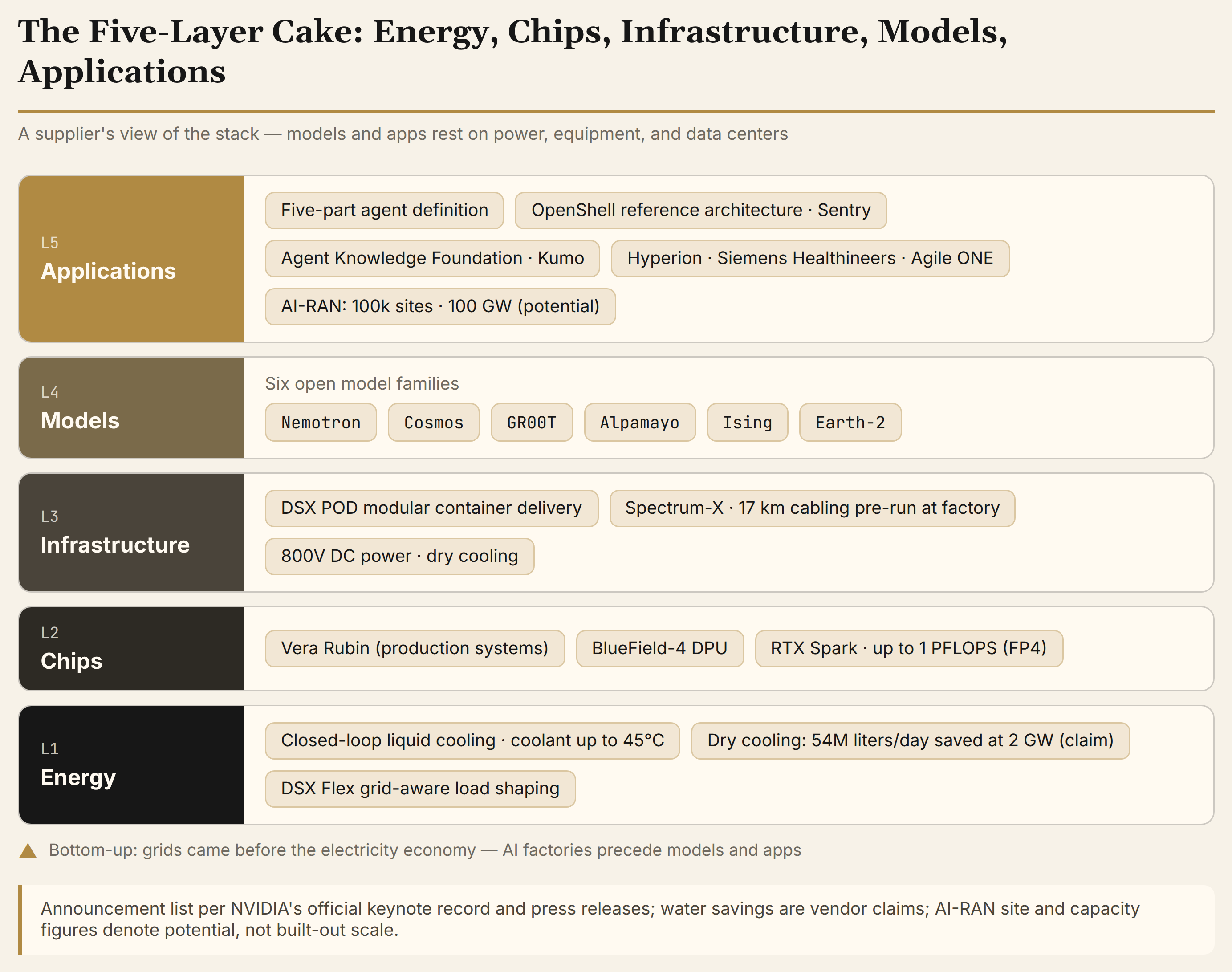
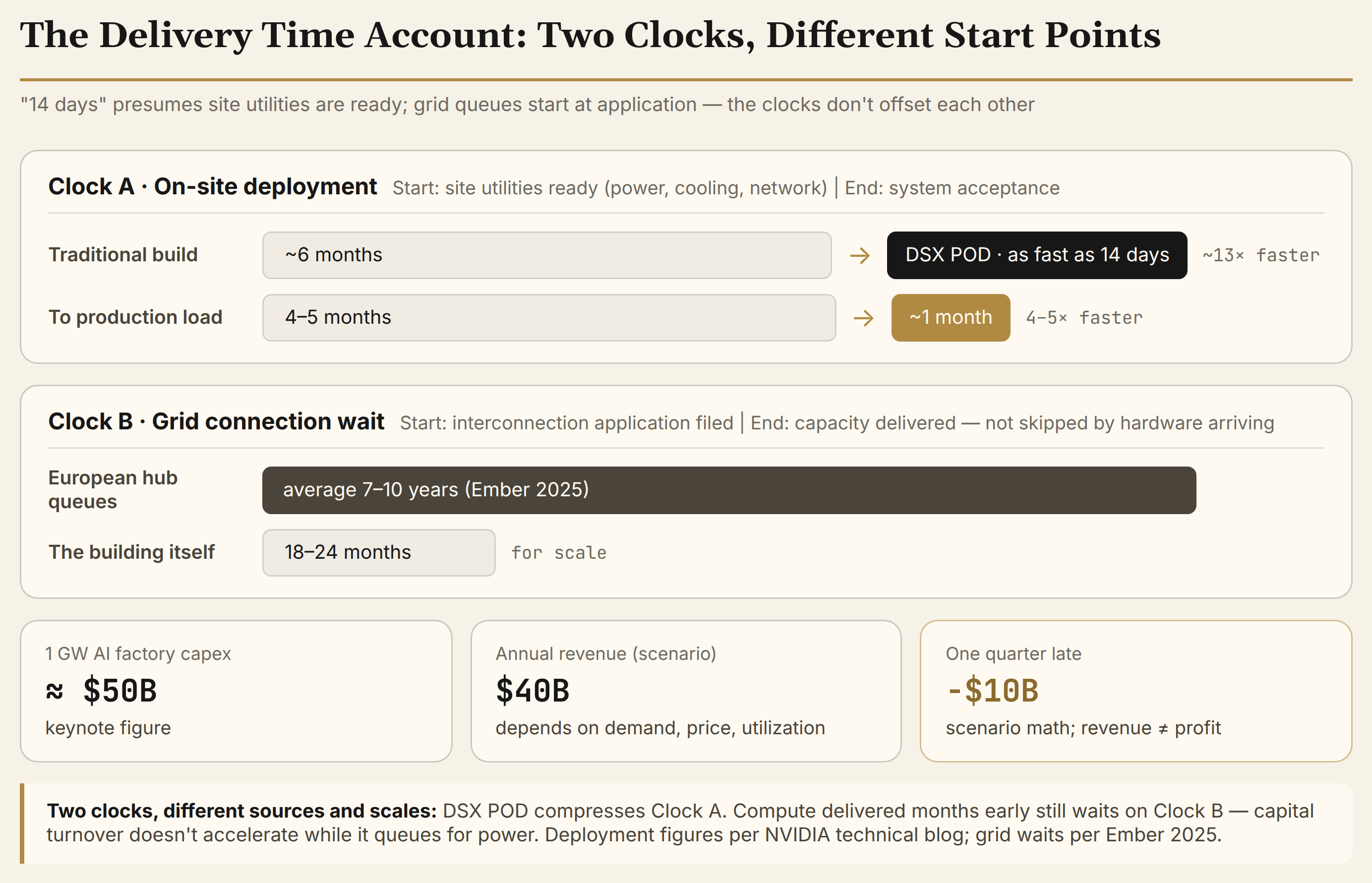
The hardware centerpiece was DSX POD. Compute, networking, rack power, and liquid-cooling manifolds are integrated and tested at the factory, then shipped as a modular container. NVIDIA claims that where site utilities are already in place, on-site deployment shrinks from roughly six months to as little as 14 days, with partner deliveries expected from early 2027. What was announced here is a reference design and a delivery method; actual manufacturing, local engineering, and service remain with partners. [3,13]
On agents, Huang listed five components: the model, a harness for orchestration and memory, a sandbox, knowledge, and tools. OpenShell sits between the agent and the systems it can touch, handling isolation, permissions, and policy enforcement. The new reference architecture further assigns model inference, agent execution, and security monitoring to Rubin, Vera, and BlueField-4. [4]
Open models fit into the same division of labor. Six families cover language (Nemotron), world models (Cosmos), robotics (GR00T), autonomous driving (Alpamayo), quantum-classical hybrid computing (Ising), and weather and climate (Earth-2). NVIDIA supplies base models, data, and training tools so enterprises can keep training on their own industry data. Huang called this the path to "sovereign intelligence." [1,5]
Two easily-missed segments followed the model list. Agent Knowledge Foundation connects enterprise knowledge (document parsing, retrieval, structured data); Kumo targets structured-data prediction. CUDA-X supplies simulation, solvers, and data processing. Together they explain how agents move from answering questions to executing tasks, and how NVIDIA's software business now reaches beyond models into workflows. [1,6,7]
Industry cases unfolded along the same line. In telecom, Nokia and NVIDIA completed the first AI-RAN call on T-Mobile's commercial network. The ~100,000 sites and 100 GW mentioned in the keynote are the potential of telecom and distributed data-center capacity that could be converted into AI infrastructure, not AI-RAN scale already built. In healthcare, NVIDIA and Siemens Healthineers are developing AI radiation therapy, linking digital twins of equipment and patient anatomy with treatment planning, real-time imaging, and adaptive control. [8,9,25]
In automotive, next-generation models from Mercedes-Benz, Volkswagen Commercial Vehicles, Volvo, and JLR were brought into the Hyperion platform's map. In robotics, the Agile ONE SN reference platform, developed with Agile Robots, is planned for researchers from early 2027. The keynote also showed agent workflows in drug discovery, production readiness, and vehicle design. Their common purpose: finding concrete business for the combination of models, knowledge, and compute. [1,10,11]
The closing was personal AI. The already-shipping RTX Spark was brought on stage; official specs include up to 128GB of unified memory and up to 1 PFLOPS of FP4 AI compute. A robot demo stitched together local modeling and simulation, cloud training, policy return, and deployment, ending with four Microduck robot ducks. The point was the continuity of local and cloud workflows. [1,12]
Put together, the commercial intent is concrete. A customer can start with one personal computer, one industry model, or one agent runtime, then plug into the same company's compute stack, servers, and factory design. The more entry points, the better the odds the whole platform makes it into enterprise procurement.
Two: What Fourteen Days Actually Change in the Engineering
DSX POD's value is moving complex fieldwork into the factory ahead of time.
Delivering a large AI system involves network cabling, liquid cooling, power, firmware, and cluster validation. Any item left unfinished keeps expensive equipment idle after it arrives. Factory pre-integration lets site preparation and equipment assembly run in parallel, reduces on-site debugging loops, and makes acceptance more repeatable. What NVIDIA is selling is a more predictable production date. [13]
Huang made the case with rough arithmetic: a 1 GW AI factory takes about $50 billion of capital; at $40 billion of annual revenue, one quarter of delay pushes aside or forfeits roughly $10 billion of revenue opportunity. [14]
That number depends on demand, pricing, and utilization all holding. Revenue is not profit, and deferred revenue cannot be conflated with revenue permanently lost. Still, it names a cost that procurement sheets miss: after hardware arrives, capital stays tied up; payback starts only when the system reliably carries production load.
So "14 days" must be read together with its precondition. NVIDIA's press release is explicit: on-site power, cooling, and network infrastructure must be ready first. The manifolds inside the container can be factory-tested; the site still has to be connected to water loops and heat rejection. Standardized interfaces reduce engineering, but they do not eliminate construction beyond the machine room. [3,13]
Europe's longest wait may happen exactly there. Ember's 2025 research found that in traditional data-center hubs (Frankfurt, London, Amsterdam, Paris, Dublin), new projects wait seven to ten years on average for grid connection. Regional variation is large, and some emerging locations wait far less, but the gap is enough to change where investment lands. [16]
NVIDIA has begun engaging the grid side. DSX Flex shapes factory load against grid conditions and coordinates on-site power with storage; DSX MaxLPS reallocates resources within a fixed power budget. On cooling, the company says Vera Rubin can use coolant at up to 45°C, with closed-loop liquid cooling plus dry cooling saving roughly 54 million liters of cooling water per day at 2 GW versus conventional cooling towers. These are conditional design and performance claims, pending project validation. [15]
Load shaping helps ease interconnection constraints; it cannot substitute for substations, transmission lines, and permitting. For European projects, the first question is usually when power becomes available and whether equipment delivery can match it. Compute delivered months early, if it only waits for power, does not accelerate capital turnover.
Nor is there reason to declare the container the settled form of the AI factory. NVIDIA's own technical notes still include conventional construction and on-site integration. The sturdier trend: the scope of pre-integration is expanding from racks to larger modules, and suppliers are starting to provide unified designs for more system interfaces and delivery steps. [13]
That sets a new bar for other supernode and system suppliers. Beyond performance, the product must now include a validated system that connects to business on schedule. How far DSX POD delivers on this will show only after the first projects: how long commissioning, acceptance, and actual production actually take.
Three: Agent Security Makes the Runtime a New Line Item
Huang's security critique was blunt: pleading with an agent through a prompt not to delete files or touch credentials is not access control. Models misread instructions; they can also be steered by external content. As long as an agent can execute operations, enterprises need enforceable boundaries outside the model.
OpenShell addresses exactly that layer. It entered open preview in March, shipped more broadly with the agent safety platform in late September, and was composed into a full-stack reference architecture in Berlin. Security rules are enforced by an external mechanism that limits the files, networks, tools, and credentials an agent can reach, and logs behavior. Model-level safety research remains necessary; runtime control gives enterprises a second, independent line of defense. [23,4]
Sentry is the hardware-adjacent piece. It runs in a separate trust domain on BlueField-4, monitoring behavior and enforcing policy. Per NVIDIA's technical notes, once a threat or policy violation is detected, an agent can be isolated in milliseconds. The company calls it optional hardware protection beyond OpenShell's software boundary. [17]
"Millisecond" needs to keep its meaning. It describes the isolation act after a violation is detected, not real-time recognition of every hazard, and not the ability to undo operations already executed in external systems. What enterprises actually need to validate includes false positives and negatives, permission revocation, and whether cross-cloud and cross-SaaS calls fall under control.
The participation of Anthropic, OpenAI, Microsoft, and AWS suggests the architecture is getting its chance inside enterprises. But a partner list does not prove model companies have ceded governance. Anthropic's own explanation is explicit: Managed Agents already run in security sandboxes; OpenShell adds protection for the execution environment, and enterprises can run tool calls on infrastructure they control, keeping their own safety and runtime controls. [4,18]
What NVIDIA is after is making this layer a common configuration for customers. Models can be swapped, applications change; the permission policies, audit processes, and operational experience built around an execution environment accumulate. Once a runtime is embedded in enterprise processes, it can be harder to replace than any single model version.
The dependency has to be judged as engineering. OpenShell's open-source license and Sentry's specific hardware implementation are two different things; NVIDIA also states explicitly that OpenShell extends to Arm, Intel, and other compute platforms. The question is what survives a move to different hardware, what has to be reimplemented, and how much revalidation that costs. [19]
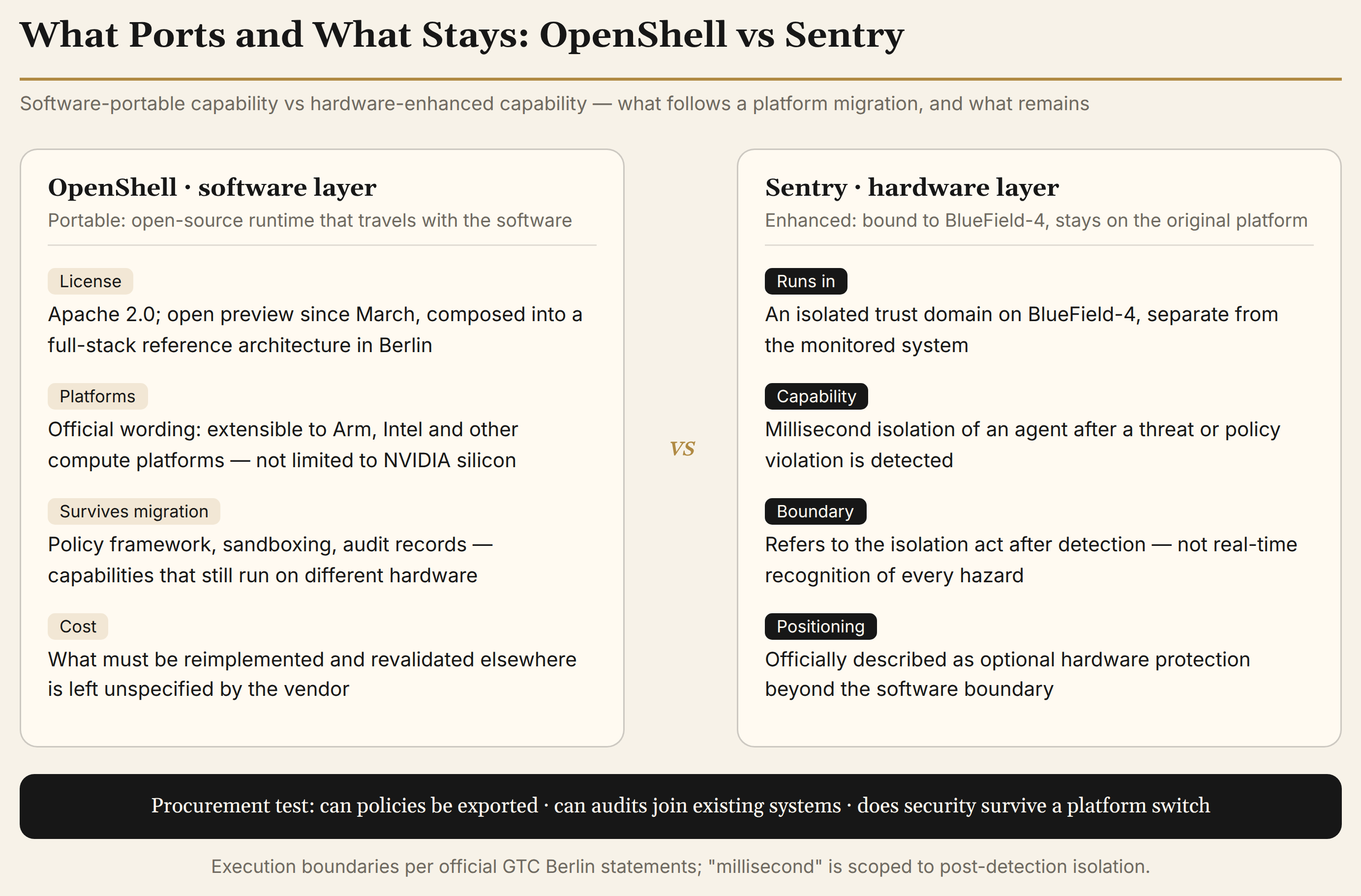
For customers, the more useful acceptance criteria than the length of the partner list are: can policies be exported; can audits plug into existing systems; who holds identity and authorization; and does the security capability still stand after a platform switch. Those conditions decide what "open" is worth in a procurement contract.
Four: Sovereign Intelligence Is Settled at the Next Procurement
Europe is one of the most persuasive audiences for this portfolio. It owns experience and data in automotive, industrial equipment, pharmaceuticals, and engineering design; it wants to turn that stock into model capability of its own. NVIDIA's cooperation with the German government puts industrial knowledge, open models, and the local ecosystem on the same development path. [20]
The open models offer real value. Enterprises can work with their own data in a controlled environment, tuning models until industry knowledge and business processes are absorbed into the system. For institutions unwilling to hand core data to external services, this is an operable path. NVIDIA's near-$10-billion commitment to the European ecosystem also widens the base of companies and developers adopting the stack. [5,24]
Commercially, the investment is also growing future customers. Open models lower the entry barrier; training tools and industry recipes shorten adaptation; compute purchases follow. NVIDIA does not need to charge at every layer; enough business growing along this technical line keeps pulling hardware and platform demand.
But local deployment only solves part of the sovereignty problem. Once the machine room and the data stay in Europe, expansion, upgrades, incident response, and price negotiations can still depend on an outside supplier. Downloadable model weights do not mean the whole business can move cheaply. Runtime libraries, networking, storage, scheduling, and operations tooling all determine whether an alternative can actually be switched on.
So Europe's position should not be reduced to "no domestic options." The EuroHPC-backed DARE project launched in 2025, with a first-phase budget of €240 million covering domestic processors, accelerators, and the software stack. Its goals are not identical to today's mature training platforms; its AI processing units are aimed first at inference acceleration in HPC. Money already committed and a deployable alternative are two different stages. [21,22]
Europe's hard problem is running both clocks at once: enterprises need usable compute soon, while domestic technology needs sustained R&D and real workloads for validation. If every procurement round chases the shortest delivery, the alternative never reaches production; if all business waits for domestic platforms to mature, industry pays for the wait.
Domestic technology needs real workloads to be validated; installed systems need room left for migration. An alternative becomes bargaining power only after it has run real loads.
What NVIDIA gains is revenue, platform influence, and a stronger position at the next expansion. The sovereignty argument lands there too: whether Europe can choose differently at the next expansion, upgrade, or shift in supply.
Five: Token Growth Still Has to Survive the P&L
Delivery, security, and industry models all rest on one demand claim: agents will make AI execute more tasks, and bring more compute with them. Huang leaned on agents' thinking, iterating, and tool use throughout the keynote. The direction has engineering substance, but how fast demand actually grows still has to be taken apart. [1]
A task burning more tokens may be doing more complex work; it may also be re-feeding context, retrying failed tool calls, or looping through redundant reasoning. For an infrastructure vendor, both are load; for the customer, their economics are not the same.
Framework optimizations, small-model division of labor, caching, and better tool interfaces can all cut per-task cost. Falling cost can also summon new tasks that offset, or even exceed, the savings. So current token growth cannot be extrapolated directly, and efficiency gains alone do not prove total demand will slow.
For an AI factory's investors, the more meaningful number is how much paid work a unit of cost completes at a given quality, latency, and success rate. Token throughput is a production metric; paid work and cash recovery decide whether the factory stays a business. Huang's ten-billion-dollar time account is ultimately underwritten by those conditions.
The Berlin keynote showed NVIDIA's capacity to widen its product range. Site integration, a security runtime, enterprise knowledge, industry models: work customers once handled separately is now purchasable. The barrier to adopting AI drops, and the dependency on the whole platform may deepen.
Whether the trade is worth it shows up at the next procurement round: whether factories come online on schedule, whether customers still hold the security rules, whether business can move to another platform. Europe needs AI faster, and needs to keep its options open. Time saved today should not become a single take-it-or-leave-it quote tomorrow.
Notes on Data and Sources
This article draws on NVIDIA's official GTC Berlin 2026 keynote record, product press releases, and technical notes, cross-referenced with Anthropic's account of the cooperation, Ember's grid research, and EuroHPC and imec project announcements. The 14-day deployment, millisecond isolation, and water-savings figures are vendor claims under specific preconditions; the 1 GW factory capex and revenue figures are scenario arithmetic from the keynote. Judgments about platform dependency, migration cost, and procurement choices are analysis based on the materials above. Fact-checking current as of October 23, 2026.
Primary Sources
Titles below link to the originals; bracketed numbers in the text refer to this list.
- [1] NVIDIA GTC Berlin 2026 official keynote record https://blogs.nvidia.com/blog/gtc-berlin-2026-keynote/
- [2] Jensen Huang AI Is a 5-Layer Cake https://blogs.nvidia.com/blog/ai-5-layer-cake/
- [3] NVIDIA DSX POD announcement https://nvidianews.nvidia.com/news/nvidia-introduces-dsx-pod-ai-factories-to-accelerate-europes-infrastructure-deployment
- [4] NVIDIA OpenShell Reference Architecture announcement https://nvidianews.nvidia.com/news/openshell-reference-architecture
- [5] NVIDIA Open models and European sovereign intelligence https://blogs.nvidia.com/blog/open-models-europe-industry/
- [6] NVIDIA Developer Agent Knowledge Foundation https://developer.nvidia.com/topic/ai/agent-knowledge-foundation
- [7] NVIDIA Developer Kumo structured-data models https://developer.nvidia.com/topics/ai/agent-knowledge-foundation/kumo
- [8] NVIDIA AI-RAN cooperation with Nokia and telecom operators https://nvidianews.nvidia.com/news/nvidia-nokia-and-leading-telecom-operators-turn-networks-into-distributed-intelligence-platforms
- [9] NVIDIA Healthcare and life sciences partnerships https://nvidianews.nvidia.com/news/healthcare-and-life-sciences-leaders-build-on-nvidia-to-advance-drug-discovery-and-expand-patient-care
- [10] NVIDIA European automakers and the Hyperion platform https://nvidianews.nvidia.com/news/european-mobility-leaders-build-safe-vehicles-and-robotaxi-fleets-on-nvidia-hyperion
- [11] NVIDIA Isaac platform and Agile ONE SN reference robot https://nvidianews.nvidia.com/news/nvidia-advances-isaac-platform-for-general-purpose-robotics-with-new-reference-humanoid-frameworks-simulation-pipelines-and-data
- [12] NVIDIA RTX Spark availability and FP4 specs https://nvidianews.nvidia.com/news/nvidia-rtx-spark-pcs-available-today-a-new-beginning-for-windows-pcs
- [13] NVIDIA Technical Blog DSX POD engineering and deployment boundary https://developer.nvidia.com/blog/achieve-productive-ai-capacity-faster-and-more-predictably-with-nvidia-dsx-pod/
- [14] GTC Berlin 2026 transcript Huang's investment and revenue scenario https://stockanalysis.com/stocks/nvda/transcripts/679541-gtc-berlin-2026-keynote/
- [15] NVIDIA DSX European ecosystem, power and cooling https://nvidianews.nvidia.com/news/european-ecosystem-builds-worlds-most-efficient-ai-factories-with-nvidia-dsx
- [16] Ember Grids for data centres in Europe, 2025 https://ember-energy.org/app/uploads/2025/06/Grids-for-data-centres-in-Europe.pdf
- [17] NVIDIA Technical Blog OpenShell and Sentry governance boundaries https://developer.nvidia.com/blog/how-nvidia-openshell-reference-architecture-secures-and-governs-ai-agent-workloads-at-scale/
- [18] Anthropic Claude Managed Agents and the NVIDIA security cooperation https://claude.com/resources/articles/giving-companies-more-control-over-their-ai-agents-with-nvidia
- [19] NVIDIA Open Agent Safety Platform announcement, September 2026 https://nvidianews.nvidia.com/news/open-agent-safety-platform
- [20] NVIDIA Industrial AI cooperation with the German government https://blogs.nvidia.com/blog/germany-wants-to-lead-the-world-in-industrial-ai-how-nvidia-will-help/
- [21] EuroHPC DARE domestic processors and software stack https://www.eurohpc-ju.europa.eu/advancing-european-sovereignty-hpc-risc-v-2025-03-06_en
- [22] imec DARE SGA1 launch and first-phase budget https://www.imec-int.com/en/press/europe-takes-major-step-towards-digital-autonomy-hpc-and-ai-launch-dare-sga1-project
- [23] NVIDIA Technical Blog OpenShell open-source runtime, March 2026 https://developer.nvidia.com/blog/run-autonomous-self-evolving-agents-more-safely-with-nvidia-openshell/
- [24] NVIDIA France investment and the near-$10B Europe commitment https://blogs.nvidia.com/blog/france-ecosystem-agentic-computing/
- [25] NVIDIA Telecom AI grids: site and capacity potential https://blogs.nvidia.com/blog/telecom-ai-grids-inference/