
Opening: A Year of Two Selloffs
After the close on October 28, ServiceNow reported a quarter that beat its own guidance ceilings on revenue and margin metrics (adjusted EPS of $1.00, slightly below the $1.02 consensus): revenue of $4.106 billion, up 20.5% year over year; subscription revenue up 21%; its AI product target raised for the second time this year. The next day the stock closed down 26.5% — the largest single-day drop since its 2012 listing, erasing roughly $41 billion of market value in a day. The trigger was one forward-looking number: fourth-quarter cRPO growth (current remaining performance obligation, contracted revenue to be recognized over the next twelve months) was guided (constant currency) to 18.5%, down from 21% in the third quarter (constant currency; 20.5% as reported) and below sell-side expectations (roughly 19%–20%, relayed). Over the following trading day, Salesforce, Workday, Atlassian, and other software peers fell 4%–7% (relayed), with Fortinet, CrowdStrike, and Palo Alto Networks following. The press called it the second software selloff of 2026.
The first round came at the start of the year. In February, after Anthropic shipped Claude Cowork and Palantir CEO Alex Karp said publicly that AI had already made an entire class of SaaS unnecessary, Thomson Reuters fell nearly 16% in a day, LegalZoom about 20%, and Salesforce and Workday were each down roughly 40% over twelve months. The market named the selloff: SaaSpocalypse.
Between the two selloffs, the industry's fundamentals told a different story: in late October, Gartner forecast that global software spending would reach $1.464 trillion in 2026, up 15.2%. Revenue rising, valuations falling — twice in one year. "AI bubble" or "AI anxiety" does not explain this. What the market keeps repricing is the terminal value of software cash flows.
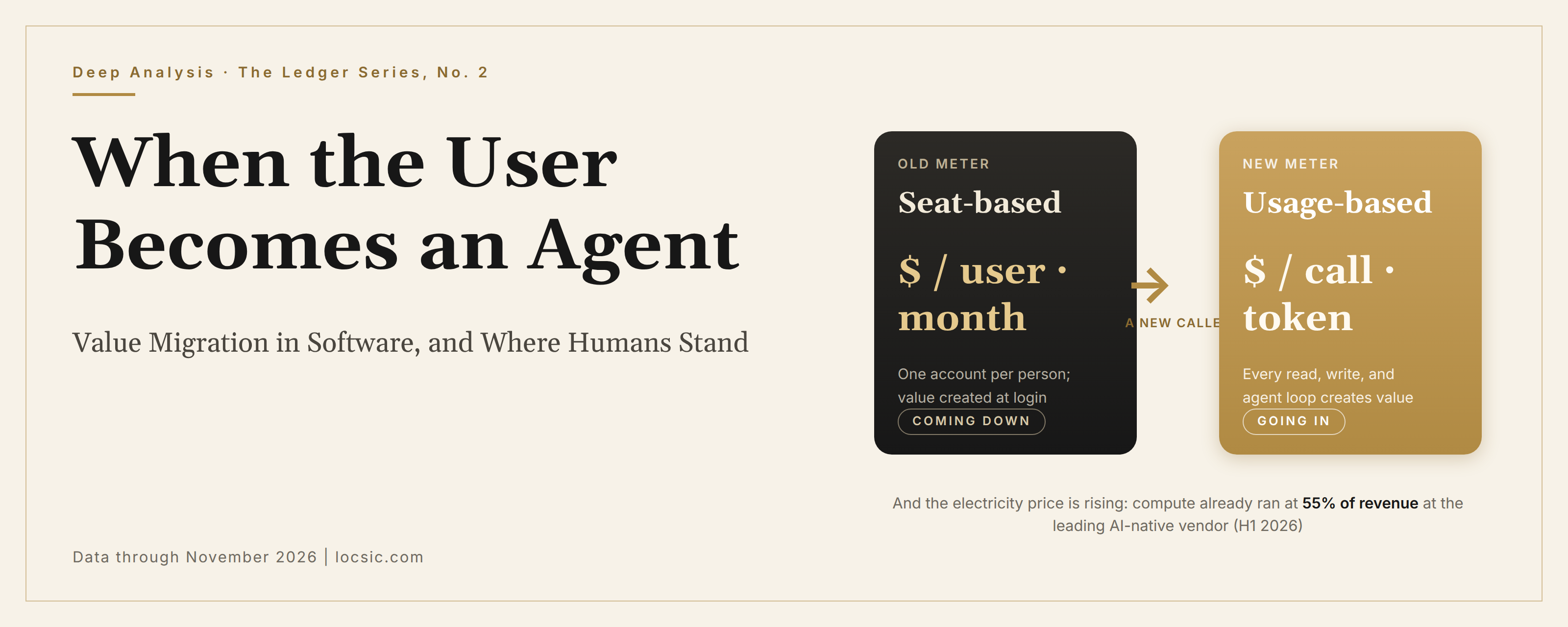
This is the second piece in the "Ledger" series. The previous one, The AI Compute Chain's Ledger, audited the hardware side: who is borrowing to build compute, and on whom the returns depend. This one audits the software side, and the two ledgers open onto each other. One is on the revenue side: the unit of software pricing is shifting from seats (per person) to usage (per call and per token). The other is on the cost side: an ever-larger share of software revenue has to be paid out for compute, and the coordinate system of gross margin is changing axes. Behind both ledgers is the same shift — the primary caller of software is changing from humans to AI agents. Humans retreat to the positions of specifying, judging, and answering for outcomes, and money and cost follow the caller.
1. The Revenue Ledger: The Total Expands, the Composition Turns Over
At its IT Symposium/Xpo on October 21, Gartner forecast that worldwide IT spending would reach $7.352 trillion in 2027, up 15% and crossing $7 trillion for the first time; 2026 would come in at $6.391 trillion, up 14.5%. Three line items matter here: software at $1.464 trillion in 2026 (+15.2%) and $1.679 trillion in 2027 (+14.6%); IT services at $1.557 trillion (+4.4%), growing another 4.9% in 2027; and data center systems up 73.8% in 2026 with another 55.5% expected in 2027. Analyst John-David Lovelock's judgment is worth recording: the next trillion-dollar increment of IT spending will be driven jointly by AI infrastructure and AI software. He also cautioned that storage price increases ("memory inflation") will persist into 2027 — a sizable part of the nominal data-center growth is price, not volume.
Within the table, three readings matter more than the total.
First, the scissors: software +15.2%, IT services +4.4%. For two decades, "software eating the world" meant software replacing offline processes; this scissors gap says software has begun replacing services themselves. Note the scale: Gartner's IT services bucket ($1.557 trillion) is actually larger than software, and consulting, implementation, operations, and support — businesses billed by the person-day — are being taken over segment by segment by agents billed per call. The industry calls this Service-as-Software. Count business-process outsourcing and professional services, and the broad services market is on the order of $5 trillion (an industry estimate, not Gartner's). What software stands to eat is not just the $1.5 trillion software market but a services pool several times larger.
Second, where the money goes. On Gartner's all-in AI tally (September 2026 press release), total worldwide AI spending in 2026 is $2.67 trillion (the January version said $2.52 trillion; the September version split agents out of AI software for the first time, so cross-version numbers are not directly comparable). Direct enterprise spending on generative-AI foundation models is only $28.3 billion — just over 1%. The bulk settles into AI infrastructure ($1.484 trillion, 55.6%), AI services, and the AI modules inside enterprise software. The biggest share of enterprise AI budgets goes into the buyer's own software and infrastructure base; buying APIs directly from model vendors is a rounding error. This explains a puzzle: competition is fiercest at the model layer, yet the steadiest financial performance belongs to infrastructure and platform software.
Third, the slope of agents. In Gartner's same table, the "AI agents and assistants" category reaches $29.2 billion of 2026 spending, with $65.5 billion expected in 2027 — more than doubling in a year, the steepest curve in software spending. Another forecast for contrast: by the end of 2026, 40% of enterprise applications will integrate task-specific agents, against less than 5% in early 2025.
Where the increment comes from and where it goes — the next section splits this by direction.
2. Who Grows, Who Shrinks: Nine Directions
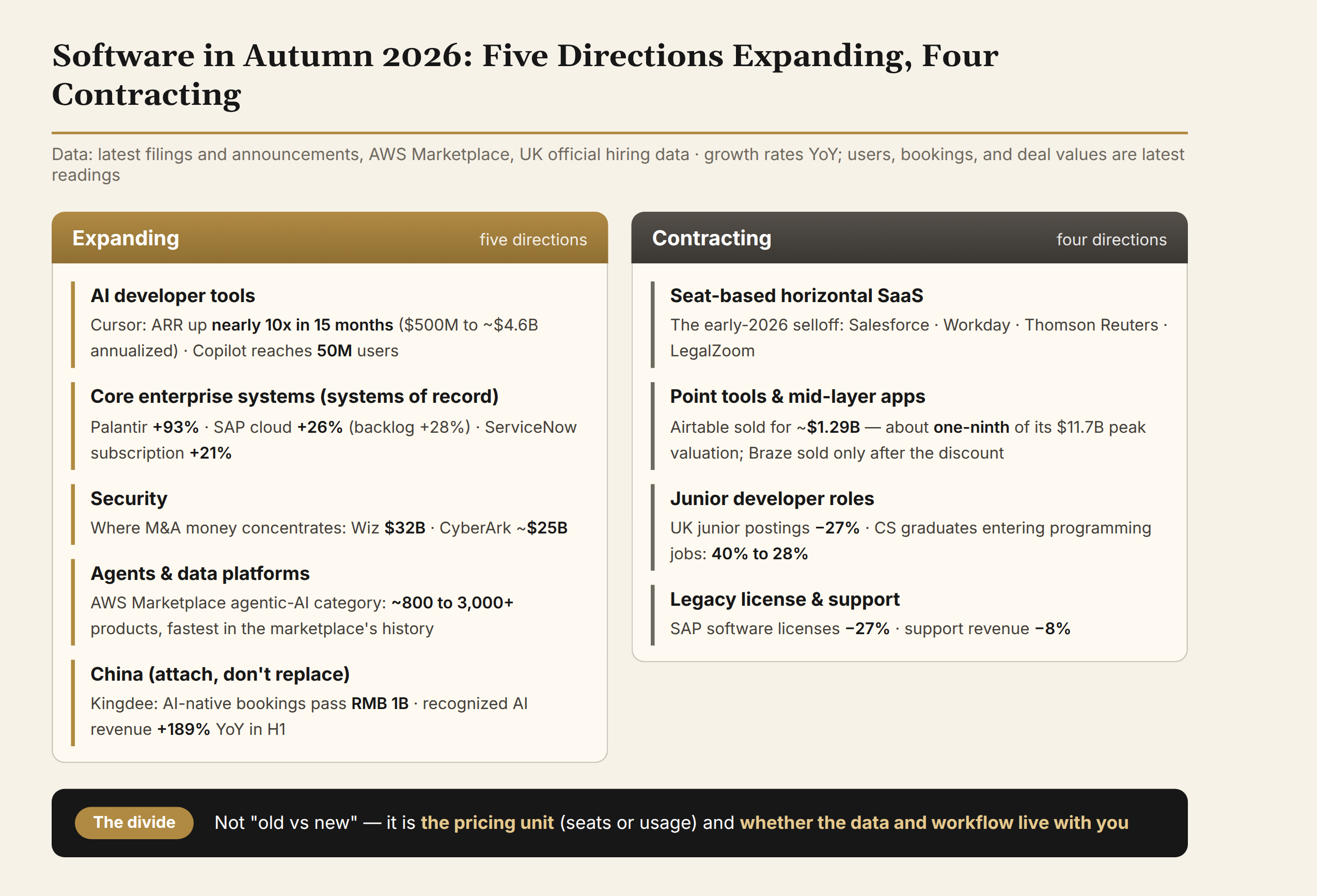
Lay the latest quarterly reports side by side and the split across nine directions is sharp. The conclusion first: the divide does not run along "new vs. old." It runs along two yardsticks — what you price by, and whether the data and workflow are in your hands.
Five directions are expanding:
AI developer tools have the steepest slope. SpaceX's third-quarter report disclosed that Cursor, acquired on August 14 for roughly $60 billion, contributed $608 million of revenue in the 48 days from closing through September 30 — about $4.6 billion annualized; in June 2025 its ARR had only just passed $500 million, and $1 billion that November — nearly ten times in fifteen months (TechCrunch, company disclosures). GitHub Copilot reached 50 million users, with revenue up 60% quarter over quarter. JetBrains' developer-ecosystem survey (a sample of more than 15,000 professional developers) found 90% of developers using a coding agent at least weekly and 68% daily.
Core enterprise systems — systems of record — are rising, not falling. SAP's third-quarter cloud revenue grew 26%, its current cloud backlog 28%, and full-year cloud guidance moved to the top of the range; ServiceNow's subscription revenue grew 21%, with 19 deals above $5 million in annual contract value (+135% year over year); Palantir's second-quarter revenue was $1.935 billion, up 93%, with full-year guidance around $8.15 billion implying roughly 82% growth. But the category is not cloud-free: the cRPO guidance slowdown that triggered the October 28 selloff (21% to 18.5%) landed squarely on a system-of-record vendor — Section 8 (Judgment 4) returns to this.
Security is where M&A money concentrates: among the largest software acquisitions of the past two years, two are security — Google's $32 billion Wiz and Palo Alto Networks' roughly $25 billion CyberArk. But demand logic and valuation logic are different things: in the late-October selloff security stocks fell too, and Fortinet's 29% billings growth did not save it.
Agents and data platforms: the Agentic AI category on AWS Marketplace grew from about 800 products a year ago to more than 3,000 — the fastest-growing category in the marketplace's history; Snowflake, Databricks, and other partners passed $2 billion of sales through that channel alone in calendar 2025.
The fifth signal comes from China, a different path, the same direction: Kingdee's AI-native bookings passed RMB 1 billion in the first three quarters, with recognized AI revenue up 189% year over year in the first half.
Four directions are contracting or being repriced:
- Seat-based horizontal SaaS — the subject of the early-year panic: Salesforce, Workday, Thomson Reuters, LegalZoom;
- Point tools and mid-layer applications: Airtable's ARR was about $480 million, still growing around 20%, yet it sold at an enterprise value of roughly $1.29 billion — about one-ninth of its 2021 peak valuation of $11.7 billion; more telling, its agent business Hyperagent had been spun out before the sale and was not part of the deal. The "for humans" part sold at a discount; the "for machines" part was kept — a ready-made footnote to this article's thesis. Braze got Salesforce's $5.66 billion offer only after losing more than half its IPO price;
- Junior developer roles: Section 4 has the detail;
- Legacy license and support: SAP's software-license revenue fell 27% and support revenue 8% through the first three quarters.
Products billed by the seat, whose value lives mostly in the interface, are being repriced; products that hold the system of record, the data, and the permissions are being accelerated by AI. To see why that yardstick holds, go one layer deeper into the stack.
3. The Mechanism: A New Caller
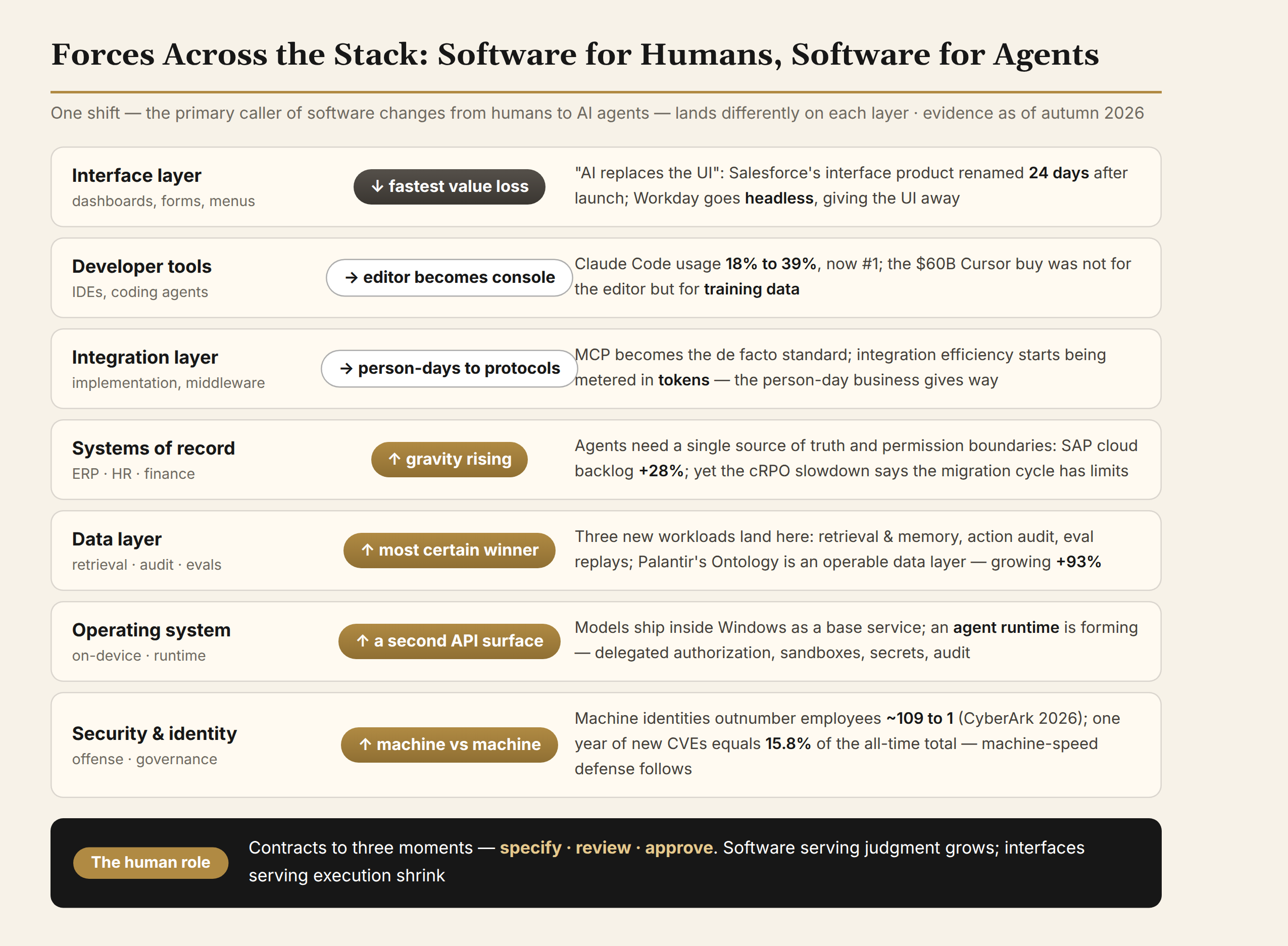
"Software for humans becomes software for machines" is too coarse as stated: each layer of the stack takes the force differently.
The interface layer is losing value fastest. Half of enterprise software's switching cost used to be built into the interface: staff mastered nested menus, forms, and dashboards, and migration costs rose accordingly. An agent operating software on someone's behalf needs no dashboard — it calls the API. Hence Salesforce's Dreamforce launch on September 15 of the interface-layer product AIforce under the banner "AI replaces the UI" — letting Claude and Slack call Salesforce data, flows, and permissions directly, so employees never open the CRM; less than a month later, on October 9, Benioff renamed it SIforce. The immediate context was the September 29 executive order replacing "AI" with "superintelligence (SI)" in federal documents — Musk promptly renamed SpaceXAI to SpaceXSI, and Benioff followed. An interface product hitching itself to the renaming wave is itself a footnote to the interface ceding value. In the same window (August 26), Salesforce and Anthropic announced the Claudeforce partnership — Claude goes into Salesforce, Salesforce goes into Claude; a month later Workday announced a "headless" agent platform, also with Anthropic. Opening the interface is defense: the interface is turning from asset into cost. Humans do not exit — the interaction contracts to three moments: specify (the spec), judge (the review), answer (the approval). BairesDev's developer survey found 67% of developers spending more time reviewing AI code: execution sinks to the machine, judgment stays with people — along with the software that serves judgment.
The gravity of systems of record is increasing. For agents to act, they need a single source of truth, clear permission boundaries, and a complete audit trail — precisely the substance of ERP, HR, and finance systems (the industry's Systems of Record). Part of why SAP's cloud backlog is accelerating in the AI era is that cloud migration and compliance have become pre-investment for AI deployment. Barclays' February call (via press reports) now looks right: AI can erode the application interface; it cannot shake the record system underneath. But record systems have their own cycle problem — ServiceNow's cRPO deceleration says the migration dividend is not infinite. Section 8 (Judgment 4) expands.
The integration layer is turning from a services business into a protocol business. Connecting two systems used to mean implementation consultants billing person-days; now MCP (Model Context Protocol), the open protocol Anthropic initiated, is the de facto standard, with agents calling tools on their own. Kingdee disclosed a self-test: the same integration scenario consumed about 16.32 million tokens on its agent platform Lingji versus about 25.33 million for a competitor (vendor self-test) — integration efficiency metered in tokens for the first time. The market for point-to-point interfaces will shrink; operators of protocol registries and security gateways will collect new tolls.
The data layer is among the most certain beneficiaries. Agents bring three new workloads, all of which land on data. One is retrieval and memory: no context window holds an enterprise's full knowledge, and every task cycle is a read-write storm — vector search for semantic recall, knowledge graphs for entities and permission inheritance, transactional stores for action state; token-cost pressure also turns retrieval quality into a cost lever: the more precise and leaner the data fed to the model, the thinner the bill. Two is the action log: once agents act autonomously, "which agent, on whose behalf, changed what, when" must be traceable, and audit logs turn from compliance burden into security substrate. Three is evaluation data: agent trajectories, replays, and evals are the counterpart of microservice-era observability. Palantir's Ontology is essentially a pre-modeled, agent-operable data layer — the market's pricing of that layer is the 93% growth in Section 2.
The operating system is growing a second API surface. On one side, models are sinking into the OS: in October Microsoft brought MAI Code 1.1 Flash into Windows 11 devices, and September's Project Zenith offers an out-of-the-box environment that runs models of more than 30 billion parameters locally — inference is retracing TCP/IP's path from third-party product to OS base service. On the other side, a new structure is forming: the "agent runtime." Can an agent do this thing for this person (delegated authorization and least privilege), where do context and memory live, what sandbox does it run in, who custodies credentials, who audits behavior. Per reports (The Information), after the Cursor acquisition an internal investigation surfaced over employee test data apparently flowing into model training through the toolchain — exposing exactly this layer's gap: data flows without custody or audit. The container-era parallel: Linux did not die, but the increment of value grew at the Kubernetes layer.
Developer tools have already changed operators. The rank changes in the JetBrains survey are the tell: Copilot's work-scenario usage fell from 29% a year ago to 21%; Claude Code rose from 18% in January to 39% and took the top spot; Codex went from 3% in January to 16%. The editor is becoming a supervisory console. The layer's center of value moves up accordingly: Musk said at the Cursor acquisition (per media reports) that only three companies have enough coding training data — OpenAI, Anthropic, and Cursor. The $60 billion did not buy an IDE; it bought a data asset.
Security is becoming machine-versus-machine. AI-generated code amplifies vulnerability output: 2025 added 48,174 CVEs — 15.8% of everything logged since NVD began; NIST adjusted its mechanism in April, giving up full analysis to prioritize actively exploited vulnerabilities. Both offense and defense now run at machine speed: DARPA's AIxCC produced its winners, and Google's Big Sleep agent found in November 2024 the first human-missed exploitable vulnerability in widely deployed software (SQLite). Security's new object is the non-human identity (NHI): on CyberArk's accounting, machine identities in enterprise networks outnumber human employees roughly 109 to 1 (CyberArk's 2026 report; the 2025 edition said 82:1). Machine users exceed humans by two orders of magnitude — that is why identity governance, audit, and security spending rise together.
4. AI Coding: The Bottleneck Moves from Writing to Reviewing
Coding is where the change of caller has gone furthest, and the best sample for watching how other industries will be reshaped. The chain of effects has four links, each with different evidence.
A disclosure first: the most important employment data in this section come from an Anthropic internal report, and the company is in its IPO window describing its own organization — discount accordingly. This article cross-checks with UK official data and Microsoft figures where possible.
Generation: adoption is complete. Beyond JetBrains' 90%/68%, Microsoft CEO Nadella's July 2025 figure was that 20%–30% of code in development is AI-generated, and CTO Kevin Scott predicts 95% by 2030. Open source is catching up fast: Alibaba's Qwen3-Coder-Next, an 80-billion-total/3-billion-active MoE, scores above 70% on SWE-Bench Verified at sharply lower inference cost.
Efficiency: the measurements contradict intuition. METR's randomized controlled trial: 16 experienced open-source developers handled 246 real issues in repositories they had maintained for an average of five years — they predicted a 24% speedup going in, self-estimated 20% after, and were measured 19% slower (the trial used early-2025 models and tools; the reading has a shelf life). The enterprise side warrants equal caution: at this year's QECon, Kuaishou disclosed that AI code-generation rates kept rising while requirement delivery cycles did not shorten; Ping An Life Insurance found that AI-generated code surviving in the trunk averages 16.2%, and 82% of requirements see merge rates below one-tenth. BairesDev's survey of 705 developers gives both faces of the same picture: AI saves an average of 13 hours a week, but 67% of developers spend more time reviewing. Review itself is importing AI too: Linus Torvalds confirmed in August that fine-grained corrections from AI-assisted review are now routine practice in Linux kernel development (via media reports).
Put the data together and they point to one place: code supply is no longer the constraint; an organization's capacity to digest code is. Writing faster does not mean shipping faster — the bottleneck moved from writing to reviewing and answering. This is also why the easy line "AI will mass-unemploy programmers" is both right and wrong: it eliminates execution seats and creates judgment load.
Employment: the structure becomes a barbell. Anthropic's internal report of October 16 (a survey of 1,334 staff) is the best single sample available: after adopting coding agents, 192 engineers' commits ran at five times the level of six months earlier with no deterioration in rollback rates; by August, agent hours deployed by staff reached six times human hours; revenue per employee ran 2–4 times what Meta or Google showed at the same stage. But at the same company, junior technical hiring fell from 27% of hires to 9%, a third of machine-learning managers and a fifth of engineering managers explicitly reduced hiring for AI reasons. Outside data point the same way: UK government figures show junior software-engineer postings down 27% year over year, and the share of computer-science graduates entering professional programming jobs fell from 40% to 28% (GOV.UK junior-hiring snapshot and The Guardian, September 2026); Microsoft's research headcount went from 81,000 to 77,000, with a voluntary-leave program opened to about 60,000 employees. At the other end, individual leverage is compounding — an Anthropic hiring manager's line is "hunger beats tenure," and two junior engineers built a Claude Code GUI prototype over a weekend. What gets squeezed is the middle: roles neither senior enough to answer for outcomes nor independent enough to define problems.
Security: the externality is surfacing. The CVE numbers are in the previous section. The contradiction has moved from "will vulnerabilities be found" to "will found vulnerabilities be digested": in 2025, 65% of open-source CVEs lacked even a CVSS score. This is the bill AI coding has laid on the whole industry, and the underlying basis of security demand — but as Section 2 said, demand holding does not immunize valuations.
5. The Cost Ledger: Margins Rewritten by Compute
The above was mostly revenue. The S-1 and the quarterly reports lay the other ledger open too: the cost structure of software is getting heavier.
Anthropic's prospectus is the extreme sample. Revenue: $16.29 billion in the first half, about fourteen times the $1.16 billion a year earlier; $11.56 billion in the second quarter alone, passing OpenAI's roughly $6.7 billion for the same period for the first time; the third quarter reportedly reached $16.8 billion, quarter-over-quarter growth easing to 45%. Cost: compute and infrastructure spending of $8.94 billion in the first half — 55% of revenue (the year before it was 201%: revenue growth is outrunning cost for now, but 55% is already more than twice the cost-of-revenue share of traditional software). More rigid is the commitment — and the calibers must be kept apart. The public S-1's contractual-commitments table holds roughly $265.6 billion of minimum purchase commitments plus $321.4 billion of signed-but-not-commenced leases, with an estimated $125–150 billion of additional compute payments kept out of the table; the filing gives no aggregate. The hardest anchor inside the table is Amazon: the April 2026 agreement requires at least $110 billion of purchases over ten years, regardless of actual usage, with a true-up if spend falls short. Media readings: Fortune counts at least $475 billion, up to about $750 billion including chip leases; the September draft caliber (Reuters) was "at least $518 billion over ten years, about 80% non-cancellable," with draft named components of roughly $111.1 billion at Google and $31.4 billion at Microsoft; the public S-1's named components are roughly $114.5 billion at Google, tens of billions at Microsoft, and about $160 billion of Broadcom-related leases. Set against the hundreds of billions on the cost side is a small number on the revenue side: as of the end of June, remaining performance obligations under customer contracts were only about $10.8 billion, 75% of it to be recognized within twelve months. The S-1 states outright that revenue is primarily consumption-based and much of it not subject to long-term commitments, that customers can cut back or walk on short notice, and that growth is expected to decline over time. Costs are locked in for years, take-or-pay; revenue is metered by usage and can be cut at any time — that duration mismatch is the most important structure on this page of the ledger. The accounting net loss of $80.7 billion looks alarming, but about $72.4 billion of it is fair-value movement on convertible instruments — cash that does not leave — plus about $7.6 billion of interest and other non-operating items; the first-half operating loss narrowed to $693 million, with operating cash inflow of $3.93 billion. Two numbers easy to miss: two customers accounted for about a fifth of first-half revenue (per the WSJ-read draft; in the S-1 made public on October 26, no single customer exceeded 10% through three quarters) — concentration diluting almost as fast as revenue explodes, itself a live footnote; and in the first half of 2026 about 48% of revenue ran through the AWS, Google, and Azure cloud marketplaces, with roughly $2.7 billion of additional channel-partner payments booked in sales expense rather than cost (Reuters put the 2025 rate at about 16 cents per revenue dollar).
Lay three tables side by side. On Anthropic's books, compute and infrastructure spending runs at 55% of revenue, while the S-1's accounting cost of revenue is only $2.38 billion — a gross margin of about 85%. The gap between delivered cost and full compute outlay is itself the signature of this ledger. ServiceNow posted a 32.5% non-GAAP operating margin in the third quarter — still a good business by any standard — but it has begun moving some subscription revenue into materially lower-margin professional services to speed AI adoption. SpaceX's third-quarter capital expenditure was $19.6 billion, of which $16.4 billion went to the Superintelligence segment against $7.56 billion of segment revenue — more than $2 of current capital spending per $1 of revenue. The cloud vendors carry the same ledger: Microsoft Cloud gross margin fell year over year to 66% (mix shifting toward Azure), with next quarter guided to about 65%. Traditional SaaS valuations are built on 75%–80% gross margins and near-zero marginal cost; when the largest cost line becomes the compute bill, the industry is, in economic terms, partly turning back into a heavy-asset business.
Three implications follow. First, usage pricing is not only "better value alignment" — it is cost pass-through: with compute as the largest cost item, mostly rigid commitments, vendors must spread fixed costs with usage revenue: Copilot going metered, Cursor folding into X subscriptions at API list prices, ServiceNow "shifting further to consumption" — offense and defense at once. Second, buyers resist: usage billing makes budgets unpredictable; CFOs demanding committed volumes, spend caps, and hybrid contracts will stretch the transition — the end state is not pure usage but hybrid. Third, value concentrates in vendors that unite "model + compute": SpaceX buying Cursor, Oracle's order book holding OpenAI's roughly $300 billion multi-year contracts, Anthropic carrying $518 billion of compute commitments (September draft caliber) — three facts, one structure. The previous Ledger asked "who is borrowing to build compute"; this one's answer is: software revenue is increasingly becoming compute revenue.
The cost ledger has a Chinese contrast: Anthropic locked compute costs high on ten-year contracts, while Chinese vendors press the cost curve down with engineering — Zhipu's per-token inference cost fell 80% from the start of the year and its API business turned gross-margin positive; on Morgan Stanley's tally, average Chinese model API prices rose rather than fell (Q2 2026 input/output averages up roughly 48%/80% versus Q1 2025). One compute bill, two solutions.
6. The Customer Side: The Meter Changed — into a Hybrid Meter
All the layer changes land on software buyers as one thing: the billing meter changed. Humans using software are billed by seat — one account per person, value created at login; machines using software are billed by usage — every read and write, every token, every agent loop creates value. In 2026 the switch entered its concentrated payoff: GitHub Copilot moved to metered billing in June (subscription unchanged, overages settled in token-priced AI Credits); after the acquisition, Cursor's new plans include only Grok-family models, with Claude, GPT, and Gemini billed separately at API list prices, the whole coding tool folded into the five-tier $8–200 X subscription; ServiceNow's CEO said on the call that the "hybrid business model is shifting further to consumption." The extreme reading is in Anthropic's S-1: net revenue retention of roughly 900% — with the caveat: excluding Pro/Max consumer subscriptions, it measures what the cohort that paid in Q3 last year spent in Q3 this year (about nine times), not comparable to conventional SaaS NRR; the top 5% of enterprise customers using Claude Code spend about twenty times per month what non-users do. The "stickiness" seat-based SaaS labored for shows up under usage pricing as the revenue number itself.
The second change on the buy side is the rebalancing of build versus buy. Klarna is the full case, worth a close read after all the number revisions: in its first month of February 2024 the AI assistant handled 2.3 million conversations, the workload equivalent of 700 full-time agents (note: a workload conversion — most of them outsourced seats, not 700 layoffs; the company's later update said 853 equivalents and about $60 million of annualized savings, while the prospectus showed about $39 million actually saved in 2024). Full-time headcount went from 5,527 at the end of 2022 to 3,422 at the end of 2024 and roughly 3,000 since — mostly through a hiring freeze and natural attrition (annual attrition 15%–20%), not mass forced layoffs; average pay for those who stayed rose from $126,000 to $203,000. In May 2025 the CEO publicly admitted the AI service had "gone too far" and rehired human agents — in the twelve months to June 2025, AI handled 69% of service conversations, but complex complaints and high-value customers still need people. His judgment on 20VC remains sharp: the cost of creating software is approaching zero, and the SaaS model of collecting rent through data lock-in is being dissolved by agents. Building is not free — but when the cycle for writing an internal tool shrinks from months to days, the default of "buy the packaged product" is interrupted.
The SaaS giants' response is defensive openness: give up the interface, hold the data and compliance. Salesforce's SIforce and the Claudeforce partnership, Workday's headless turn — the same move. Two Gartner forecasts frame the battlefield: by 2030, about $234 billion of enterprise application spending is exposed to agent disintermediation and repricing; in the same window, ERP with agent capabilities will form a $72 billion new market. What is disintermediated is seats; what grows is calls.
China's path differs but converges. Chinese customers rarely paid by seat to begin with, and AI lands as "attach, don't replace": Kingdee's Lingji deploys as an independently procured agent platform connecting existing ERPs over MCP — 26 customers so far, under the slogan "data stays put, intelligence flows." With no seats to lose, there is one less shock to absorb; but the old problem of moving from project billing to subscription operations does not vanish because of AI.
7. Ten Incumbents, and the New Entrants
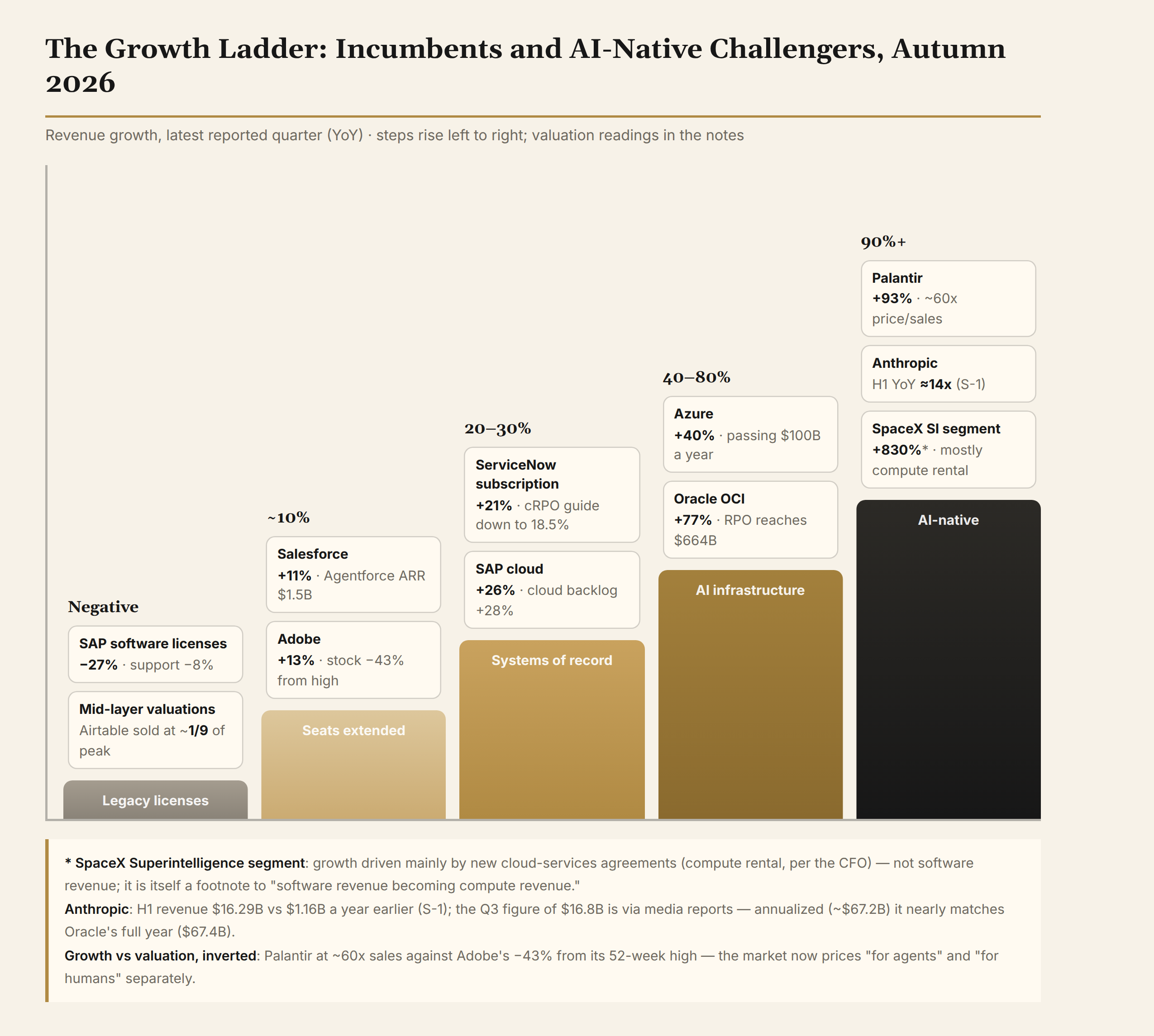
Line up the traditional top ten's latest reports and the contrast is this: the list hasn't changed; the growth ranking has inverted, and the valuation ranking has inverted harder. Microsoft's FY2026 (June-ending) revenue was $331.8 billion (+18%), Azure passed $100 billion for the year ($101.9 billion, +40%), and M365 Copilot paid seats went from about 20 million to more than 30 million in a single quarter. Oracle's FY2026 revenue was $67.4 billion (+17%), cloud revenue +39% (OCI +77%, per a BNP Paribas survey); remaining performance obligations reached $664 billion (+46%) as of the first quarter of FY2027 — on Oracle's accounting, about half converts within 36 months (about 12% within 12) — with more than $30 billion of new AI cloud contracts added in a single quarter. Salesforce's latest quarter (FY2027 Q2) brought revenue of $11.35 billion, up 11%, with Agentforce ARR at $1.5 billion — the growth engine has indeed changed; the growth rate has not collapsed. Adobe's FY2026 Q3 revenue was $6.76 billion, up 13%, with AI-first ARR up more than 150% year over year and full-year ARR growth guided at 10.2% — double-digit revenue growth while the stock sits more than 40% below its 52-week high: the market's pricing of generative AI replacing GUI creative tools does not stop at the revenue line. Palantir: annualized revenue of $8-odd billion against a market cap of about $478 billion, roughly 60 times sales — the market is not buying today's revenue but the option on "the right to tax agent adoption."
The new entrants are rewriting the list faster. Anthropic's third-quarter revenue of $16.8 billion (an investor-disclosure figure relayed by media; the S-1 discloses only through the first half, at $16.29 billion) annualizes to about $67.2 billion — nearly equal to Oracle's entire FY2026 of $67.4 billion; one company is about five years old, the other forty-nine. SpaceX's Superintelligence segment took in $7.56 billion for the quarter (+830%), about $30 billion annualized, but the CFO said on the call that growth came mainly from new cloud-services agreements — mostly compute rental; the unambiguously software part, Cursor, annualizes to about $4.6 billion (Grok subscriptions are not separately disclosed). OpenAI's second-quarter revenue was about $6.7 billion (WSJ), and by late September its annualized revenue was approaching $50 billion (Bloomberg, FT). Count model APIs and subscriptions as software in the broad sense and two AI-native companies already sit in the top ten — Anthropic and OpenAI; SpaceX does not qualify as software, and that in itself is a footnote to Section 5.
The next two years of increment are already locked in orders: Microsoft's commercial RPO at $677 billion (+73%, about 30% to be recognized within 12 months), Oracle's $664 billion (+46%), AWS backlog at $578 billion (growing triple digits year over year), and Google Cloud at $560.8 billion (Alphabet's 10-Q: just over 55% within 24 months) — roughly $2.5 trillion across the four, order books filled mainly by AI. Institutional expectations for 2026 have the tiers set: AI applications and agents compounding at 35%–50%+, security at 20%–25%, data and cloud-native infrastructure at 18%–25%, traditional ERP/CRM at 10%–15% (relayed). The market is already pricing "for humans" and "for agents" separately — and beginning to price "light-asset" and "heavy-asset" software separately too.
8. Where This Goes: Five Judgments, Each with a Test
Judgment 1: Software keeps growing at double digits, with the increment flowing mainly to software for machines; the main risk in AI software is not the level of gross margin but the mismatch in duration between revenue and cost. Revenue is billed by usage and customers can cut back on short notice; costs are locked into multiyear take-or-pay contracts — about $10.8 billion of RPO against hundreds of billions of commitments is the portrait of that mismatch. The compute-to-revenue ratio is improving for now (201% a year ago to 55% in H1), but most contracted capacity is not yet online, and the S-1 itself warns that large deliveries of new compute will compress margins; on the cloud side, the reading is Microsoft Cloud gross margin down year over year to 66%. Seat pricing does not die at once; what dies is "pure seat pricing": horizontal seat-based apps settle into single-digit growth, while systems-of-record ERP/CRM still carry institutional expectations of 10%–15%. Tests: (i) if the median cRPO growth of leading SaaS falls below 10% in H1 2027, the first half fails; (ii) whether the compute-to-revenue ratio rebounds (author-set threshold: above 60%) as capacity lands in volume in the first four post-IPO quarters; (iii) whether RPO relative to compute commitments rises — customers signing longer contracts would mean the mismatch narrowing.
Judgment 2: Value concentrates in vendors that unite model and compute; the middle layer is most at risk. The model layer erodes the tool layer's pricing power (Cursor bought for its training data); application vendors' exits are downward into data and workflow or upward into outcome pricing; point applications with neither data nor models get systematically cleared. This year's buyers paid premiums for exactly two kinds of assets — security capability and developer distribution (Braze went at a discount, not a counterexample). Test: if MCP or comparable open protocols get closed into a single vendor's loop, this judgment fails.
Judgment 3: Pricing shifts to hybrid, not straight to pure usage. The seat-to-usage-to-outcome transition lands as "committed volume + spend caps + outcome share" hybrid contracts, because CFO budget discipline and vendor pass-through needs are pulling against each other. Test: the direction of pure-usage versus hybrid revenue shares in 2027 filings (proxies: Copilot AI Credits usage disclosure, X subscription tier structure, ServiceNow's call language).
Judgment 4: The record systems' migration dividend peaks around 2027. Much of SAP's and ServiceNow's current growth comes from the one-time cloud-migration and compliance cycle; ServiceNow's Q4 cRPO guide (21% to 18.5%) is the leading signal — and moving some subscription revenue into professional services to buy AI adoption speed says the new growth has not picked up the baton. After the migration, these companies turn from growth stocks into value stocks: stable revenue, compressed multiples. Test: ServiceNow's Q4 report in January 2027 — does cRPO growth hold the 18% band or keep sliding.
Judgment 5: The services market deflates as it is replaced; "software eats services" is not a seamless transfer. IT services' +4.4% is compatible with both "being replaced by agents" and "prices falling"; if AI does the same work at a fraction of the human price, the likelier outcome is a market that shrinks overall, with software catching only part. When outcome-based revenue gets its own line in enterprise-software reports, this line graduates from narrative to fact.
Verification points, in time order: Palantir's Q3 report on November 2 (can 93% persist); Anthropic's IPO pricing in the week of November 16 (range talk $1.5–2 trillion; May private pre-money $965 billion; Damodaran's estimate $1.475 trillion — where it lands is the valuation anchor for AI software itself); Palo Alto around November 18 and CrowdStrike around December 1 (whether security demand and valuation can decouple); ServiceNow's Q4 in January 2027 (cRPO); SpaceX's Q4 (Cursor's first full quarter).
Closing
The software industry is keeping three ledgers at once. On revenue, the billing unit shifts from seats to usage and outcomes. On cost, an ever-larger share of revenue pays for compute, and a portion of "software" turns back, economically, into heavy assets. On valuation, the market keeps re-folding terminal value — two selloffs in a year, both selling off the old meter. Software for humans retreats to the three moments of judgment and accountability; software for machines takes over the long tail of execution; value moves from interface to API, from seat to call, from license to outcome — and from light margins to heavy assets. The early-year "SaaS apocalypse" neither arrived nor ended: the old meter is being dismantled, the new meter isn't installed, and the electricity price itself is rising. When it is installed, the software industry will be bigger than today — and heavier, and stranger.
Sources: Gartner IT-spending forecast press release, 2026-10-21 (IT services $1.557T, data center +73.8%, "memory inflation"); Gartner AI-spending press release, 2026-09-16 (all-in $2.67T / $1.484T / $28.3B / agents $29.2B to $65.5B; January version $2.52T); agent-integration shares (40%/<5%) and the 2030 $234B/$72B forecasts relayed. ServiceNow Q3 2026 official release and call, 2026-10-28 (subscription +21% as reported/+20.5% constant currency; cRPO +20.5% as reported/+21% cc; the Q4 guide of 18.5% is constant currency, against sell-side expectations of roughly 19%–20% (relayed); adjusted EPS $1.00 vs. $1.02 consensus; AI ACV target raised again to $1.7B; subscription-to-professional-services shift); next-day close down about 26.5–27% (sources range 26.3–26.9); peer drops of 4%–7% the following day relayed. Anthropic S-1 (filed 10-26, ticker ANT): H1 revenue $16.29B; net loss $80.7B (including ~$72.4B fair-value movement); cost of revenue $2.38B / ~85% gross margin (CNBC on the S-1); commitments across calibers (public S-1 table: ~$265.6B minimum purchases + $321.4B signed-not-commenced leases + ~$125–150B additional compute outside the table, aggregate left blank; Amazon April 2026: at least $110B regardless of usage; RPO ~$10.8B, 75% within 12 months; Fortune at least $475B and up to ~$750B with chip leases; the $518B/80%-non-cancellable figure and its named components (~$111.1B Google, ~$31.4B Microsoft) are the September draft caliber [Reuters]; the public S-1's named components: ~$114.5B Google, tens of billions at Microsoft, ~$160B Broadcom-related leases [GeekWire itemized]); customer concentration (WSJ-read draft ~1/5; public S-1: no customer above 10% through three quarters); channel mix (H1 2026 ~48% via the three cloud marketplaces, ~$2.7B more in channel fees booked in sales and marketing; Reuters' 2025 estimate ~16 cents per dollar); Q2 $11.56B passing OpenAI (~$6.7B) and Q3 $16.8B per media (FT, others); OpenAI Q2 $6.7B (WSJ), annualized near $50B by late September (Bloomberg/FT); IPO range $1.5–2T (Fortune/WSJ), Damodaran estimate $1.475T, May private pre-money $965B. SpaceX Q3 2026 earnings and call (capex $19.6B, $16.4B to the Superintelligence segment; Cursor $608M in 48 days post-closing; ARR ladder per TechCrunch and company disclosure; CFO on compute rental). Microsoft FY2026/FY2027Q1 (official call and disclosures: FY2026 Azure $101.9B, +40% (restated-segment caliber first disclosed in dollars at FY2027Q1; the legacy caliber read about +41%); FY2027Q1 Microsoft Cloud gross margin 66%, down year over year on Azure mix; capex $45.2B below plan on delayed third-party capacity; commercial RPO $677B, +73%, 2.3-year weighted duration, ~30% within 12 months). AWS backlog $578B (Amazon Q3 call, triple-digit growth); Google Cloud backlog $560.8B (Alphabet 10-Q: $567.7B total, just over 55% within 24 months). Oracle FY2026 and FY2027Q1 RPO (OCI +77% per BNP Paribas survey). SAP 2026Q3. Palantir 2026Q2. Salesforce FY2027 Q2 ($11.35B/+11%, Agentforce ARR $1.5B) and the Dreamforce launch and renaming (official newsroom; Salesforce Ben 9-15/10-12). Workday (relayed). Adobe FY2026 Q3 ($6.76B/+13%, FY ARR guide 10.2%) and market coverage (−43% from 52-week high). Airtable transaction (TechCrunch, Benzinga, MSN: EV $1.285B, peak $11.7B, ARR ~$480M/+20%, Hyperagent spin-out). Braze (Salesforce announcement). JetBrains 2026 Developer Ecosystem Survey (official research blog; May–July 2026 window; 15,509 respondents). METR randomized controlled trial (relayed; early-2025 tools). QECon 2026 (Kuaishou, Ping An Life). BairesDev survey (705 developers). Anthropic internal efficiency report (10-16; IPO-window disclosure noted). UK employment data (GOV.UK junior-hiring snapshot; The Guardian, 2026-09-12). Microsoft headcount and voluntary-leave program (relayed). NIST/NVD April 2026 adjustment, 2025 CVE statistics and the 65% unscored share (relayed). AIxCC (DEF CON 33); Big Sleep (Google disclosure). CyberArk Identity Security Landscape 2026 (109:1; 2025 edition 82:1). Kingdee Q1–Q3 2026 operating announcement and Lingji self-tests (vendor self-test). Klarna (company releases, prospectus, CNBC, Entrepreneur, 20VC, relayed). AWS Marketplace (relayed). X subscription revamp (relayed); GitHub Copilot billing change (GitHub blog, effective 2026-06-01). Qwen3-Coder-Next (Alibaba official). Musk and Torvalds quotes (media reports). Zhipu interim report and Morgan Stanley China API-price survey (relayed). Palantir's Q3 (after the close ET, November 2) must refresh §2/§7/§8 Verification Point 1 once published; the analytical frame (the change of caller, the two ledgers, the five judgments) is the author's.