
Suppose a server costs RMB 7 million and rents for RMB 235,000 a month. Divide one by the other and the equipment appears to pay for itself in less than thirty months. With a five-year tenant, everything after that can look like profit.
It is an inviting calculation for a capital-intensive investment. It also leaves out the questions that matter most: when rent starts arriving, what else must be paid before then, who carries the cost of idle capacity, and how much cash remains at the end.
In a reference project with 10,000 B300 GPUs, adding facilities, networking, construction time, tax, working capital and exit proceeds leaves a project internal rate of return of about 7.3%. Cumulative nominal gains are positive, but the return falls short of the assumed 10% hurdle. The purchase price, rents and customer growth are scenario inputs, not signed transactions. The full assumptions and sensitivity analysis are set out in Inside a 10,000-GPU Token Factory: Investment, Operations and Exit.
My view is that "compute is scarce" is not a sufficient investment thesis for a token factory. Scarcity may explain today's quote. It cannot tell an investor who will keep paying after delivery, or whether those payments will compensate for the capital and risk.
High Prices First Demonstrate the Seller's Bargaining Power
When compute is scarce, buying equipment and selling services often become more expensive together. Rising rents do not necessarily improve the returns available to a new entrant. Equipment sellers may capture the anticipated upside in the purchase price first.
For someone who already owns the equipment, higher rents can directly improve cash flow. For someone about to buy, the relevant comparison is a new purchase price, a new delivery date and the rent that can actually be contracted for the future. The same quotation sheet can mean very different things to those two investors.
Forward procurement is not automatically cheaper, either. A discount accompanied by a larger deposit, later delivery or weaker warranty must be weighed against cash tied up, rent forgone and performance risk. Spot and forward offers cannot be compared on price per server alone. Nor can today's high rent simply be moved to a commissioning date a year away.
Scale magnifies the difference. Across 1,250 eight-GPU servers, a RMB 1 million change in unit price changes the investment by RMB 1.25 billion. In our reference case, five years of energy charges total about RMB 426 million. Cutting them by one-fifth saves roughly RMB 85 million before discounting. The payments occur at different times, so a formal comparison still needs present values. But the orders of magnitude are enough to make equipment terms worthy of at least as much diligence as energy efficiency.
That does not make power and cooling unimportant. They determine whether the project can open, when billing can begin and whether promised services can be delivered reliably. The distinction is between conditions that make a project possible and variables that make it worth doing.
Renting Compute and Selling Tokens Are Different Businesses
Compute rental sells the right to use resources for a period. Its central questions concern lease duration, customer credit, availability obligations and renewal prices.
A token service sells model output under agreed quality and response-time conditions. It needs a product, integrations, inference engineering, metering, customer support and model maintenance as well as equipment. Customer willingness to buy cannot be inferred from the GPU count.
Moving idle machines into a self-operated service therefore does not automatically establish a revenue floor. Technical capacity can be large while revenue remains small if there are no paying customers. Even when customers exist, the relevant comparison is incremental cash contribution after added costs, not gross token revenue against rent.
The reverse claim is no more reliable: operating a token service is not inherently worse than renting capacity. Model choice, context length, acceptable waiting time, cache billing and realized prices can produce very different unit revenues. A benchmark establishes the capability of a particular configuration and workload. It does not establish that customers want that service, and it is not a bill.
Under the same reference assumptions, selected GLM-5.2 and DeepSeek V4 Pro services can earn more operating profit per server-equivalent than a long lease under the stated conditions. The DeepSeek V4 Flash products may fail to cover their fully allocated costs. There is no contradiction. Token services are not one uniform commodity to which a universal price can be assigned before declaring the entire business profitable or unprofitable.
The operating advantage worth investigating is the ability to find customers for a specific service and fulfill it reliably with fewer resources. That is harder to build than ownership of popular GPUs, and it requires continuing evidence.
Buying Machines Does Not Buy Customers
A mix of long leases, short leases and token services provides choices. It does not create orders by itself.
The reference project assumes five-year leases for 500 servers, producing RMB 1.41 billion in annual revenue. Their five-year total of RMB 7.05 billion accounts for only about 42% of the project's revenue. Short-term and token customers must deliver the remaining 58%. Even the long leases still need real contracts.
Token revenue, in particular, must rise from RMB 512 million in year one to RMB 2.032 billion in year five. Across four growth intervals, that is approximately 41% annual compound growth. Drawing the line in a financial model is easy. In practice it represents customer acquisition, integration, acceptance, expansion and renewal. Each can take longer than planned.
Dynamic allocation improves the use of resources among opportunities that exist. Moving a machine from a rental pool to a token pool does not generate demand. If a customer requires one model, its requests cannot simply be reassigned to another because the second has a better margin.
Likewise, a short-term rental server billed for 60% of the year does not necessarily have another 40% available for sale. Contractual rights, the continuity of idle windows, model loading and cache recovery can all separate nominal idle time from usable capacity.
I would rather see a project explain where its revenue comes from: binding minimum payments, repeat purchases already observed, or customer opportunities still to be won. That separation says more about operating risk than a single assumption of "80% utilization."
Positive Cash Flow Can Still Miss the Investment Hurdle
When equipment costs are paid upfront, subsequent operating cash flow can look substantial. Ignoring the purchase payments and focusing on later receipts mistakes capital recovery for profit.
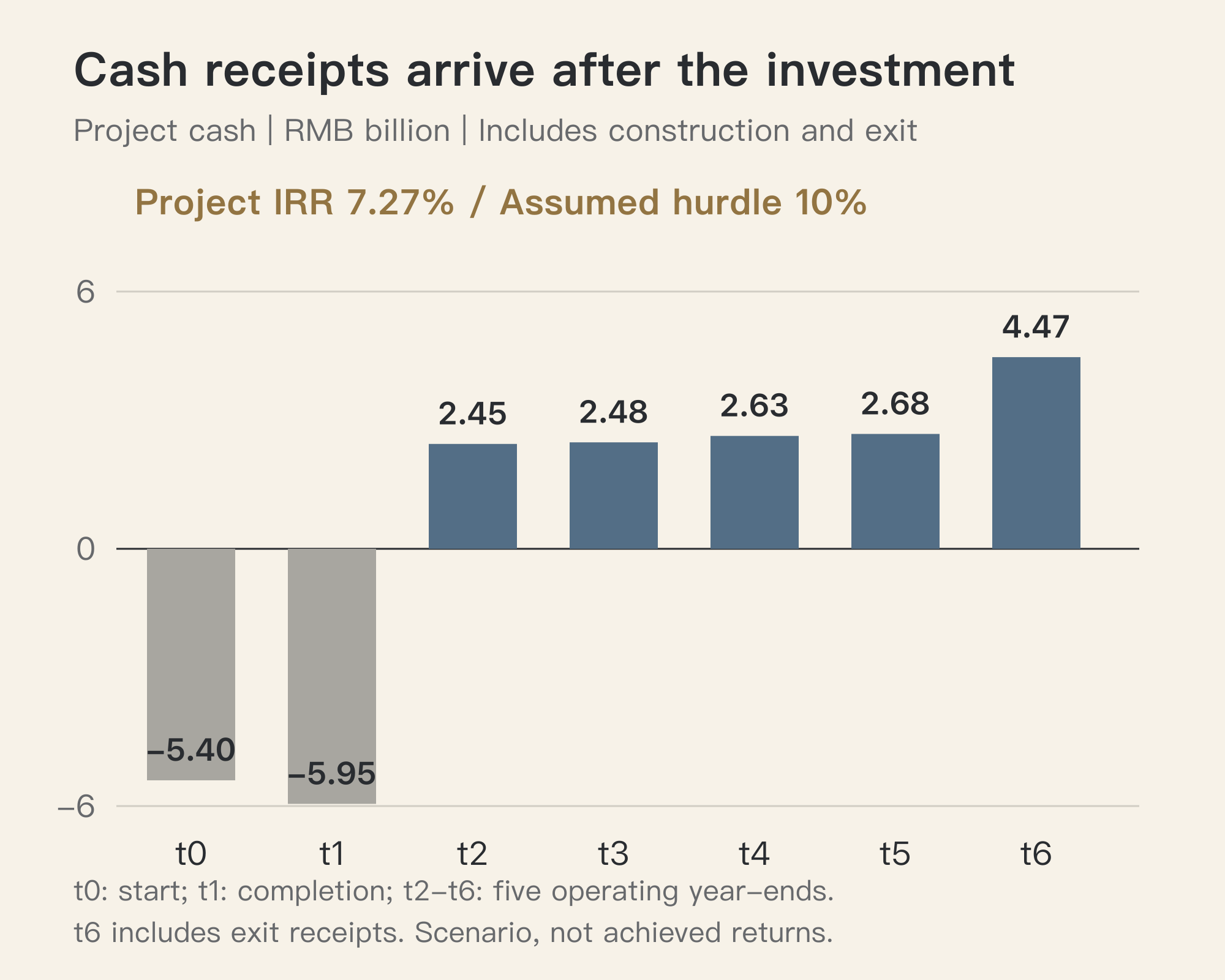
Initial capital expenditure in the reference project is RMB 10.8 billion. Startup costs, working capital and minimum operating cash bring funding required before revenue to about RMB 11.35 billion. Five years of operating free cash flow contribute approximately RMB 12.90 billion, with another RMB 1.81 billion from exit and released funds. After the initial outlays, nominal project gains are about RMB 3.36 billion.
But those flows do not occur together. With one year of construction and five years of operation, project IRR is about 7.3%. At the assumed 10% hurdle, net present value is approximately negative RMB 940 million. That does not mean the operation creates no value. It means the combination of purchase price, orders and timing does not deliver the required return.
Financing does not remove the problem. Debt changes when shareholders contribute and receive cash, while imposing repayment and distribution constraints. A loan rate below project IRR does not allow shareholders to distribute every operating receipt. Payment priorities and obligations to provide additional equity affect what shareholders actually receive. The World Bank's discussion of project-finance priorities places equity behind debt; non-recourse finance is not an unconditional transfer of losses.
Working backward from the reference operating conditions gives a maximum server price of about RMB 6.04 million at a 10% project hurdle. That is not a business-independent buying rule. If half of GLM and Pro input is instead billed at the lower cached-input rate, applying the same model rules reduces the ceiling to about RMB 5.30 million.
What the equipment is worth depends on the net cash that can be recovered from it.
Preserve the Ability to Decide Before Committing Irreversibly
For a project that has not cleared its hurdle, the next step need not be to stop investigating. Nor should it be to build the full planned capacity first.
A bounded validation budget can test the conditions with the largest effect on the conclusion: equipment offers with comparable specifications and delivery terms, complete deployments that pass acceptance tests, and the prices, volumes and payment terms customers will actually sign. Those results should determine the first procurement and construction phase.
Phasing is valuable because revenue not established in one stage need not immediately justify all the capital in the next. Shared facilities, minimum purchase commitments and expansion costs still exist, however. Dividing a 10,000-GPU budget by ten does not produce ten independent small projects.
What would change my assessment? Lower equipment costs with credible delivery; customer commitments that produce sustained collections; or technical improvements that reduce costs or enable additional orders at the same quality and service level. Any of those should be put back into the cash-flow model.
High rents can draw attention to a business. Customers, costs and collections that still hold after delivery are what support an investment. Until those conditions have enough evidence, the ability to delay procurement, reduce the first phase or stop expansion may be worth more than acquiring equipment quickly.
Companion reading: Inside a 10,000-GPU Token Factory: Investment, Operations and Exit, with the full assumptions, cash flows and sensitivity analysis. Figures here use the same reference scenario to illustrate a decision process, not a completed transaction or an industry earnings forecast. This is not investment advice.